In order to move to a real 3D production pipeline, a coding agent must go from a single object to a complete scene to an interactive world to open a rift.
In the past, three-dimensional reconstruction, generating and editing relied heavily on special algorithmic pipelines in traditional vision and graphics. Now, Coding Agent, with visual understanding and program execution capabilities, is disrupting this process.
However, existing assessment benchmarks tend to tear static geometric quantum crystals apart from their interaction with the dynamic world of crystals, making it difficult to answer a core question:
"Will today's Coding Agent be able to accommodate the demand for creativity from objects, scenes, to the open world?"
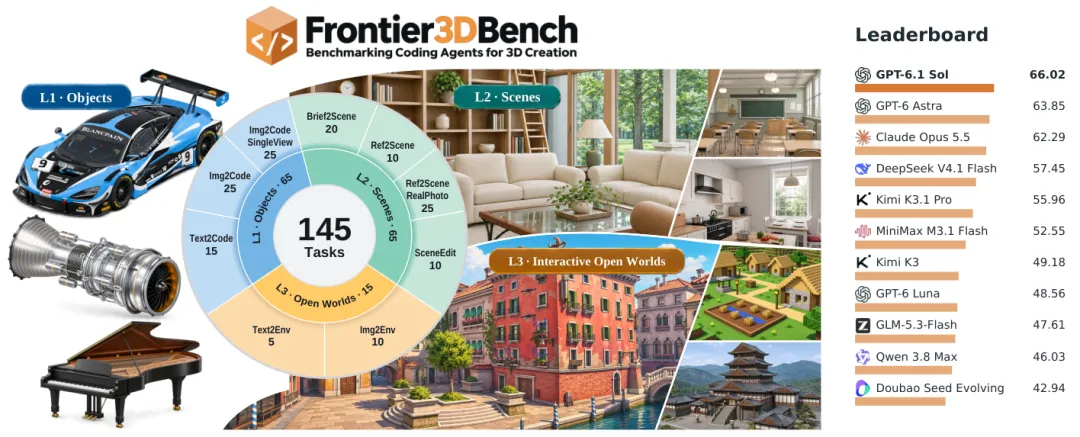
For this purpose, Einsia AI released Frontier3DBench, which spans the two major industrial environments of Blender and Unreal Engine, covering 9 major categories, 145 missions (65 objects + 65 scenarios + 15 open worlds), a comprehensive evaluation of 11 mainstream front-end models and Agent framework configurations, from three dimensions of appearance, structure and behavior, to systematically outline the boundaries of Coding Agent's 3D creativity capabilities.
Frontier3DBench: Benchmarking Coding Agents for 3D Creation across Objects, Scenes, and Interactive Open Worlds
The main page of the project:
GitHub:
Paper:
From pinching objects, scenes, to creating the world.
What does Frontier 3DBench measure?
In 3D creation, pinching a model, building a room, and creating an open world that can run and jump, the difficulty is not at all on a quantitative level. Every step forward, the Agent has to take care of several layers: objects look at parts and proportions, scenes look at the layout of space, and the world has to adapt to action, interaction and constant change.
Previous assessments have often broken these links. Some only look at static assets and some only measure the game's code. Just looking at a rough total, it's hard to figure out if Agent was driving because of missing reference chart details, missing room location, or being stuck in some step interaction while running.
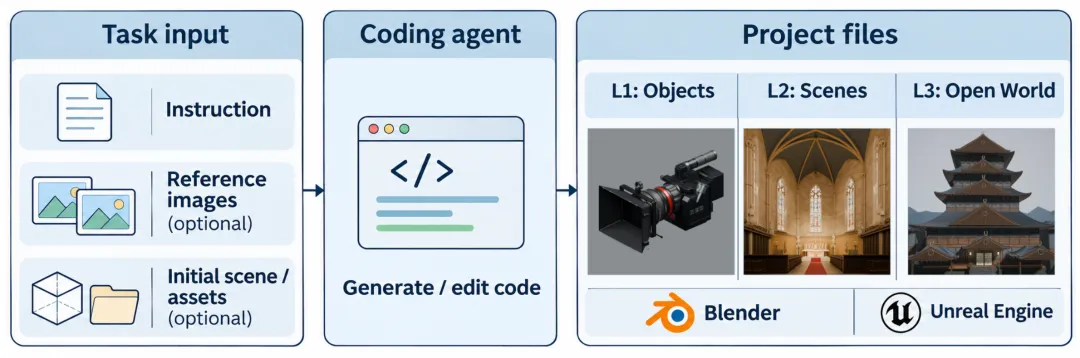
For this purpose, Frontier3DBench incorporates these three layers of requirements into the same set of assessment standards, covering nine major categories and 145 tasks:
L1 Object Layer (65 items): Delivery of editable Blender assets, including pure text modeling (Text2Code) and single view, multi-view reference image reconstruction (Img2Code).
L2 Scenes Layer: 65 items: Delivery of the full Blender Scenes, coverage of text generated (Brief2Scene), rendering graphics reconstructed (Ref2Scene), real photo reconstructed (Ref2Scene-RealPhoto) and localization modified (Ref2Scene-RealPhoto) and scene editing of the surrounding walls (SceneEdit).
L3 Open World Level (15 items): Deliver Unreal Engine engineering, requiring the construction of a multi-regional connection based on text (Text2Env) or a reference diagram (Img2Env) to support continuous interaction activities in an open world.
Evaluations also follow engineering documents, scoring three coordinates for each 3D answer:
Appearance: look at the results of rendering, check the visual aesthetics and reference image restoration;
Structure: disassembly of native engineering, quantity size, number of parts, modularity and connectivity;
Behavior: Running independent tests, driving the characters through actual interactions in the world, verifying the existence of actions and states.
With a weighted sum of 30% (object), 30% (scene) and 40% (world), the team thoroughly examined 11 mainstream models and the Agent framework.
Sol is number one overall.
But forging a world cup changed the leader.
GPT-6.1-sol took first place in the overall standings with 66.02 points, with a clear advantage at the object level (71.21) and the scenic level (70.35).
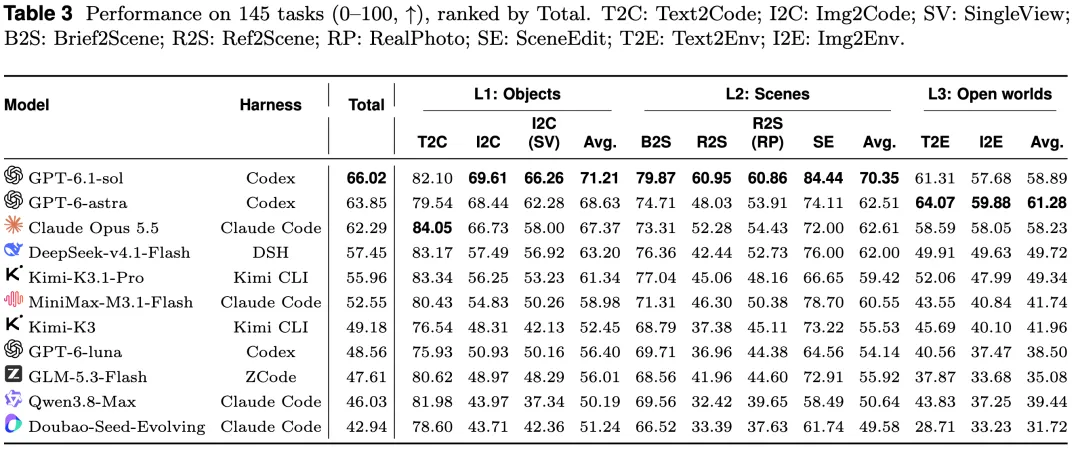
But there are nine sub-categories, and no model can eat them all:
The leader of the open world (L3) became GPT-6-astra (average score 61.28);
The highest score for a text-generating object ((Text2Code) is in Claude Opus 5.5 ((84.05));
The sixth-ranked MiniMax-M3.1-Flash took second in the standings with 78.70 points, while the editing performances of the Kimi-K3 and GLM-5.3-Flash also doubled the overall average.
When choosing a 3D agent, the first thing you have to ask yourself is: do you want to make it real, change the scene, or create the world in a fantasy engine?
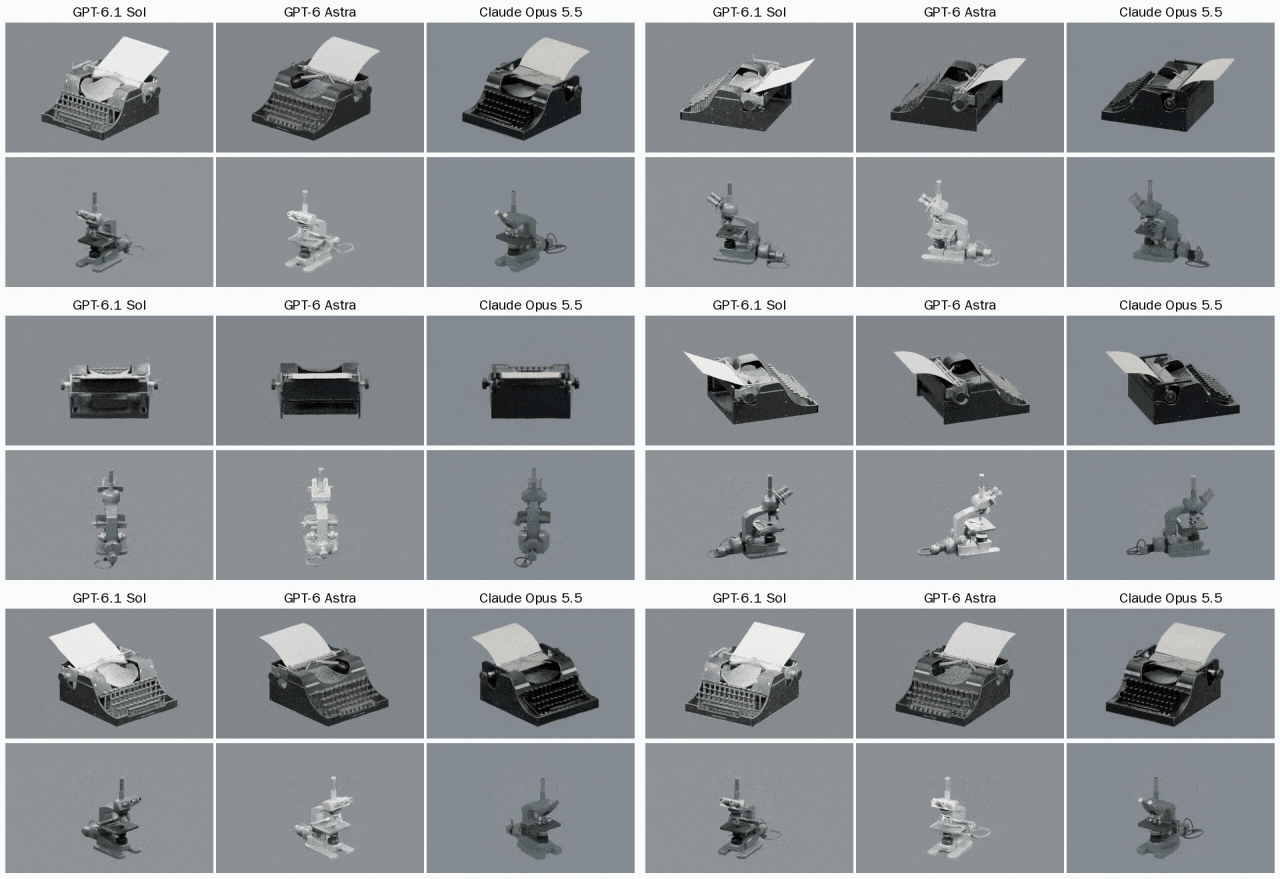
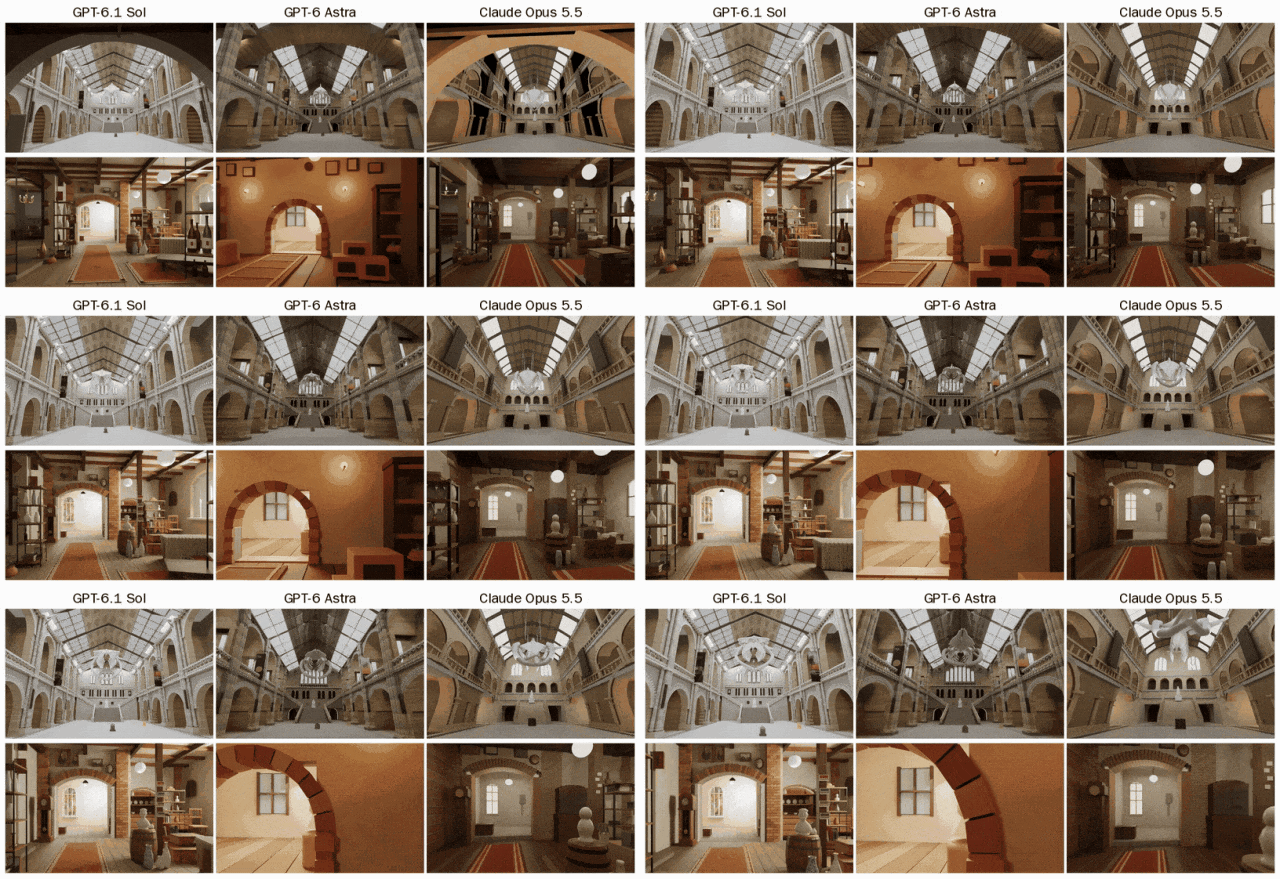
Free play over 80 points
In the meantime, we've been working together to break through the barriers.
Looking closely at each model's scores on each task, it can be found that all models have significantly lower scores on the reference graph to reconstruct the graph than the graphs generated by the graph:
Text-generating objects generally score as high as 75.93 on 84.05 points;
In terms of multi-view and single-view reconstruction, the highest scores of the whole match were 69.61 and 66.26 points respectively.
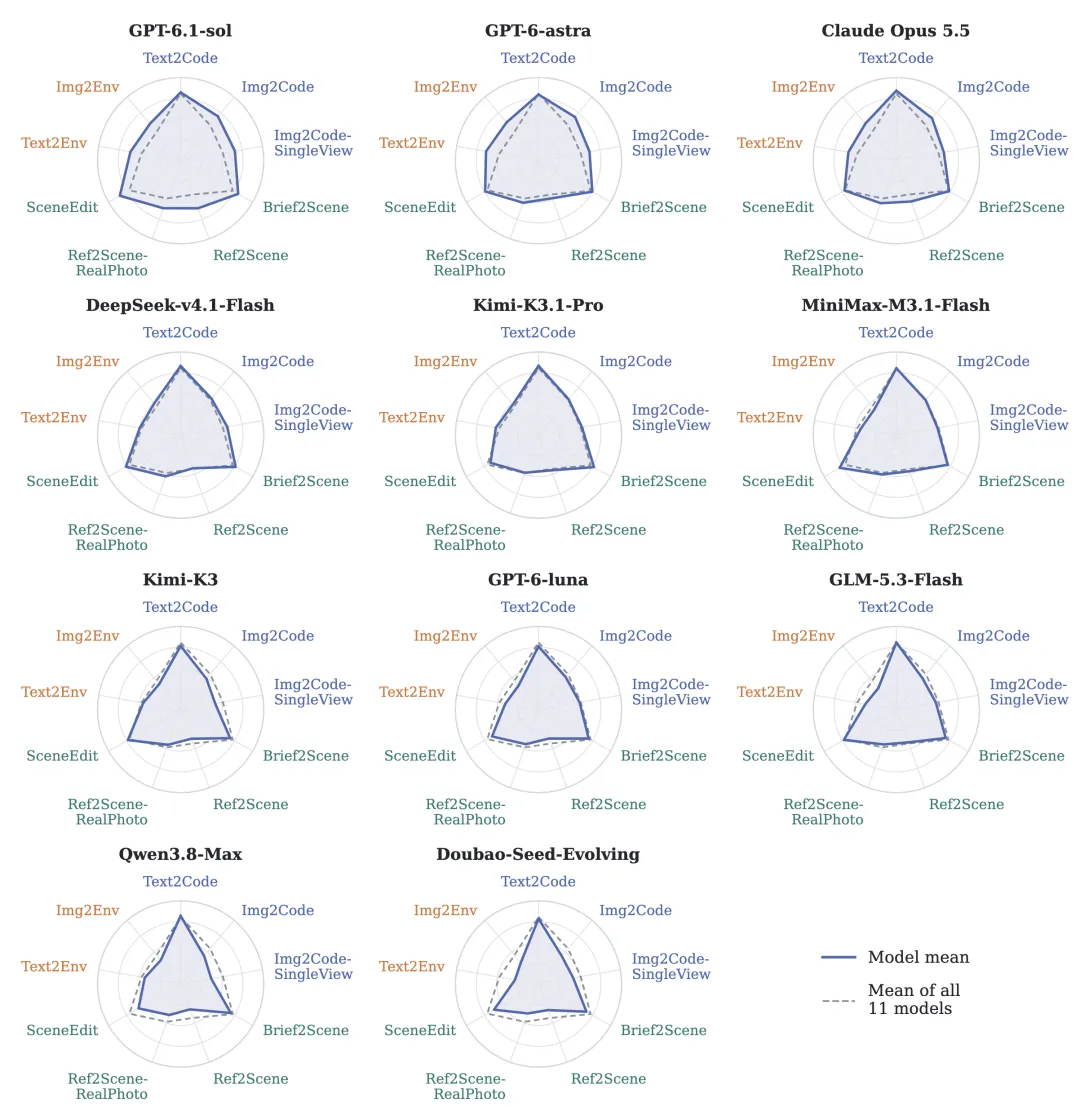
Qwen 3.8-Max demonstrates this contrast particularly clearly: its text-generating objects are as high as 81.98 points (approximately 82.10 of the top Sol), but multi-view and single-view reconstructions plummet to 43.97 and 37.34.[4] Kimi-K3.1-Pro and DeepSeek-V4.1-Flash also show a distribution of strong generation and weak reconstruction chips.
It is not difficult to make a work that looks reasonable, but it is difficult to transcend the shadows and perspectives, to reproduce the work that the artist has designated.
The gap lies in appearance, structure and detail.
By dividing the total into visual quality, structural consistency, and three dimensions of task completion, the model's shortcut becomes even more noticeable.
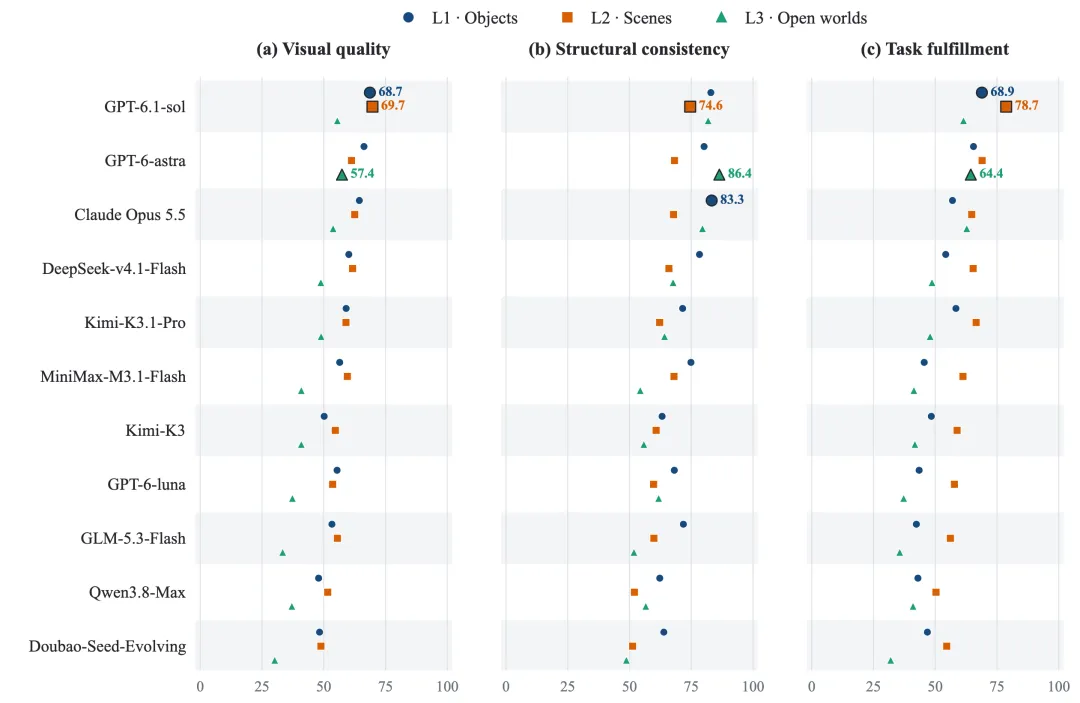
The visibility and completeness of objects and scenes are led by Sol and the open world by Astra; while in the structure of objects, Opus is 83.27 points weaker than the super Sol. Overall, the models are relatively easy to position the main components and build rough skeletons (the L1 structure is 72.77), but it is much more difficult to fill in the fine appearance and details.
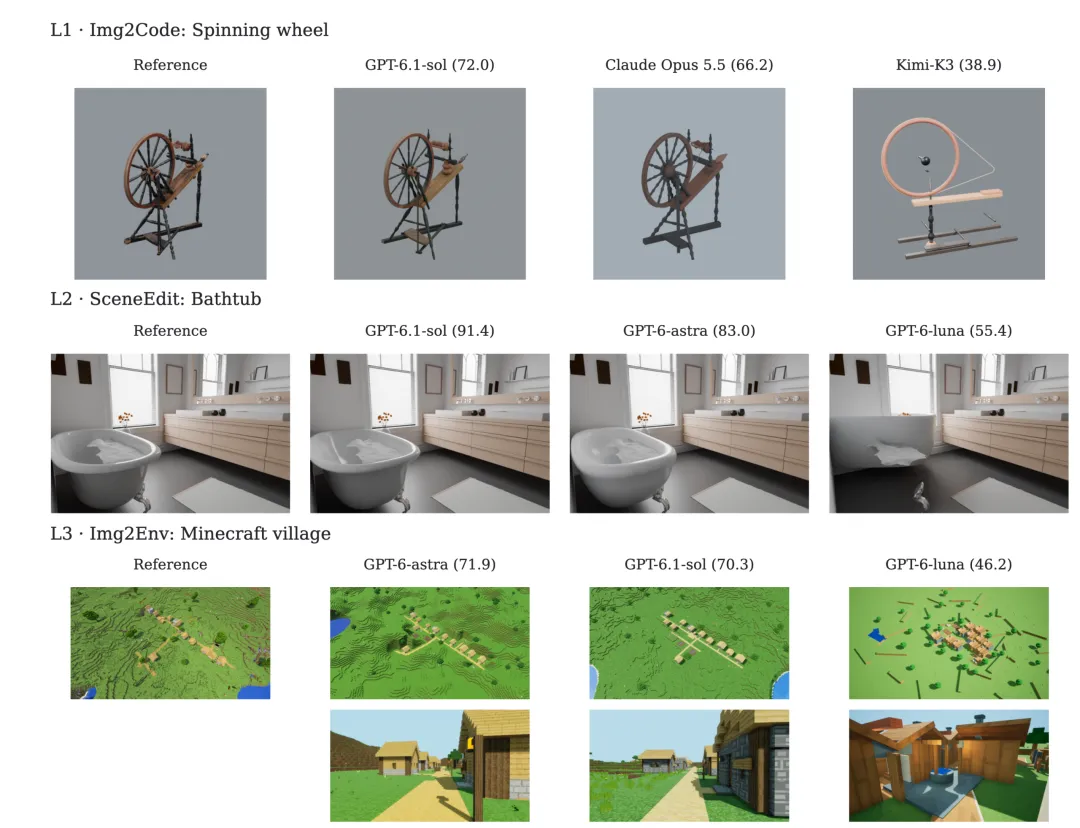
This is the first time I've ever heard of this kind of thing.
Brake Rebuild (L1 Objects): Sol and Opus restored the main mechanical components, while the Kimi-K3 simplified them into abstract circles and wooden rods, losing the core drives;
Bathroom Repair (L2 edit): Sol and Astra have made the new bathroom fit seamlessly into the original support, while Luna's bathroom shell is separated from the support;
Minecraft Village (L3 World): Astra and Sol reconstructed the axis of the village with continuous terrain terrain, while Luna stacked the buildings densely on flat ground, losing the space context.
A single organ can run 83 minutes.
The number of complete missions dropped to 30 per cent.
The real test of the open world is the moment when the code is running. The average score of all models at the L3 world level is lower than the results of their respective objects and scenarios.
Testing the operation of 165 generating worlds yielded an eye-catching set of data:
Local interaction: an average of 83.08 points
Sports avoidance: only 20.82 points
Status and workflow: only 30.26
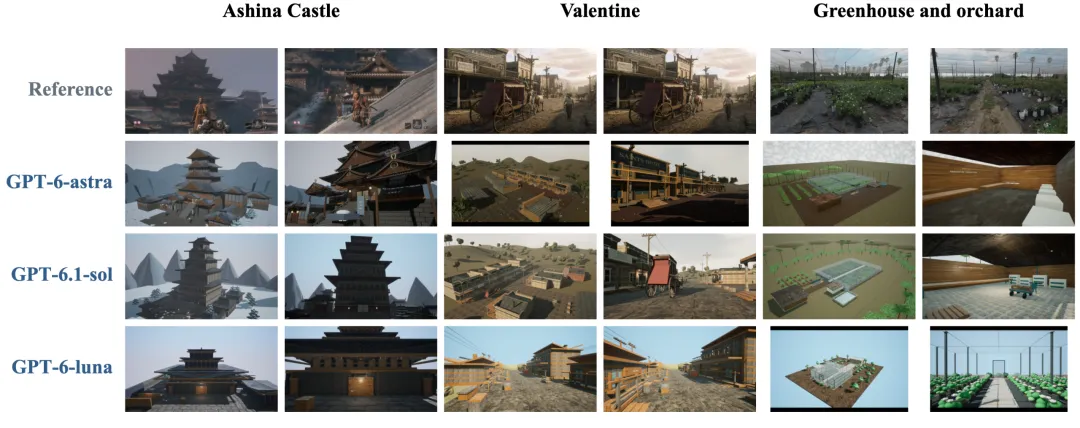
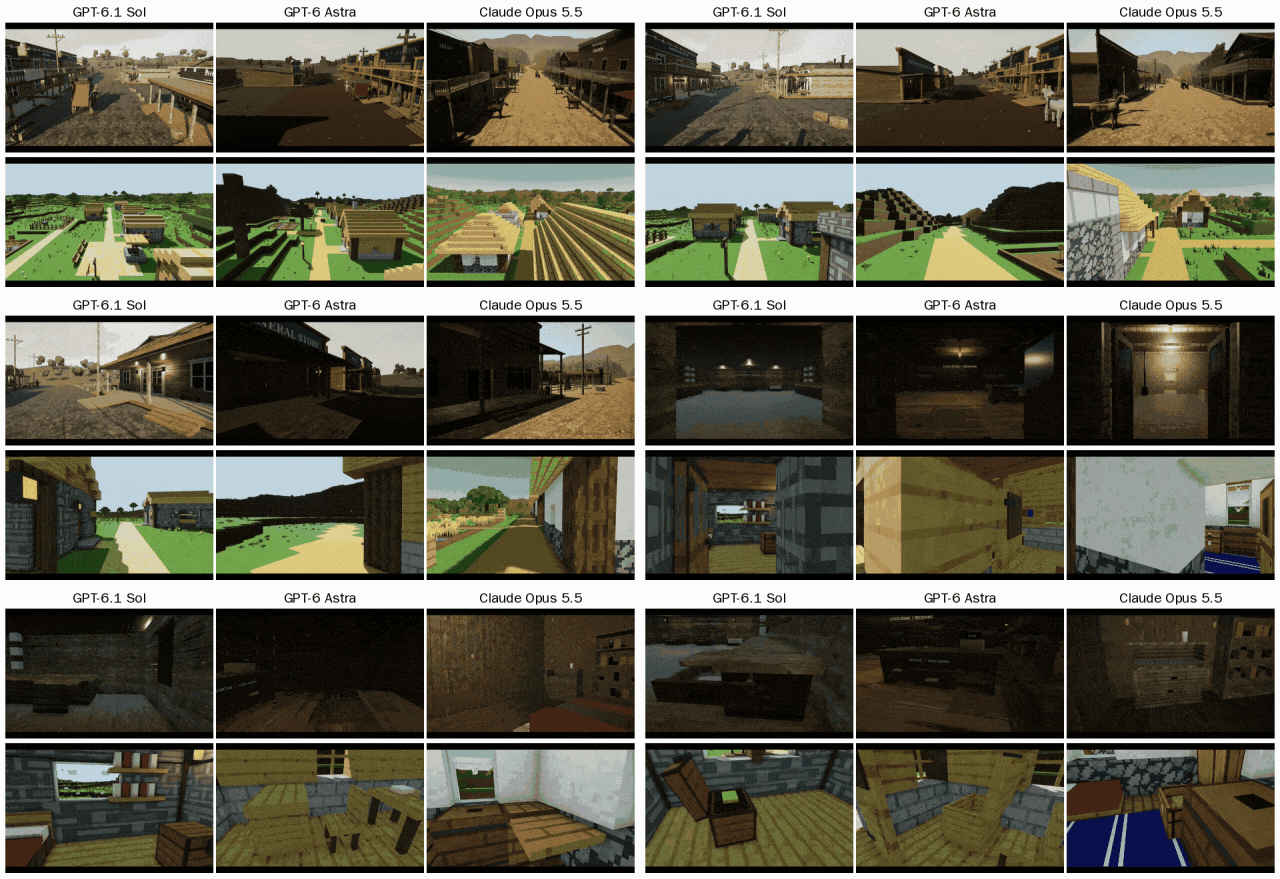
The conclusion is clear: local authorities have already done it, but it is difficult to link them together.
Writing a single switch or organ alone, the Agent is already familiar; but allowing the character to move seamlessly across the region, triggering the action, and allowing the altered state to continue to affect the next operation, thus running an entire set of activities, is a key link that the current Agent is waiting to cross.
Accounting
The more money you spend, the better the work?
Putting the overall quality together with the average cost of a single API estimate, we have this price-to-price map:
Choose a 3D creative partner to watch the work and calculate the API bills behind it:
The three-dimensional price comparison of gatekeepers: GPT-6-luna (about $0.27/theme, 48.56); DeepSeek-v4.1-Flash (about $0.45/theme, 57.45); and GPT-6.1-sol (about $1.01/theme, 66.02) form the frontier of Pareto.
More expensive is not better: GPT-6-astra (about $5.58/theme, 63.85) and Claude Opus 5.5 (about $21.17/theme, 62.29) cost much more than Sol, but overall quality is lower.
The next step
Let the 3D world in the code really work.
A precise machine, relying on the tightness of the parts; a reasonable room, examining the spatial order between objects; a vibrant world, where action and feedback are necessary.
Today, Coding Agent is writing these complex requirements that originally belonged to graphics and 3D vision into executable program code in a single line.
Not only did Frontier 3DBench draw the first panoramic capability map for this technological route, but it also pinpointed the two great mountains that must be conquered on the path to becoming a true 3D creator:
Crossing the gap between the free hydrogen generating hydrogen and the precise regeneration of hydrogen, so that the geometric structure and details seen can be constructed correctly;
It opens the closed loop between the local organs and the global workflow, allowing continuous action in the interacting world to truly synchronize with the enduring state.
When these two mountains are overtaken, the Coding Agent will deliver not just isolated assets or static landscapes, but truly accessible, interactive, and scalable digital worlds.
From "writing code" to "creating the world", the next era of 3D creativity is about to really open up the screens.