In the 1940s, computers still occupied a huge amount of space. They were huge and expensive, and only a few research institutions and large organizations could use them. At that time, computing was an expensive and scarce resource.
But to this day, the computing power of just the iPhone in the hands of ordinary people has been increased by billions of times.
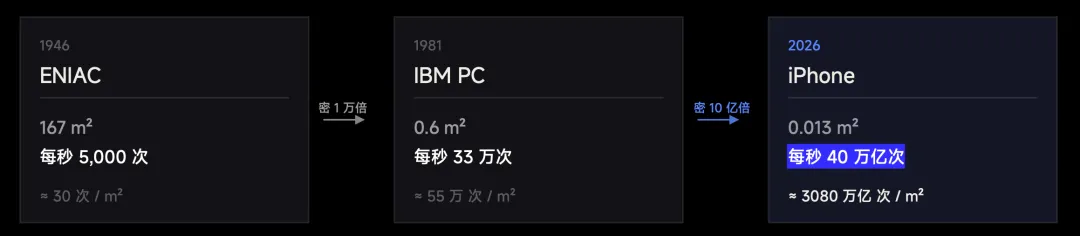
History is a circle, and so is the development of intelligence.
With the rise of GPT, the wave of big models began, with the ability to be perceived by users as "smart" concentrated in the data centers of a handful of tech giants, running in the cloud. We, the first generation of the big model, did not expect that only a few years later, a model beyond the GPT-4V level of intelligence would be able to run on mobile phones.
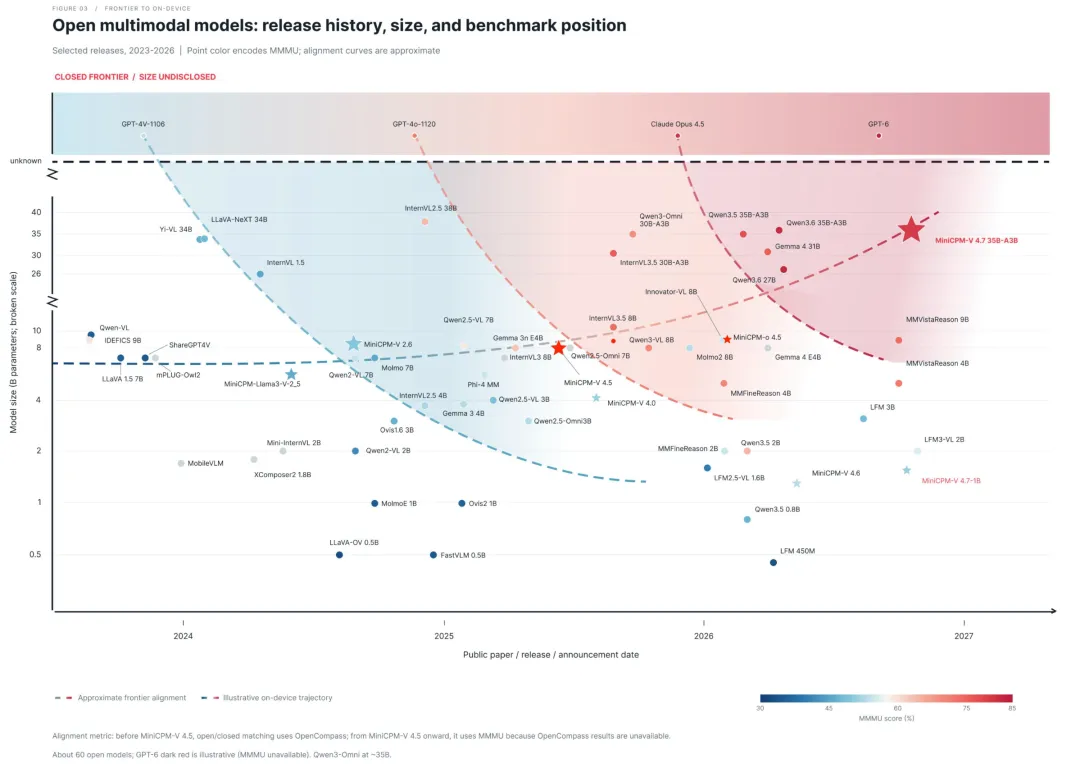
The long axis is the time, the long axis is the parameter. Color represents the performance of the model, red represents strong performance and blue represents weakness.
The MiniCPM-V 4.7 is a 35B-A3B version, a 35 billion-parameter MoE multi-modal model that only accounts for about 3GB of memory on mobile phones, and is over 30 tokens per second on the latest iPhone 18 Pro Max.
Let's take a look at an iPad that opens the flight mode, runs the MiniCPM-V 4.7-35B-A3B side model, and performs real-screen recording for multi-mode tasks.
As a fully automatic 35B parameter model, the performance was truly amazing. While answering correctly, the output speed was still remarkable, maintaining an emotional flow, but not to the point of blinking an eye. Multimodal capabilities were also strong and the mathematical solutions written by the opponent could be accurately identified.
The MiniCPM really evolved from the "small steel cannon" of that year into a full-scale performance monster capable of running on the edge.
"Starting in 2024, we were talking about doing edge intelligence, when it was still a vision. Today, that vision has become a near vision".
Behind this model is the Masquerade Intelligent Multimodal Large Model Laboratory. The laboratory is led by Masquerade Intelligent Associate Chief Scientist, Assistant Professor of the School of Artificial Intelligence at Tsinghua University.
With the arrival of the MiniCPM-V 4.7, Wang believes that we have arrived at "the dawn of edge intelligence" and that the future of edge intelligence will be even more unimaginable.
"Within two years of GPT-6 (level intelligence) on mobile phones, we don't think there's a problem".
The "three-horse carriage" on the edge of the smartphone:
Models, hardware and Infra
The MiniCPM-V 4.7 35B-A3B is the world's first open-source MoE multi-mode model that runs on end-to-end memory without loss, while the 1B version continues the route of the MiniCPM-V 4.6, featuring entry-level equipment and end-to-end intelligent access.
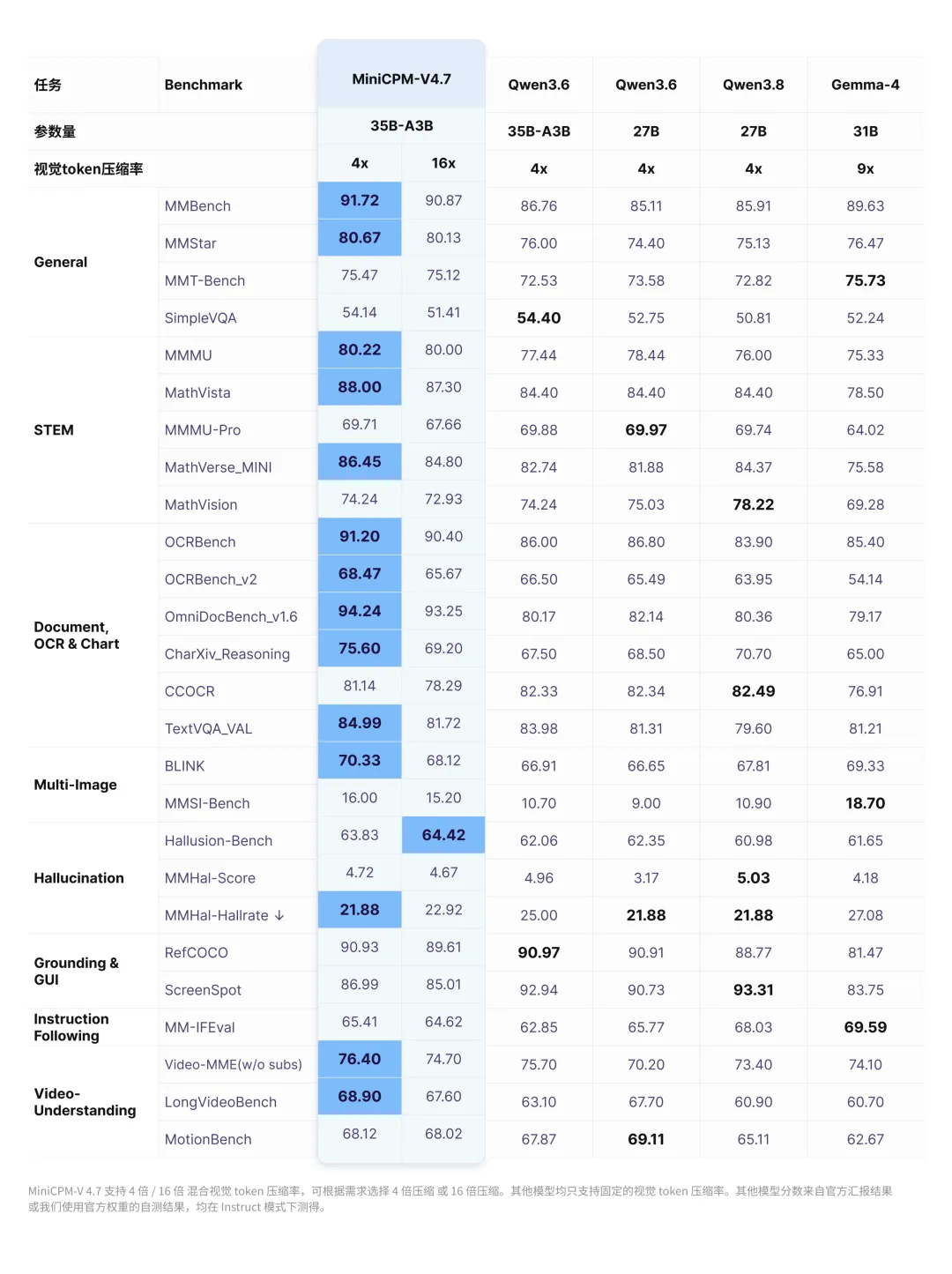
Among the 34 officially released benchmarks, 35B-A3B leads Qwen 3.6-35B-A3B in general vision, mathematical reasoning, OCR and graphing, and long video, and also surpasses Qwen 27B and Gemma-4 31B. The smart level of this generation of models is, "GPT-4V, the cloud flagship over 2023, should be identical".
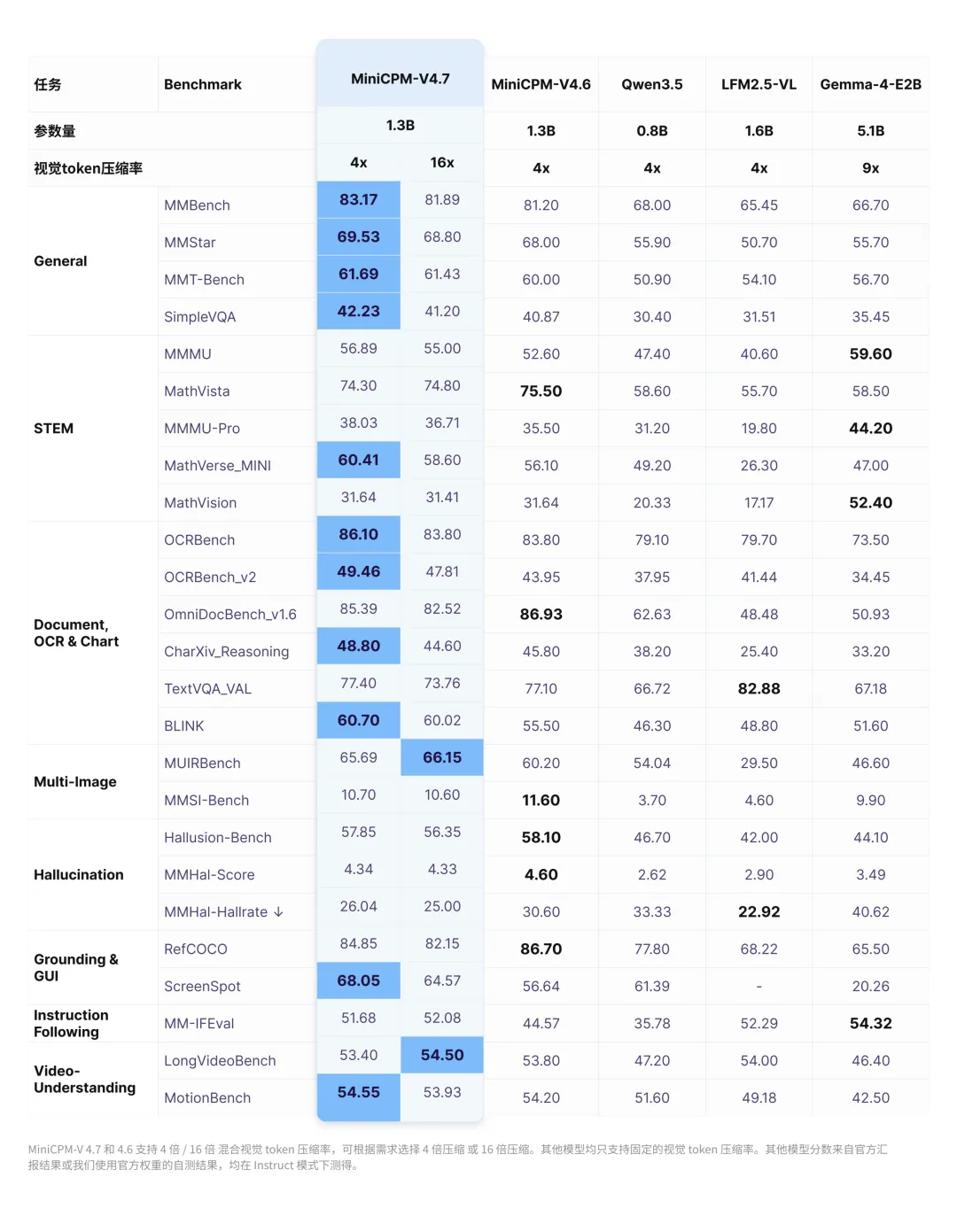
The latter was responsible for paving the way. The 1B version outperformed the Qwen 3.5-0.8B in OCR, graph reasoning and multi-graph understanding, as well as the larger LFM 2.5-VL 1.6B and Gemma-4.
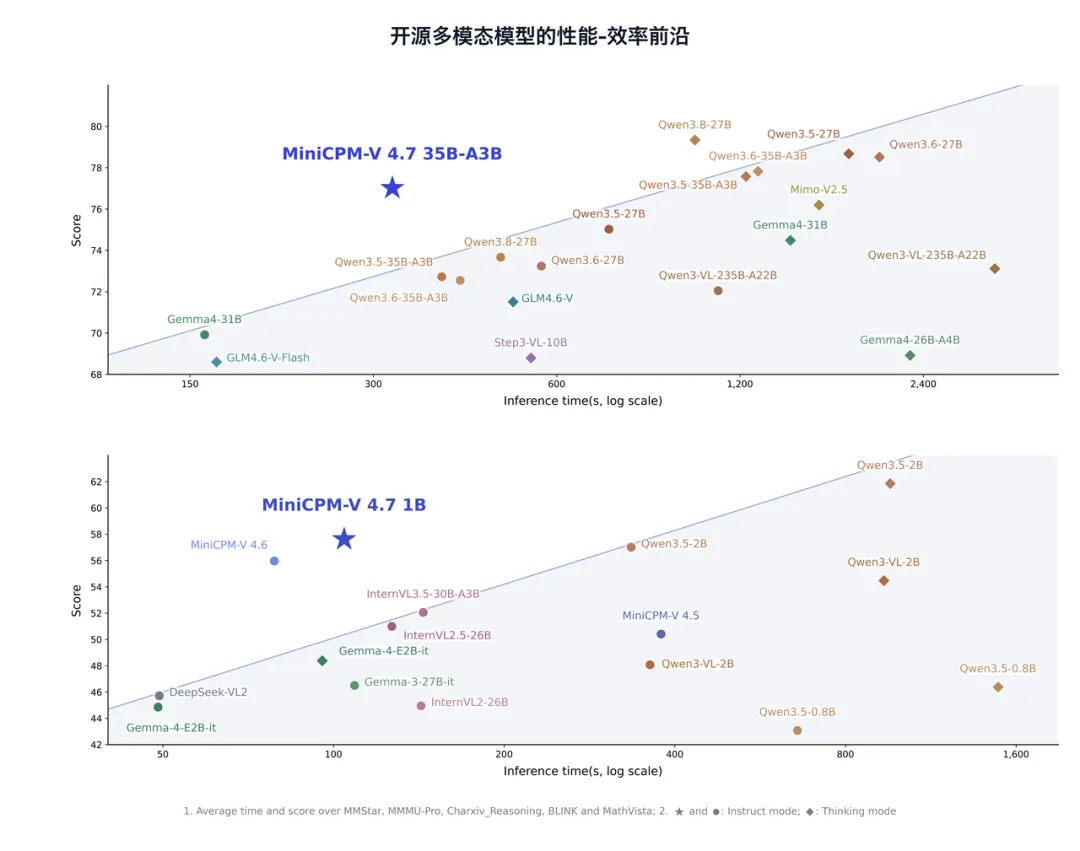
For end-to-end devices where both memory, computing and power are severely restricted, the strength of the model is important, but more importantly, the ability to obtain more powerful intelligence at a much lower cost, i.e. a higher "capacity density". Both versions of the MiniCPM-V 4.7 propelled the "Performance, Efficiency and Pareto Front" of the multimodal model at their respective parametric scales.
The excellent performance of the MiniCPM-V 4.7 also allows us to re-examine the driving force behind the advancement of end-to-end intelligence. The development of end-to-end intelligence is separated from three key factors: models, hardware and infrastructure.
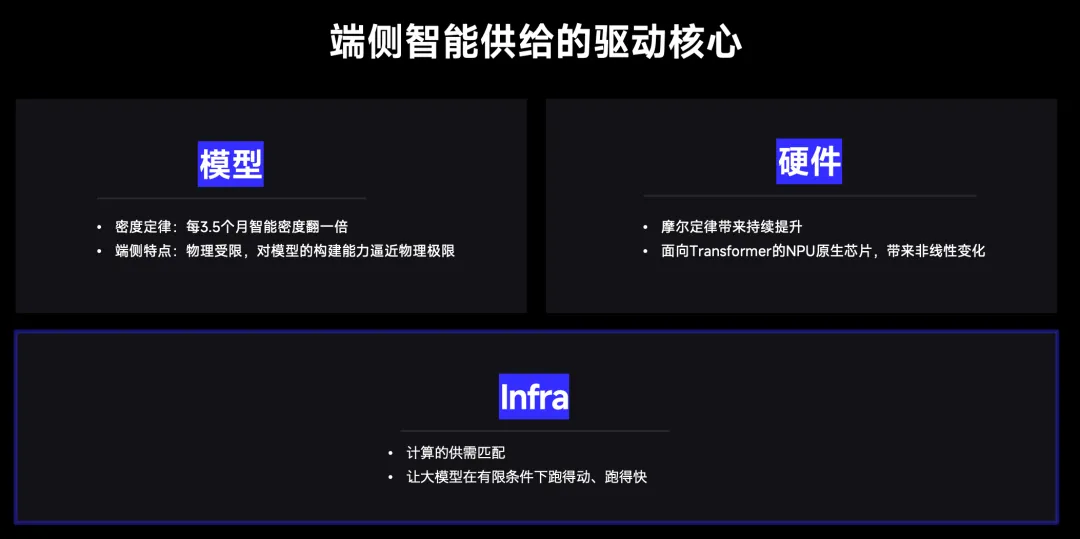
Model: pushing the density of intelligence to the physical limits
On the other side of the model, the main line of front-end intelligence has always been intelligence density.
The demands for density on the edge are extremely demanding. The human brain consumes about 20 watts of power, an 8-capacity AI server is loaded with more than 10,000 watts, the mobile phone has a daily budget of only a few watts, and runs a 20-watt program that discharges power in no time. "Nature has already proven that intelligence can be extremely efficient".
So the most important thing for an end-to-end multimodal model is to "see, think, learn", to see the world with fewer calculations, to solve problems with fewer steps, to learn new realities at less cost.
The 3D-Resampler compressed six consecutive videos together with only 64 tokens, reaching 96 times the compression rate; the LLaVA-UHD v4 along this generation brought the compression in advance to the interior of the visual encoder, reducing the encoding computation by 55.8%, and supporting 4x and 16x dual compression rates on demand.
From RLHF-V, which corrects errors by word of mouth, to RLAIF-V, which allows open-source models to be verified step by step, to RLPR, which uses the model's own confidence as a reward, without the need for curves, rewards are becoming cheaper and models can respond to more difficult questions with shorter reasoning time.
"School" solves the problem of forgetting. Before tweaking, the model must answer a set of general questions, combine high-quality answers with new task data, train new tasks to learn and not lose old skills, and forgetfulness is reduced by 80% to 99% in four open source models.
Hardware: Budget approved by the factory
The front-end team's positioning is clear, the model and Infra stick to self-development, and the chips are handed over to partners. Hardware determines the computational budget of end-to-end intelligence, and how much role models and Infra can play.
Cloud computing, memory, and bandwidth can be expanded on demand, and resources are basically fixed once the end devices are out of production. Currently, the price of storage chips continues to rise, accounting for three to five percent of the material cost of some phones, and 12GB of memory is also becoming the front line of AI phones. The more expensive memory is, the more valuable it is to run a stronger model with fewer resources.
However, the hardware itself is also undergoing changes. Chang noted that, influenced by the chip development cycle, many NPUs are still primarily targeting early architectural optimizations such as CNN, RNN before 2026, while the new generation of chips are beginning to natively support the Transformer's self-attention calculation, with the hope of further releasing the performance of the edge model.
The MiniCPM-V 4.7, which was released on the same day, completed its adaptation to platforms such as AMD, Apple, Arm, Intel, NVIDIA, Intel Core Micro, after-market smartphones, and supported domestic AI chips such as Huawei, Sunlight, Qualcomm, Morelin, and Silicon through its flagship flagship software. In addition, the MiniCPM-V 4.7 has entered into deep collaboration with manufacturers such as Qualcomm, Ultraviolet Display, and Intel Core.
Infra: How much memory is not equal to how much intelligence is
This time, the third rider was the one who received the most attention.
In 2024, the front-end will put the 8B model on the iPad; in 2025, the 4B model on the iPhone. If the end-end model is running tight, how much memory is available on the device, only how many models can be installed, and how much intelligence can be provided.
"How much memory represents how much intelligence? If so, the upper boundary of the edge model's capabilities is blocked by the upper boundary of memory". And the way to break through this upper boundary is the Infra layer.
The core solution for MiniCPM-V 4.7 is called Lookahead Expert Scheduling (LES).
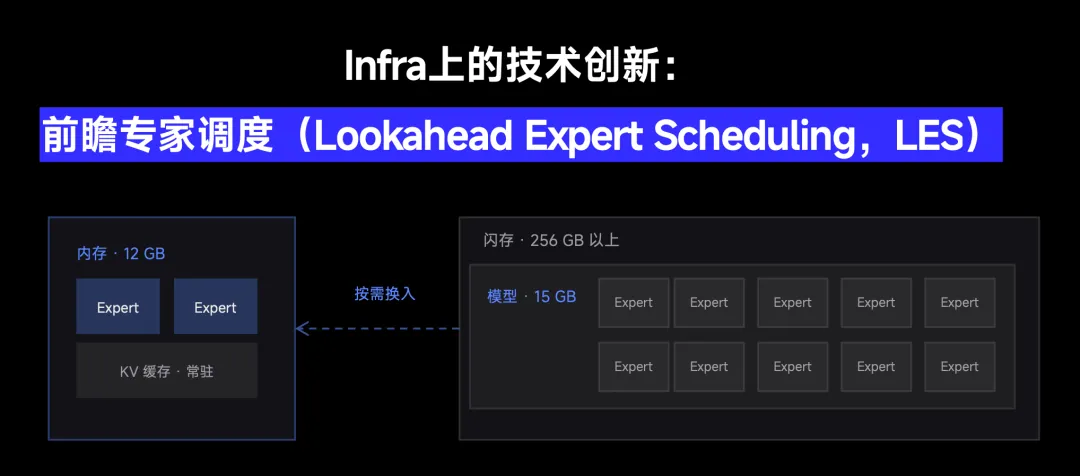
In the 35B-A3B example, even with more radical 4-bit quantification, the model still weighs about 15GB, far more than the available memory of a mobile phone.
The parameters of the MoE model are scattered among different experts, with only a few experts activated each time a token is generated.
The question is, how do we move data fast enough without delaying reasoning?
One intuitive idea is "pre-loading": when calculating L-layer, read the L+1 expert requirements in advance to allow the data to be read and calculated in parallel.
But the difficulty is that the next level needs experts, which must wait for its routing calculations to be completed. While the calculation time of one level is about 1.25 milliseconds, it is not enough to read about 8 experts and not enough to go through all 256 experts.
The idea behind LES is to predict in advance. The research team found that due to the residual structure of the Transformer, the hidden state changes in the adjacent layers are usually small, and the choice of experts has some stability. Using this feature, LES can predict in advance what the next layer of experts will need when calculating the current layer and load the corresponding weights in the background.
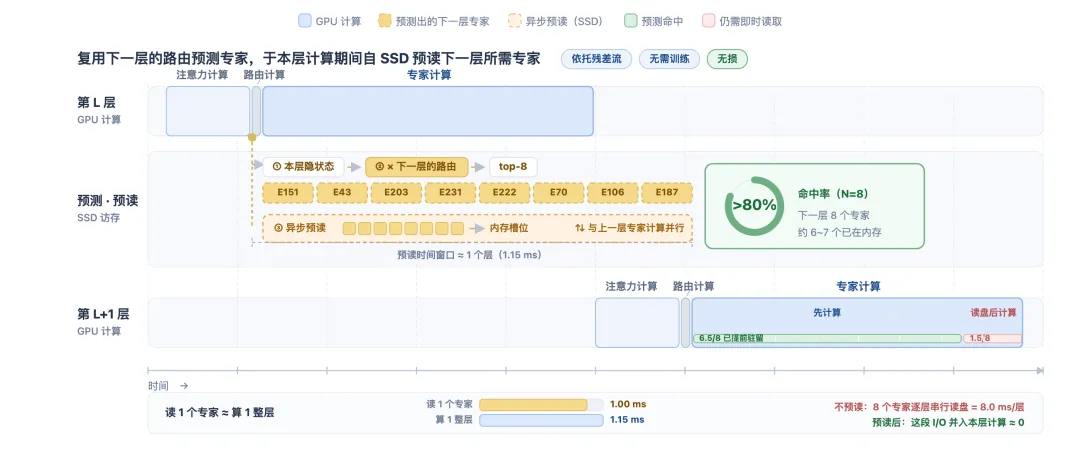
More cleverly, the LES only changes the timing of the load and does not change the actual choice of the model's experts, thus being able to increase the speed without losing accuracy.
Combined with weight-to-weight storage optimization, hybrid accuracy quantification, and DSpark speculative decoding, the 35B-A3B achieved more than 13 tokens/s on the iPhone 17 Pro Max at launch; more than 17 tokens/s on the iPad Pro M4, and more than 20 tokens/s on the iPhone 18 Pro Max. The latest LES 2.0 also increased the speed to more than 30 tokens/s, while the memory occupancy remains around 3GB, and the accuracy loss is almost negligible.
Three wheels, multiplied by overlay
When asked about "the future direction of end-side model technology", Wang said the most important thing was the co-evolution of the tricycle.
The models provide intelligent capabilities, the hardware provides computing resources, while Infra is responsible for making the two better matched, so that every bit of computing power provided by the hardware is used as much as possible where the model really needs it, reducing the loss of intermediate links.
The hardware wheels are constantly rotating, but a generation of chips takes years from design to mass production; the model wheels start accelerating in 2024, doubling in intelligence density about every 3.5 months; and the Infra wheels start late, but rotate fastest.
Furthermore, it is worth noting that progress in these three areas can amplify each other. If models, hardware and Infra progress continuously, and the gains of the three are multiplied, the overall gain may be more than five to six times greater; if further collaborative design, the gains are more than seven to eight times greater.
But that doesn't mean that one ring can replace the other. When asked if Infra is already more important than the model, Yang emphasized that the model always determines the boundaries of intelligent ability.
In contrast, if a model already has a capability but cannot be used because it runs too slowly, the value of Infra becomes very prominent.
The competition for edge-side intelligence is getting closer and closer to a full-scale system engineering. It is difficult to build long-term advantage by relying on a single generation of models, or a single generation of logical optimization. The real challenge is to understand the development direction of models, hardware, and applications, and then combine them effectively.
The arrival of the age of smart devices has also brought a whole new trend towards end-to-end soft-hard collaboration.
In the past, underlying algorithms were mainly written by hand by engineers, and development costs and maintenance requirements often required consideration of cross-model, cross-chip versatility. Now, AI can automatically generate and optimize algorithms for a generation of models, or a chip, without even considering too much versatility.
In his opinion, AI automatically writes calculators that are expected to further unleash the potential of lateral hardware and open up new imagination for future software hardware collaboration.
He was not pessimistic about the potential bottlenecks between tricycles. In his view, in the short term, a certain circle may become a constraint, but as models, hardware and Infra constantly adapt to each other, these constraints will also be gradually overcome, "which will tend to be fully matched and maximized in the process of dynamic edge intelligence".
"The Night Before the Lines" by the Edge Smart:
From end-to-end cloud collaboration to smart balance
The future of end-to-end intelligence can be told from the user's needs for intelligence.
Users are divided into two categories for the needs of smart. One category has almost no limits, such as developing software, designing chips, the stronger the smart, but few people really have these needs. The other category is the daily needs of the vast majority of people, which has a relatively stable limit.
He believes that in the future, 10% of demand for smartphones will remain in the cloud without a clear limit, while 90% of daily demand with a limit will gradually shift to the edge.
The ability of intelligent supply-side and edge-side models is rapidly improving. From the original text rewrite, information extraction, to today's image and video understanding, to tool calls, more and more everyday needs have been met locally.
"You don't have to worry about how it's going to be done, as long as it's done, you want to keep it on the sidelines".
He believes that the development of computing technology follows a similar law. From large machines to personal computers, to the era of mobile intelligence, every time computing platforms change, there is a "clash line" between the supply of technology and the needs of users.
"Macroscopically, what we're seeing is a succession of successful companies, the bottom line of which may be the technological supply-demand collision, which naturally shapes the divide of the times".
When computing capabilities are insufficient to meet a specific demand, applications are difficult to popularize; new applications and industrial opportunities arise once capabilities cross thresholds.
Today's end-to-end smart, like the PC era with only 256KB of memory, looks a long way off, but it's bound to come.
Promoting the Arrival of Balanced Intelligence
After the 35B mobile phone, one of the most frequently asked questions is whether to make the model smaller or larger at the end.
The answer is that two things never contradict each other. Modeling is done to make models smaller on the same hardware; the hardware is continuing to progress, and the flagship models that can be installed will naturally grow larger. From the earliest 1B, 2B, to the later 7B, 8B, and today's 35B-A3B, the goal of face-to-face intelligence has always been to "provide the strongest intelligence on the edge".
This is where he believes the end-side and the underlying logic of the cloud model are different. Clouds typically have more abundant, scalable computing resources that can be improved by adding parameters and algorithms. The end-side is severely limited by memory, chip performance, and power consumption, and each resource needs to be carefully planned.
In the blink of an eye, if the hardware clearly has potential, it is a waste of time because the limitations of the model and the reasoning technology cannot be realised. Therefore, the front-end option is to simultaneously push two paths: one is to "touch high" and continuously break the limits of end-side intelligence capability; the other is "comprehensive" so that more ordinary devices can run models that are powerful enough.
One side of the lower threshold has been lowered. The previous generation MiniCPM-V 4.6 is already running on Apple, Android, and other smartphones, and several hundred yuan devices can reach more than 15 tokens per second. The 1B version of this generation continues to upgrade along this line.
To make end-to-end smart popular, we can not only wait for more expensive, more powerful phones to appear, but also to make existing ordinary devices run better models.
Open source, lower the threshold a little bit.
In addition to enabling the model to run on more devices, front-end intelligence also wants to be open source so that more developers and ordinary users can actually use it.
With the release of MiniCPM-V 4.7, the façade simultaneously opens up model weights, end-side reasoning codes, app installation packages and modulation schemes. As long as the same device is used, the developer will be able to reproduce the effects of the official presentation after downloading, which can be accepted by the open source community verification.
The team believes that a general model of laboratory training can solve many problems, but in the real world there is a huge need for separation, spread across different people's work and lives.
Face-to-face intelligence hopes to provide a simple enough approach to allow developers to quickly customize models based on their own scenarios, teach them new tasks, and retain their original capabilities as much as possible.
For ordinary users without a technical background, the team is also further lowering the threshold. The team introduces that in the future it plans to access the model in the form of Skill to all types of smart bodies. Users only need to send an official link to their usual smart bodies and say, "I want to use this model" to complete the call.
From downloading models, configuring environments, to calling capabilities, a series of operations that originally required a developer to complete may require only one natural language instruction in the future.
Open source is also creating business opportunities.
In overseas communities, developers are already using MiniCPM to develop smart glasses, apps, and other products. These applications are being explored by developers themselves and could become the starting point for commercialisation in the future.
The value of open-source is also becoming apparent here: models are getting into more devices, being used by more developers to discover needs that are not necessarily seen in the lab, and continuing to improve in real-world scenarios.
Whether or not end-to-end intelligence can meet its own era ultimately depends on whether the technology supply can cross the thresholds of user needs, and how many people can actually enjoy it after it is crossed. From pursuing stronger models, to lowering the hardware and usage thresholds, to expanding applications in open source communities, the front wall is trying to make both happen at the same time.
In the end, Huawei is great in itself.
The hardware foundation for end-to-end AI is rapidly opening up.
IDC predicts that China's new generation of AI phones will reach 147 million units by 2026, accounting for 53% of the overall market. This means that for every two new phones sold, there will be an AI capability on the side.
But with regard to the current "AI cell phone", Liu believes that "we have far from enough imagination for an AI cell phone".
"We can only use a few obvious things for AI to help me, and it's very localized, saving us a little time". In the future, maybe we should think: what is the ideal phone?
In fact, the concept of a "native AI mobile phone" itself may be just a transition. As few people today have deliberately emphasized a "smart phone", every mobile phone in the future will have built-in AI, and intelligence will be ubiquitous. However, before it is actually ubiquitous, there is a more realistic question that needs to be addressed: should the price of the device be determined by the intelligence that everyone can get?
In the past, end-to-end models often had to be "degraded" with hardware configuration, lower-priced devices, which meant more limited intelligence. The front-end wants to change this situation so that as many people as possible, no matter what device they have in their hands, can enjoy enough AI capabilities.
"This whole thing is big enough on its own", Yang said.
The most important value of universal access is that those whose economic and material conditions have not yet reached a certain threshold are able to use the best technology. More importantly, they are given not only the opportunity to use tools but also the opportunity to participate in creation.
AI programming has enabled many people without a professional programming background to develop software independently, and ordinary people have begun to use large models to solve problems that have required expertise in the past. When the threshold for the use of intelligence is low enough, more people have the opportunity to turn their ideas into reality.
In retrospect, the advances in edge intelligence have been surprising enough.
Three years ago, cloud flagship models such as the GPT-4V appeared to still have an impenetrable computing gap with mobile phones, and today, in part capable of surpassing previous cloud flagship models, they can run on a disconnected iPhone.
From the cloud to the mainstream, only a handful of cloud smart manufacturers have ever been able to provide intelligence, and it is entering more and more common devices. Measuring the scale of AI progress, in addition to how smart the strongest models are, it should be seen how many people can actually use these smart devices.
It's only when a few hundred-dollar phone can provide smart enough support for its owner that the changes brought about by AI will really impact more people's lives.
And what the front-end intelligence is doing is making such a future come early.