 A halt is impossible, but a major slowdown is inevitable.
The King of Techno
Editor's note:
On the morning of November 4, 2026, the day after the midterm elections in the United States were scheduled, OpenAI executives sat together.
According to sources familiar with the matter, they are discussing whether or not to reset the data center capacity forecast for 2027.
Over the past few months, major data center connectivity projects across the United States have been suspended by pressing a button. Former Governor Abbott has frozen data center merger and air licensing since August, requiring audits until the end of the year; newly elected Governor Gina Hinojosa has pledged to suspend the approval of all new data centers until state legislature legislation protects residents, and the legislature's term ends in May 2027.
Ohio Governor Amy Acton proposed a conditional suspension, requiring the new project to cover all electricity costs and be built only on old industrial land; while Georgia Governor Keisha Lance Bottoms prepared to sign an executive order immediately after taking office to suspend new construction throughout the state.
According to Tokenpost,Between July and November 4, at least 21 large data center projects in the United States were canceled, bringing the total to nearly 23 by 2025.In its tender filed on October 26, Anthropic also listed the risk factors: some jurisdictions are considering or have approved the suspension, may delay or block the computing facilities that rely on it, and voices against data centers are becoming more organized across jurisdictions.
If we push this trend to the extreme and imagine a scenario like this, if all the planned data centers in the U.S. are not built, what does that mean for AI now and in the future?
01
Potential growth in computing is cut by 50%
In order to define the boundaries of the projection, we set up an extreme scenario based on three assumptions:
1,All unfinished planning projects in the United States are frozenThis is equivalent to pushing the current suspension range of about 41% nationwide.
2,All the projects that are already under construction are completed on timeThis is consistent with the practice of suspension orders for new approvals only in Texas and elsewhere;
3,The only hard constraints are electricity and ground.We're only playing the mainland of the United States, and we're not discussing the transfer of computing power.
According to Newmark's estimates, the U.S. data center currently uses about 60GW of electricity, which includes all data centers, not all of AI. Capacities vary in different sizes: Cleanview about 57GW, Wood Mackenzie about 80GW, DCMap statistics about 90GW in August. This portion of the project will be completed as usual in the scenario, constituting the total increase in U.S. computing in the coming years.
The biggest is the "planned unfinished" part, with DCMap reporting 228GW in August, and Wood Mackenzie's cumulative pipeline of more than 430GW.This is a relatively stable range of about 230 to 340 GW.。
It is roughly estimated that, in extreme situations,The total capacity of U.S. data centers will stop at about 120 to 150 GW by 2028, about 2 to 2.5 times what it is today.As a reference, Synergy previously predicted that U.S. capacity would double by 2029; if all of the pipeline planning had failed, that number would have been more than five times today.
The chip would be more intuitive. 1GW of power would be enough to power hundreds of thousands of Blackwell-class GPUs: the theoretical calculation of 1.8 to 2.3kW on a single charge would be about 430,000 to 550,000; the real park area of Abilene would be about 270,000 GW.Plans for 2,300 GW were frozen, equivalent to the loss of tens of millions of state-of-the-art AI chips.
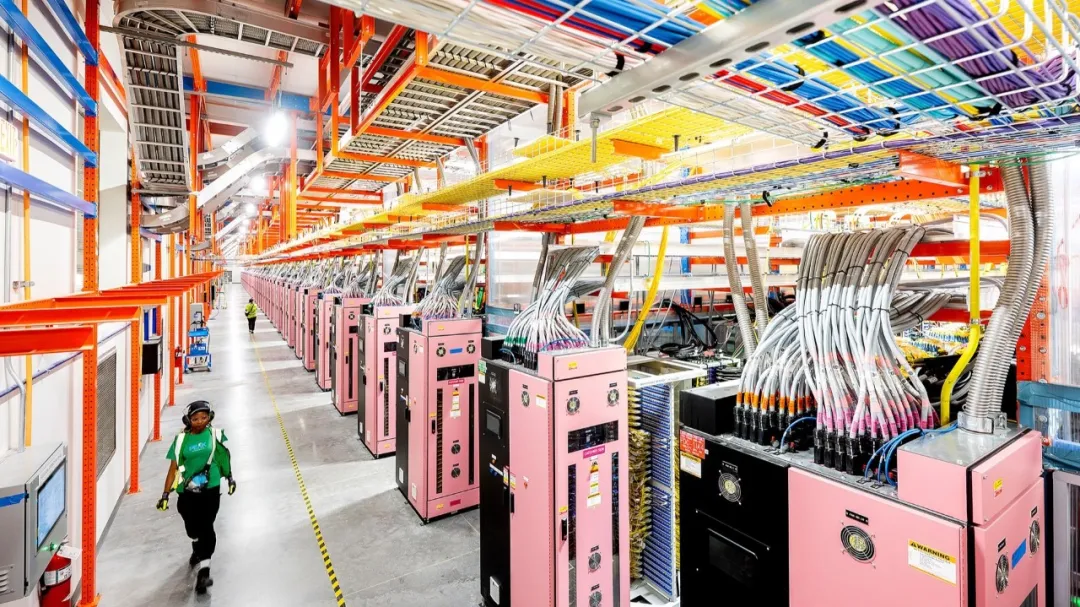
Inside the Project Rainier park that Amazon is building for Anthropic.
The scenario is extreme, but not ridiculous. According to Cleanview's calculations, in the states where the governor pledged to suspend the program, planning capacity totals 158.6GW, about 41% of the country, including 88.4GW in Texas, 21.9GW in Ohio, 20.2GW in Georgia, 11GW in New Mexico, and 9.9GW in New York.
There's something to be said for honesty, and the number of hydrates that are currently being planned is huge. The Texas grid ERCOT's large load line is about 474GW, about 1800 projects, equivalent to about five times the peak load of the grid, most of which are speculative statements of occupancy nature.
What will be the impact on AI after a "calculator brake" steps down like this?
02
As usual, the next generation of AI is blocked.
If the extreme scenario happens tomorrow, users won't feel any different in a year or two.It's a model that's on the cutting edge before 2027 and it's trained as usual and it's being replicated as usual.。
The training bases supporting this generation of models have been completed or near completion. According to Epoch AI's database, the largest known AI park currently is Anthropic and Amazon in New Carlisle, Indiana, with a capacity of 1037MW; followed by xAI's Colossus 2,946MW.
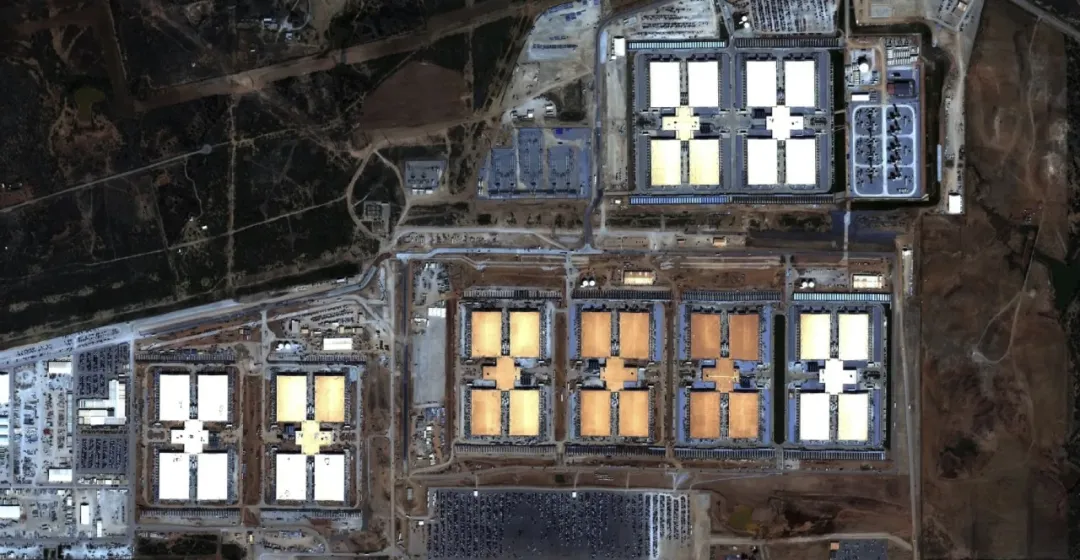
OpenAI's satellite map of the Stargate Park in Abilene, Texas is provided by Epoch AI.
The next-generation model, which is scheduled to enter service between 2028 and 2030, will need several GW to power the plant.
Data from Epoch AI shows that the demand for electricity in frontline training is growing by 2.2 to 2.9 times per year, with the current frontline training already exceeding 100 MW. Epoch expects several parks to break 1GW in the next year, and in about two years, the largest training may use about 2.5 million units of H100 equivalent capacity; according to this trend,By 2030, the maximum one-off training will be 4 to 16 GW.。
In contrast, the largest park today is just over 1GW. Epoch also points out that the capacity of the data center is actually the upper limit of the training scale: how big the park is built, how big the model can train at most.
And super-projects aimed after 2028 have hit the walls a lot.
OpenAI's Stargate is projected to exceed 9GW by 2029, with most of the seven U.S. stations scheduled to go online on a massive scale between 2027 and 2028, mostly concentrated in the suspended states of Colorado, New Mexico, and Ohio.
Among them, the expansion of the Abilene sidewalk project has been abandoned; Project Jupiter, a 2.45GW project in Doña Ana, New Mexico, was rejected by the State Land Office in March this year; and the Lordstown, Ohio station, which had not seen a large-scale construction in satellite imagery until April.
Meta's Prometheus Park of about 1GW is also in Ohio, with only Hyperion, a 5GW target in Louisiana, avoiding this round of suspension.
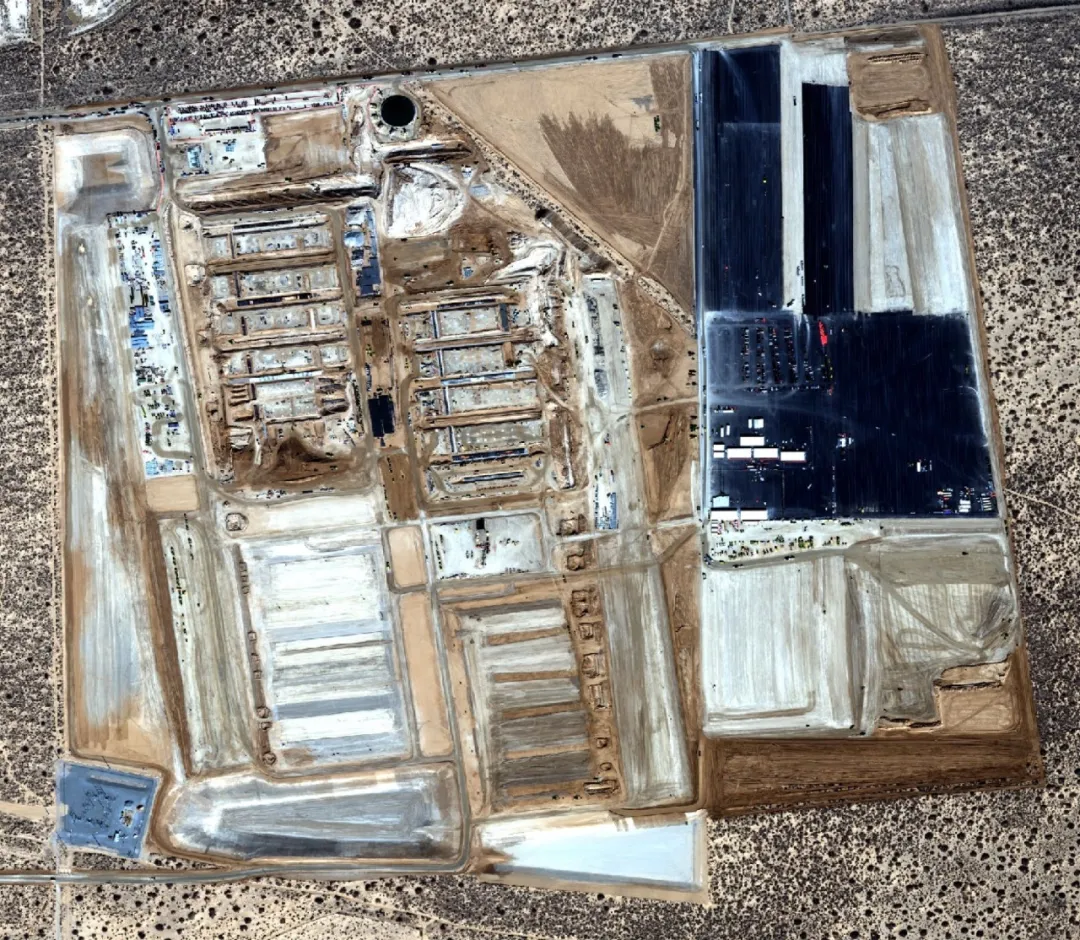
Project Jupiter's newest artificial satellite in Doña Ana, Mexico, is located at Epoch AI.
This raises the following questions:Training for the Next GenerationCalculationHow slow will AI progress after the base is flooded??
03
Slow down, but not stop
To answer this question, we need to break down the growth of computing power.
According to Epoch AI, the training capacity of front-end language models has increased by about 4 to 5 times a year since 2020.[citation needed] During the same period, training power has grown by about 2.2 to 2.9 times a year.[citation needed] The difference between the two is about 2 times greater, mainly due to the improvement in chip energy efficiency, i.e. the computing power provided per watt is increasing.[citation needed]
In addition to hardware, algorithms are also helping. The commonly used range is that algorithm efficiency improves by about 3 times a year (Ho et al. Research in 2024 gives about 2.7 times).
Now we can make a rough estimate.
Under normal circumstances, AI gains "effective computing" growth each year, equivalent to physical computing growth (4 to 5 times) multiplied by algorithm improvement (about 3 times) and about 12 to 15 times per year.
Under scenario A, after 2028, new electricity will be reduced to zero, with one of the biggest pillars of physical arithmetic growth being pulled out, leaving only the energy efficiency of chip replacement to be improved about twice a year.The annual growth rate of "effective computing" decreased from 12 to 15 times to about 6 times.
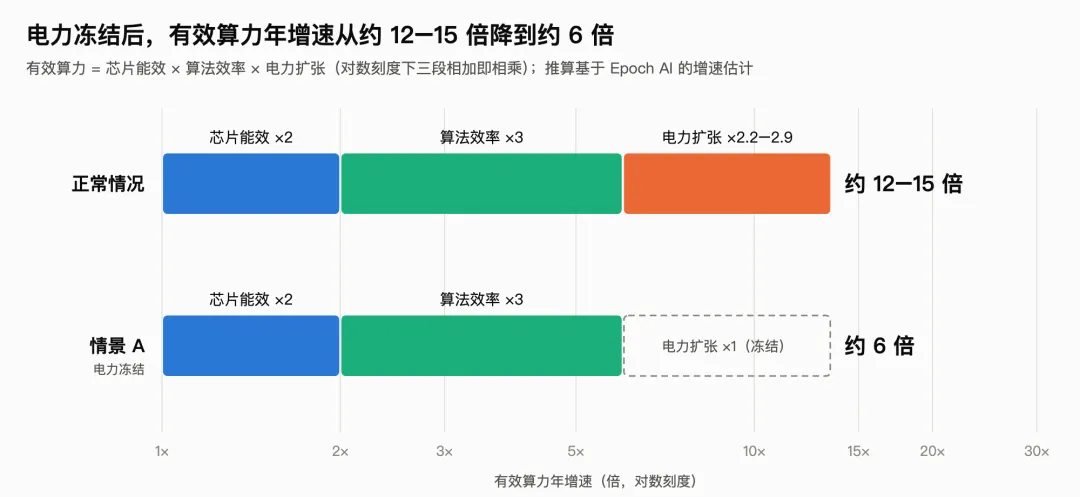
Effective calculation year-on-year decomposition: normal situation compared to extreme scenario A
If Epoch is replaced with a more optimistic algorithm range (about 10 times per year), the normal rate of effective arithmetic is 40 to 50 times per year, and scenario A is about 20 times lower. Under both ranges, an electrical freeze would cause the effective arithmetic range to drop to about four to half the original rate.The algorithm is progressing faster, and it doesn't replenish what's left of the power expansion.。
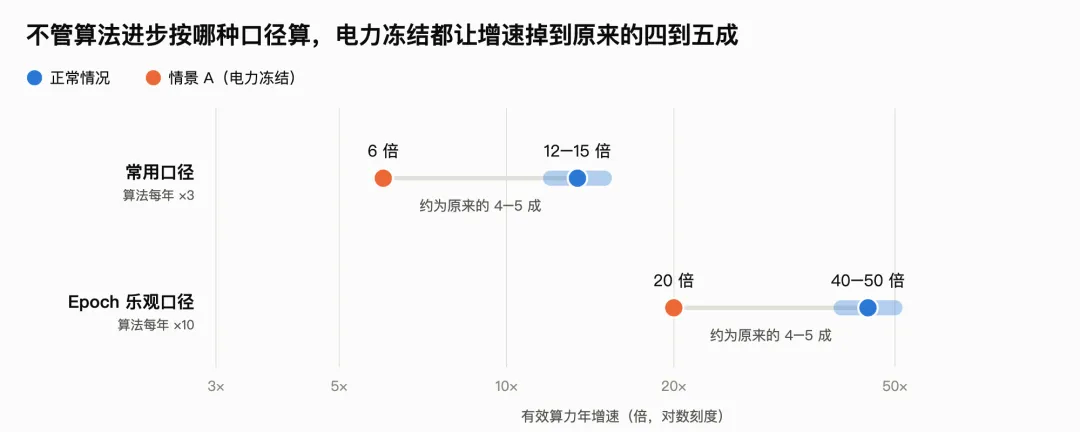
Under the two algorithms, the effective year-on-year growth of electricity before and after the freeze is calculated.
There is also a risk. The chip's energy efficiency dividend, provided that the new chip can be installed in the machine smoothly. After the total power capacity of the machine is locked, the difficulty of electricity supply and heat dissipation conversion may make this twice as much discount.
Even so, about six times a year is still a remarkable number.
In extreme scenarios,AII will.Clearly slowing down, but not stopping。
However, this account is only a fraction of the math required for training.Putting visibility into the operation of the entire AI, after the power is locked down, there is another battle that will begin immediately.。
04
It's time for the Token limit.
In the past, it was not enough to build a new machine room in a circle. In extreme scenarios, there is so much electricity in the plate.Each time the electricity is distributed to the training, it is extracted from reasoning, intelligence and post-training.。
According to Deloitte's predictions, reasoning will account for about one-third of all AI calculations by 2023, and about half by 2025.It is expected to reach about two-thirds by 2026。
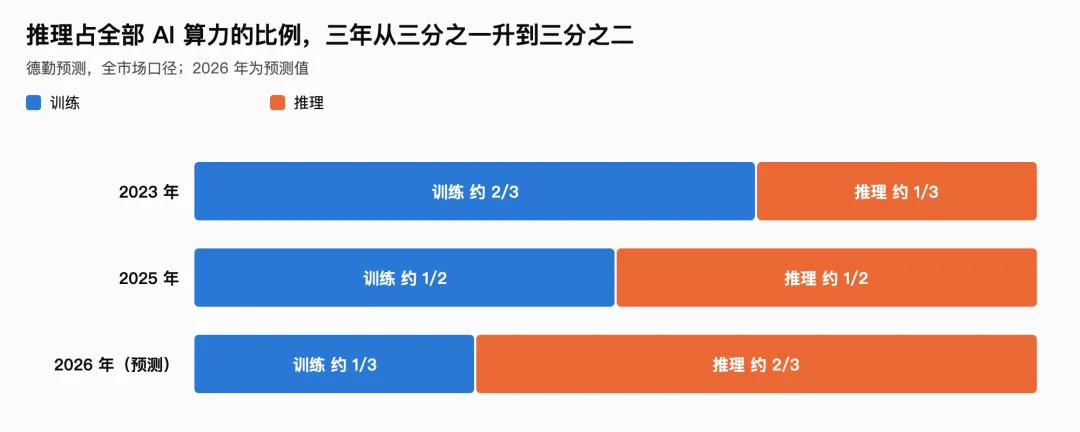
Reasoning and training vary in proportion to all AI calculations
SemiAnalysis estimates based on the combined computational power of OpenAI and Anthropic show that in early 2024, pre-training accounted for 67%, post-training and reinforcement learning accounted for only about 5%, and reasoning for about 29%.Less than 50% by 2025, and post-training will continue to riseSome researchers have pointed out that this is a change in proportion, the total computing power of the laboratory has multiplied many times, and the absolute amount of pre-training does not necessarily decrease.
More pressure comes from the shape of the product. Reasoning models generate a long chain of thought before responding, which users can't see, but are consuming power every step of the way.The amount of tokens a smartphone consumes to complete a task is 5 to 30 times that of a regular chat.。
Goldman Sachs predicts that total global token consumption will grow 24 times between 2026 and 2030.

Growth in consumption of smart devices and tokens Source: Polaris Park
Putting these numbers into a set amount of electricity in extreme cases, each lab faces the same choice:Every megawatt will either be used to train the next generation of larger models or to serve existing users and smart devices.
In order to adapt hundreds of thousands of cartridges to a larger base model, it is necessary to limit the number of calls made by existing users; prioritize reasoning, preserve users, and the next generation of models will fall behind.
After this path of increasing electricity is blocked, the remaining problem is whether to continue to develop AI under fixed amounts of electricity and computing, and what other path to take.
05
Four "complementary routes"
Under the pressure of extreme scenarios, energy-saving technologies that were previously disregarded because of "reverse energy charging" will become mainstream:
Replace the hardware verification indicator with "how many tokens are generated per watt of electricity".
In power-fixed machines, replacing old chips with new, more energy-efficient ones is the only way to expand.
The preferred indicator for Intel is the "tokens for each full-range megawatts of electricity output per second", which is calculated in terms of the total electricity consumption of the park, including the heat dissipation and the network. The popularity of this indicator suggests that chipmakers have already defaulted on customers' bottles of electricity, and the number of cards is secondary instead.
According to Intel, the per-watt performance of the Vera Rubin is 10 times that of Blackwell and up to 30 times that of the GB300 in a smart-body scenario. Independent testing also yielded close results: CoreWeave tested that, at the same DeepSeek R1 load, at the same interfacing speed, the token output of the Vera Rubin NVL72 per megawatt is 10 times that of the GB200 NVL72.
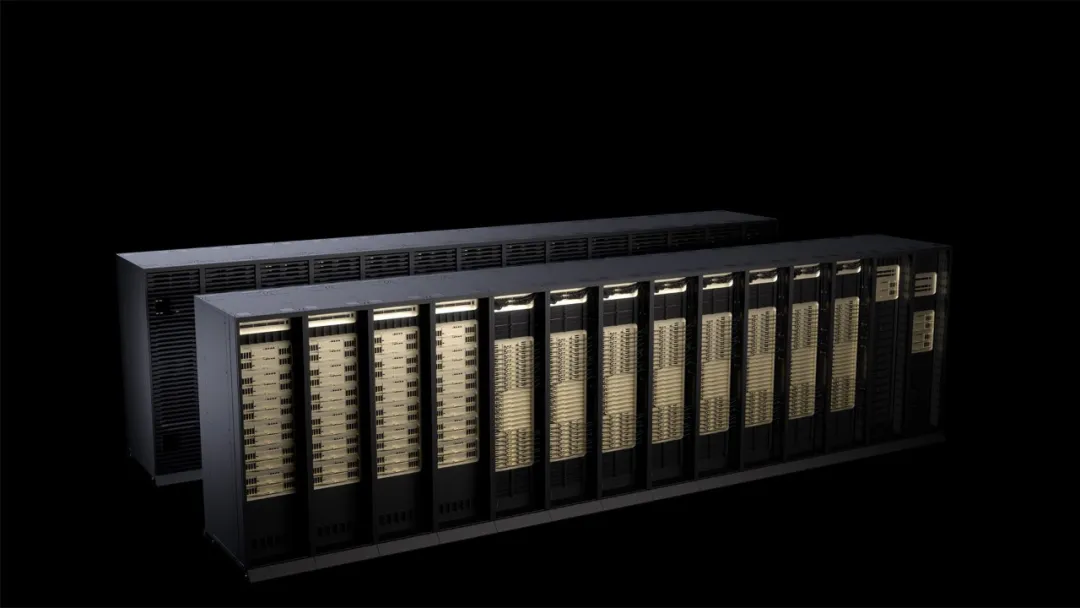
Invisalign Vera Rubin NVL72 Air Cabinet photo provided by NVIDIA
Distribution training across the machine room.
The suspension order is generally aimed at large data centers with hundreds of megawatts of power. A natural bypass is to break up the training tasks into small and medium-sized machine rooms in different regions.
This method is already being tried by the giants. Google has explained that Gemini is trained synchronously in clusters at multiple locations; Microsoft has connected machines in Wisconsin and Georgia; CoreWeave has announced cross-cloud training with Google Cloud. Google's DiLoCo research shows that training can be done between remote facilities with regular network connections and can tolerate hardware failures.
But the difficulty of this approach is not small. The authors of DiLoCo also acknowledge that the technology is currently only able to complement superclusters and cannot form a replacement.Network delays significantly impair the overlap between computing and communication when the machine room is tens to hundreds of kilometers away, with a large amount of computing power waiting for the data to go blank.。
Focus on research and development from pre-training,Afterwards training and reinforcement learning.
Pre-training relies heavily on a single supergroup and is limited at the extreme. If several GW of clusters are not built, engineers will focus on less demanding post-training, reinforcement learning, and architectural improvements such as hybrid expert models, low-precision computing. Cursor has publicly stated that its Composer 1.5 model has outperformed pre-training.
The end-side and small model are distributed to the cloud.
By 2026, distillation is already the mainstream method of making small models. Quantitative small models can handle structured tasks directly on mobile NPUs, with models under 10 billion parameters running about 12 to 15 tokens per second. More and more applications are adopting a hybrid model: local small models process most requests first, with a few complex requests handed over to cloud large models.
06
Opportunities under constraints
The extreme scenes are tied to the electricity of the US mainland. For the other two types of players, this constraint opens a window:Model companies that have accumulated years on the efficiency trajectory, and AI entrepreneurs who are ready to enter。
Look ahead to the distance between the front and the tracker. According to Epoch AI's measurements in May this year, the strongest open-source model averaged about 4 months behind the closed-source front, roughly equivalent to the horizontal difference between GPT-5 and GPT-5.5.
Look at pioneers on the efficiency path - Chinese model companies such as DeepSeek, Qwen, Kimi, GLM, MiniMax, and others - who have been promoting open-source, low-cost and mixed-expert architectures that have been reflected in usage data.
According to a joint study by OpenRouter and a16z, the Chinese open-source model's share of tokens on the platform rose from about 1.2% at the end of 2024 to nearly 30% by 2025, and by 2026 many statistics give a proportion between five and 60 percent.
A16z partner Martin Casado also estimates that about 80% of startups using open source technology are running a Chinese model. OpenRouter is just a platform that doesn't include ChatGPT in-house traffic and enterprise private deployments, but the trend is clear:
When the industry as a whole has to answer the question of "how much intelligence is generated per generation of electricity", the long-term experience of the team working on this issue will be more valuable.
* Source: Amazon
A question from the PolesIf the physical expansion of arithmetic stops,
You think AI is going to lead to a round of algorithmic breakthroughs.
Or a long period of platforming?