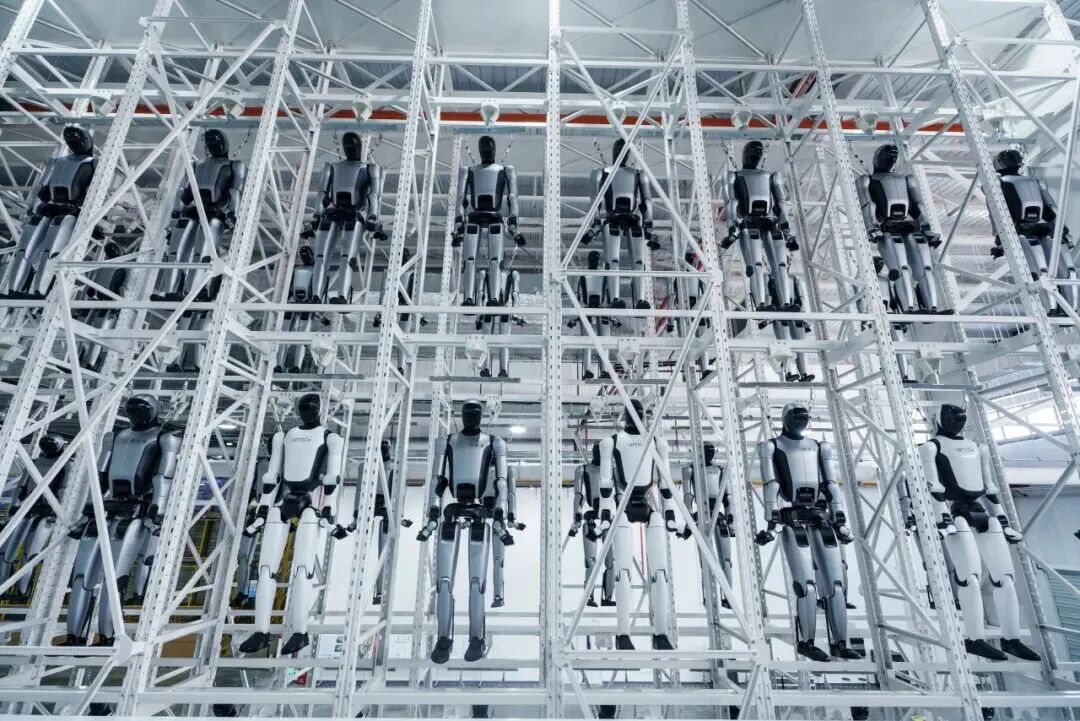
Six award-winning papers on the evolution of technology.
Global scientific trends
CoRL 2026 will be held in Austin, Texas from November 9-11, local time.
The CoRL's paper awards are limited to two: the Best Conference Paper Award and the Best Student Paper Award, which recognizes outstanding field presidents and outstanding reviewers. Six finalists entered this year's pool, two of which were announced at the Awards & Farewell on 11 November.
We did a survey of all six entries in this year's competition: two winners, four entries, covering body-to-body control, context-based strategies, skillful pre-assembly training, world model data, multi-body weight planning, and an audit of the benchmark itself.
Welcome to the world of deep blue AI.We will continue to share the dynamics at the forefront of AIDeep blue AI1—Award for best paper🏆 CoRL 2026 Best Conference Paper Award
SuperMimic: Full-body control of a humanoid robot with a micro-world model
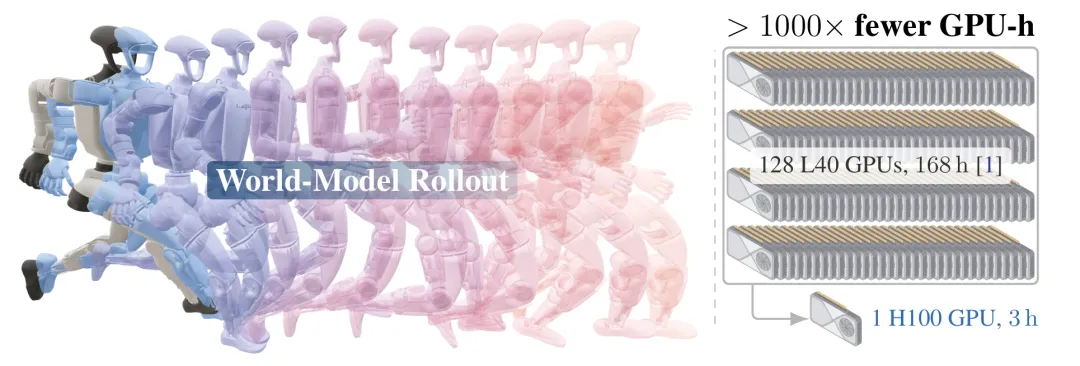
Keywords: micro-world models, shared dynamics, BPTT visualization, depreciation of training costs
The team is composed of Qiayuan Liao, Yiyang Shao, Junfeng Long, Kevin Zakka, Roberto Horowitz, Pieter Abbeel, and Koushil Sreenath.
Research content: Human-robot full-body movement tracking relies on large-scale reinforcement learning training, such asSONIC requiring about 21,000 GPU hours. SuperMimic proposes an alternative physical simulator to a micro-world model unrelated to movement. It adapts to the sharing of rigid dynamics from the simulation log, allowing the strategy to make short-term fantasy projections in the model, using the analysis gradient update, and bypassing the simulator's immeasurable difficulty. At 129,000 motion benchmarks, a single-card 3 hours exceeds theSONIC cluster model, failing from 179 to 25, the calculation step decreased more than 1,000 times. The strategy directly deploys the U-tree G1, completing the high-level rolling and jumping task.
The article links to:https://arxiv.org/abs/2610.28480
Link to the project:https://supermimic.github.io/
Deep blue AI2—Award for best student thesis🏆 CoRL 2026 Best Student Paper Award
RoboTTT: expanding the context of robotics strategy
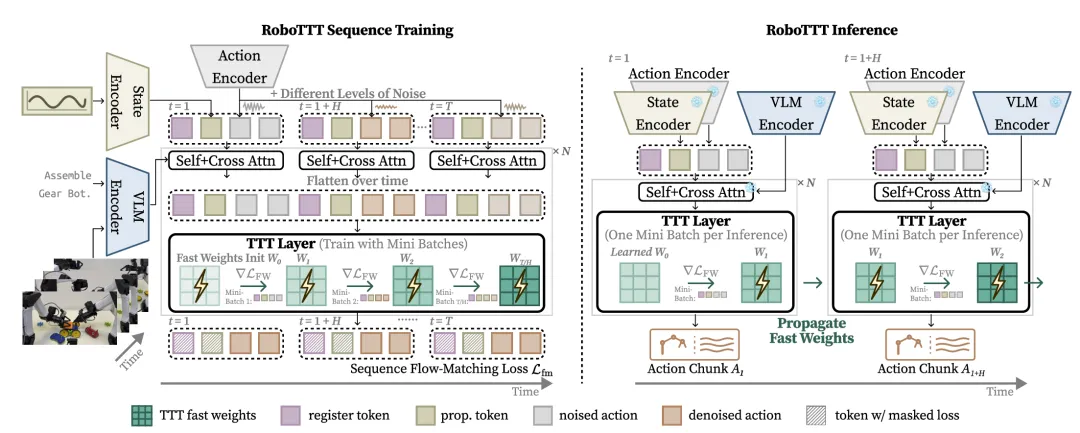
Keywords: training during testing, fast weighting, intercepting feedback, enforcing sequence actions
The team is composed of: Yunfan Jiang, Yevgen Chebotar, Ruijie Zheng, Fengyuan Hu, Yunhao Ge, Jimmy Wu, Tianyuan Dai, Scott Reed, Li Fei-Fei, Yuke Zhu, Linxi, and Jim Fan.
The robot strategy is limited to reasoning delays caused by KV cache and RNN's capacity bottlenecks, which are difficult to handle in context. RoboTTT stores memory in parameters: it introduces rapid weight-loss and test-training (TTT), updates the history-writing parameters with each step through the internal gradient. In engineering, it combines sequential actions to force and interrupt retransmission, successfully training 8000 on context. In real machine assembly tasks, it completes 79% of the single-step baseline (42%). It also supports human video simulation, or failing trajectory in context, correcting targets for steaming, and the trajectory utilization rate is three times that of the standard DAgger.
The article links to:https://arxiv.org/abs/2607.15275
Two of the best papers can be read in detail at CoRL 2026 Double Feature.
Below are the nominees for best paperDeep blue AI3—Is it because it hasn't learned to play?Play2Perfect: What really works in precision-mounted pre-training?
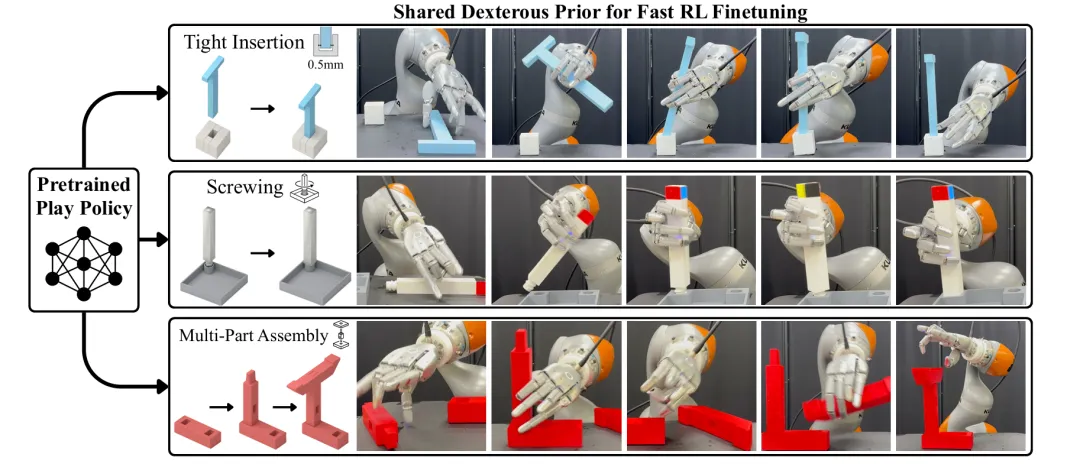
Keywords: In-hand redirection, tasks not related to pre-training, rare rewards, zero samples sim-to-real
The following is an excerpt from the book of the same name:
Research content: Precision attachment to contact intensive tasks, scarce rewards make reinforcement learning extremely difficult to explore, and traditional methods rely heavily on specialized claws or structured environments. Play2Perfect proposes a pre-training framework for pre-playing post-play reinforcement: first through task-related reinforcement learning, allowing multiple fingers to practice clutching and hand-to-hand reorientation on a variety of objects, establishing a general zero-operation precedent; then minimizing in installation tasks. Research shows that this precedent is 33 times more efficient than training reinforcement learning samples. In sim-to-real samples, tightly coupled plugging for contact gaps of only 0.5 mm has achieved a 60% success rate.
Link to the paper:https://arxiv.org/abs/2606.26428
Link to the project:https://play2perfect.github.io/
Deep blue AI4—Can the training data of humanoid robots all grow up in a virtual world?GRAIL: Creating mobile operations from models of the world
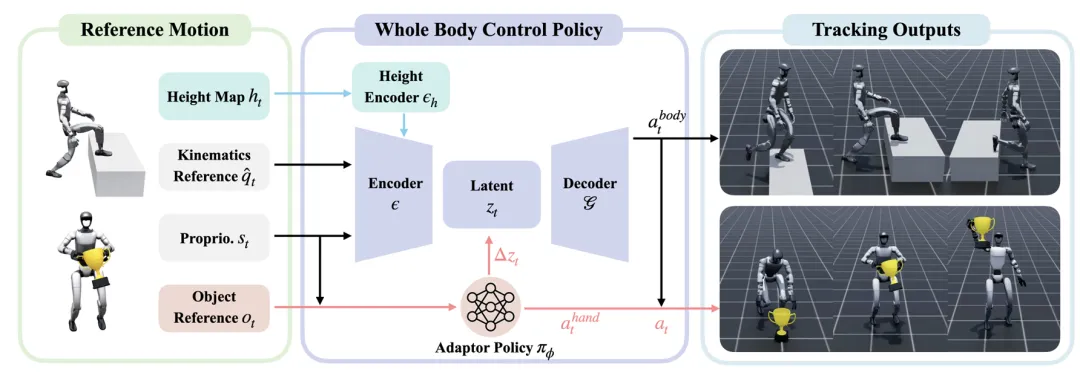
Keywords: video world models, 4D interaction rebuilding, movement redirection, scene perception tracker
The team is composed of Tianyi Xie, Haotian Zhang, Jinhyung Park, Zi Wang,... Chenfanfu Jiang, Sanja Fidler, Jan Kautz, Linxi, Jim Fan, Yuke Zhu, Zhengyi Luo, Umar Iqbal, Ye Yuan.
Research content: Human mobile operations data relies heavily on physical acquisition, remote operation, and motion capture to scale. GRAIL constructed a flow stream that generates data entirely in the virtual world. It started from a known three-dimensional configuration, used video generation models to recover 4D human trajectories with metric measurements and physical interaction, and then trained general trackers with the ability to sense objects and navigate through scenes by moving forward.
Link to the paper:https://arxiv.org/abs/2606.05160
Deep blue AI5—Do you decide which object to put first and how to put it in the order that can be learned?DISCO: Long-range polynomial weights for distilling trees in continuous action space
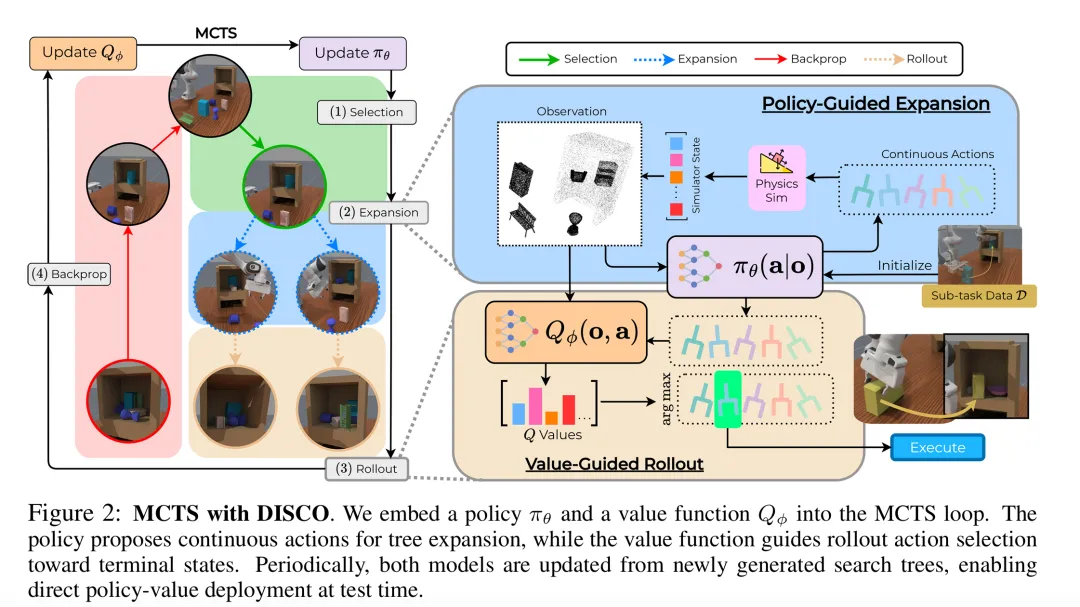
Keywords: Gradually widening MCTS, strategic value modeling, GPU parallel simulation
He is also a member of the faculty at the University of California, San Diego, where he teaches creative writing.
DISCO proposes that search and strategy be mutually facilitated: in physical simulation, using progressively enlarged Monte Carlo tree searches (MCTS) to generate long-term schemes based on learned strategies to generate continuous action and value function evaluation progress; using GPU parallels, cyclically distilling MCTS schemes back into the strategy-value model. After collection, the strategy model can be detached from direct search deployment, saving on-line computing power. In simulation and real-time desktop embedding tasks, it is significantly superior to the behavior cloning baseline.
Link to the paper:https://arxiv.org/abs/2610.25785
Link to the project:https://distilled-search.github.io/
Deep blue AI6—Why would a small model without a language encoder reach the highest score on LIBERO?What are we evaluating in a robot-operated mission?
Keywords: benchmark audits, shortcuts, statistical significance, gradual adaptation, data source dependency
Team: Toyota Institute of Technology in Chicago/University of Chicago/Argonne National Laboratory (Tianchong Jiang, Xiangshan Tan, Samuel Wheeler, Luzhe Sun, Tewodros W. Ayalew, Matthew Walter)
The study conducted a systematic audit of the benchmark: it found that 90 million parameter probes could approach SOTA without understanding instructions; most benchmarks did not report discrepancies, lacked statistical significance; and that slight disturbances in the distribution would lead to a significant decline in model performance; these findings pointed out that high scores may not originate from real generalization, leading to deep reflections on the bottom line of benchmarking.
Link to the paper:https://arxiv.org/abs/2606.04233
Link to the project:https://ripl.github.io/manipulation_benchmark_audit/