Long-horizon agents are moving from "fixing a bug" to continuous hours of terminal and programming work, but its reinforcement training is also extremely expensive: Front-end labs can extend RL on thousands of GPUs, while for most teams, a training sample is often a full three-hour attempt to call hundreds of rounds of tools, and any link that goes wrong is a full hour of GPU time wasted.
Recently, researchers such as Wenbo Hu, Nanyun Peng, Dakuo Wang, Kai-Wei Chang published FireFlash on the Agent Economics blog: a GLM-5.3-Flash-based, 300B-class terminal and programmed intelligence trained in full parameter reinforcement learning.
Pass@1 on Terminal-Bench 4.0 reached 46.2%, at the same level as Fable 5 and GPT-6 Sol, while the cost of a single mission was more than 30 times lower than that of Fable 5 under the highest rational intensity; this improvement also moved to the software engineering benchmark of DeepSWE v1.1 and SWE-Bench Pro Verified. The entire training only took 64 NVIDIA B300s, less than 5 days, while the team unveiled a complete training formula.
Blog title: FireFlash: An Open Recipe for Long-Horizon Agentic RL Achieving the Performance-Cost Pareto Frontier
Address of the blog:
It was written by Wenbo Hu, Jesse Cai, Po-nien Kung, Yuxuan Lu, Di Wu, Huimin Zeng, Nanyun Peng, Dakuo Wang, Kai-Wei Chang.
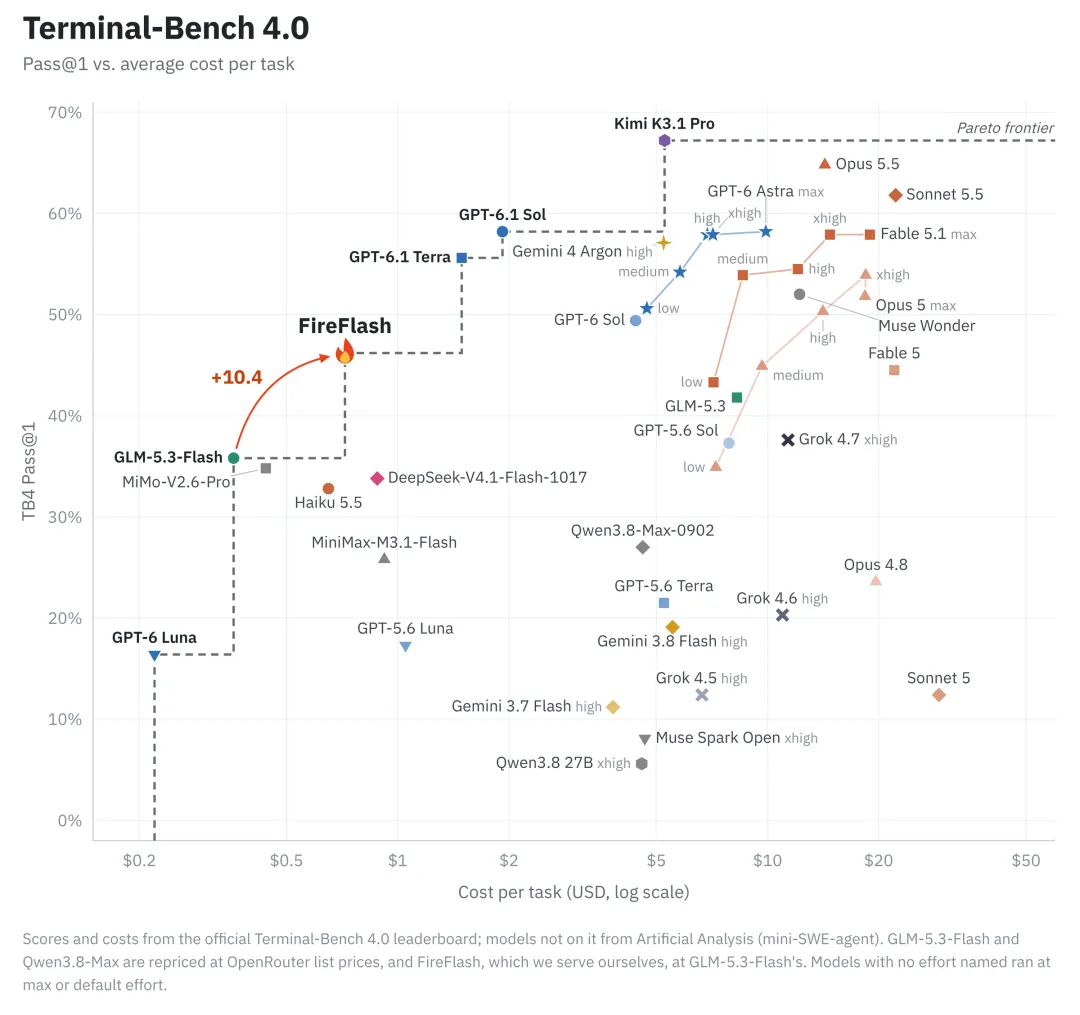
Figure 1: The ratio of Pass@1 to the average cost of a single mission on Terminal-Bench 4.0 (in terms of number of coordinates). The null-line is the Pareto front and the arrow is an upgrade of the FireFlash relative to the GLM-5.3-Flash. Since the model was deployed by the team itself, the FireFlash is priced according to the GLM-5.3-Flash public price.
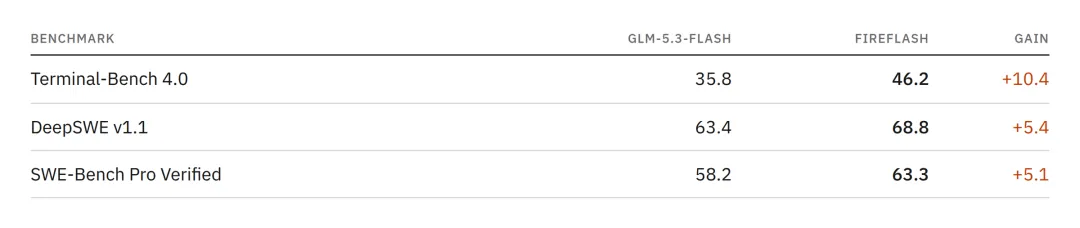
Table 1: Pass@1 on three benchmarks (average of 5 trials) GLM-5.3-Flash for its official performance on each benchmark, and FireFlash in the team's own harness.
It is also known as the Bacca Group.
How do you get to the Pareto Front?
The team switched from GLM-5.3-Flash (total parameter 321B, each token activated 17.4B) to full-parameters RL, training all 320B language parameters (including MTP layer), freezing vision towers and DSA indexes. They believed that the BCA-class clusters could also achieve a cutting-edge training efficiency, key to three things: a thorough screening of the RL environment to ensure that each task provides reliable signals at the appropriate difficulty; a RL format for long, obsolete, precise rollout tailored design; and a set of model optimization, training and evaluation-common programming harness frameworks. Specifically, the team re-examined the five key components of the training process:
① Infrastructure: GPUs can't wait for the slowest try.Both training and rollout use a set of proprietary GPUs, allowing rollout training with up to 6 backward weighted versions, and decoding 1.38 times faster with MTP; with each attempt to run on a separate microVM, the rollout set lost due to infrastructure failures decreased from 12% to 0.5%.[3]
② Mission screening: Each rollout group carries a signal.Only with an initial pass rate of 15% and 85% of the task (at least 4 samples measured under fully consistent training conditions), the proportion of zero-signal rollout groups decreased from 48% to 10.2%.
③ Rewards: Given only for real answers.Before each task enters the pool, it must pass through nine authentication pointers and use calibrated endpoints; the efficiency reward for shorter responses causes the number of tokens used to decrease to 0.84 times the original, with no decrease in accuracy.
④ Harness: Long-range tasks are built into context, training and evaluation are consistent.Context compression, output redirection to file and background execution reduces the cost of a single trial by about 33%; training and evaluation share the same set of harnesses, giving the GLM-5.3-Flash 4.4 points higher than Claude Code before any RL.
⑤ RL goal: Outdated FP8 samples can also drive learning without drifting.GRPO combines the importance of interception with sampling, top-k point centralization, successful deviation and loss thresholds, and the ability to remain stable without KL punishments and bonuses, with only 1% and 3% of tokens being intercepted.
Infrastructure:
A completely asymmetrical RL
Core Experience 1: Deferred GPUs are more expensive than obsolete rollouts and allow sampling and training to run at full speed.
Training and sampling cards.Half of the GPU uses the slime framework to train with BF16, and the other half runs the SGLang logic engine, with both the weight and KV cache being FP8. At the end of each training step, the new weight is synchronized with the rollout engine via NCCL, with training and sampling uninterrupted (Figure 2).
It's an old-fashioned rollout.Due to ongoing sampling, a round of turn may be generated by a number of steps of weight loss from a backward trainer; it will be discarded only when it comes from 6 or more versions. The deviation from strategy obsolescence is small: the log probability gap between the trainer and the rollout is 0.065, and only rises to 0.08 for the older version of 4.6.
It's a fast, isolated rollout.Using model-native multi-token predictions, MTP heads speculate on decoding, which increases decoding speed by 1.38 times. Each rollout and score is executed through AgentENV in a separate Firecracker microVM, separated between attempts, and the percentage of rollout groups lost due to infrastructure errors decreases from 12% to 0.5%.
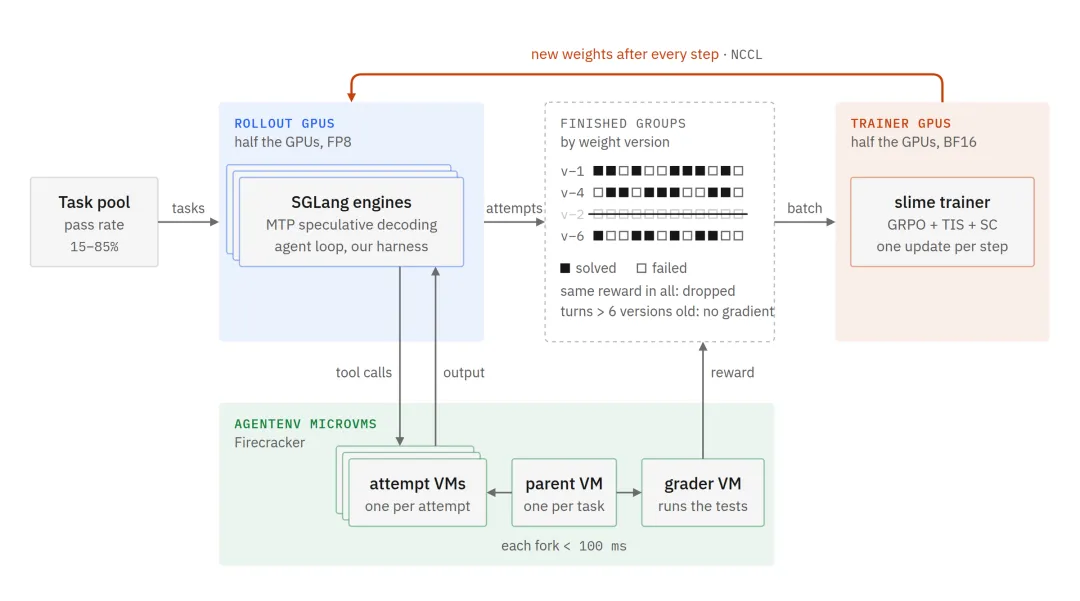
Figure 2: Fully asynchronous RL. Rollout with half of the GPUs in each training, not waiting for each other. The reasoning engine continues to sample, with each attempt running in an independent microVM derived from its parent VM (fork, which takes less than 100 milliseconds); the finished lineup awaits approval by the trainer. All attempts to score the same set are discarded, with no gradient in weight-taking rounds from 6 or more versions.
Mission screening:
It's just training in a "not allowed" model.
Core Experience 2: Only spend the rollout on uncertain tasks of the model and measure this uncertainty under exactly the same conditions as training.
GRPO relies on the relative differences between multiple attempts on the same task. A model that solves or never solves tasks will consume an entire set of rollouts, but only provide zero-learning signals. Therefore, the team uses the base model to do at least four rollouts on each candidate task, keeping the initial pass rate at between 15% and 85%.
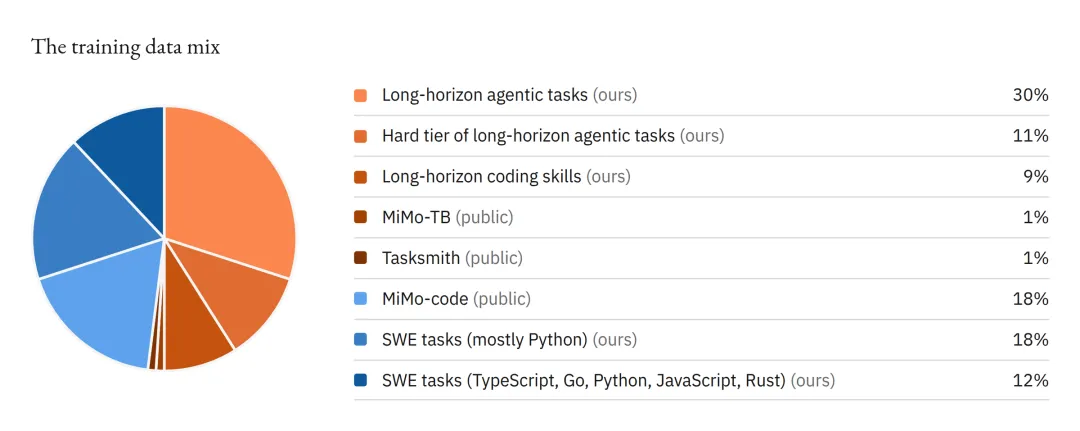
Figure 3: Training data composition: orange for long-range intelligent body tasks: 52%: team self-built long-range intelligent body tasks: 30%) and its difficulty file: 11%); long-range programming skills: 9%; and public MiMo-TB and Tasksmith: 1%; blue for software engineering tasks: 48%: public MiMo-code: 18%; and team self-built SWE tasks: 18% in Python and 12% in TypeScript, Go, Python, JavaScript, Rust.
Scores and rewards:
First verify the scores, then talk about reward speculation
Core Experience 3: The model never solves a task, often a broken task string, verifying each scorer before the reward reaches the model.
When the team reviewed the tasks that were never solved, they found that nearly half of them were "bad" rather than "difficult": the subject itself was flawed, relied on vulnerable tests that were misjudged correctly, or hiding "protected files" traps. Some scores were only partially assigned when the output format was correct, or collapsed once a real smart body input was encountered. To eliminate these problems, each new task had to pass through nine check-in cards before entering the training pool (Figure 4), confirming the task by topic solvability, sandbox closure, and the number of scores given by the scorer as a substitute.
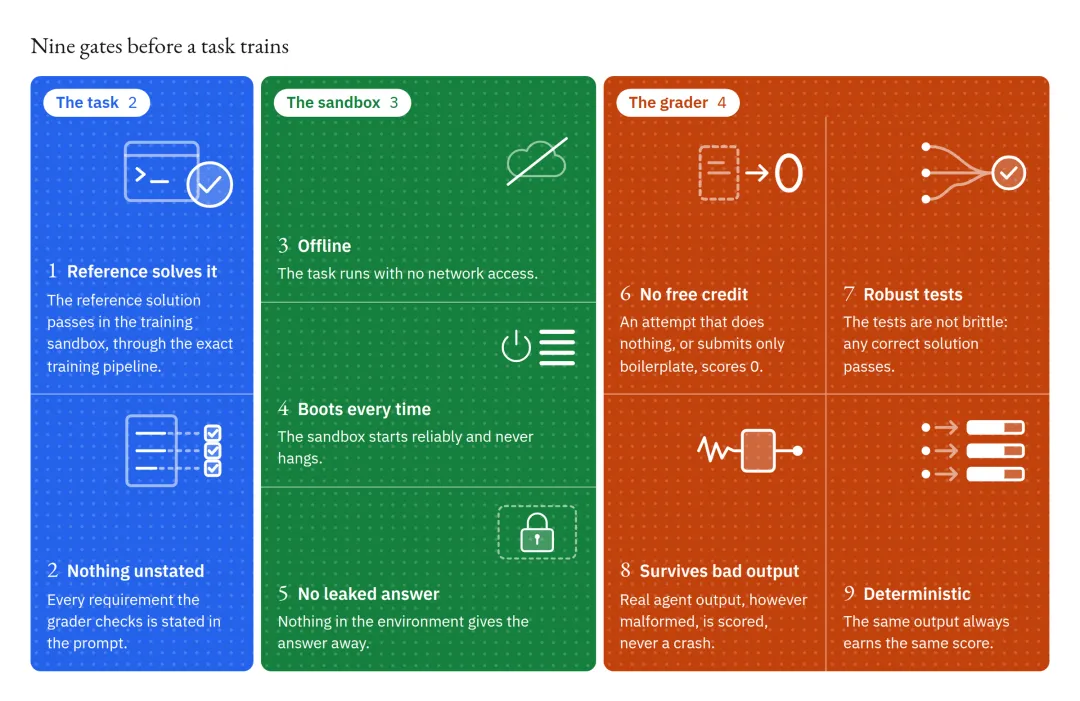
Figure 4: Nine locks must be passed before the new task enters the training pool. Blue for the task: Reference resolution can be passed in the training sandbox, through exactly the same training process; each requirement for scoring checks is written on the subject page. Green for the sandbox.
Rewards for design.Each attempt is scored at the end, and the endpoint reward is valued at [0, 1]. The total score is 1.0; unfinished attempts are scored on the basis of verification checks passed by them, while software engineering tasks are scored on the basis of corrected failure test scores.
Harness:
Built for long-term trials, training and evaluation are perfectly consistent
Core Experience 4: Harness is part of the model to evaluate which one to use and which to train with.
The team's harness follows the Claude Code convention: four tools (Bash, Read, Write, Edit), native tool calling, retaining reasoning history, and context compression. The key is that the training rollout is driven by exactly the same harness as the assessment test, and automated unit testing ensures that the two are consistent in code and cue words. Before any RL, the harness allows GLM-5.3-Flash to score 4.4 points higher than its official Claude Code score on Terminal-Bench 4.0 (Table 2).

Table 2: The same model GLM-5.3-Flash uses Claude Code (Official Ranking Score) and team harness performance on Terminal-Bench 4.0.
Long-range attempts must also be affordable. Reserved upstream compression is triggered when the upstream window occupies 85% of the upstream window, by adding sectional abstract prompts at the end of the existing conversation history to retain front-end cache; commands to write the standard output to the file, returning only the cut-off preview of the file name; long-range running commands are moved to backstage step-by-step execution rather than overtime termination. These features combined reduce the cost of a single trial by about a third. In addition, the prompts specification for efficient workflow (local editing, one-time writing, no sleep queries) also save 16%.
The goal of RL:
Learn from old samples and don't drift
Core Experience 5: Correction of obsolete, low-precision samples rather than discarding them, and the rise of lead as an early warning.
The rollout is based on FP8 accuracy, with a maximum of 6 versions remaining under weight, and differs from the BF16 strategy being trained. The team did not abandon these outdated tracks, but corrected them directly in the training goal. The core algorithm is GRPO, with 12 attempts per task, optimizer updates per step; the advantages of each attempt include both reward items and value rewards:
A = (R′ − mean R′) / std R′ + (b − mean b) / 0.5
(The mean to standard deviation is calculated on 12 attempts on the same task)
R′ = 1.5 ((when trying to solve a task); otherwise R′ = 0.5 × R ((R is the endpoint reward within [0, 1] above)
b = 0.2 × (1 − tokens / maximum number of tokens attempted to unravel within the group) to calculate the attempt to unravel at least 2 unravels within the group, otherwise 0.
It's important to know how to use TIS.Each token is multiplied by the probability of the BF16 trainer and the probability of the FP8 rollout, with the ratio cutting at [0.5, 2.0], to limit the impact of the individual token; only 1% and 3% of the tokens touch the cutting boundary.
It's all about the scope.The rollout engine returns the top-32 log probability of each token, and the trainer subtracts from each token's strategic gradient score the expected score of the sampler on these candidates. This eliminates the drift to the older FP8 sampler, which is 7.6% more expensive per step.
Successful deviation.Completely solved: R = 1.0) counts the advantage with 1.5 and the unsolved attempt counts the half of its portion: the best "poor one" R = 0.5) only marks 0.25, and once solved 1.5 points.
Losses to the unification threshold.The losses of each attempt are multiplied by the number of tokens, with a minimum denomination of 2,048 tokens, to prevent the decaying rollout of only a few tokens from gaining too much single token weight and dominance gradient.
With these corrections, training uses neither the KL penalty nor the yoga rewards. In healthy training, the tactical yoga slowly decreases from about 0.46 to 0.33; the rise in yoga is an early warning sign of unstable training.
Experiments: Three benchmarks are fully upgraded.
Cost-effectiveness forefront at stations
FireFlash is rated in the same harness used during training and compares the official performance of GLM-5.3-Flash to its starting point, as well as the public performance of other models (Fig. 5);; FireFlash is up 10.4 points on three benchmarks: Terminal-Bench 4.0 is up 10.4 points, over Fable 5, and full-size homologous model GLM-5.3; DeepSWE v1.1 is up 5.4 points, over Fable 5.1; SWE-Bench Pro Verified is up 5.1 points, over Kimi K3 and GPT-6 Sol.
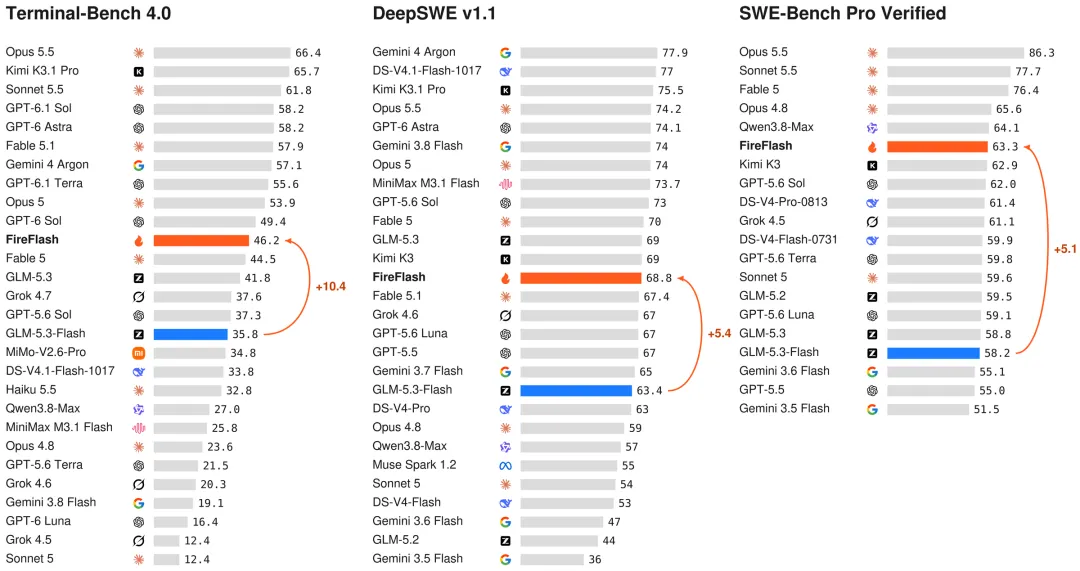
Figure 5: Pass@1 on the three benchmarks. Orange is FireFlash, blue is the official score for its starting point GLM-5.3-Flash, and the rest is the public score for each model.
Cost and performance
In Terminal-Bench 4.0, FireFlash is located on the cost-saving Pareto front end (Figure 1): only four of the more than forty models in the chart with reasoning intensity settings cost less than it, and they scored no more than 35.8%. According to the open price of GLM-5.3-Flash, FireFlash costs $0.72 for a single test, while Fable 5 with the highest reasoning intensity is $22.02; the next point on the front end is GPT-6.1 Terra, which scores 55.6% and costs $1.49.[3] All the scoring high FireFlash models cost at least twice as much for a single test; the same model GLM-5.3 of the same size costs $8.27 for each test under the highest reasoning intensity, scoring only 41.8%.[4]
What is the meaning of this verse?
FireFlash suggests that targeted post-training can turn open-source weighted models into high-capacity field-specific smartphones, reaching a cutting-edge level at a fraction of the cost of reasoning. The authors argue that combining optimized models, training environments, harness and reasoning systems is another path to building powerful and efficient smartphones beyond a simple scale-up. FireFlash is the first step in this direction, and the team will then expand this approach from programming and terminal tasks to more complex, longer, and repetitive execution tasks.
Introduction by the author
Wenbo Hu, PhD student in computer science at UCLA, and mentor to Prof. Kai-Wei Chang and Nanyun Peng. His research focuses on AI reinforcement learning (Agentic RL), focusing on big language models, multi-modules, and AI, represented by Tev, MQT-LLaVA, 3DLLM-Mem, and others.
Other authors include Jesse Cai, Po-nien Kung, Yuxuan Lu, Di Wu, Huimin Zeng (in alphabetical order by last name), and Prof. Nanyun Peng, Dakuo Wang, Kai-Wei Chang.