OpenAI’s robotics team has been disbanded.
Fortune reports that OpenAI has dissolved its standalone robotics research group and reassigned its researchers to other parts of the company.
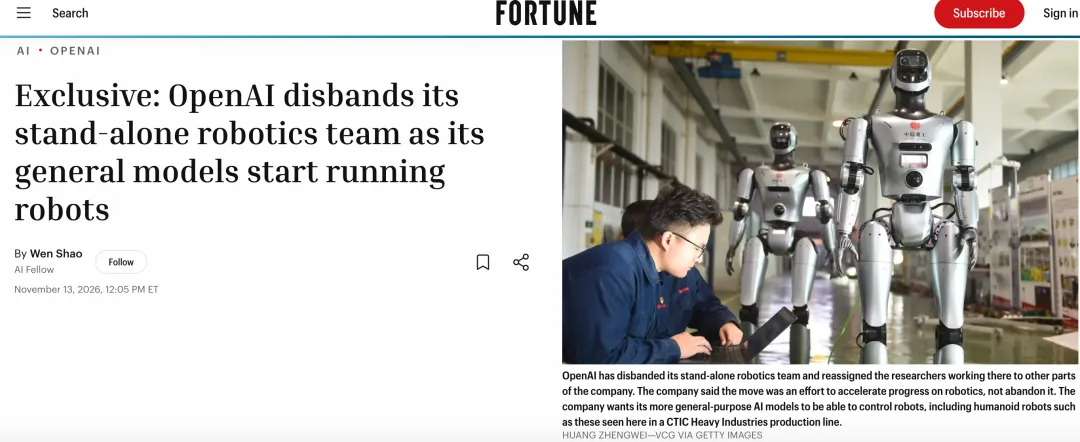
The research team has joined the core research organization, reporting to Chief Research Officer Mark Chen. The applied robotics and hardware teams have moved to the larger Applied organization, led by OpenAI President Greg Brockman.
OpenAI has confirmed the changes.
At the Conference on Robot Learning (CoRL) in Austin this week, OpenAI had reserved a booth. Its name appeared in the conference app and floor plan, but booth 208 was empty and bore no company logo.
OpenAI says robotics remains central to its long-term vision. It describes the reorganization as a change in structure, not a withdrawal from robotics, and says it is still committed to bringing general-purpose robots into the real world.
Why disband the standalone robotics team now?
One possible explanation is a shift in technical strategy. General-purpose foundation models are beginning to show that they can control robots directly, and OpenAI is exploring whether these models can take on more of the intelligence required for robotics.
Why has OpenAI reorganized its robotics team again?
OpenAI’s robotics effort has gone through several starts and stops.
The company formed a robotics team in its early years, then disbanded it in 2020. Co-founder Wojciech Zaremba later said that limited robotics training data was a major obstacle, and that other paths toward AGI might be more efficient.
OpenAI then shifted its research focus to large language models, training them on vast amounts of human-written text. That approach led to ChatGPT, released in late 2022.
In 2024, OpenAI re-established a standalone robotics team and announced a partnership with humanoid-robot startup Figure to develop AI models for humanoid robots. The partnership did not last: Figure ended it in February 2025 and chose to develop its own robotics AI.
OpenAI subsequently began developing humanoid robots of its own. In late May 2026, Sam Altman publicly recruited for the effort, named it OpenAI Robotics and set 2027 as the target for a first public demonstration.
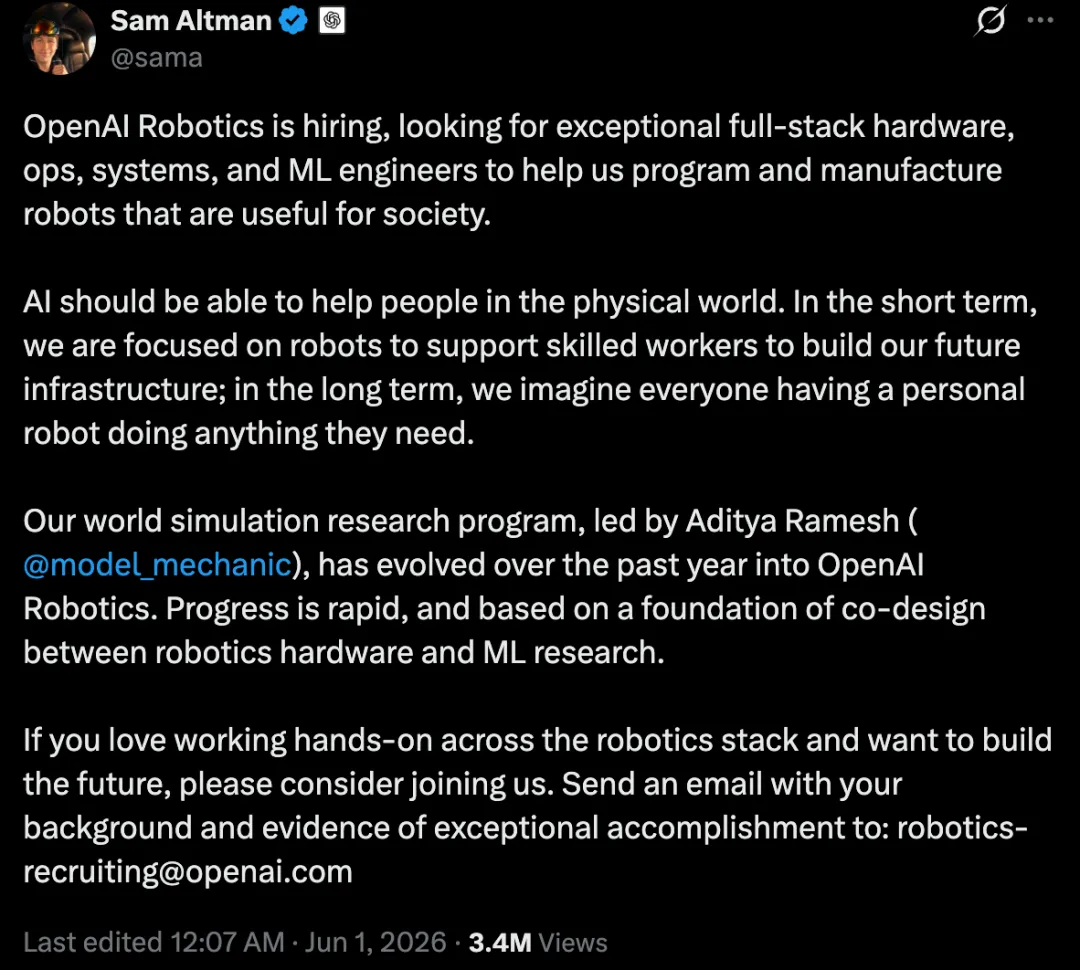
The history points to continued investment in robotics, with the technical approach and organizational structure changing over time.
Fortune reports that, early this year, OpenAI was still looking to work such as its Sora video-generation model for possible robotics breakthroughs.
To generate realistic video, Sora has to learn about object motion, spatial relationships and some of the regularities of the physical world. Those capabilities could potentially transfer to robotics.
OpenAI later found that frontier general-purpose models, including GPT-6 Astra, could already be applied directly to some robot tasks.
That finding changed the company’s research approach. OpenAI decided to integrate robotics researchers into its general-model research organization, tying robotics work more closely to advances in foundation models.
The move reflects a technical approach gaining traction across the AI industry. Robots have traditionally relied on specialized models to interpret their surroundings, plan actions and control actuators. Adapting those systems to different hardware, tasks and settings can require substantial task-specific data. General-purpose models trained on language, code and images are now showing potential to control devices in the physical world as well.
Can general-purpose models take over the robot’s “brain”?
Some recent experiments have produced surprising results.
Researchers have connected GPT-6 Astra to robots, giving the model camera images, information about the robot and interfaces for issuing actions.
In an NVIDIA study, an Astra-powered agent achieved a 74.8% success rate on a simulated robot-manipulation benchmark. The best published result from a specialized robotics model on the same leaderboard was 51.0%.
The experiment took place in a digital simulation: the model controlled a simulated robot, not a physical one. Even so, the results point to the potential of general-purpose models for robotics tasks.
Guanya Shi, an assistant professor at Carnegie Mellon University’s Robotics Institute, said the reorganization sends an important signal: OpenAI may no longer see robotics as a separate problem to solve, but as a downstream application of general intelligence. That resembles AI coding, legal and financial tools, which use a shared general-purpose model connected to task-specific tools and interfaces.
As general-purpose models improve, robots may become less dependent on training for each individual task.
For example, a model may still adapt when a bottle moves or lighting changes. It can also reason about the order of steps, detect when something has gone wrong and adjust what it does next.
But general-purpose models still face significant limits before they can take over robot control wholesale.
The first is inference speed. Large language models can be capable but slow, and often rely on cloud computing. For robots that need real-time responses, network latency and connection reliability are practical constraints.
Shi said small, specialized models that run on a robot’s onboard computer will continue to matter. They can handle some tasks without a continuous network connection.
The second challenge is data and experience in real environments.
Russ Tedrake, an MIT professor and co-founder and CEO of Walden Robotics, said robotics companies have an advantage that is hard for AI labs to reproduce: their robots already work in real settings such as factories and continually accumulate practical experience. Deployment data can help robots adapt to particular workplaces and tasks. Stronger foundation models may also make it more efficient to learn from that data.
In other words, general-purpose foundation models and real-world data need to advance together: the models contribute broader understanding and reasoning, while deployment data helps robots adapt to specific environments and jobs.
Pete Florence, a co-founder of Generalist, a startup focused on general-purpose robotics AI, said it is still too early to know which technical approach will dominate. Intelligence can develop from different starting points, and today’s models do not yet establish a long-term winner.
Is robotics heading toward a different technical approach?
OpenAI’s reorganization could also affect the wider robotics industry.
Over the past few years, billions of dollars have flowed into robotics startups pursuing a similar strategy: build a dedicated AI “brain” for robots, collect large amounts of robot data and train specialized models to develop general-purpose manipulation skills.
OpenAI is now exploring another possibility: first build general models with strong understanding, reasoning and spatial abilities, then connect them to physical devices through interfaces and use them for robot intelligence and control.
If this approach continues to advance, the research systems built around specialized models may need to be reconsidered. Robotics companies would still matter: real-world deployment, hardware design, control systems and data from operating environments remain important to scaling robotics applications.
The reorganization also comes as OpenAI faces pressure to control costs.
Last year, Altman called for the company to drop “side quests” that were not central to its goals and focus resources on higher-priority products and research. OpenAI has since adjusted several projects as it reallocates computing resources.
Reports put OpenAI’s operating loss at $10.9 billion in its most recent quarter. The company is also seeking another funding round and preparing for a possible IPO in early 2027.
Against that backdrop, bringing researchers from separate teams together around general-purpose model research may also help the company use resources more efficiently.
OpenAI’s view of robotics is changing. Will future robots need independently trained, specialized “brains,” or will they be able to call on general intelligence that keeps improving?