Let AI become an assistant in AI research and development, S2.1 Flash is showing the potential of AI4AI. Recently, this large scientific multi-modal model was officially released and open sourced, achieving a score of 90.3 in the machine learning engineering benchmark, demonstrating the ability of AI to participate in machine learning R&D tasks.
Its performance also extended to more general-agent tasks: 72.2 points on complex office document processing and 37.1 points on spreadsheet tasks. In the above three benchmarks and the professional legal document task Harvey LAB, S2.1 Flash scored higher than DeepSeek-V4.1-Flash-1017 and Claude Opus 5 in this comparison, ranking first among the participating models.
This model was jointly launched by Shanghai Artificial Intelligence Laboratory, Fudan University, Institute of Software, Chinese Academy of Sciences, Renmin University of China, Institute of Automation, Chinese Academy of Sciences, East China Normal University, Harbin Institute of Technology, Peking University and other institutions. The goal is to open up the full-link closed loop of AI model-driven artificial intelligence and scientific research, and build efficient and credible scientific research and scientific research professional software usage capabilities.
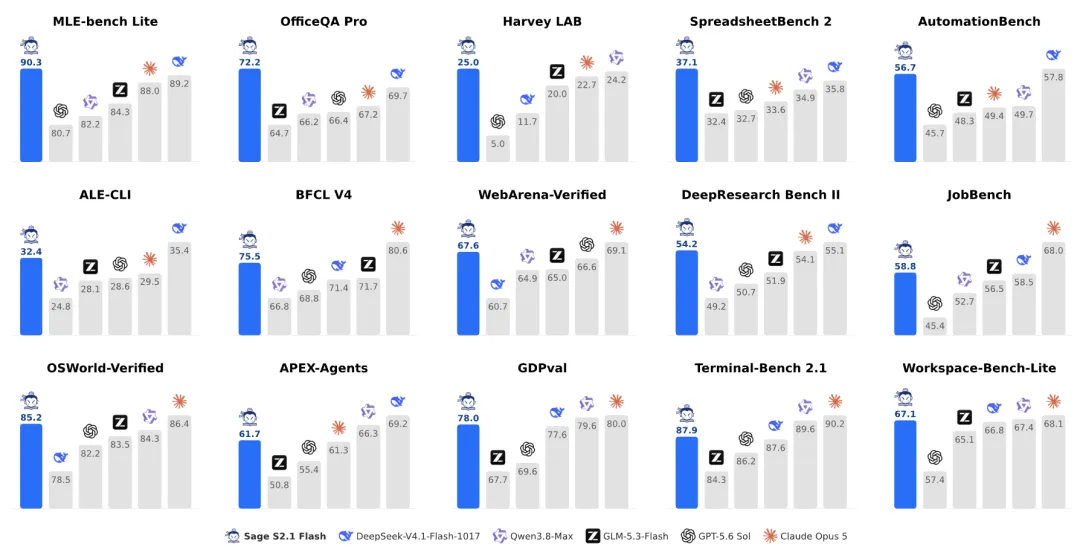
Figure 1 | General agent capability evaluation
- Experience link:
ModelScope:
Huggingface:
- Technical report:
Practical operation of scientific research software: from data analysis to 3D modeling
In complex scientific research tasks, intermediate results often determine the next step. S2.1 Flash uses professional software to carry out analysis and modeling, and verifies the results and adjusts subsequent steps through original slices, remote sensing images, assembly views and EEG waveforms.
CT slice analysis: reconstruct three-dimensional bones and review original slices
After restoring the slice sequence, S2.1 Flash extracts bony areas according to the density threshold in 3D Slicer, reconstructs the three-dimensional skeleton, and views the spatial relationship between the ribs and the spine from multiple angles.
After discovering local bony protrusions, the model further called up the adjacent original sections for verification, and wrote the preliminary observations after verification into a report.
Architectural 3D reconstruction: Generate editable 3D projects from multi-angle photos
In the building reconstruction task, the input is architectural photos of the Shanghai Artificial Intelligence Laboratory’s new campus from multiple angles, as well as night scene references. Based on this, S2.1 Flash analyzed the stacked volumes, overhangs and curtain wall structures of the building, built a three-dimensional scene in Blender, and then gradually added glass materials, metal grilles and indoor lighting.
During the production process, the model compared the rendering preview with the reference photos to check the architectural proportions, lighting levels and lens composition, and then modified the model and visual effects.
The final delivery was an architectural presentation video and a .blend file. The project can be reopened, edited and rendered again, with the 3D structure, materials and lighting settings saved.
Poyang Lake Water Area Analysis: Unify the comparison scope and review the water area boundaries
In the analysis of water changes in Poyang Lake, S2.1 Flash used multispectral data to extract candidate water areas, and then superimposed the results back to the original color image to zoom in to view the lakeshore. The junction of shallow water and wet shoals can easily affect boundary judgment. The model focuses on checking these locations to decide whether to adjust the extraction rules.
Area statistics are only performed in the study area where the two phases of images are both valid, ensuring that the comparison range is consistent. The model finally exported change maps, area tables, and QGIS projects to facilitate review of the original imagery along the coastline.
Engine parametric modeling: complete assembly based on reference drawings and check for part interference
S2.1 Flash identifies the overall configuration, external outline and parts layout of the engine from the reference drawing, sorts out the relative size and assembly relationship of each part, and completes parametric modeling and complete machine assembly in the CAD environment.
After completing the assembly of the whole machine, the model uniformly checks whether the parts interfere with the assembly position and repairs them. The final output of editable CAD models and renderings can be used by engineers to review part locations, assembly relationships and overall configuration, providing a basis for subsequent manufacturability assessment and design iterations.
Multimodal scientific reasoning: joint analysis of molecular, sequence and experimental signals
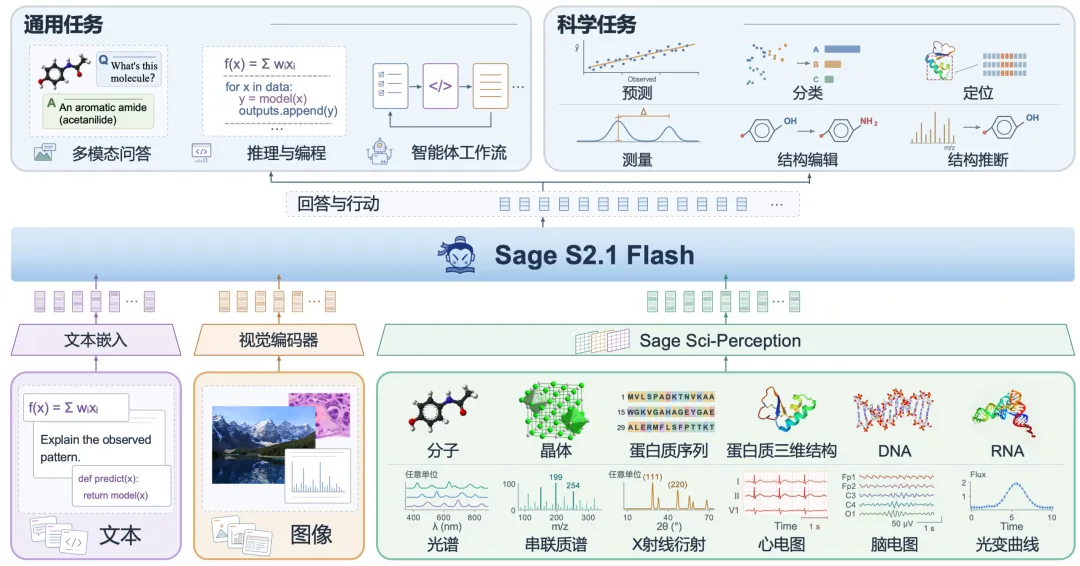
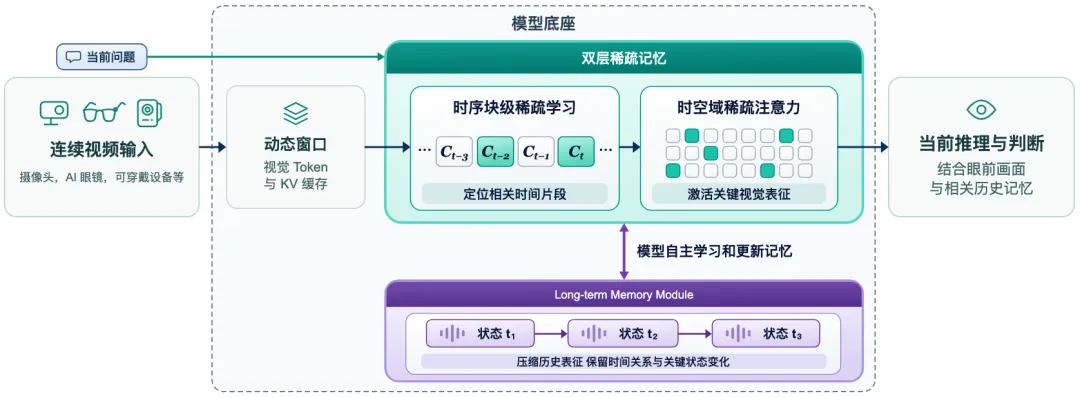
Figure 2 | Scientific multi-modal unified representation architecture
The basis for scientific research problems may be hidden in the spatial arrangement of atoms in the crystal, the local characteristics of the protein sequence, or it may be reflected in the peak position and intensity of the spectrum. The model needs to understand the structure of these data and then conduct analysis based on the instructions of the researcher.
S2.1 Flash supports different types of scientific data. Molecular diagrams, crystal structures, protein sequences and three-dimensional structures, DNA sequences, RNA sequences, as well as more than ten types of scientific inputs such as spectra, mass spectrometry, X-ray diffraction, ECG, EEG and light curves. Different types of data undergo their own feature encoding and projection, and participate in calculations together with natural language instructions for tasks such as prediction, classification, site positioning, quantitative analysis, and structural inference.
During the analysis process, the model will also check intermediate results such as images and waveforms to determine whether the method needs to be adjusted. For example, the local structure in the three-dimensional reconstruction can be returned to the original slice for verification; the changes before and after EEG processing can be compared at the same scale.
General ability assessment: covering 33 benchmarks, with many results ranking among the top
A scientific research task often requires accessing information, writing code, calling tools, and reviewing the processing process when an exception occurs. These general agent evaluations provide a reference for observing the performance of the model in the above links.
Across 33 general-purpose agent benchmarks, S2.1 Flash ranked first on four and second on seven, according to the article.
On the machine learning engineering benchmark MLE-bench Lite, S2.1 Flash scored 90.3, 1.1 points higher than the second place score of 89.2.
The other three first places are OfficeQA Pro (72.2 points), Harvey LAB (25.0 points) and SpreadsheetBench 2 (37.1 points). These three benchmarks examine complex office document analysis and processing, complex legal document analysis and delivery of professional results, and spreadsheet completion, error correction, and visualization.
S2.1 Flash ranked second on seven benchmarks: AutomationBench, ALE-CLI, BFCL V4, WebArena-Verified, DeepResearch Bench II, JobBench and OSWorld-Verified.
From .blend files for architectural scenes, to QGIS projects for water change analysis, to editable CAD assembly models, these demonstrations leave results that can continue to be inspected and modified. Researchers can go back to the original data, review the processing, and continue working on this basis.
and launches a limited-time discount: from now until December 9, the price is only 1% of the benchmark model; from December 10 to December 31, the price is only 10% of the benchmark model. At the same time, new users will receive a large number of free credits upon registration, further reducing the experience threshold and usage costs.Welcome to the Scholar·Duanyan experience: