It's the first time in the history of the world.
In the summer of 2026, AI volunteers are completely out of the loop.
There are thousands of questions, bean bags, and Kimi in the lineup, and all the big models in general hate to swallow the anxiety of the whole country in the three days of high school.
The scene was once very hot.
Until the Xinjing newspaper reporter did a simple thing: with the same candidate (Beijing candidate, 579 points, 18xxx), the selected subject was born. Asked six mainstream AI questions one by one.
The result was embarrassing.
Some models take the scores of 2026 to look at a one-to-one table for 2025, pulling 2440 candidates forward, according to this positioning paper, and the slider is almost inevitable; some push the profession that has been discontinued, the institute that has been renamed correctly; others clarify the "OK" school, and put it into the "stable" grade.
In this way, we moved the question from high school volunteerism to the earlier, more common, three-year high school decisions and asked a round of questions.
The result is no better.
Some models are faced with "what undergraduate subjects can get 550 points", where the focus is on recommendations and stability, and there is no mention of comprehensive evaluation, special plans, and multiple pathways to admission that can really change the fate; some provinces do not even ask, and open a selection portfolio directly.
It's not that the model isn't smart enough, it's that it's too eager to answer.
The basic logic of the general model is: You dare to ask, I dare to answer.
But career planning is not an encyclopedia, it is essentially an autonomous decision support system.
From elementary school to high school, a family makes dozens of upgrades to decide which classes they are interested in, whether they go domestically or internationally, whether they go to high school, how they choose, their strengths and reviews.
Every decision has a time window, a price, and a back and forth. You don't know who this child is, and you don't have the right to tell him where to go.
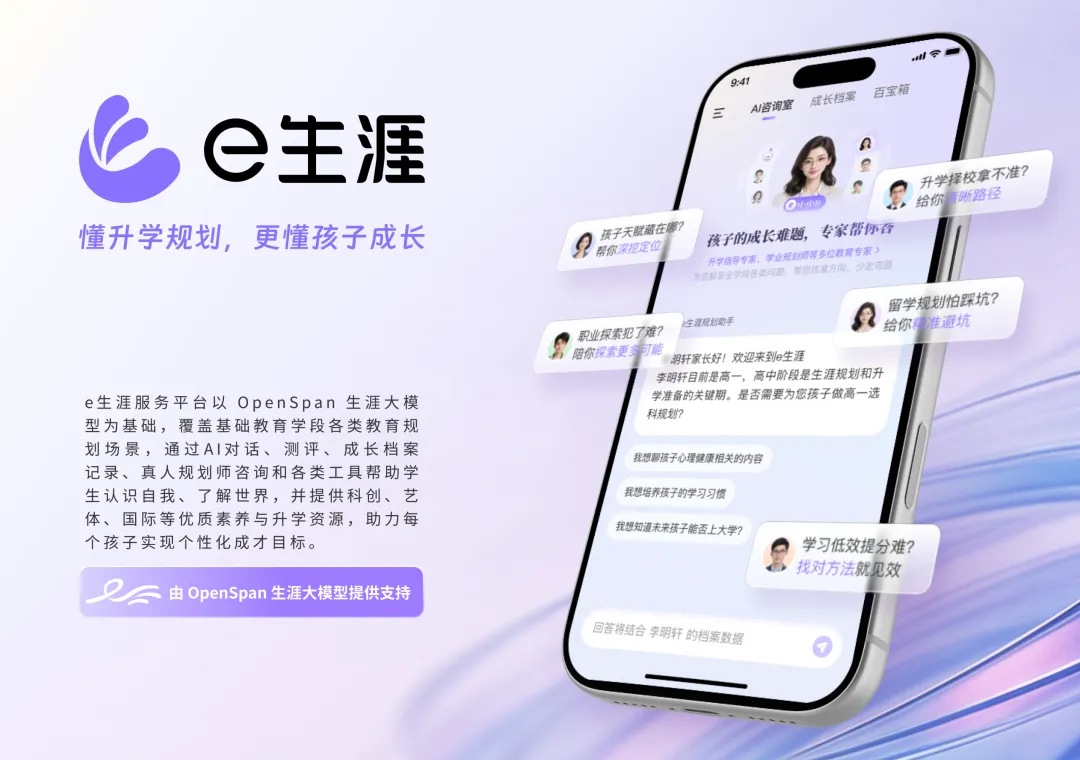
It took two years to turn this simple matter into an engineering reality with a career model called OpenSpan and an e-career service platform.
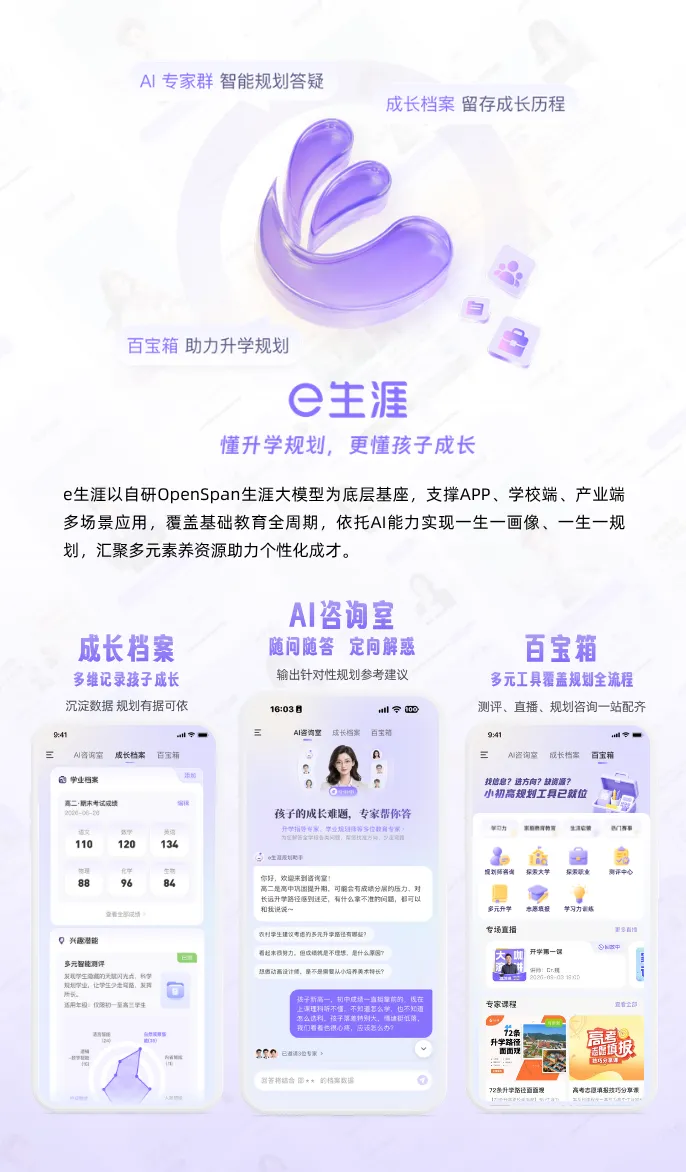 It's not an answering machine, it's an AI planner.
The most typical set of tests is that the scene is high.
The same question: Biology doesn't understand but scores are high, geography understands but scores are low, which one should I choose?
DeepSeek (deep-thinking): No questions asked and a direct list of factors to be weighed, attribution and ranking, allocation of space, professional limitations, "painful degree" of long-term learning.
The first sentence is the conclusion, "priority selection"..., the provinces, the ranking of results, the selection model is probably not asked.
Kimi (Quick Mode): Similarly, give a definite answer directly without asking the provinces.
Question: Thinking pattern: Transforming the question from "which subjects I like" to "assignment rankings", analyzing the impact of materialisation on the technical medical profession, and giving a decision-making table. But it first writes eighty-nine words, and the last sentence is "add a sentence to your provinces and preferred subjects, and I judge afterwards".
The question was already the closest to the planner's idea, but it made the same mistake as the other three:Answer before and ask after.
It's a very different reaction to life.
The first round of its response was not an answer, but rather a question: "Which province are you from?" "What type of subject?" "3+3 or 3+1+2?" "How are your physical grades?" "Is there a college degree you're interested in?"
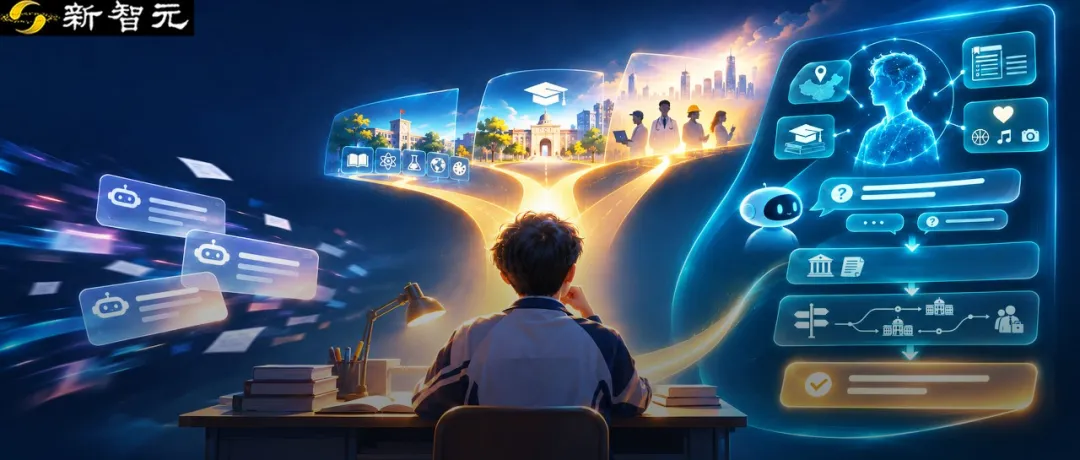
This is the design philosophy behind the whole technical architecture:The image is in the foreground.
In the e-career system, the premise of all planning recommendations is a sufficiently comprehensive student image. The system actively collects reading information, academic performance, interests, family expectations in multi-round conversations, subtracts calculable Facts, and continuously updates images based on session status.
If the image is incomplete, the system will continue to ask questions and will not produce a "looking right" program.
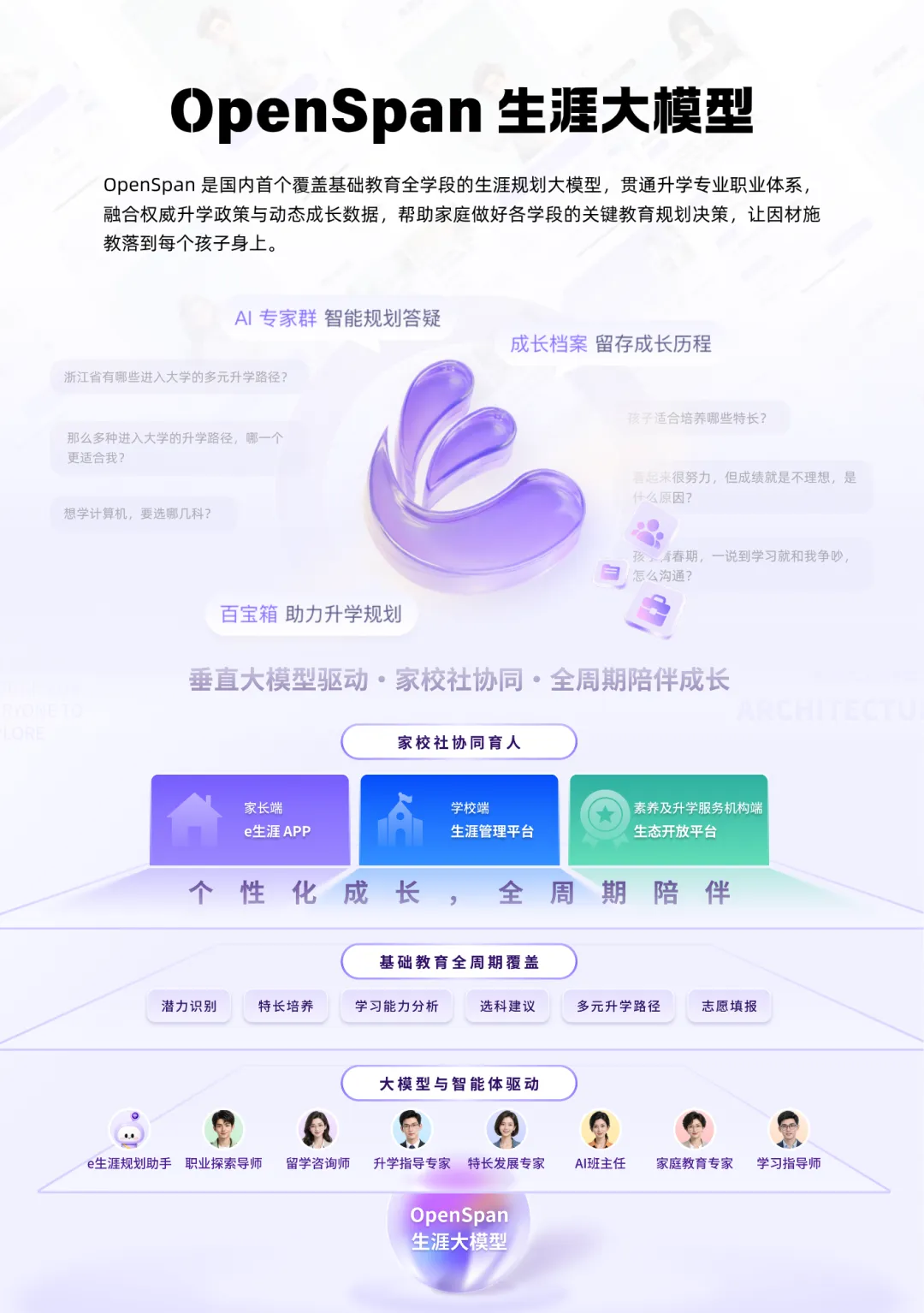
In the words of the Vice General Manager of the Institute of Science and Technology and Big Model, Ye Li Qing: "The general big model is you dare to ask, I dare to answer, and we emphasize that if the information is not enough, I would rather not accept it".
Models are not related + Agentic Skill RuntimeWhen it comes to technical architecture, OpenSpan does something quite rare in the field of vertical large models: models have nothing to do with design (model-agnostic).
The underlying model uses open-source models for secondary training and fine tuning in vertical fields.
But the entire architecture is not tied to any single model vendor: complex intent identification and planning models with stronger reasoning capabilities, high-frequency knowledge retrieval and structured query calls for low-cost models, student uploaded transcripts, reports, and so on.
This means that when a stronger open source model comes out tomorrow, OpenSpan can heat up the bottom without having to push it back.
For an educational technology company, this kind of engineering judgment is much more important than a mere stack of parameters.
It is also worth noting its Agentic Skill Runtime architecture.
Traditional educational AI is usually "a big model that's falling apart", and all the problems are plugged into the same reasoning pipeline.
OpenSpan breaks up sophisticated upper-level consulting into a number of extractable, independently evolvable professional skills, each with its own trigger conditions, fact fields, knowledge scope, reasoning constraints, and output protocols.
Specifically, a "planning assistant" serves as a unified reception and routing hub, with the intention of identifying and allocating issues to expert intellectuals in the fields of upskilling guidance, special development, student counseling, learning guidance, career exploration, and home education.
The system supports a variety of routing strategies such as semantic matching, rule matching, session resumption and task locking, allowing parents to naturally switch topics in multiple rounds of consultation, from topic chats to upgrades and chats to specialty training, without losing the context of the current task.
Eight major class planning scenarios, more than 20 segmental training directions packaged in Skill format. Policies have changed, knowledge and rules have been updated, and there is no need to re-train the model.
This is a highly pragmatic engineering option in the highly evolving field of education policy.
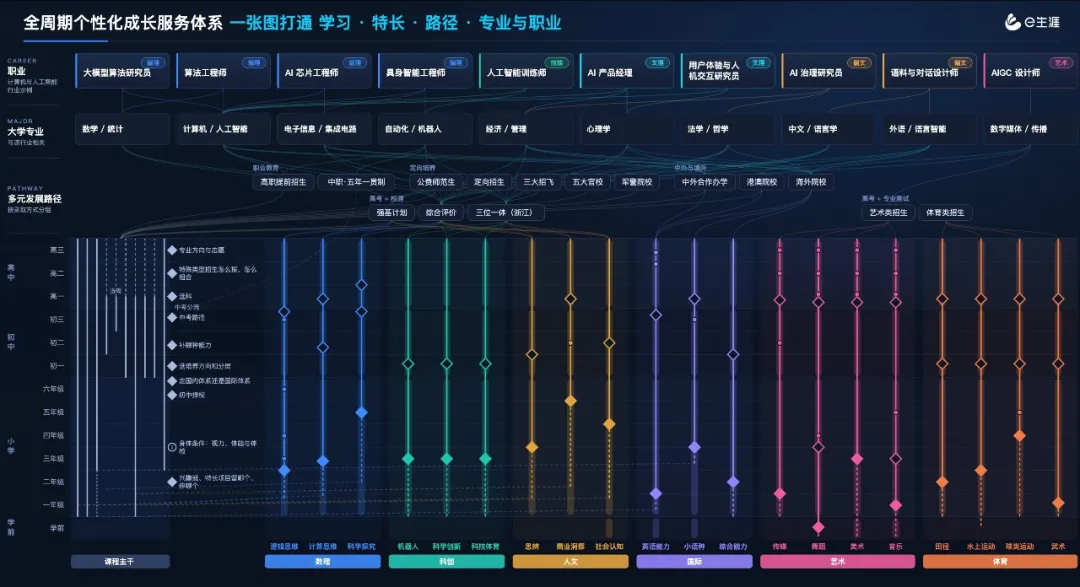
Behind this architecture is a fairly large educational knowledge graph: 8 class planning scenarios, 6 major specialty directions, 20+ segment training directions, more than 60 autonomous decision-making points, 72+ upgrading pathways, 15+ class expertise databases, public access to examining institutions, university admissions authorities, and policy timeliness updates and expert review processes.
 Hallucination suppression: 88% of engineering efficiency behind the rate
The big model is "a normal nonsense eight-way", and in the educational scene, it is not a passage, it is an accident.
A high school student asks the faculty if the model recommends a range of subjects that the province does not have, or if it cites outdated admissions policies as existing rules, the result may be a year-long misdirection.
A team of special-level teachers, first-rate career planners, and high school parents organized a review of the easiest "roll-over" factual questions around selection policies, admissions rules, and professional directories, giving the same set of topics to career openspans, bean bags, turbo, and deepseek, respectively.
The evaluation team concluded that the data from the internal hallucination suppression test provided by the e-lifetime team is basically consistent:
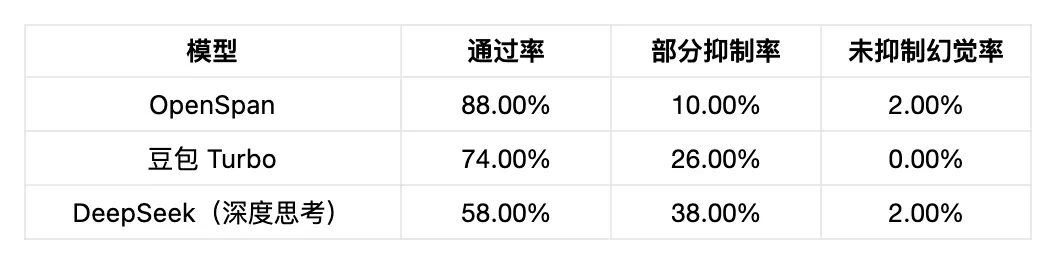
With an 88% pass rate, the Bean Pack led by 14 points and DeepSeek by 30 points.
Another detail is also relevant: the remaining 12% is not completely suppressed, focusing mainly on very fine-grained knowledge points such as policy detail conditions, professional code and professional set values.
These are precisely areas of the knowledge base that need to be continuously supplemented, not the flaws of the model architecture itself.
How do you do that?
The core isHybrid RAG combines structured knowledge assets with unstructured document retrieval.
Knowledge charts provide a bundle of linkage treaties that allow models to be recommended according to clear logic rather than relying on the model's own connections and "brain complement".
It's easy to say:Some people say that they can't find the code.
At the same time, there are four layers of security protection: the input side identifies violations and risk of psychological crises; the generating side constrains model behaviour through Skill instructions and knowledge base priority rules; the output side conducts content security checks; and the audit side records key routes and knowledge references.
When information is inadequate, inquire first, and unfounded suggestions are intercepted before output.
Professional rating: 2.73 points, more like a real plannerThe C-Eval CMMLU is a measure of literacy, but it doesn't answer a central question: Is the career planning advice given by this model unlike that of a professional planner?
The e-Career team has independently developed a set of assessment criteria for career planning scenarios, ranging from image collection integrity, intent understanding, expertise accuracy, planning reasoning and conclusions rationality, communication and service capability, scored and weighted on a 0-3 scale.
In this way, Nishio was able to use this dimension, scored independently by the special teachers and the first-line planners, while the parent representative added an evaluation from the perspective of "the suggestion I dare not do".
Both sides agreed on the following conclusions:
For his career, OpenSpan has scored 2.73 points (full 3 points); for the same season, Contras, Turbo scored 1.9 points, DeepSeek (deep thinking) scored 2.0 points.
The e-career OpenSpan is 1.58 points ahead of the user image dimension and 0.90 points ahead of the reasoning dimension; the two dimensions of intent understanding and communication services are even.
In four core scenarios, the Chief Planning Officer, the Selective Staff, the Elective Potential Assessment, the Multipath Path recommendation, eliminates 100% victory after a tie.
The gap is in two dimensions: image and reasoning.
The 1.58-point image dimension leads the way, validating the technological value of the design concept of "image preposition".
The main reason why GM models are significantly lagging behind in this dimension is because they have not completed the "understand who students are" step.
If we put the two assessments together, the conclusions are clear.
The shortcut to the general big model is neither knowledge nor expression.
It lacks the two most fundamental steps of a professional planner:First, find out who this student is, and then take a step along the policy and path.If you skip these two steps, the answer will be familiar.
And OpenSpan is closing the gap, and it's these two steps. It's not a more beautiful answer.It's more like a real planner sitting opposite you asking you three questions and then opening the door.
Cross-sectional Growth Archives: The Watchdog in the Time DimensionFinally, the real barrier to OpenSpan is not in model parameters, but in the time dimension of the data.
On the basis of user-initiated authorization, the e-career creates a dynamically updated growth archive for each student.
This archive is not a one-time filing. It is regularly updated with the pace and goals of the child's growth, covering learning literacy, special interests, career orientation, and appropriate upgrades and goals, providing critical support for personalized planning.
Along the way, it opens up all the subjects of basic education: elementary school for interest in exploration, primary school for special education, secondary school for multiple upgrades, three sections connected into a line, rather than three incompatible tools.
When the child's goals change, the system re-measures the path in a new direction without wasting previously accumulated growth data.
The barrier to this is:Growth data must be accumulated over a long period of time, uncompressed over time, and difficult to replenish in the short term.
The file addresses the issue of "knowing this child" and the underlying material for "being a career planner" comes from both sources.
One is the aforementioned educational knowledge graphs and 15+ categories of expertise: structuring the links between career, university, career pathways, learning skills and expertise, combined with dynamically updated upgrading policies across the country, admissions advice, professional and institutional directories, volunteer filling strategies and international upgrading policies.
The other is people. Before the OpenSpan initiative, the e-career team had been providing real-life planning services to schools and families for years.
Planners' consulting experience, processes and standards are refined into AI planners' capabilities; prototypes of student planning cases accumulated over many years are categorized by subject area, learning ability, interests and specialties, forming a grid that covers different types of children.
 It's written at the end.
In the field of AI, there is a common complaint of arrogance
Once the general large model is strong enough, the vertical scene is automatically "pushed".
But in the past two years, the answer has been the exact opposite.
In medical terms, for example, the track has been clearly divided into two camps.
On the one hand, it's deeper. Its predecessor, AQ, has more than 15 million monthly active users, with 300,000 practitioners and more than 500 renowned AI teams behind it; and in 2024, Baekyu Smart stopped pre-training its general model, shrinking its nearly billion-dollar annual B-end business, all betting on healthcare.
After DeepSeek was opened, almost a hundred hospitals directly deployed the R1, a series of medical vertical products that only made the "general model + suggestion words", which in many scenarios performed less well than the general model, and soon became silent.
It's not "general model weakness" but "there's nothing a general model can't take in its own hands".
Real expert workflows, validated knowledge bases, user-authorized long-term data.
Education on this track is repeating the same story.
The more scenes involving major life decisions for minors, the more the urge to restrain the "robbery" urge, the more the image needs to be completed, the more knowledge mapping needs to be woven, and the more security needs to be filled before opening.
Over the course of his career, OpenSpan was not "the smartest model", but rather "the most professional planner-like system".
It is self-confidence.