AI is helping to speed up the next generation of AI, and we finally have a specific number.
On 5 November, METR, a third-party rating agency, released a survey report on Anthropic, stating that the company's benchmark capacity improvement over the past year is roughly equivalent to the previous two years.
From August 12 to October 29, the institute spent about 11 weeks inside Anthropic looking at its model performance, training algorithms, R&D efficiency, and interviewing researchers.
Their analysis used the Anthropic version of the AECI comprehensive capability indicator. Data shows that since October 2025, large models have progressed on the indicator about 1.9 times faster than before, with a 95% confidence interval of 1.5 times 2.8 times.
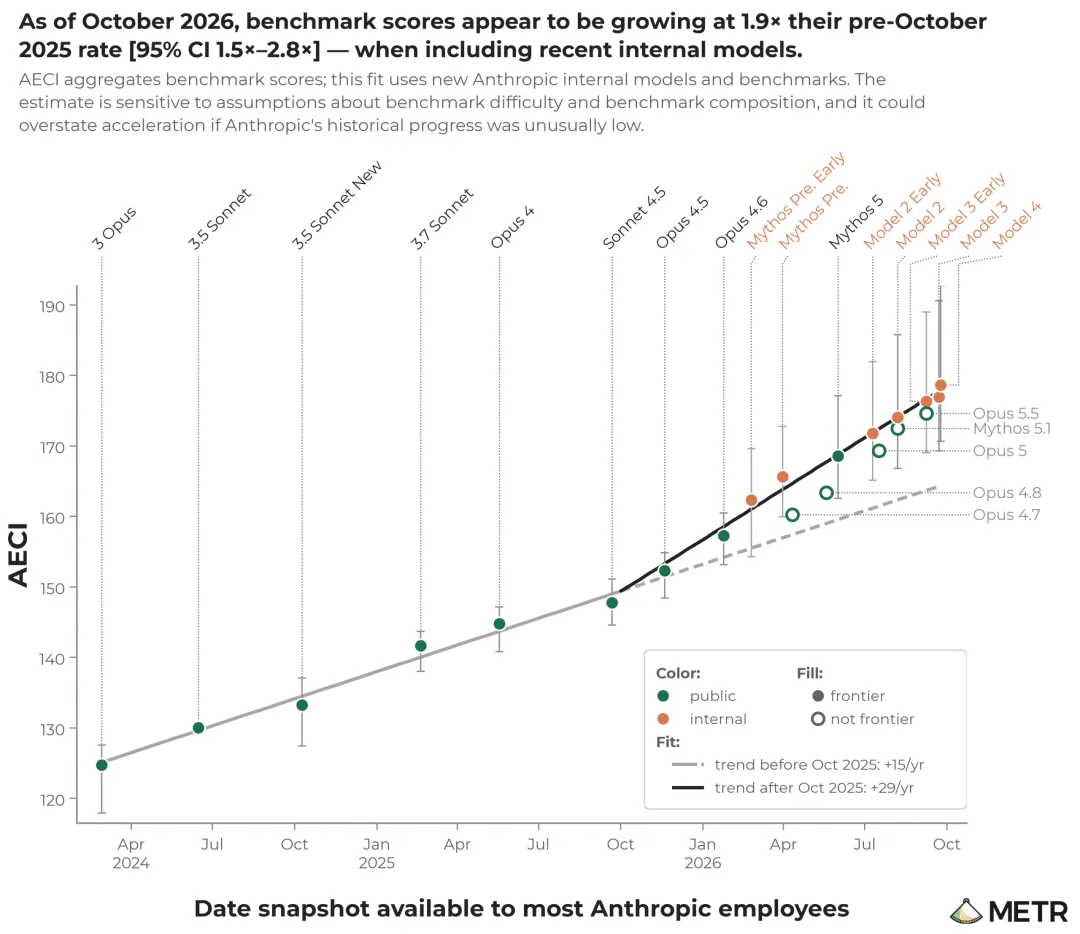
Since October 7, 2025, the score has jumped from about 15 minutes/year to about 29 minutes/year, a year after the previous two years, a scale roughly equivalent to Claude 2.1 to Sonnet 4.5. Anthropic's own risk report had previously assumed that Mythos Preview was a one-shot jump and would then return to the original trend, but now new models have emerged and the new slope continues.
Looking at the industry as a whole, the acceleration of the front-end model is only 1.4 times greater.
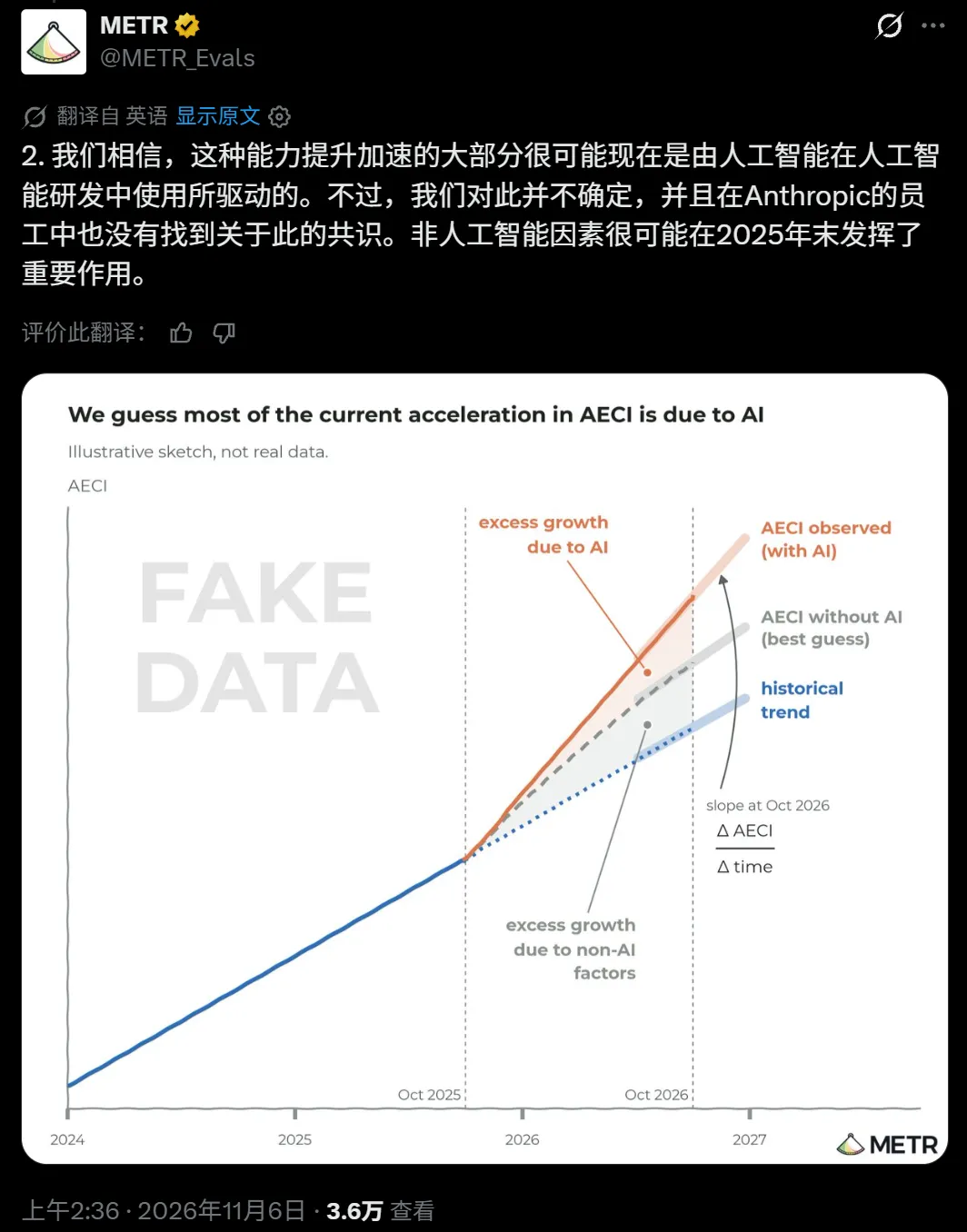
More importantly, METR is fairly confident that this acceleration is not due to the rapid growth of the scale of AI training. The main reason for the advancement of AI capabilities is due to AI's own help.
In interviews, a recurring phenomenon is that researchers can finally test more ideas.
In the past, an experiment could take a day or two to complete, time and computational costs were unsurpassed, and many ideas that had not yet been validated were put on hold. Today, researchers can give multiple ideas to Agent to see which ones are worth pursuing.
One researcher described that his work is now largely confined to ideas and computing, and that the code is no longer a bottleneck. Some people feel that after using Claude, they have developed post-doctoral and post-graduate projects together. Experiments and implementation have become cheaper, making researchers more willing to try, and many small experiments that were considered not worth the effort now have the opportunity to turn into new research directions.
METR's report also reveals some of the inner workings that the outside world has not seen before. Their analysis included three unpublished models from Anthropic, known as Model 2, Model 3 and Model 4, which were trained between July and October of this year.
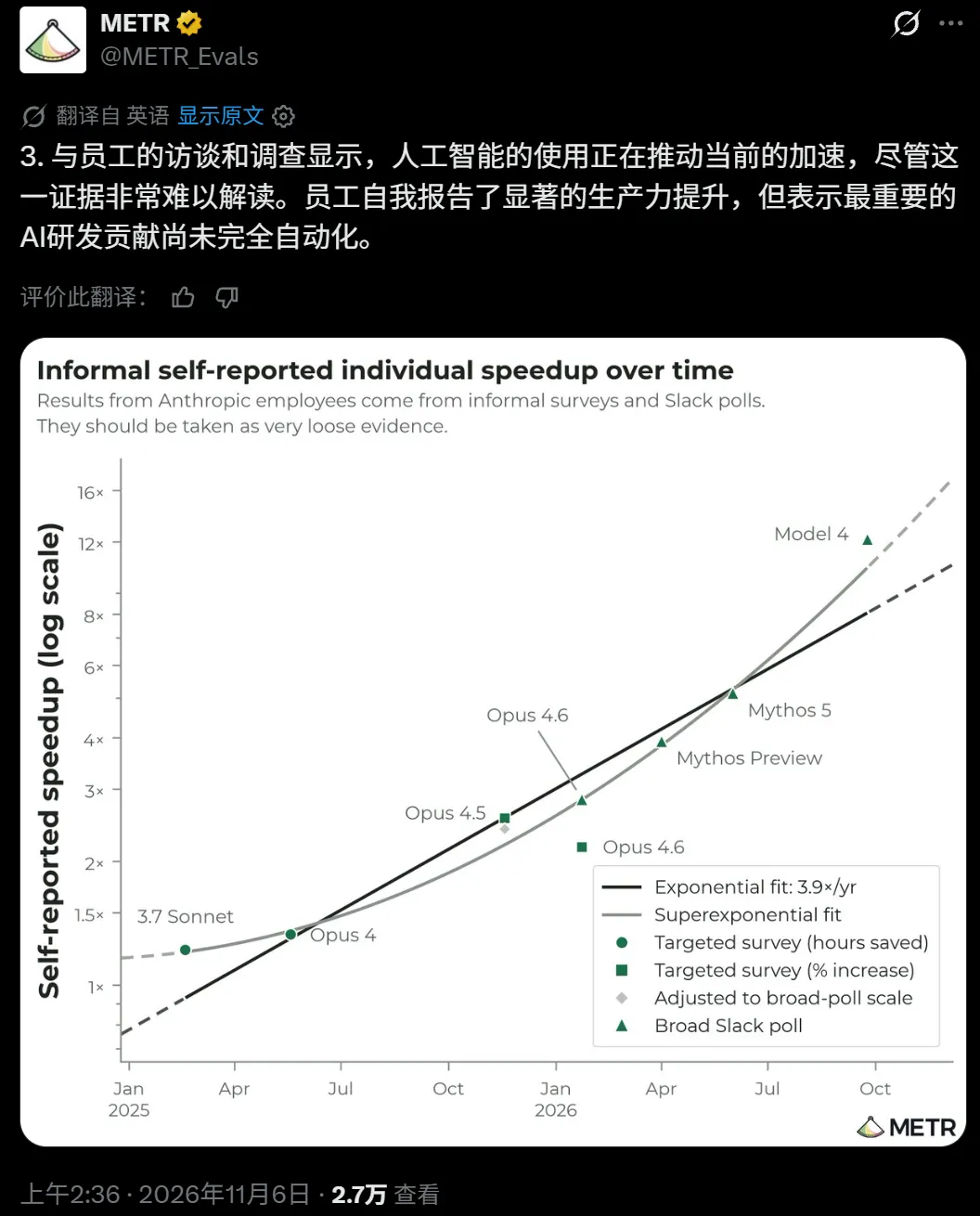
The current strongest is the Model 4 (sometimes assumed to be Claude 6), which has scored more than 90% on many common benchmarks. Anthropic employees made a subjective estimate of it internally in October, voting that it was about 12 times more effective on its average work.
These models have not yet been released, nor will they necessarily become public products, but their existence is a reminder to the outside world that just looking at conferences and public listings may not be able to fully judge what is happening inside the AI giant. From the beginning of 2025, about 1 times, to Opus 4.5 about 2.5 times, Mythos 5 about 5 times, Model 4 jumps to 12 times, and the index matches 3.9 times a year.
METR estimates that as of October of this year, about 80% of current AI acceleration studies are estimated to be from AI; 20% are from non-AI factors, details Anthropic did not reveal.
So is AI capable of developing its own next generation independently?
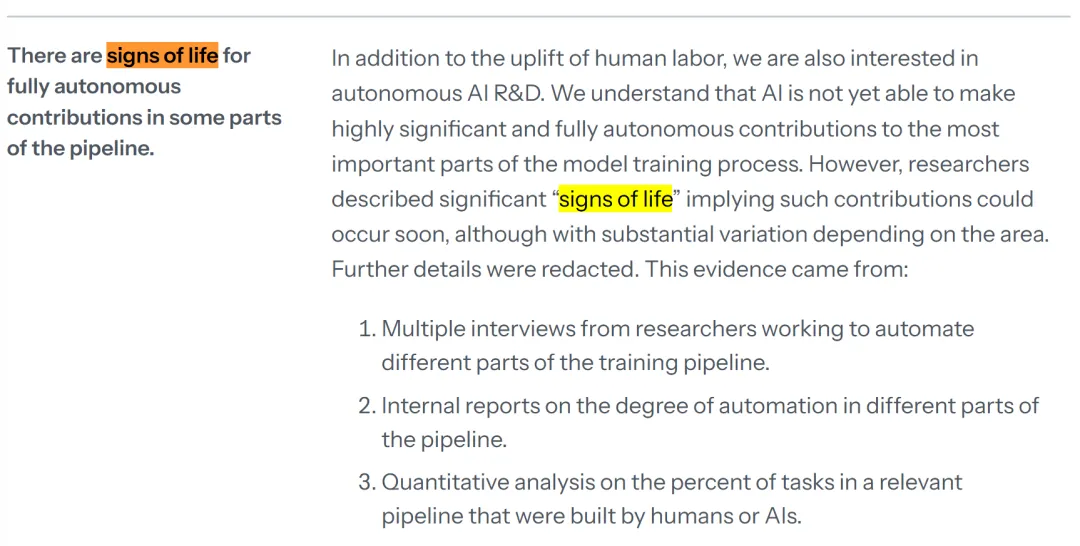
There is still a gap between the complete regression to self-improvement (RSI) for AI to develop the next generation of models autonomously. Researchers at Anthropic themselves believe that AI has not yet made a highly important and fully autonomous contribution to the most important part of model training.
However, Anthropic researchers have described the vast amount of autonomous contributions of AI as "signs of life" and quantitatively analyzed the proportion of tasks performed by AI vs. humans in each of the statistical stages, but the data was removed by Anthropic.
As long as a stronger model helps researchers develop the next generation faster, the feedback process can continue to improve. How far the RSI pathway can go depends on unautomated links and whether resources such as computation can be followed.
In terms of near-future forecasts, METR does not see a clear bottleneck for rapid progress over the next 12 months, but confesses that they have changed their judgments several times as the information has increased, with limited confidence at present.
In addition, while Anthropic has allowed the third-party agency METR to access its internal investigation, the 100-page report currently given has been substantially removed. The most compelling evidence has largely been removed by Anthropic itself.
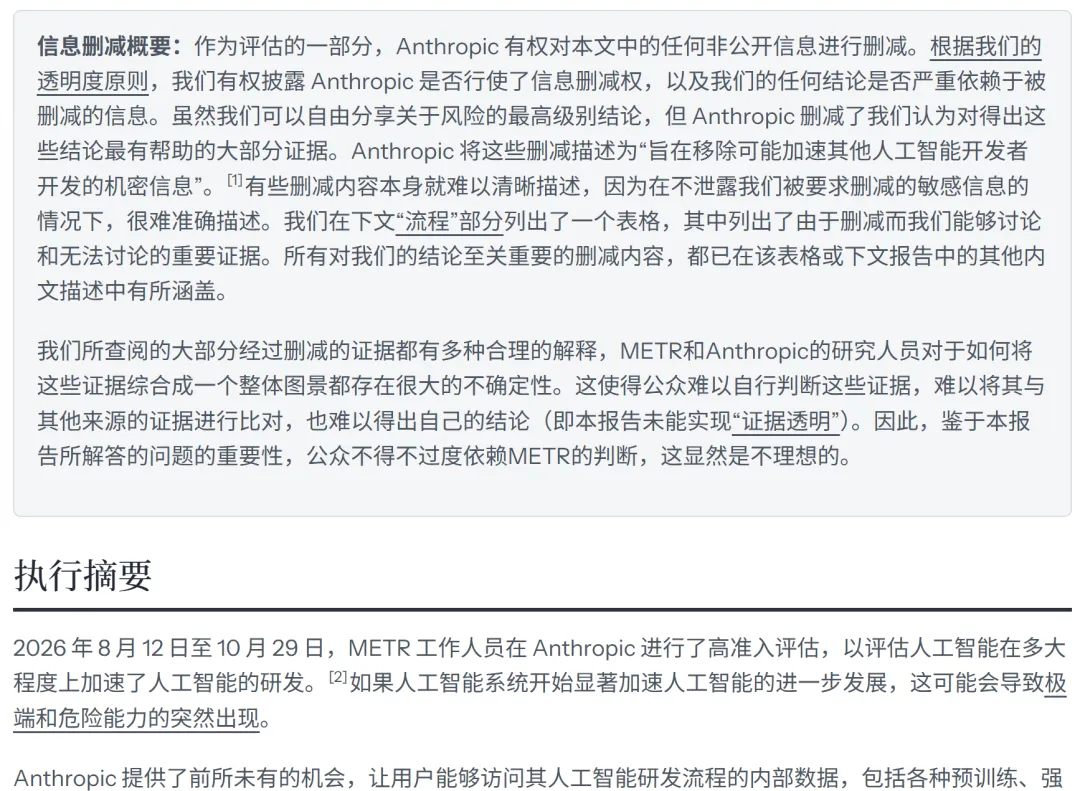
The accompanying review, released the same day, also revealed differences in the two sides' risk statements: Anthropic described a leading indicator of progress as "less than doubling" and METR calculated about 1.97 times its internal data, suggesting that a more accurate statement should be "about doubling" - doubling the early warning threshold for Anthropic.
The METR believes that it is impossible to rule out the possibility that the relevant threshold has been exceeded as of July 15, but most relevant researchers still tend to not have been exceeded at that time. Both parties believe that the direct disaster risk of the relevant model at that time is lower.
As models become more and more involved in R&D, whether people can see changes in time, whether companies can fully disclose uncertainty, are becoming a question that must be answered before the next generation of AI arrives.
References are given below: