I'm going to tell you something.The shadows
Recently, there has been a noteworthy trend in the fitness industry:More and more enterprises are introducing robotic model services, and model competition extends from capability itself to call, training and deployment.In October, Dream Labs, the world-class model company in the United States, released Dream-1, which at the same time opens up the Dream API and model micromanagement service, allowing developers to directly call models to control robots and use their own data for customized training. At the same time, Physical Intelligence also launched the Pi API, which supports developers uploading robot-operated data, completing model micromanagement and logical deployments in the cloud, and continuing to optimize models based on real-world mission feedback.
 These actions together release a clear signal:Intelligent baseline models are accelerating towards serviceability, with enterprises and developers not having to rely on self-development models, and with APIs giving robots the ability to operate.However, the ability of the model to be called, rather than the ability of the robot to actually function. How to make the model fit different bodies, complete real tasks, and improve success rates, is the key to commercialisation.Nuclear Lions announces the upgrading of its body-smart model service platform Dexmal MaaSIt's a great way to showcase real-life events.Post-training skillsIt supports developers uploading robot-operated data, completing model training and deployment reasoning in the cloud. In this upgrade, the platform supports SFT, DAgger, RECAP, and Pipeline models, and provides access to Dexos Lite, MaaS APIs, and more.
01.
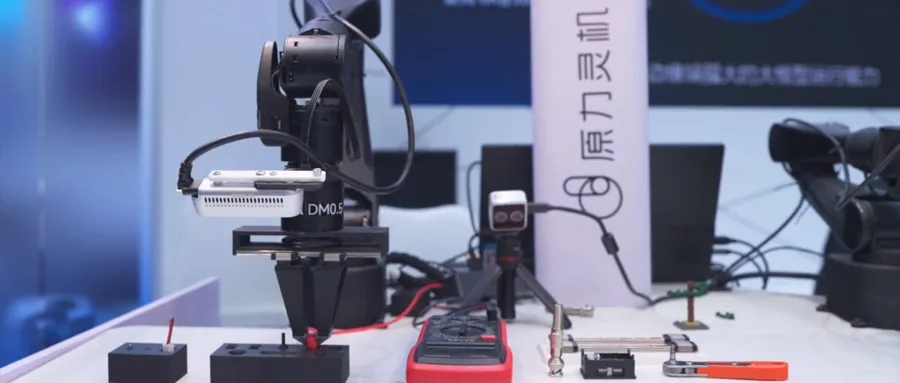
MaaS was upgraded and the entire model development process startedUnlike large language models, which primarily handle information such as text, images, body models require direct interaction with the physical world, not only to understand the environment, but also to generate actions based on tasks and execute them through the robot itself, which raises higher demands on the model's computing, hardware adaptation, and task execution capabilities.The limited computational resources of a robot's own body are difficult to meet the needs of large-scale model reasoning.On the other hand, while the general model has some basic operational capabilities, it faces specific robots and actual tasks.There is still a need for further adaptation through post-trainingAfter-training platform construction engineering is large and poses high demands on the technical capabilities of the enterprise. Therefore, the built-in MaaS not only solves the cloud calling problem of the model, but also needs to provide the after-training capabilities as a service, so that the robot enterprise does not need to build a complete training system on its own, but can also customize the model for specific tasks. Before that, the platform, based on its self-developed model DM0.5, has been able to provide model calling, reasoning and cloud deployment services to customers or developers.Picking up, placing, stackingHowever, when faced with different scenarios and more specific task requirements, models still need to use the data for targeted post-training.It's the ability to further open up the model.● Developers can upload existing robot-operated data to the platform and conduct targeted training based on DM0.5. Dexmal MaaS supports LeRobot v3 format datasets and provides visualized data and model management workstations, reducing the thresholds for data preparation and post-modelling training. Once the training is complete, the model can also be deployed directly to the MaaS platform to reason in the cloud to mitigate the problem of inadequate intrinsic computing capabilities.02.
Learn to operate, correct mistakes, and robots can continue to evolveThe problems that robots encounter in actual tasks are not the same: some require learning new operations, some need to correct movement biases in the execution process, and others need to optimize for repeated failures. Different problems correspond to different training needs. For these situations, the nuclear engine provides training pipeline after SFT, DAgger, RECAP three models in the Dexmal MaaS.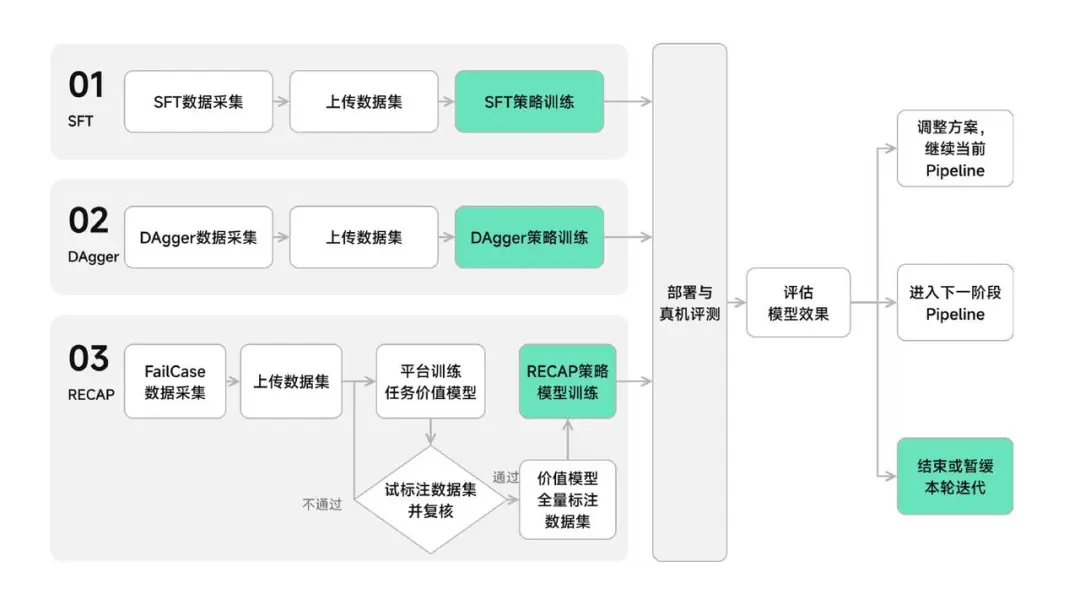 The first class is SFT, which allows robots to learn how to handle new tasks.SFTs mainly use the successful operation data of artificial demonstrations to train the model to learn how to operate and the rules of action in the task. Users can upload the corresponding successful robot operation data to the platform to learn how to complete the model and further build specific task execution capabilities on the basis of the original model.The second category is DAgger (data set aggregation), which corrects execution biases on its own.When performing a specific task, different situations arise from the original demonstration due to different physical environments, changes in the position of objects and operational deviations. Based on SFT training, users can further introduce effective DAgger error data, train and iterate on the platform. Based on this, the model can learn how to adjust movements in different states and improve execution performance in actual tasks.The third category is RECAP, which uses failures to further optimize operational strategies.Even after the first two stages of training, robots may still fail in the face of some complex or special situations. RECAP further uses data such as SFT, DAgger and Fail Case to combine the platform training's value models to provide a basis for model strategy optimization.The three types of post-training programs are both independent of each other and can form progressive relationships.On the horizontal side, the three schemes cover different stages of robot model optimization, each with greater flexibility. The user can choose the corresponding training method based on the problems encountered in the actual task. On the horizontal side, they can form a progressive relationship through the accumulation of data. The training data generated at different stages can be continuously absorbed into the subsequent optimization process, allowing the model to be continuously improved on the basis of already existing capabilities.
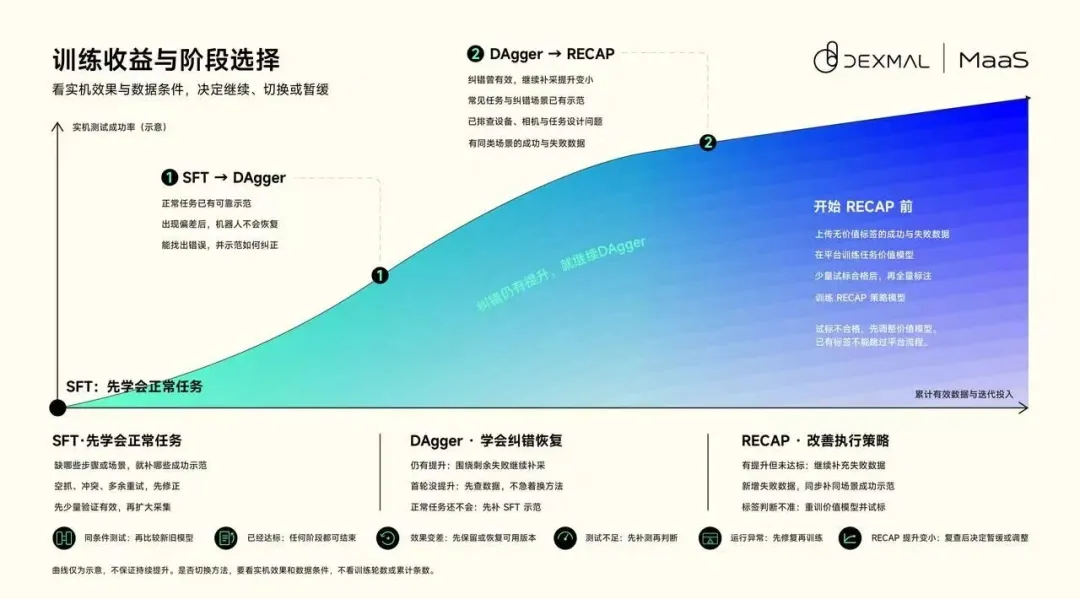 In practical effect, the Dexmal MaaS-supported model achieved a 100% success rate in real-world atomic mission testing.
03.
Opening up real-time access to more scenarios to allow model capabilities to landAfter the model is trained and deployed, it also needs to access the main body.DexOS Lite and MaaS APIThere are two ways: DeXOS Lite is available.Lightening the ClientsIntegrated reasoning cycles, image processing, multi-step action execution, and request retesting capabilities that help robots access cloud models quickly and provide native support for models such as the Mirror prototype.For scenarios that require deep customization, users can also call the MaaS API directly.Flexible integration based on the robot's own body, control systems and business processes.In the end, it's all about how it performs in real life.Currently, Dexmal MaaS has been deployed in logistics storage, production manufacturing and industrial operations. In logistics storage, desktop robots equipped with MaaS have been deployed on the side of the transmission line, carrying out procurement tasks, and inter-industry shooting.More than 1200 pieces per hourAs a whole,More than 99% success rate。Faced with the huge number of goods in the warehouse, with different specifications, the robot can steadily grab thousands of SKUs and, in collaboration with the transporting robot, complete disassembly and sorting. In the field of consumer goods production, the mechanical arm is able to synchronize the assembly of skincare kits and quickly and steadily place items on the production line.Sub-millimeter accuracy mass inspection。
04.
I'm not sure what I'm going to do.Applications of physical intelligence are acceleratingThe industrial value of physical intelligence should be reflected not only in the breakthrough of the capabilities of a few robots, but also in the ability to be acquired by more enterprises, replicated by different tasks, and truly integrated into the production system. When model capabilities are no longer limited to single products and enterprises, but become an industrial resource that can be continuously called upon, adapted and replicated, physical intelligence can truly enter more industrial networks and be transformed into reproducible productivity.