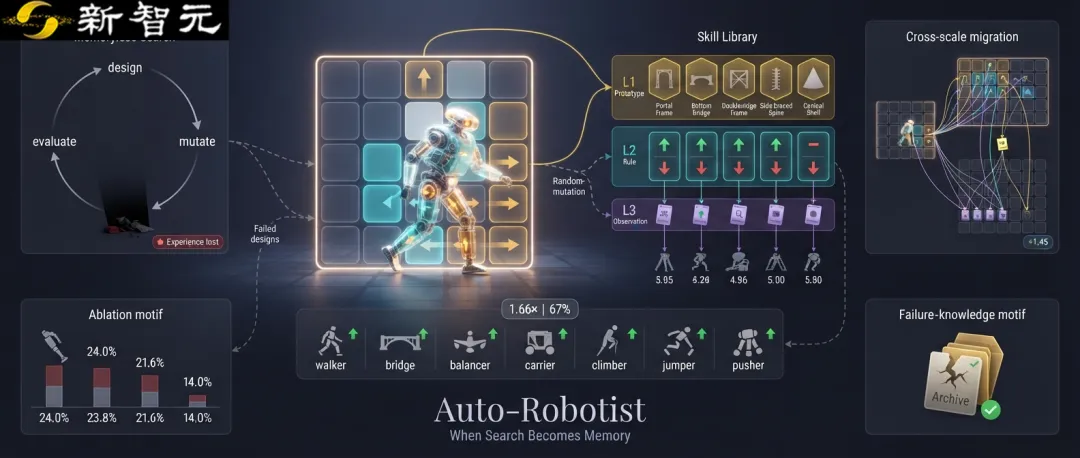
AIHow can we build experience in designing robots repeatedly like engineers do?
The physical structure of robots is closely linked to the control of movement: where the drivers are placed, how the body stays stable, needs to be verified through control training and simulation. These trials and errors are expensive, and the experience is often not organized into knowledge that can be reused for subsequent design.
A research team at the University of Michigan at Ann Arbor has proposedAIThe robotsAuto-Robotist is a collaborative design of an intelligent body.Related work has been obtainedEMNLP 2026 hosted and open source。
The term "co-design" here refers to combining the search for a robot's physical structure with controller training. The system uses a large language model to propose structural improvements for a candidate robot to train controllers, then simulate the test results, and organize the results into the next round of design experiences that can be used.
Link to the paper:https://arxiv.org/abs/2605.25832
The code link:https://github.com/wangyf9/Auto-Robotist
The core of Auto-Robotist is a continuously updated "skill library".Here's the skill, how to designThe robotsthe experience ofFor example, how to support the driver to avoid structural instability.
Experiments showed that these experiences improved the design search for seven software robot simulation tasks in EvoGym and migrated from 5×5 grids to 10×10 larger design spaces.A failed robot can also leave valuable experience for the next design.
Why Robot Design Needs Memory
The design of a robot's physical structure faces a huge combination of spaces. For example, in the software robot simulation platform EvoGym, a robot is made up of units in a grid. Each grid has five possible states: empty, rigid materials, flexible materials, and horizontal or vertical drive units.Combination of 100 squares of 5。
Selecting a design is also expensive: you need to first train the controller with the enhanced learning algorithm PPO, let the robot learn how to move, and then simulate the performance of its tasks.Robots performing their missions。
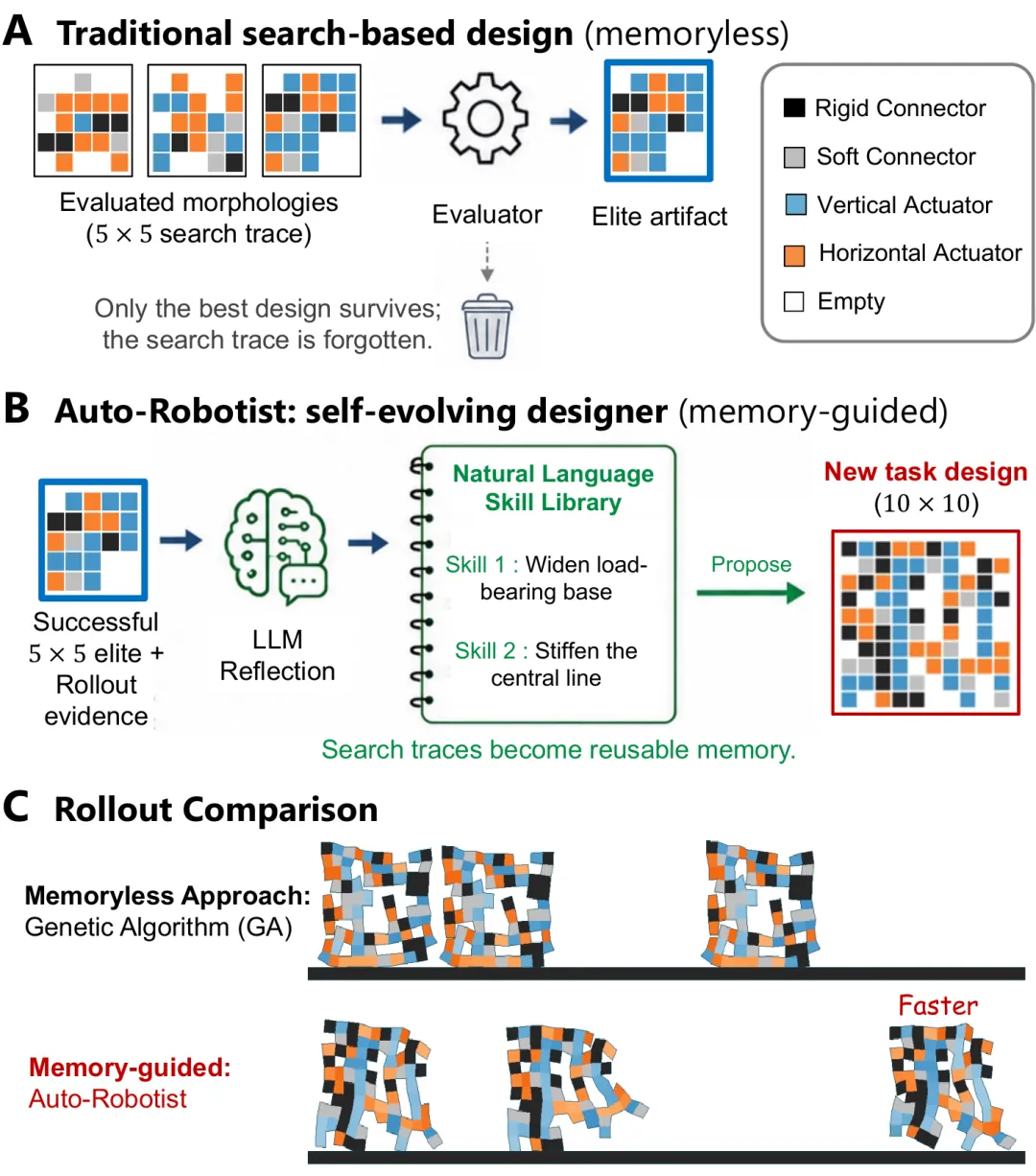
Comparison of conventional searches to Auto-Robotist: Can trial and error records become replicable design knowledge
Genetic algorithms (GA) seek out better robots by maintaining better-performing designs, continually generating new variants. It primarily retains search results in populations and superior designs, usually without organizing success and failure into directly readable, repeatable design rules.Auto-Robotist hopes to preserve the experience behind these trials and errors.Figure 1 refers to this process of accumulation of knowledge in the absence of explicit design as "memory-free search".
Making the experience of design knowledge reusable
The core idea of this work is:A search can produce both good design and design knowledge.Auto-Robotist allows large language models (LLM) to organize "design notes" in the search process, which structures are helpful and which problems should be avoided from the simulation results, and then use these experiences to guide subsequent design.
In order to make these notes really useful, the skills library follows three principles:The Law of RecordIn addition to this, it is important to ensure that experience can be used in new designs.Keeping the evidenceMake the rules consistent with specific assessment records;Allow for revisionNew results can be added to, combined with or corrected with old experiences.
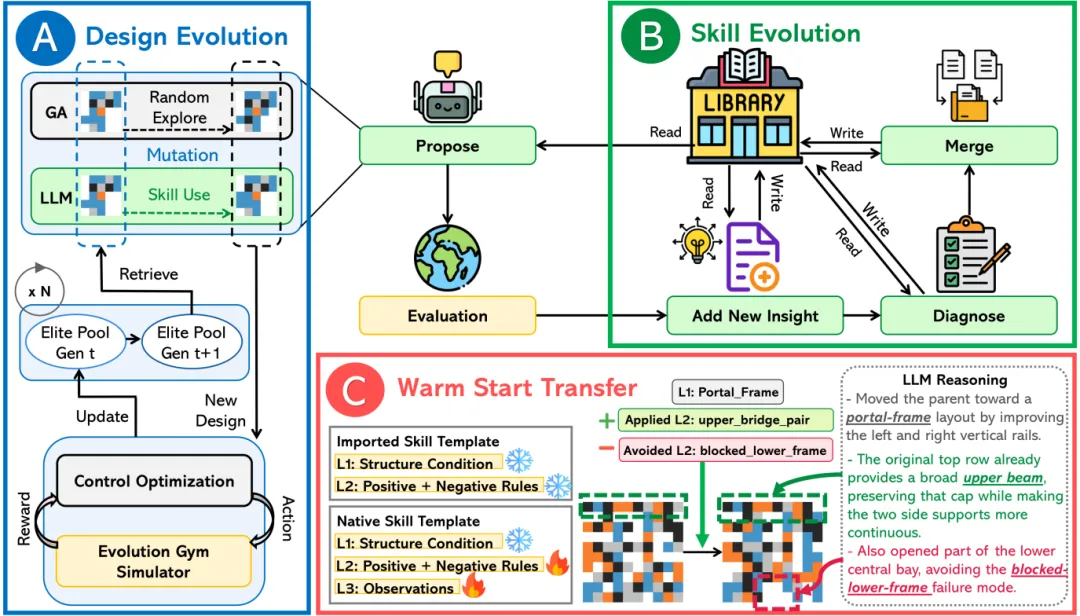
Auto-Robotist framework: guided design with experience and updated experience with new experiments
What each design skill recordsAs shown in Figure 2, each skill is divided into three levels, each answering "what structure works", "how to improve" and "what is the basis".
L1 prototype aluminum structure may be useful.It records a structure and its conditions of use, such as the door frame that forms a support around the driver.
How to improve the L2 rule and what problems should be avoided.Right-to-rule summaries help improve scoring practices, negative-to-rule records repeated failure patterns, and associate supporting evidence with performance statistics.
L3 observes which experiments support these judgments.Save specific designs, tasks, grid sizes, scores and design sources to re-check the basis of each rule.
Auto-Robotist repeatedly executes three steps to let experience guide the design and update the experimental results:
Design suggestions.To retrieve relevant experience from a skill library, LLM can modify existing designs to perform better. While retaining the random variation of GA, it explores existing structures that have not yet been covered by the rules.
It's a simulated verification.First, check whether the parts of the candidate robot are connected, whether they contain the drive unit, and then use the PPO training controller to get the task score through simulation.
It's a new experience.Add new structural experiences to the skills library, modify the rules according to the evaluation results, and merge repeat entries into Merge.
How experiments compare
The mission covers seven capabilities.The experiments were conducted on the EvoGym Walker, BridgeWalker, Balance Balancer, Carrier, Climb, Jump, Jumper, and Pusher missions. Each candidate robot received 512 000 steps of PPO control training, followed by simulation scores.
Comparison using the same assessment budget and population size.The main results of the EvoGym Standard Genetic Algorithm GA―Auto-Robotist report averages and standard deviations below three random seeds ((0、9、42)), which are used to observe fluctuations between average performance and operation.
Experiments are evaluated from the two perspectives of the final performance and the search process:
What a beautiful design we finally found.The "highest reward" refers to the evaluation of the best-designed task scores that are searched for when the budget is exhausted.
How many evaluations are needed to reach the reference score."Crossover acceleration S" is the number of times a GA is required to reach its highest score, excluding the number of times it is required to reach the same score as an Auto-Robotist. The larger the S, the less evaluation is required; this indicator measures search efficiency by the number of times it is assessed.
How much of the search remains in the lead.The "Leadership Ratio L" refers to the percentage of evaluation times that Auto-Robotist has exceeded GA's highest score to date throughout the entire evaluation budget.
The first batch of experimental testsCan a skill base be built from scratch in a search?Auto-Robotist starts from a blank skill library, designs robots in a 5×5 grid and compares them to GAs under the same assessed budget. This is the "cold start search" in the text.
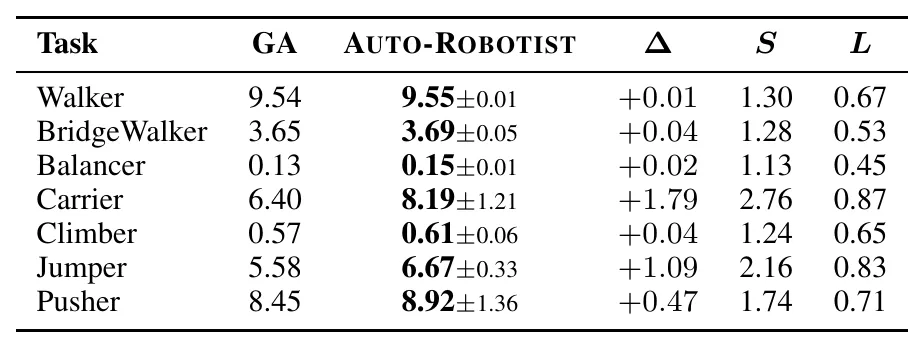
Cold start search results in the 5×5 grid of Table 1
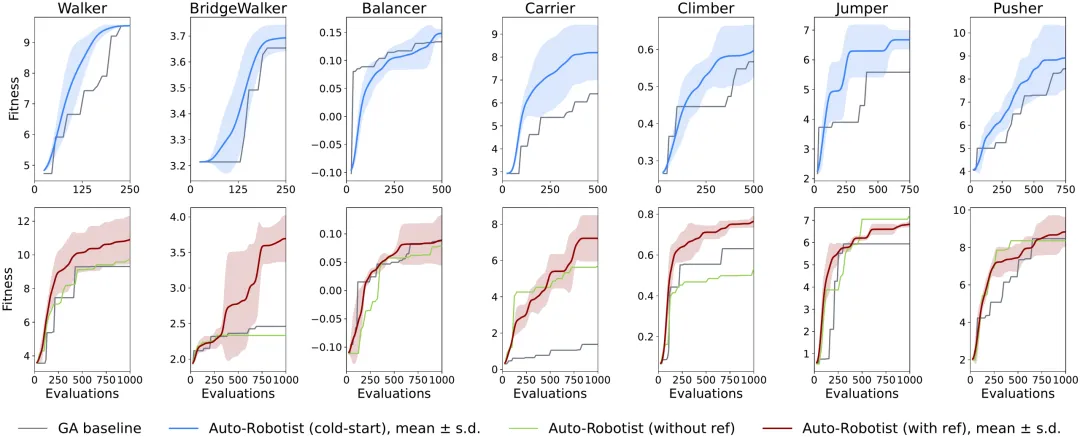
Figure 3 shows an increase in the number of evaluations, with each method scoring the highest task at the time; 5×5 cold starts at the top and 10×10 cross-scale experiments at the bottom (Auto-Robotist averages ± standard deviation for three random seeds)
In Table 1 and Table 3, Auto-Robotist is shown inThe average ultimate best score on seven missions is higher than GAThe average convergence rate is accelerated by the aforementioned estimated number of times.1.66 timesThe average lead rate is 67%, which means that, on average, about two-thirds of the evaluation phases remain ahead in the search for each task.
The final scores for the transport, jump and push tasks are significantly improved. These tasks are more sensitive to contact, load and support structures, and the design experience can help the system adjust the robot body more targeted.
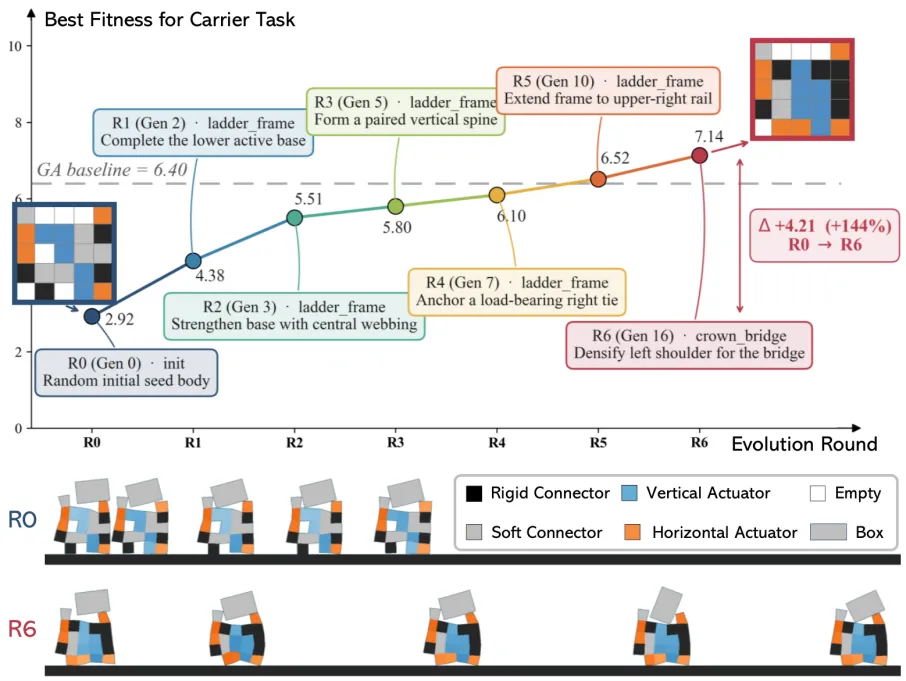
Figure 4 A representative design evolution of a relocation mission
Figure 4 shows the evolution of a robot in a transportation mission from initial design to final form. Each step of modification has a skill base of rules involved in guidance, and the task scores from2.92 up to 7.14This example allows the reader to see how the design experience involves one specific structural modification at a time.
Experiment 2: Reusing experience in a larger design spaceThe second group of experiments imported the skill libraries learned in 5×5 searches into 10×10 grids.Whether design experience in small grids can help search for larger gridsThe L1 structural prototype and L2 design rules are retained as a reference when migrating; the original L3 observations do not move directly past. New designs still need to re-train the controllers, undergo simulation testing, and accumulate corresponding evaluation records.
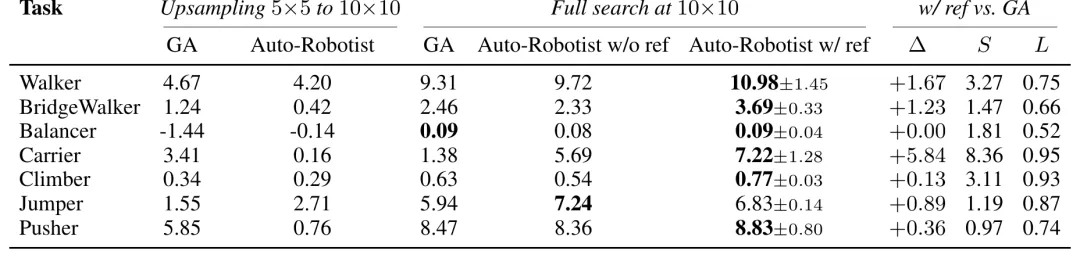
Cross-dimensional results in the 10×10 grid in Table 2 ((results with reference design to mean ± standard deviation of three random seeds)
While providing a skill library and a 5x5 reference design setup, Auto-Robotist is currently in the process of introducing new technologies.Over GA on six missions, one with a level playing field(Table 2) The average difference between the initial reward scores for each task and the ultimate best score was +1.45. This indicates that experience in the larger design space of this experiment has been shown to be an effective aid to search.
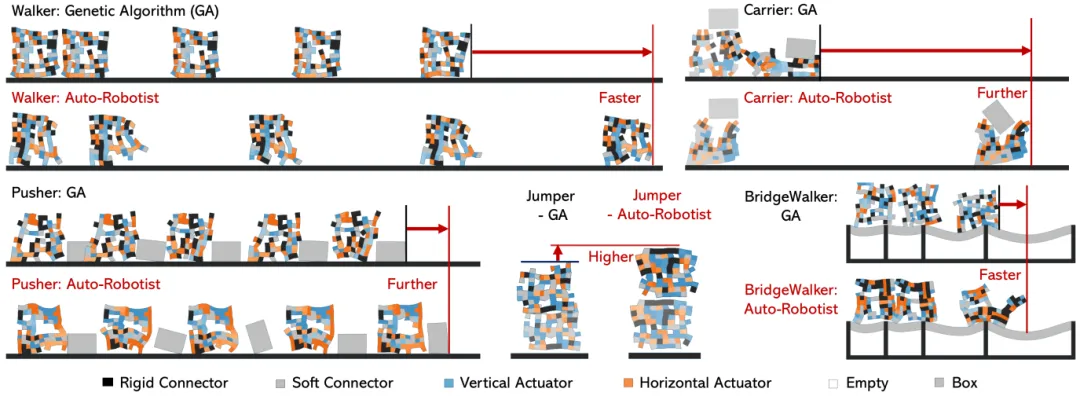
Simulation of robots in a 10×10 grid
Designed memory helps to maintain support and contact relationships that are closely related to mission performance.Figure 5 compares the simulated movement of the best robots on both sides. Some of robots found by GA are able to move, but are prone to contact disruptions, support fractures, or changes in energy consumption within the body.
The representative design found by Auto-Robotist better preserves stable walking frames, load-bearing drying, and continuous contact with objects. These observations provide an intuitive explanation for performance differences.
Migration is a matter of design rules or specific shapes.
To understand why migration works, the research team made two sets of controls: one group directly magnifies the old design, and the other group provides only the design rules and does not provide the appearance of the old robot (Figure 6).
Directly enlarging the shape, it is difficult to stabilize and maintain the original properties.The team expanded each grid in a 5×5 grid into 2×2 pieces to yield 10×10 robots. Although similar in appearance, the contact, leverage and load distribution varied. For example, the post-amplification Auto-Robotist transport design scored only 0.16.
The result shows that in these tasks, direct amplification is not enough to replace re-optimization. The value of design rules is to help new robots reorganize support and contact relationships, such as placing supports around drivers, providing rigid support for soft-contact areas.
Without providing a reference shape, design rules can still work on some tasks.The research team removed the 5×5 reference design from the tip and retained only the skill library, which still outperformed GA in walking, moving and jumping tasks. This suggests that the skill library contains functional experience available for use in new designs.
Crossing, balancing and climbing tasks are more beneficial when providing a reference design at the same time. For these tasks, the rules indicate which structural relationships should be maintained, while the reference design provides a specific modification starting point.
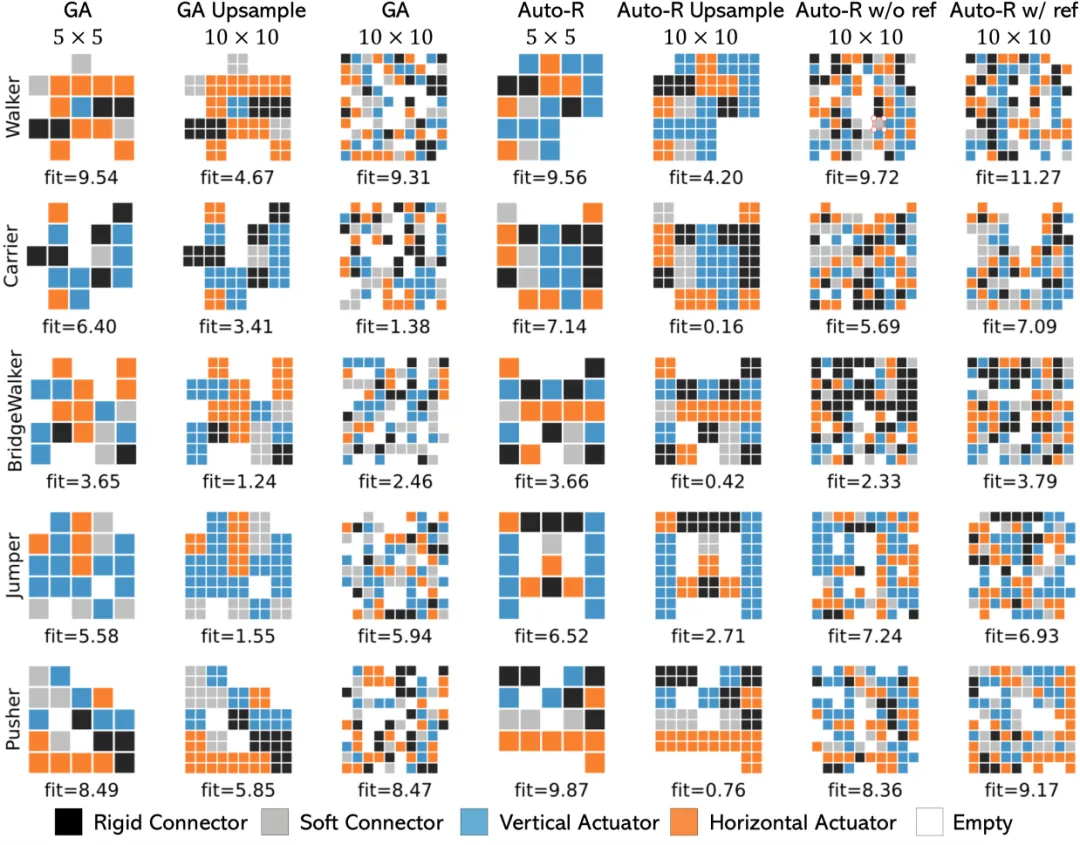
Figure 6 shows the representation of the 5x5 and 10x10 grids.
What components contribute to effectiveness
The team also removed system components one at a time to observe how the performance changed. Such "melting experiments" were conducted on walking and pushing tasks and used the same 5×5 cold start protocol to report average best scores under three random seeds (Figure 7).
In the pushing mission,After removing the GA random variable path, the score fell by 24.0%.• Removing the L2 rule from the tip and observing L3 dropped by 23.8%; skipping the rule revision (diagnose) and repeat entry merger (merge) dropped by 21.6% and 14.0% respectively. These results suggest that exploring new structures, using existing experience and maintaining skill libraries are helpful in performing this task.
In walking tasks, the correspondence decreased to 0.2% and 4.3% respectively. The role of the components varies with the task, and is more pronounced in more difficult structure-search push tasks.
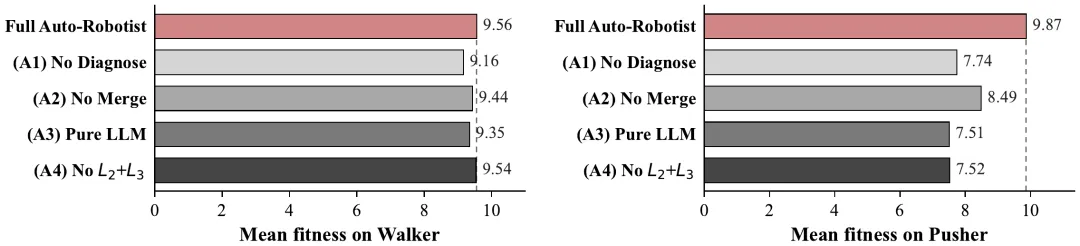
Figure 7 Changes in the performance of walking and pushing tasks after removing components one by one (three random seeds)
What does the skill library remember?
The research team examined the skill base formed in walking missions.Each rule reviews the evidence for its corresponding evaluation.The reader can see which designs it refers to, how these designs score, and how the rules are involved in subsequent designs. This allows the experience library to be checked and revised.
Figure 8 Accumulated design experience in walking missions, including structural prototyping, directional rules and failure experiences
As shown in Figure 8, the skill library eventually contains five structural prototypes: the bottom bridge structure, the door frame, the bi-vertebral frame, the lateral spine column and the convex hull, as well as 12 straight-line rules and 17 negative-line rules. All five types of prototypes gain sampling weight, indicating that after merging repeated entries, the skill library retains multiple structural ideas.
The experience of failure is also worth preserving.In this skill library, negative-directional rules are recorded, even more so than positive-directional rules. Repeated problems such as fragile bottom connections, excessive orbits, and gaps in the closed shell are recorded, helping subsequent designs avoid traps that have already been discovered.
What is the result of this study?
Auto-Robotist shows a way to continue to accumulate experience in robot design:
It's time to leave knowledge behind for the next design.The value of a search also includes whether it can leave design rules available for use in subsequent questions.
It's important to ensure that the design experience is verifiable.The rules relate specific evaluation records to which researchers can examine, challenge and revise the contents.
It is also possible to gain experience without the need to minimize the language model.LLM's parameters remain fixed, and the natural language skills library is constantly updated; robot controllers are still trained by PPO on a mission basis.
The current verification focuses on EvoGym's networked software robot simulation mission. The next step is to explore three-dimensional structures and real hardware designs, test the effects of different major language models, and improve rule uncertainty assessment and conflict handling.These design experiences need to be further verified if they can pass real hardware testing.
Each costly simulation can leave an experience for the next design.When success and failure are both verifiable and reproducible, robotic design searches become a continuous process of knowledge accumulation.