In multi-phase reasoning, local misjudgments may be a prerequisite for subsequent judgments and continue to affect subsequent steps.
This problem is particularly prominent in sympathetic speech dialogue: perception, psychological state inference and response generate a close association, and early biases may eventually lead to misunderstanding and inappropriate responses to the speaker's needs.
It is difficult to locate biases and provide targeted feedback with an overall assessment of the final response alone.
How to model dependency between phases and implement feedback into corresponding steps is key to reducing multi-phase reasoning error transmission.
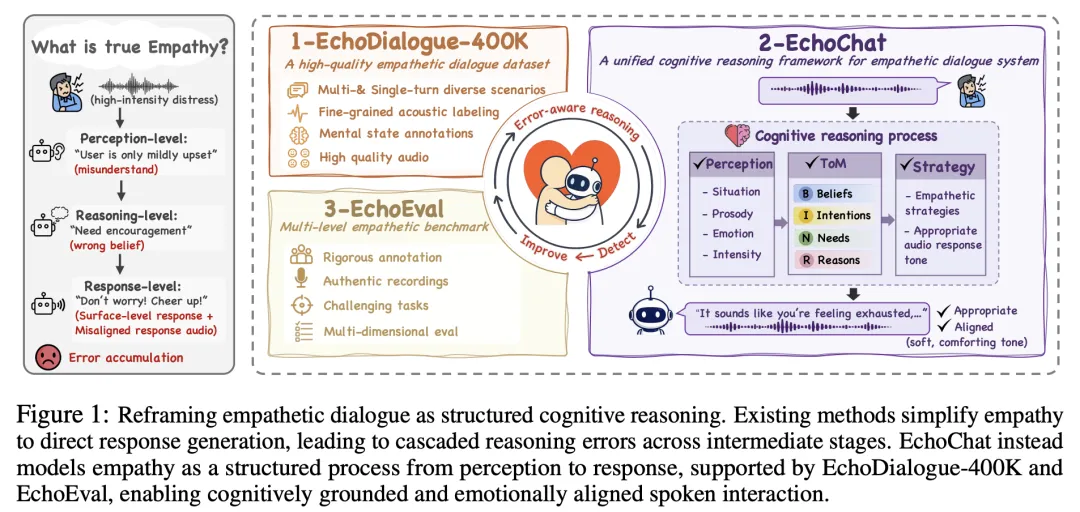
In response to this challenge, a research team from the Chinese University of Hong Kong and Microsoft has proposedEchoChatThe team noted that simplifying empathy into direct mapping of input into responses makes it easy for models to fall into "empathic mimicry": responses appear warm in expression but do not match the speaker's underlying psychological states and actual needs.
EchoChat will incorporate perceptual, mind-theoretical reasoning and voice response generation into a unified optimization framework, relying on constraint phases through tiered gate control rewards, and using step-by-step credit allocation to provide targeted updates to mitigate errors in the continuation of reasoning.NeurIPS 2026。
Link to the paper:https://arxiv.org/abs/2610.04826
There are intermediate steps in reasoningTraining also requires more detailed feedback
In compassionate dialogue, underestimating emotional intensity may cause models to ignore the speaker's urgent need for support; a misunderstanding of psychological needs may shift response strategies away from the issues that the conversation really needs to address.
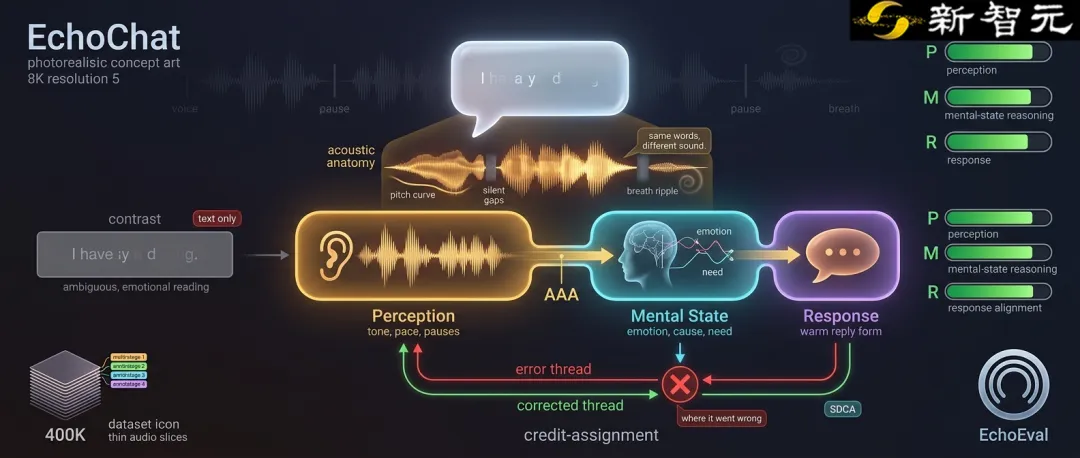
EchoChat explicitly organizes this process into perception, psychological state inference, strategic planning and response generation, giving distinctive structure to the different links.
But structural reasoning does not automatically guarantee reliability: follow-up analysis can continue on the wrong premise, even if it is logically coherent.
Therefore, training needs to distinguish the performance of each stage, identify which links provide a reliable basis, which links introduce bias, and give feedback accordingly.
Rewards for dependency, feedback and response steps
EchoChat addresses this issue in the reinforcement learning phase from the two levels of reward design and credit allocation.
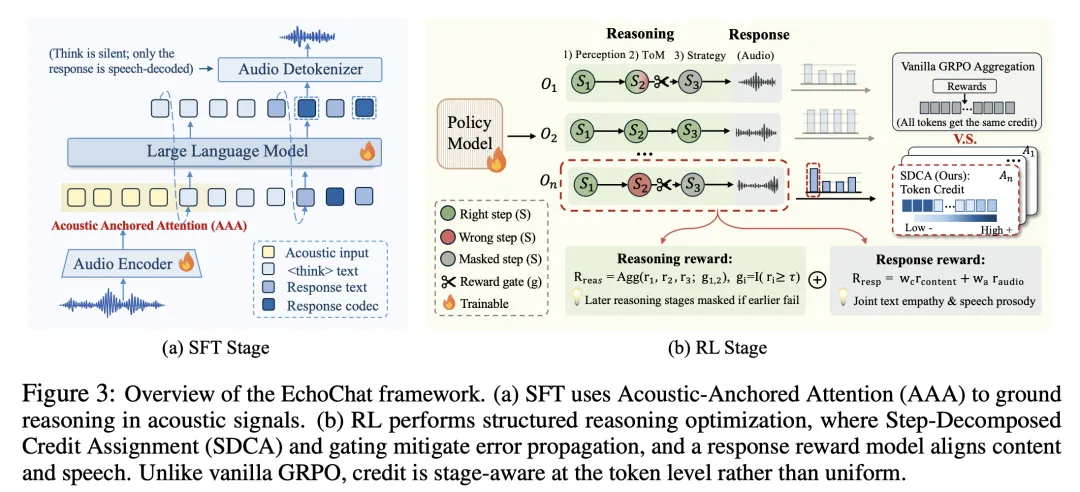
Level gate control: Subsequent rewards require a reliable pre-order basis.
The scores of different stages cannot simply be regarded as independent of each other. If the perception has been biased, the psychological analysis based on this perception generated, even if superficially reasonable, lacks reliable premises. If the subsequent stage still receives a higher reward, the overall score may cover up the upstream error.
EchoChat therefore introduced a tiered gateway control for reasoning rewards, so that the rewards for psychological state inference and strategic planning are constrained by what is shown at the pre-order stage, reducing the likelihood that the model will compensate for preorder errors by subsequently making a seemingly reasonable analysis.
SDCA: To allocate phase feedback to the corresponding generation segments.
Even if the rewards have considered the stage dependence, it is still necessary to clarify the steps in which these feedback should work. The standard GRPO usually calculates the unified advantage signals based on the total rewards of the entire trajectory and applies them to all generated tokens, making it difficult to fully distinguish the contributions of each stage.
To this end, EchoChat has proposed:Step-Decomposed Credit Assignment(SDCA)Relative advantage within the computing group for different stages, then allocate it to the tokens that generate the corresponding segments, so that each step receives a training signal that matches its own performance.
On this basis, EchoChat combines multi-modal rewards at the response level, combining optimised reasoning processes, response content and voice expression.
Keeping Long Chain Logic Acoustically Based
In order to reduce the miscommunication, attention should also be paid to the reasoning on which the information originally depended.Long chain reasoning (Long CoT) often faces an important risk: as the generation of text continues to accumulate, the model may increasingly rely on its own existing judgments, and the focus on original inputs gradually diminishes.
This issue is particularly relevant in sympathetic speech dialogue. The tone, rhythm, pause and sound are strong, carrying emotional information that is difficult to retain in full text. When reasoning is gradually dominated by text generation, these acoustic cues may be overlooked, and initial misjudgements are more likely to continue in subsequent psychological state inferences and strategic choices.
To this end, EchoChat is being introduced during the monitoring and mitigation phase.Acoustic-Anchored Attention(AAA)By restraining attention, reasoning at the sensory stage enhances attention to acoustic expression, making emotional judgments more fully based on sound evidence, and provides a reliable basis for subsequent reasoning and responses.
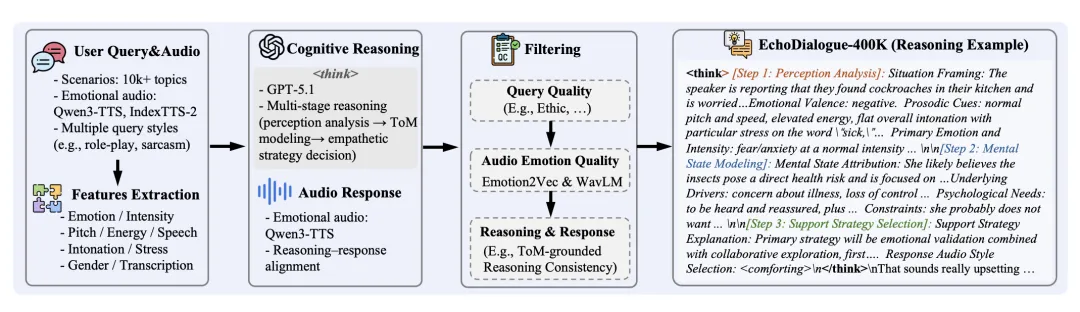
In order to provide corresponding learning signals, the research team constructedEchoDialogue-400KThe data sets cover a diverse range of conversational contexts, language styles and subtle emotional expressions, and link perception, psychoanalysis, strategic choices and responses to provide structured supervision for multi-stage learning.
EchoEvalFrom perception to response to multidimensional evaluation
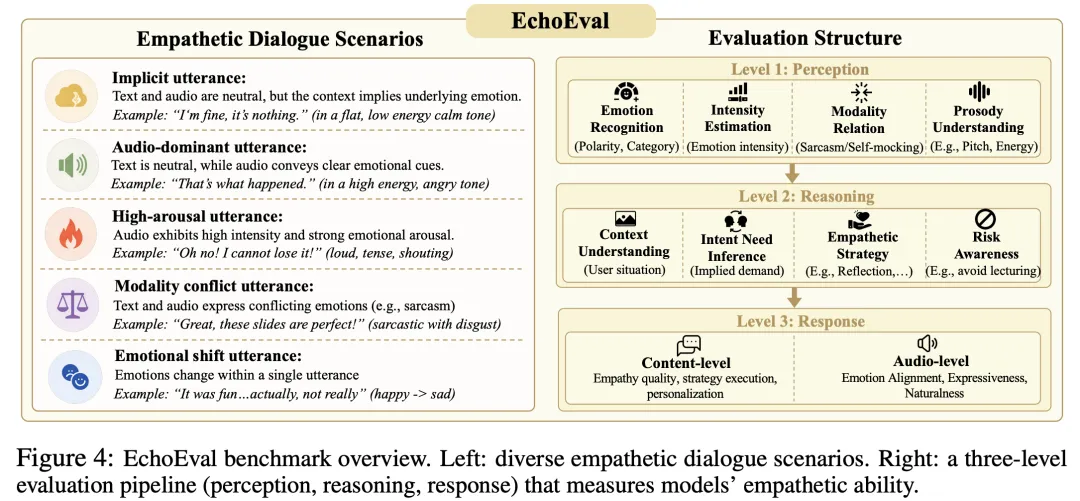
In order to measure the ability to empathize as objectively as possible, the team further examined whether the model accurately perceived emotions, reasonable inferences about psychological states and supporting needs, in addition to making subjective assessments of final responses, to establish a clearer, more analytical basis for empathic evaluation.
For this reason, the research team suggestsEchoEvalEchoEval will fine-tune the overall perception of sympathy into a systematic examination of the quality of perception, reasoning, and response.
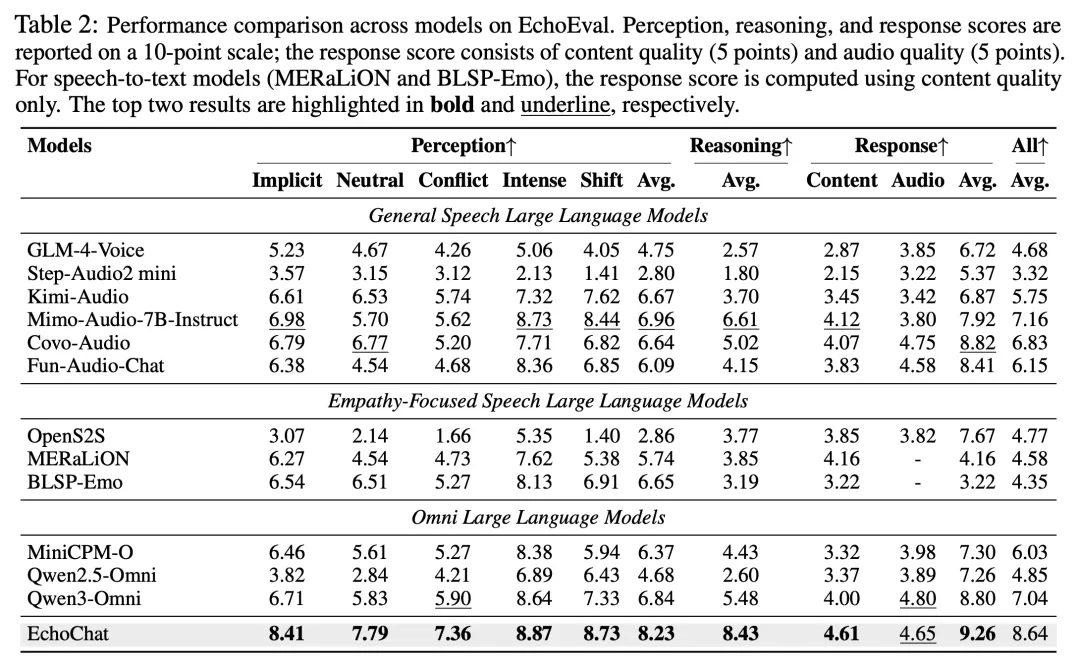
EchoChat has led the way in perception, reasoning and response coordination. Analysis of dilution and error dissemination further shows that level gate control and step-level credit allocation can improve the connectivity between different stages, mitigate the effects of intermediate misjudgments on subsequent reasoning and response, and support the effectiveness of this training method.
Summary
Sympathetic speech is essentially a cognitive process of perception, inference and interdependence in decision-making. Warm expressions may end up in "empathic mimicry" if there is a lack of understanding of the psychological state and actual needs of the speaker.
EchoChat explores how to reduce the continuation of intermediate misjudgments by explicitly modeling and optimizing the process to build responses on a more comprehensive acoustic basis with more reliable reasoning.