Some agents are already working on behalf of people with their own computers.
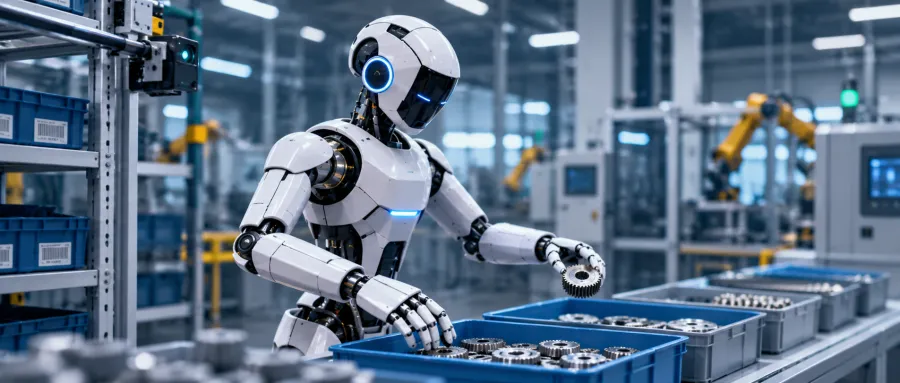
AI landing has two legs: one to go into the physical world and become physically intelligent; the other to go into the digital world and become Agent.
By 2026, both routes are breaking the boundaries of interaction with the environment: in the physical world, world models and spatial intelligence give AI the ability to perceive, predict and act on real space; in the digital world, agents begin to truly take over computers, operate software, call tools, and perform complex tasks.
As Agent moves from exploration of technology to practical applications, how to integrate people's work and life more naturally and conveniently, beyond what it can do, becomes a new evolutionary direction.
Recently, Chinese telecommunications firm Sky Wing AI's Stellar super-smart body TeleAgent introduced an upgrade to V3.0, one of the core changes of which is the further introduction of cloud-based execution capabilities based on the original desktop-end local execution capabilities. This is also the first in the domestic Agent product to explore the practice of combining the smart body with the entire Windows cloud computing environment.
Compared to the Linux cloud environment used by some overseas Agent products, TeleAgent is more compatible with the domestic office software ecosystem and user usage habits, better able to support the installation and operation of mainstream office software and business systems, and provides AI Agent with more practical solutions for landing applications in local office scenarios.
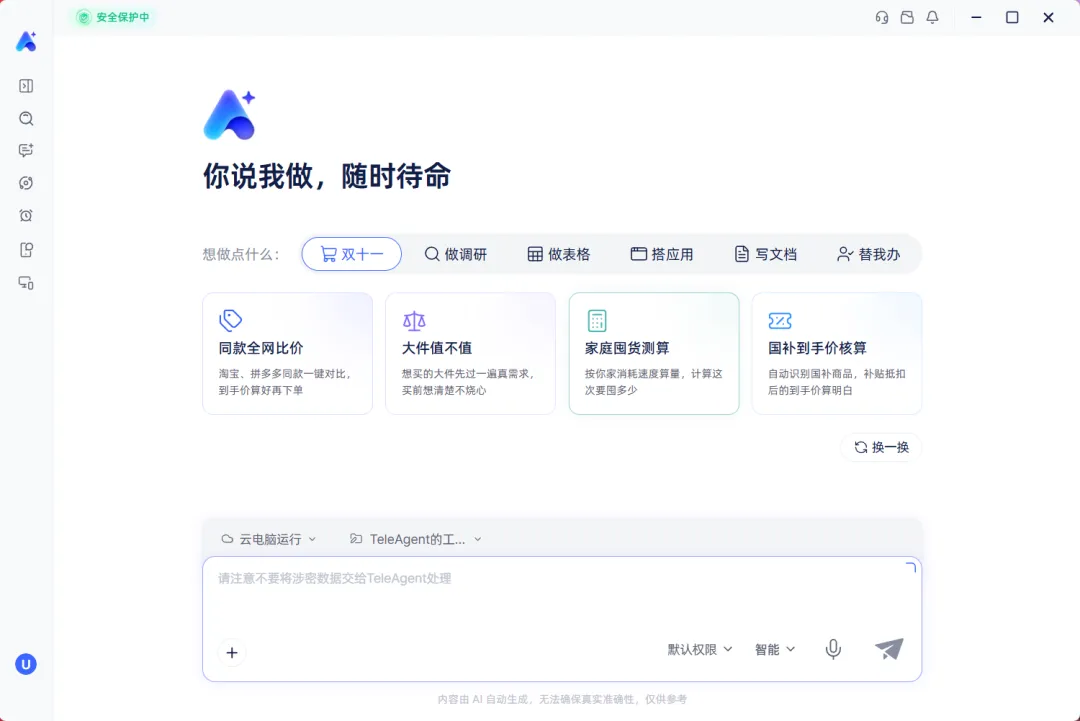
Simply put, TeleAgent is not only able to call on the resources of the user's local computer, but also has an independent cloud workspace. If the user makes a request, the agent can autonomously operate software, process files and perform tasks without continuing to occupy the user's local computer resources.
At the same time, V3.0 also upgraded the interoperability between desktop, web, and mobile, as well as memory synchronization and skill squares.
As Agent moves into the real office environment, what kind of digital jobs does it need, and how will it change the way people use computers?
Give Agent his own computer.
AI Agents are becoming more and more efficient, but their work environment does not necessarily keep pace with the evolution of their capabilities.
This year, more and more AI products are beginning to offer "computer mode" or "cloud execution" capabilities. With just one instruction input, Agents can open web pages, search for information, organize files, or even run code, and appear to be able to use computers like humans.
But it's not that simple if you want it to download professional software, complete a complex design task, or operate an enterprise system that doesn't have an open API interface.
Where is the question?
Currently, Agent's cloud execution environment offers different technological implementation paths. One type relies on pre-set tools and lightweight sandboxes, which typically provide basic capabilities such as browsers, file systems, shells, but may still be limited in situations such as installing traditional desktop software, operating complex graphical interfaces; the other class is beginning to offer a more complete cloud computing environment that allows Agent to install software, operating the desktop. However, there are still differences in experience in terms of Windows software compatibility, graphical interface interaction, and user intervention editing.
The idea behind TeleAgent V3.0 is that if you want Agent to be a real digital employee, maybe you should give it your own computer first.
In addition to its original local execution capabilities, TeleAgent provides Agent with an independent Windows cloud computing system. In this cloud environment, Agent is no longer limited to calling pre-packaged tools, but can use Windows systems to install software, execute commands, manage files, and perform more flexible desktop operations.
More importantly, users can deploy everyday office software and professional tools in the cloud based on actual work needs and build work environments similar to real PCs.
We started with a simple test: let TeleAgent install enterprise WeChat on a cloud computer.
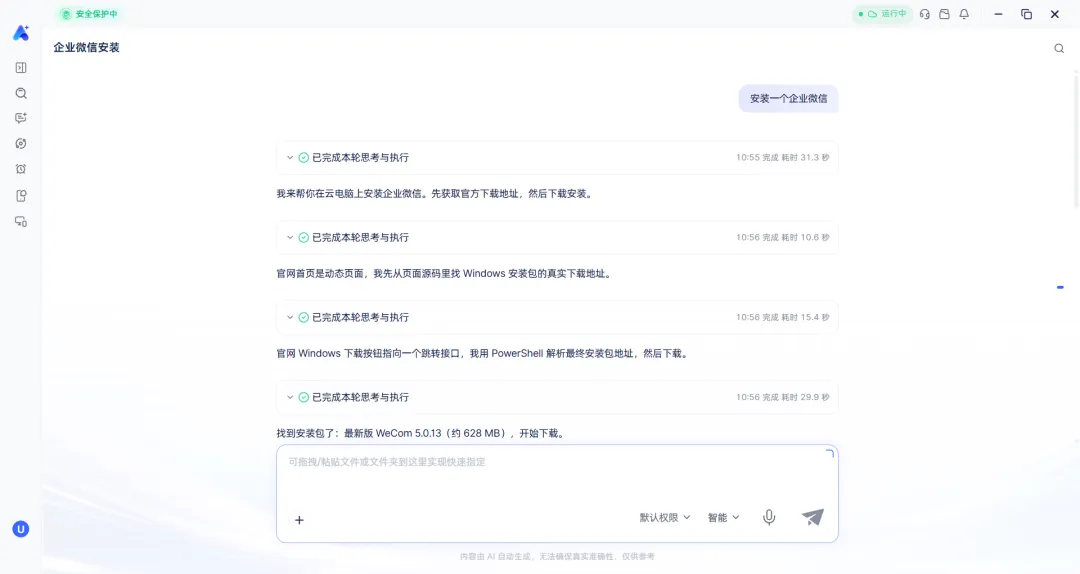
After receiving the instructions, TeleAgent quickly completed the software installation.
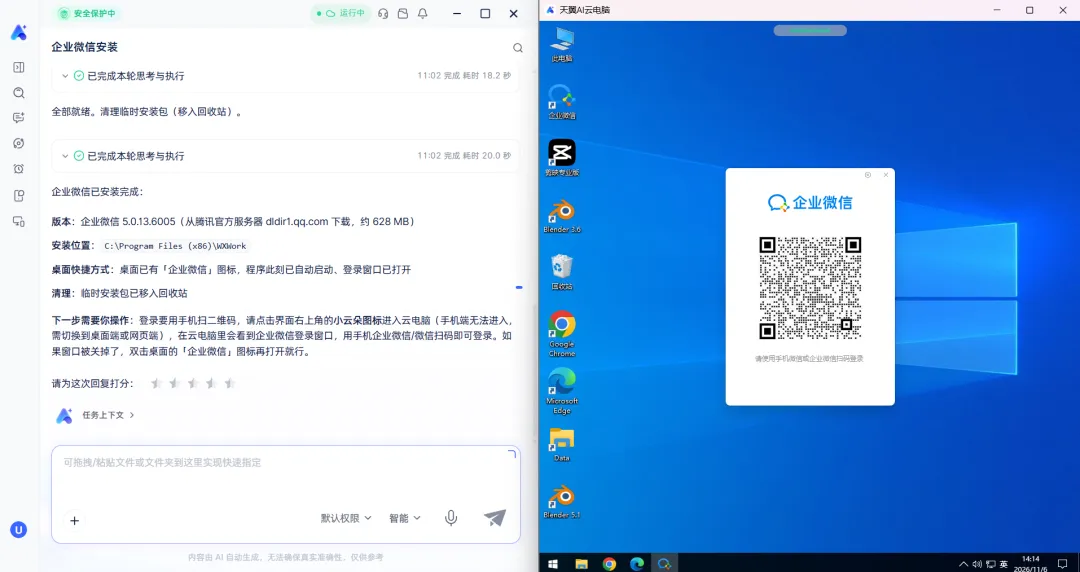
You don't need to manually manipulate cloud computing, you just have to tell the Agent what to do.
Furthermore, the cloud computing environment is also capable of supporting some professional software. According to tests by the TeleAgent team, the current version has verified the ability of some 3D modeling software to run in the cloud.
We also tried to get TeleAgent to model a car using Blender.
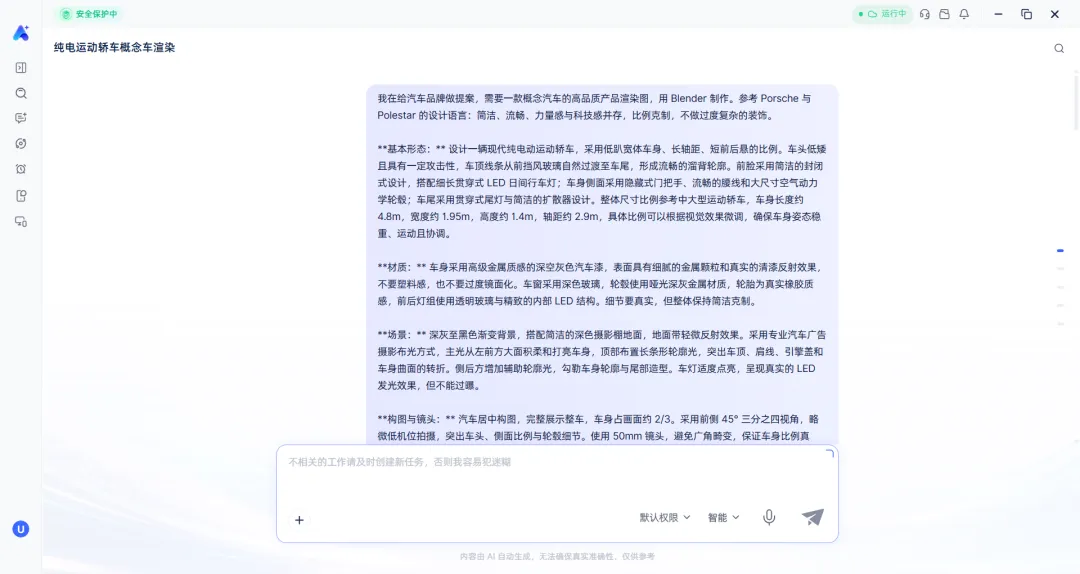
After several rounds of thought and deliberation, TeleAgent finally delivered the car's rendering map and the corresponding Blender engineering documentation.
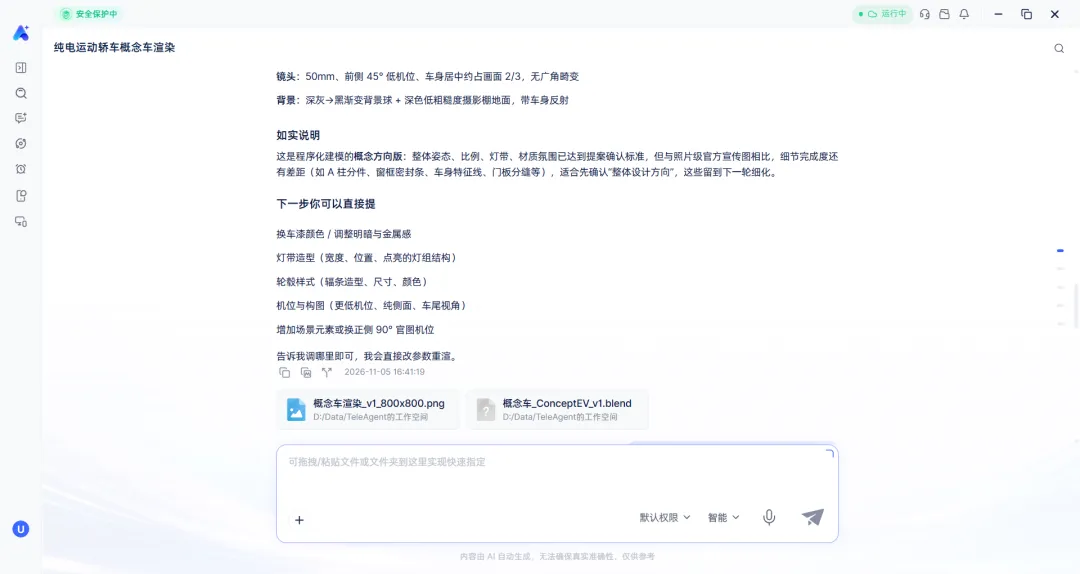
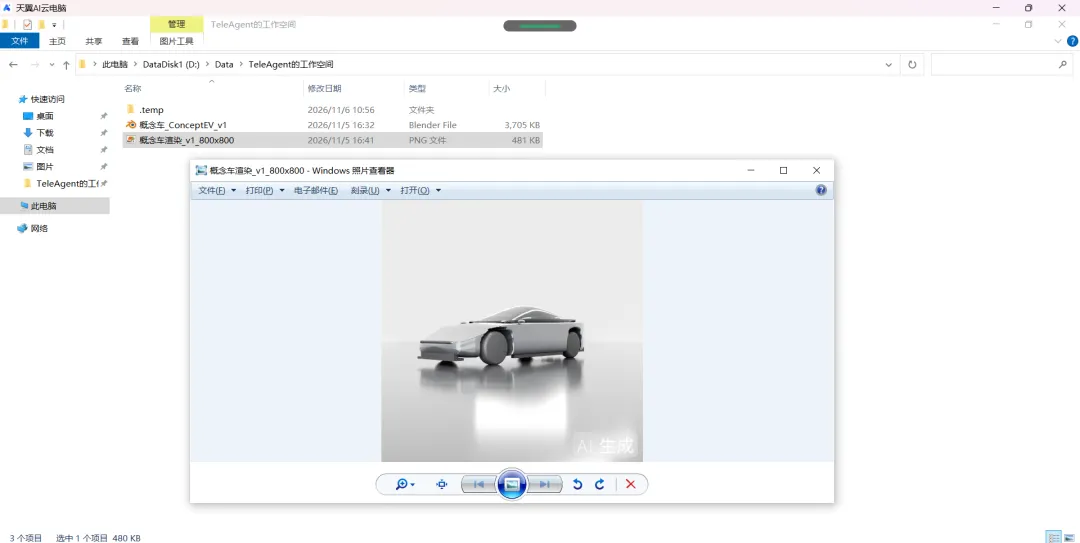
However, the testing process did not go smoothly.
When we tried to open Blender further, we found that the software could not start properly. So we sent the problem directly to TeleAgent, and it checked it out itself.
After two rounds of attempts, TeleAgent successfully resolved the startup issue and restored the previously installed higher version of Blender.
Eventually, the Blender was successfully opened, and previously generated car models could continue to be edited and rendered in the software.
In the cloud execution mode, TeleAgent's Agent service itself runs within the cloud, so long as the cloud computer and related services continue to run, the task execution does not have to continue to occupy the CPU resources of the user's local computer.
Of course, the local model also has its advantages. For tasks that require direct processing of local files and use of existing software, TeleAgent can still call on the resources of local computers directly within the scope of user authorization to complement cloud execution.
We tested a very close-to-daily workflow scenario locally: letting TeleAgent operate the browser with a GUI, retrieve the global AI hot spots of the day, and compile a daily AI forefront intelligence report.
Tasks involve the retrieval of information from multiple sources, news screening, content classification and trend analysis, and there are certain requirements for the ability of the Agent to process information and the process of executing tasks.
TeleAgent, after a lot of searching and sorting, eventually produced a fairly detailed report in Chinese, covering a wide range of dynamics in the field of AI and analyzing important information.
The cloud is open, multi-domain connectivity
Continuity of work has always been a real issue for people who often switch work scenes in the office, at home and on the go. Especially when the Agent starts performing tasks on behalf of people, it can be difficult to continue performing tasks when the user leaves the workplace if they are still dependent on a local computer to run them.
TeleAgent V3.0 attempts to change this relationship.
In this upgrade, TeleAgent connects the desktop, web, and mobile terminals, allowing all three inputs to execute and manage cloud tasks. In this upgrade, the desktop can both perform local tasks and execute cloud tasks with a single button; the upgraded mobile app, in addition to being capable of managing cloud tasks, also supports the operation of desktop TA tasks, allowing both local and cloud execution modes to be managed via mobile devices.
In the real-world experience, we can see a complete record of previous tasks such as car modeling, blender debugging, including task execution processes and final results, on both the web end and Android end, and we can continue to see task details, launch new tasks.
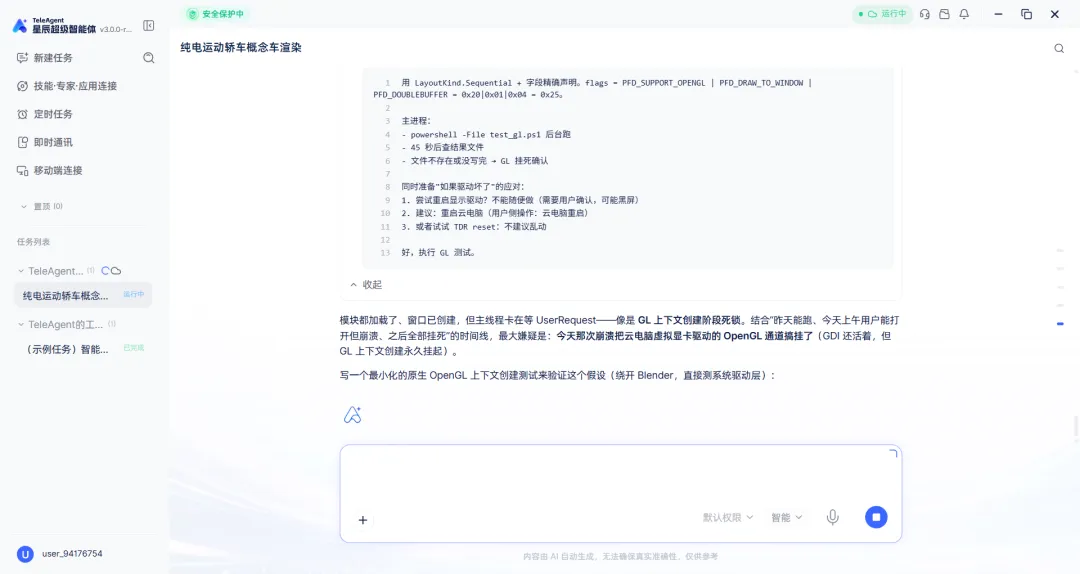
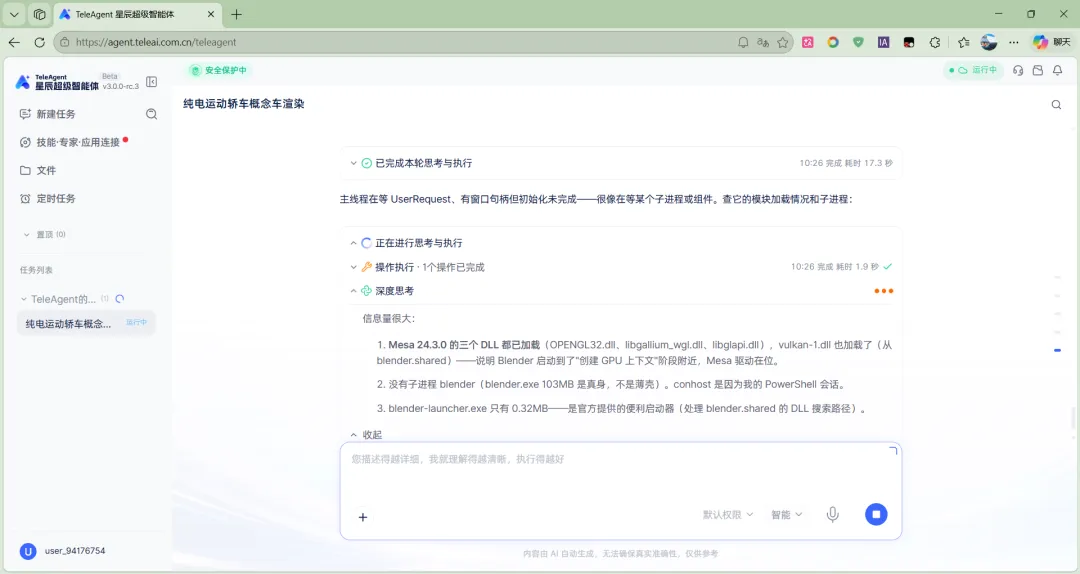
The desktop end is responsible for efficient interaction, the mobile end is suitable for launching tasks at any time, checking progress, and the web end reduces the barrier to use. Different devices become the gateway to the agent's connection, no longer deciding where the agent can work.
However, to make this cross-device connection really smooth, it is not enough to simply enter synchronous tasks. Agents also need to remember who the user is, what they have done before, and the context of work between different terminals.
For this reason, TeleAgent V3.0 further introduces memory synchronization capabilities.
When a user uses the same account to launch a task on multiple terminals, the system can integrate information from different devices through a unified memory management mechanism. Even if the web end and mobile end are used simultaneously, the underlying memory is regularly combined and the information source is tagged, reducing the context cracking when used cross-end.
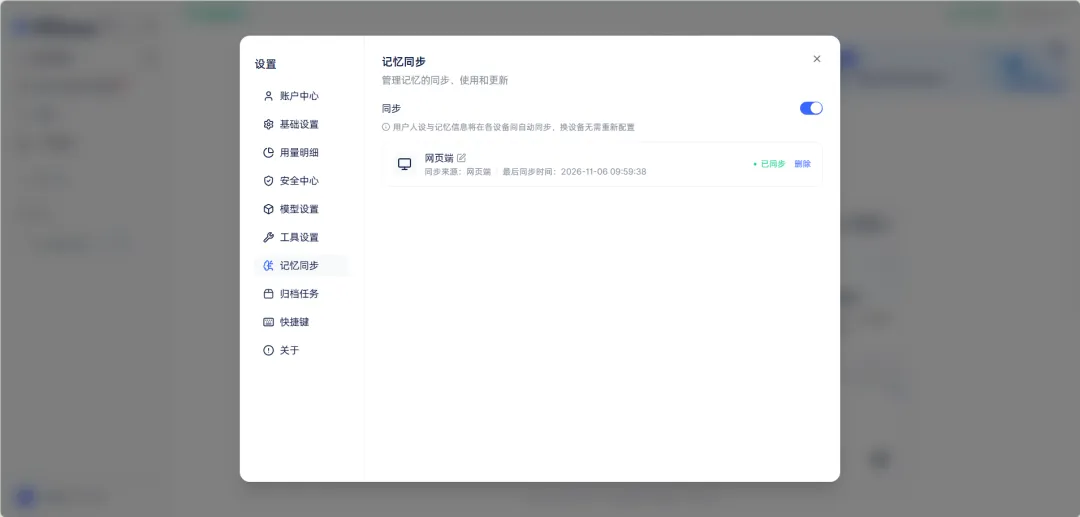
The corresponding memory management and forgetting mechanisms are also essential, and TeleAgent is able to adjust the obsolete information generated during long-term use, cleaning out content that is no longer needed when necessary.
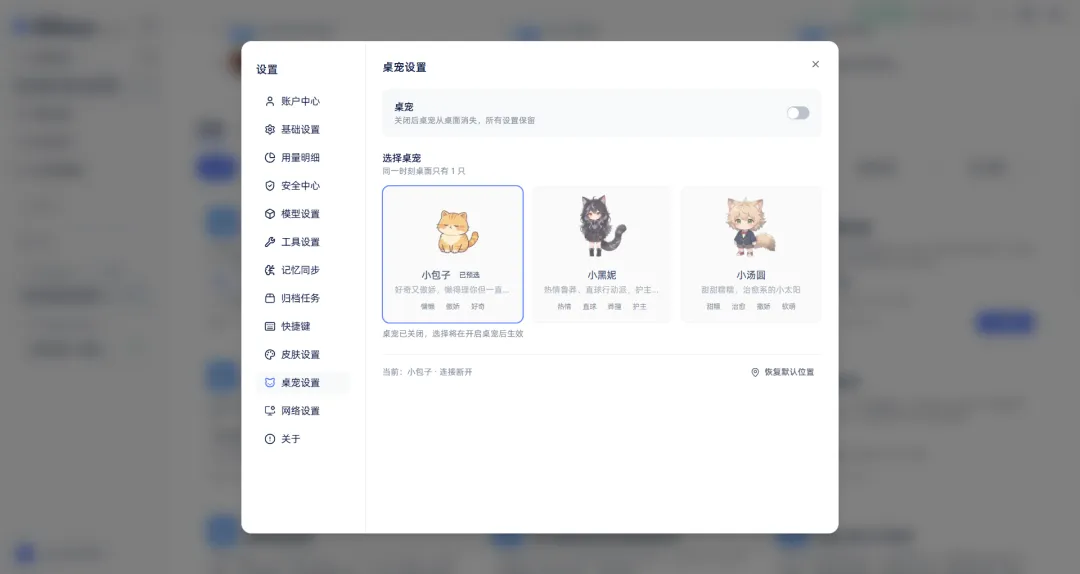
In terms of the interactive experience, V3.0 adds voice input functionality for real-time recognition and voice word cleaning, as well as personalized settings such as shortcuts, custom skins, desktops, to improve work efficiency and provide emotional value to workers. At the same time, the new version also releases Windows PC clients, upgrades to Android App, and plans to launch an iOS version.
Of course, moving the execution environment to the cloud also means that users will be more concerned about file and data security. To this end, TeleAgent relies on China Telecom's existing cloud computing security capabilities, adopting encryption channels during data transmission, implementing encryption for files stored in the cloud, and enhancing data reliability through multi-copy backups and fault recovery mechanisms.
Ultimately, what TeleAgent V3.0 hopes to build is a set of collaboration models with Agent as the executive, with both local and cloud execution environments, and multi-terminal interactive inputs.
Connecting more capabilities, opening up more scenarios
With his own computer, will Agent be able to do all the work?
Real-world work often requires complex processes. Writing an industry report, which may require searching for information, organizing data, producing charts; planning a marketing campaign, which may involve document writing, visual design, collaborative communication; handling business internal affairs, which may require the invention of specific systems and following fixed processes.
In addition to being able to operate a computer autonomously, it also needs to master more professional skills, connect to different platforms, and even form specific ways of working according to the actual needs of the user.
Another upgrade to TeleAgent V3.0 revolves around these needs: further improvement of the skill field, expert systems and connector ecosystems, enabling the Agent to expand its capabilities according to different tasks.
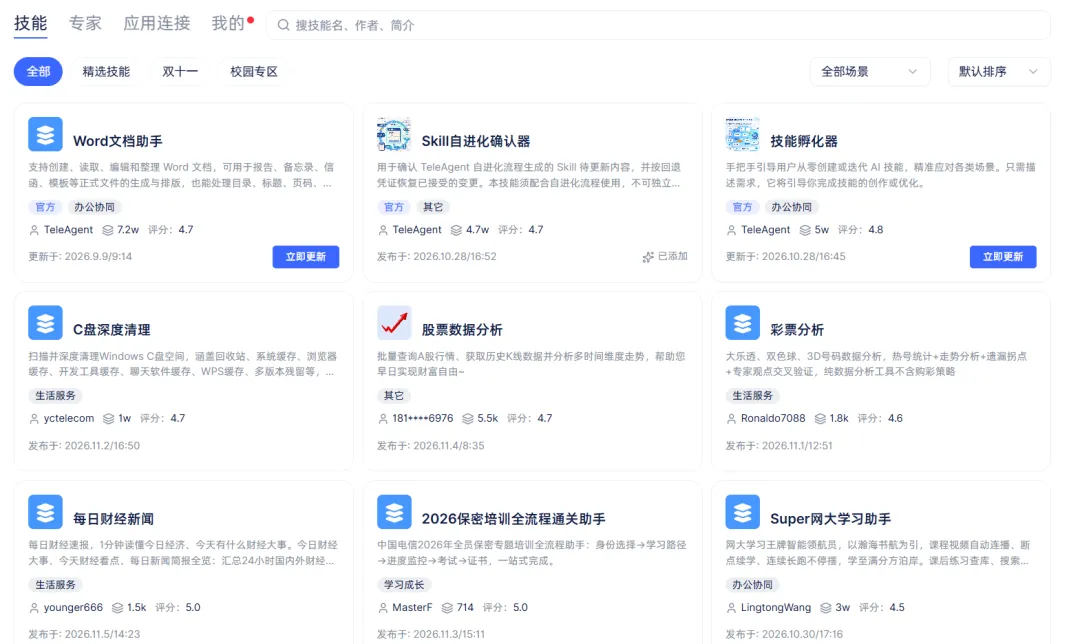
The method of acquiring skills is very convenient and TeleAgent V3.0 supports the ability to retrieve the relevant skills in the skill field in the mission dialogue and to install them in a single click.
Of course, the value of Skills Square lies not only in the convenience of installation, but also in the continuous expansion of professional capabilities.
The update also further enriched scenery skills such as office, content creation, and personal decision-making. For example, public text editing skills can be customized according to the national standard for generating Word documents; AI comics crafting skills cover processes such as script adaptation, role-setting, interim planning to full-screen quality checks; and skills to transform life suggestions into structured decision-making frameworks. At the same time, official Office series skills have optimized mobile adaptation, and web application creation skills have added new support for data sustainability.
In addition to calling on existing skills, TeleAgent V3.0 also supports users to create and manage proprietary specialists based on their needs. By setting expert names, responsibilities, expertise and related configurations, the Agent can work in a way that is more relevant to specific business scenarios.
For example, the same is true for writing documents, where market planners may be more concerned with disseminating effects and creative expression, and enterprise executives with more emphasis on public documentation and format requirements. Instead of each task, reinterpreting the context, emphasizing rules, and pre-configuring appropriate experts can give follow-up work a clearer execution direction.
At the same time, the limits of Agent's capabilities are also being extended to more external applications.
TeleAgent V3.0 adds multiple connectors for scanning Almighty King, Pictorial, Big Data, Gold, QQ mailboxes, TNT files, microcloud plates, TNT conferences, and waterproof cameras, covering scenes such as document processing, visual design, electronic signature, information collection, email communication, file management, and online conferences.
TeleAgent V3.0 also provides new support for enterprise users.
The upgrades have launched an enterprise-specific skills platform where enterprise users can distribute skills to enterprise-specific regions, forming a resource of internal capabilities. At the same time, a supportive enterprise management background supports unified management of relevant skills.
This provides a new way for enterprises to recharge and reuse their business capabilities.
What is the meaning of this verse?
Over the past few decades, the development of computers has always revolved around a question: how to make machines more convenient to use.
From the command line to the graphical interface to the mobile Internet, technology has been reducing operational barriers, but people still need to learn software, understand the interface, and personally complete most of the operations.
The emergence of agents is bringing new changes. When AI is able to understand user intentions and perform a series of operations autonomously, people may no longer have to worry about which software specifically completes a task, how many steps they need to go through, but can focus more on the goal itself.
The upgrades to TeleAgent V3.0 are in line with this trend. From cloud execution, multitasking to improved skills and memory capabilities, Agents are gradually moving away from the constraints of devices and tools to integrate people's work and lives more naturally.
Of course, there may be a long way to go from true "senseless interaction", but human interaction with the digital world is moving to a new stage.