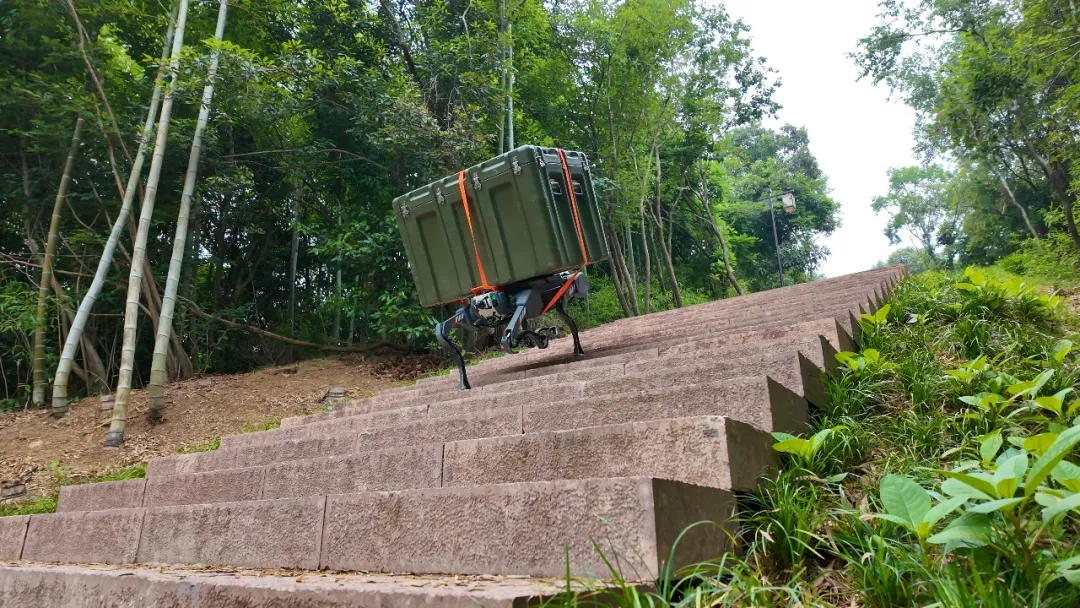
“ Larger loads, stronger traffic, and deep clouds push machine dogs into deep water zones.
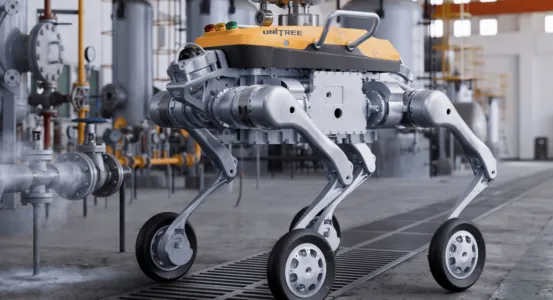
In the exhibition hall, the four-legged robot flipped over the tower, always changing the applause; in the power station, a machine dog climbed a 35-degree slope with 50 kilograms of tools, with few applause around.But the latter is the real watershed in the quad-foot robotics industry.
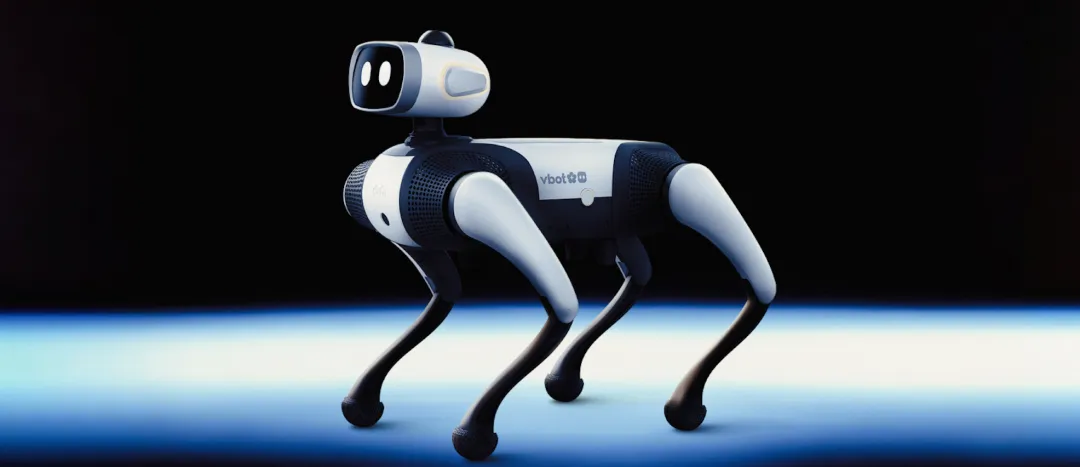
On November 6, a new generation of X50 quadruped robot, introduced by Cloud Deep Technology, incorporated overload and the long-term constraints of passing through the two, into the same product definition: 50 kg of rated load, 3 meters per second of sustained acceleration of two kilometers per second, staying steady on debris, stairs, slopes and empty steel ladders.
This is a set of parameters that the industry needs to stop and read three times. Because any number can be taken out separately, there may be products in the industry that can be touched. But pushing the load, speed, duration of distance, and topography through the four core properties simultaneously pushes the boundaries and ensures a steady landing on the same machine dog has hardly been fully verified in the four-legged robot industry in the past few years.
This was done in the depths of the clouds, and in a way that was very cloud-deep. Not chasing the edges of the boundary parameters, not stacking the instantaneous peaks in the laboratory, but simply answering a hard-core proposition from a real workplace in engineering language.
The question is, when a machine dog is carrying something, running, running for a long time, is it going to be able to survive?
01.
It's a real entry ticket to an industry-class quadruped robot.
In the four-legged robot's parametric competition, the torque load capacity torque has always been the highlight of the competition.But deep cloud technology has made a restrained choice on the X50 quadruped robot, which has repeatedly emphasized a continuous operating load of 50kg.
This differs substantially from the industry's flagship line of maximum standing loads. The gap between the two is roughly equivalent to two kilometers of mountain roads with heavy loads standing for three seconds. The former can convert the load into available operational capabilities, while the latter is more of a pile of paper numbers.
Instantaneous limit load testing is based on whether a structural part can withstand instantaneous shocks and can be achieved by a one-time redundancy design; while continuous running load testing is based on the stability of the entire system in the long run, which must be supported by the engineering surplus of the entire chain.
This is the most fundamental area of product logic in the deep cloud technology imaging series with most similar products. In real workplaces, the question arises as to who can continue to work in dust, debris, slopes and water accumulations.
A real electrical inspection, an emergency fire, an industrial operation on the ground, no task is to keep the machine dog standing still, they only need the equipment to pick up the detection modules, water belts or workpieces and walk perfectly between the debris, slopes and stairs.
Concentrating the indicator on a continuous cubic second is equivalent to converting the verification scale from a short-term peak in the lab to a full beat of the workplace, which is both the choice of the technical route and determines whether the product will ultimately be delivered to the user, whether it is a running parameter or a functioning device.
The indicator of continuous running load of 50 kg is the core threshold sufficient to support industry-level lithium positioning. Behind this indicator is the thermal balance under the long-term high-torque output of the joint motor, the fatigue life under repeated shock of the structural parts, and the stable allocation of power management during continuous operation. Any shortboard will be exposed to lithium continuously in this dimension.
In turn, being able to deliver this indicator steadily means that the system has crossed the threshold of industry-wide application.
For industry users, the meaning of this threshold is specific. For example, electrical inspections. In the mountainous area of Takai, high-altitude lines, roadless field repair sites, there has been a long period of rigidity pain point. Hydraulic tools, insulation substrings, underground line assemblies. These repair equipment, units weighing tens of kilograms, depend entirely on manpower for long distances.
This is where the value of the Imaging Machine Dog is, as it is the heaviest link in body strength for humans. When 50 kg of continuous load capacity, combined with the ability to climb 35 degrees slope, 25 cm of continuous staircase, it is the driving unit that directly intervenes in the operation process.
From the X30 to the new X50, the X30 series has delivered more than a thousand machines, the vast majority of which operate in real lines such as energy, fire and industry. Each machine dog carries a real customer's mission.
High-density real-world scene feedback, which in turn drives the product to complete the role leap. Machine dogs from observer to operator, from information input to capacity extension.
With the continuous loading of the indicator itself, it completed a declaration of the right to speak in the industry.
02.
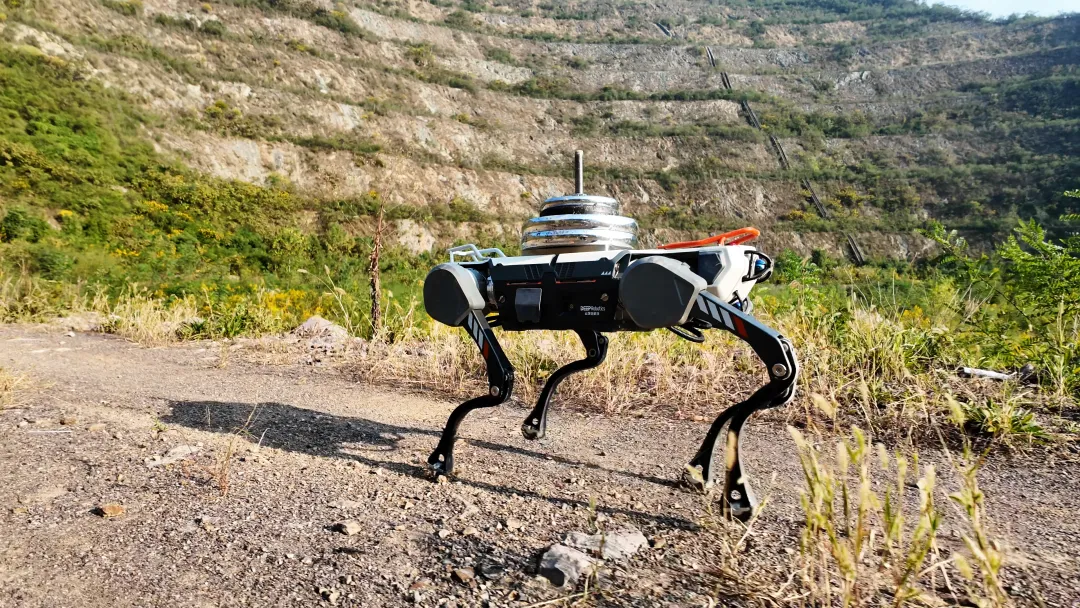
Gesture control is a hard-core technique that is hidden underneath the word "stable".
There is a common misconception in the robotics industry that flexibility and stability are the opposite, that the faster you run, the harder it is to run, and that the more agile you step, the less engineering value you have.The loading dog is most likely to turn around at the moment of dynamic disruption in the loading state. Continuous posture occurs when firing a fire cannon; in the event of a pulled collision, the dog's center of gravity is suddenly shifted; small deviations in body posture can cause a decrease in recognition accuracy when adjusting the detection angle during an electrical patrol.
Inadequate gesture control, light equipment instability, disruption of tasks, heavy loads that slow down the entire operation process, and even pose safety risks.
In the face of this difficulty, the solution offered by the X50 quadruped robot is full-scenes gesture control. This is the key hub for converting pump mobility into pump operation capability.
Deep cloud technology features a new generation of gesture control algorithms and high rigidity fast-response joints on immature machine dogs, supporting flexible configuration of tilting, deflection, rolling angles. Machine dogs are able to real-time decipher bodily states during movement, predict external disruptive forces, advance adjustment of node positions and gesture angles, so that external shocks are gradually eliminated in coordination with the algorithm and the joints, rather than accumulating the risk of overturning.

This ability is demonstrated as step stability while moving and directly determines the accuracy of work when working.
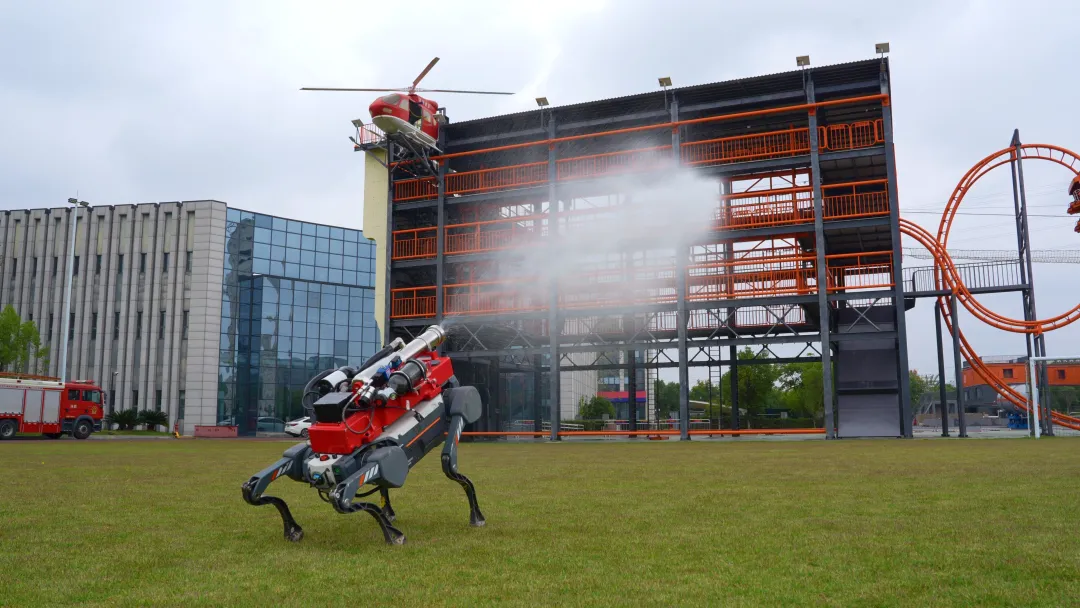
In a fire scene, the value of this set of capabilities is maximized. The seating capacity of a high-pressure water cannon injection is no less than a continuous small vibration for machine dogs weighing tens of kilograms. If gesture control is not followed, the injection accuracy will decrease rapidly, the water column will deviate from the fire point, and the entire firefighting mission will decline from intelligent operation to mechanical performance.
Imaging machine dogs are able to resist post-sitting forces with high rigidity high-response joint systems, with gestural control to lock the direction of the water gun's ejection in the target area, effectively turning the quadruped robot from a mobile carrier into an operational unit that can control the wires in the field.
If understood from an industry point of view, stability is actually a severely underestimated indicator. It is difficult to see in the parameters table. Loads can be written into PPT, speed can be captured in video, but stability under dynamic disruption is difficult to spread in the marketing context, it can only be felt in the day-to-day accumulation of front-line operations.
But it is precisely this poor ability to communicate that determines whether a machine dog is a helper in a real-life situation or an additional burden.
Deep cloud technology has trained the series in a variety of complex terrains for many years, essentially nurturing this indicator. Whether it's the repeated grinding of early silos at power stations, or the ongoing deployment today in situations such as fire, water, and emergencies, all of the accumulation is ultimately concentrated in the same capability: engineering intuition for the stability of the machine in dynamic complex conditions.
Stability is an asset of trust rather than a productivity.
03.
It's about two kilometers of running in response to industry questions.
In emergency situations, a new word is often used: golden rescue time.Within this window of time, the three factors that determine the efficiency limits of the rescue are response speed, passing capacity, and operational capability.
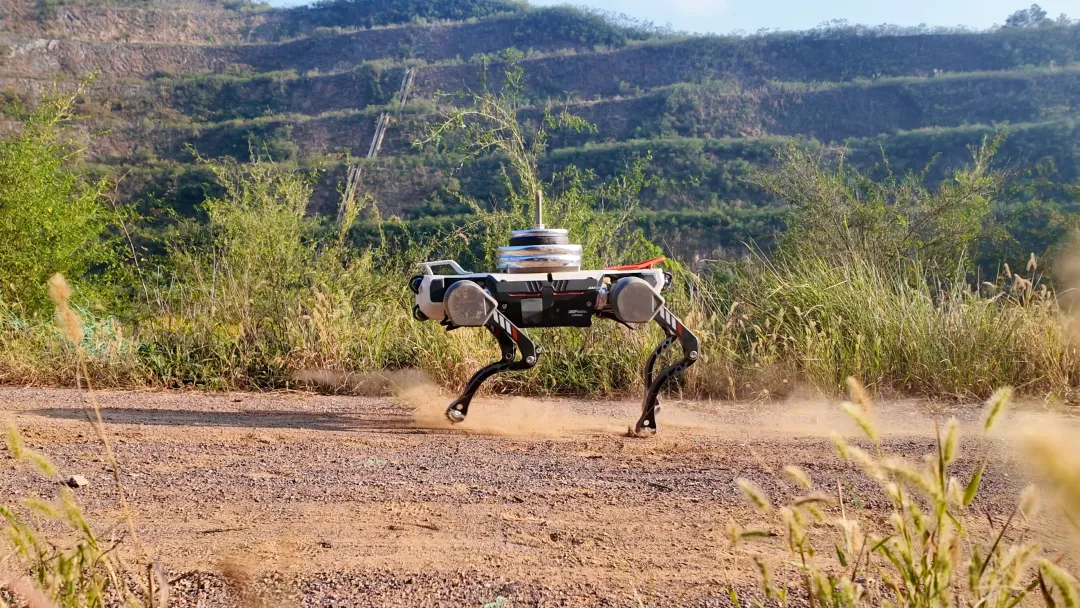
The X50 quadruped robot is capable of running 2 km/s at a rated load of 50 kg at a speed of 3 m/s. 3 m/s is about the same speed as an adult runner. While the X50 quadruped robot can run at a load of 50 kg at a speed of 2 km. It is a systematic test of the entire mechanical power system, joint rigidity, heat dissipation capacity, and structural strength.
In high-load high-speed travel, the impact on the joints is multiplied with each footfall; the power system requires a long period of high power output without decreasing; step control needs to be stable between load and speed.
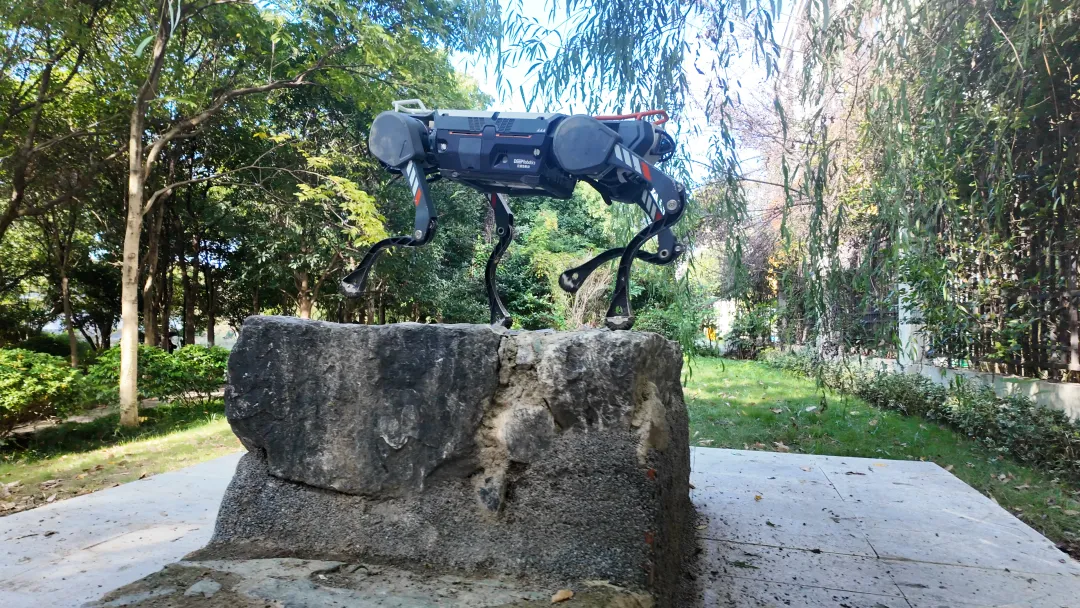
In emergency situations, this means that the machine dog can carry demolition tools, medical supplies and reconnaissance equipment, cross the rubble road in the gold rescue window, overturn the wreckage before the rescue force reaches the core area. In the time book of the disaster site, each minute has a clear value.
Similarly, in long-distance industrial patrol scenarios, sustainability is at the heart of efficiency. A mountain-area transmission line of dozens of kilometers will have a sharp decline in marginal gains if the machine dog is forced to fold due to low load or to shut down due to low power capacity. The X50 quadruped robot has a continuous running life of 2 hours under 50 kg load and a 20 kg load life of 3.5 hours, which means that it can cover multiple routes that have previously required multiple turns, significantly improving patrol efficiency.
When the robot's task radius doubles, the single-step synthesis book is diluted in half, a decision-making basis that is truly of concern to industry-level customers.
04.
Sensory fusion is the defining feature of the last meter of the tube.
A new upgrade to the fusion sensing capability is one of the most underestimated features of the X50 quadruped robot.The motion control of the quadruped robot, in the long run, is a delicate dualism. The control scheme, traditionally based on the model of motion, is steady, but perception and movement are two shades of skin. Laser radar scanning terrain, motion algorithm scheduling, and the delay and error between the two can be dramatically magnified under high load conditions.
A few centimetres away from the landing point, perhaps only a slight deviation of the ankle when loaded; but when climbing the stairs with 50 kilograms of equipment, a single step in the air can be the starting point of all uncontrollable things.
This is the last meter of the most notorious but deadliest of the heavily loaded passenger trains.
The response program of the Imaging Machine Dog is a comprehensive upgrade to the sensing integration. It integrates data from multiple source sensors such as the laser radar point cloud and IMU in real time, converting perception and information input into prediction and decision-making for the next landing point; then, under the framework of the Enhanced Learning Motion Control Algorithm, the perception judgment will be instantly mapped to joint action, forming a complete loop of sensing-decision-executing circuits, achieving visibility, calculation, and stepping.
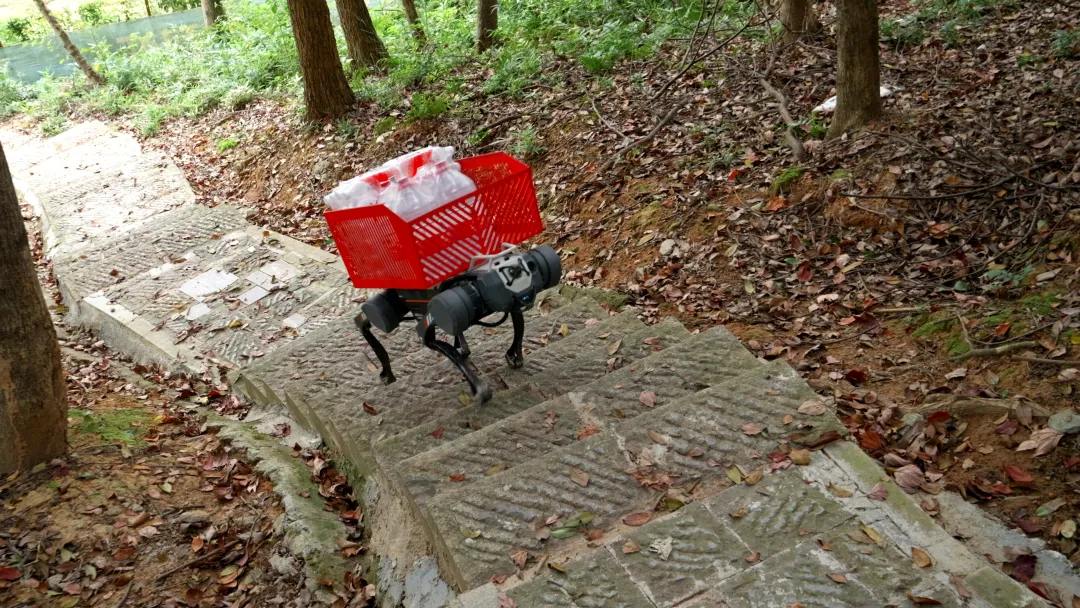
The most intuitive engineering value of this upgrade is reflected in the typical scene of climbing stairs.

Many people don't realize that the four-legged robot climbing stairs and the human climbing stairs are completely different in complexity. Human vision, frontal systems synchronize with the brain in milliseconds, automatically adjusting each step's leg height, ankle angle and body weight. But for machine dogs, the step spacing, level height, and width of each step can vary, especially in industrial settings.
For a machine dog that weighs tens of kilograms, it is possible to set up a machine card in the hallway if you judge wrongly on a landing spot.
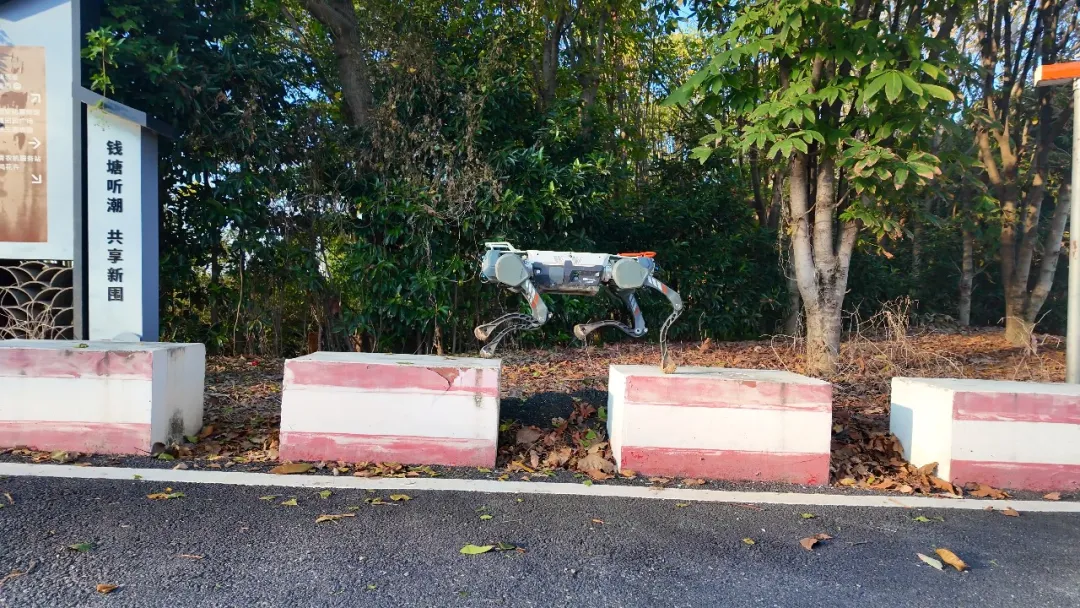
In this generation of products, it achieved steady climbing of 25 cm continuous stairs and adapted to industrial vacuum staircase scenarios. This ability was achieved as a result of repeated training in real-world scenarios. It was able to determine the position of the feet in advance, plan gestures in advance, adjust the joint response in advance, and establish repeatability, delivery, and predictable throughput.
For industry customers, this certainty is more important than any extreme traffic data. Because the industrial scene is unlucky. The escalators in the fireplace, the empty steel stairs in the boiler room of the power plant, the pipeline platform in the chemical plant, will not be allowed to operate because the machine dog is likely to have approved its operation in the past.
This extreme pursuit of certainty is the common direction for all technological inputs of deep-cloud technology robotics. Whether it is the long-term autonomous operating capability that has been accumulated in previous conversion station twin-engine collaborative surveys, or the complexity of the terrain manifested in situations such as emergency defense, the same technological philosophy is behind it.
Perception is the input of data, control is the output of behavior, and reinforcement learning is the decision-making engine that constantly alternates between the two. Every time a real-life scenario crawls, crosses, or steps into the void, the self-correction accumulates data for the next better decision.
05.
The overload of machine dogs is a value deep in the clouds
Through the launch of the X50 quadruped robot, cloud-based technology is truly transmitting a sense of judgment and belief about the industry.The value of a four-legged robot is ultimately measured by the weight it takes in a real-life scenario.
There has never been a shortage of machine dogs in the industry that can flip their heads, jump to heights, or run at incredible speeds in videos. The industry is always scarce, with 50 kg of tools on its back, climbing 35 degrees up mountain roads, steady posture in bumps and bumps, and still stable operating class equipment after two kilometers of continuous running.
Because products like this can only be soaked from countless real scenes, from the roads that carry heavy mountains, the stairs that go through the smoke and rain, the engineering experiences that are repeatedly crushed in power stations, fireplaces and tunnels.
IDC's latest Global Quad-Foot Robot Market Share, 1H26, shows that in the first half of 2026, the global Quad-Foot Robot Industry Application Market exceeded $270 million, an increase of 125.1% compared to the previous year. This is the second year in a row that the authority has made the same certification after the first global Quad-Foot Robot Industry Application Revenue in 2025, according to the Sullivan Report.
This position is underpinned by a deep understanding of cloud-based technology and the recharging of silicon at the industry level.
At a time when the industry is still debating limit parameters, deep cloud technology has absorbed the three terms sustainable, reliable, and delivable into every detail of a product.
Negative weight forward is the most polite gesture of an industry-class machine dog.