“ Vbot DEV is trying to fit the entire development environment into 20,000 yuan.
Vbot is no stranger to readers who are interested in the robot lecture hall. Vbot is a regular visitor to our community and online activities, and many readers are users of it themselves.
From appearance and interaction, to mobility, perceptual systems and computing platforms, it has been a distinctive feature of the consumer-grade machine dog and has gained market recognition. These inherent abilities also appeal to developers: if it can be further invoked and expanded, can it accomplish more of its own designed tasks?
According to Vbot, developers have previously hoped to launch a development version aimed at Polaris to make better use of the perception, computing and mobility of the main characters. For this group of users, machine dogs are both smart partners who can participate in everyday life, as well as a development platform that can connect exteriors, run code, and realize creativity.
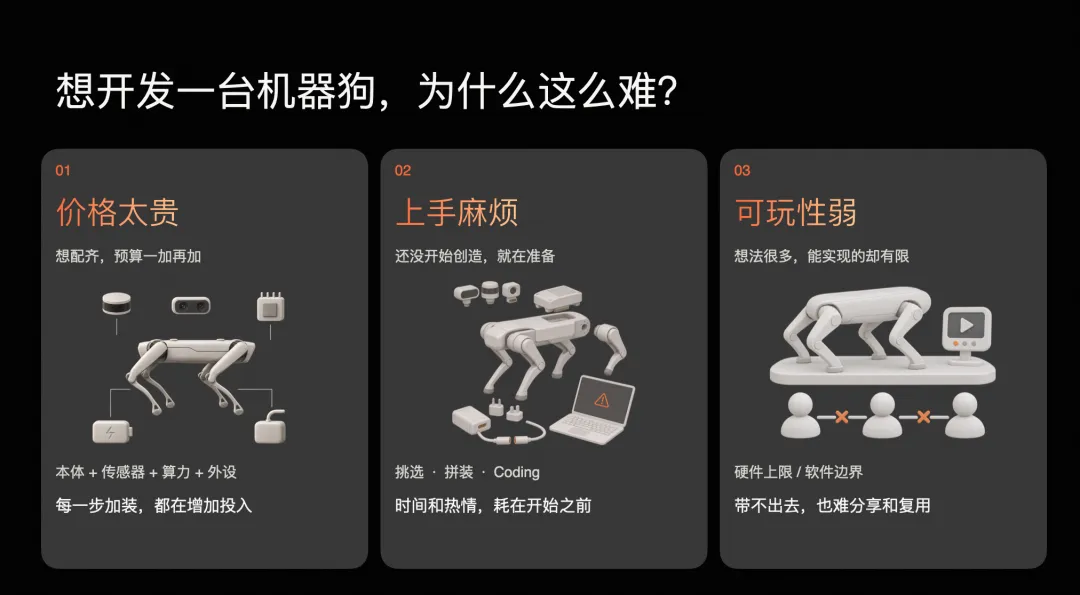
But from idea to application, individual developers still face several barriers. The cost of acquiring quadruped robots that support secondary development often reaches tens of thousands of yuan; some products also require additional purchases of equipment, configuration environments, the development and adaptation of basic functions to complete navigation, vision, voice, etc. These work require more time, and the degree of computing power, expansion of interfaces and software openness also affects the extent to which creativity can be achieved.
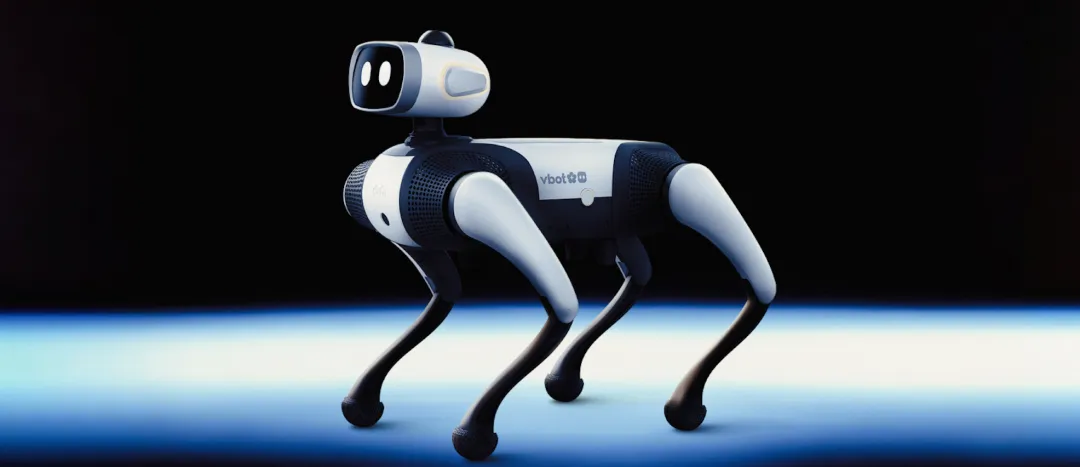
On November 10, Vbot Vita Power officially released the DeV DeV DeV developed version of the DeV DeV developed for personal developers and polar users, with an official guide price of $22,988.
DEV continues its native advantages in motion, perception, and computing, further providing a complete software functionality base, open interfaces with AI native development tools, enabling developers to create in-depth based on mature product capabilities.
For Vbot, this is an extension of a product that responds to the needs of developers; for individual developers, the budget of a MacBook Pro would allow them to access a more complete set of software hardware development platforms, reduce additional equipment purchases, build environments and build infrastructure functionality, and spend more time on their own application ideas.
What makes Vbot DEV the most valuable quadruped development platform in the field of embroidery? It needs to speak from the configuration, capabilities and development it provides.
01.
At 20,000 yuan level, the software and hardware are aligned.
If a four-legged robot cannot be a development platform, the hardware configuration determines what it perceives, what it operates on, and how much further development the developer can do on it.
The Robotics Workshop found that DEV's configuration was the flagship for a development platform.
DEV first provided a set of hardware combinations covering spatial perception, visual recognition, positioning and voice interaction. It labelled 360°16 linear laser radars, 1080P depth dual vision, UWB positioning and four microphone arrays. Laser radars helped machine dogs perceive surrounding space, dual vision provided depth information, UWB added positioning capabilities, and microphone arrays provided hardware for voice interaction.
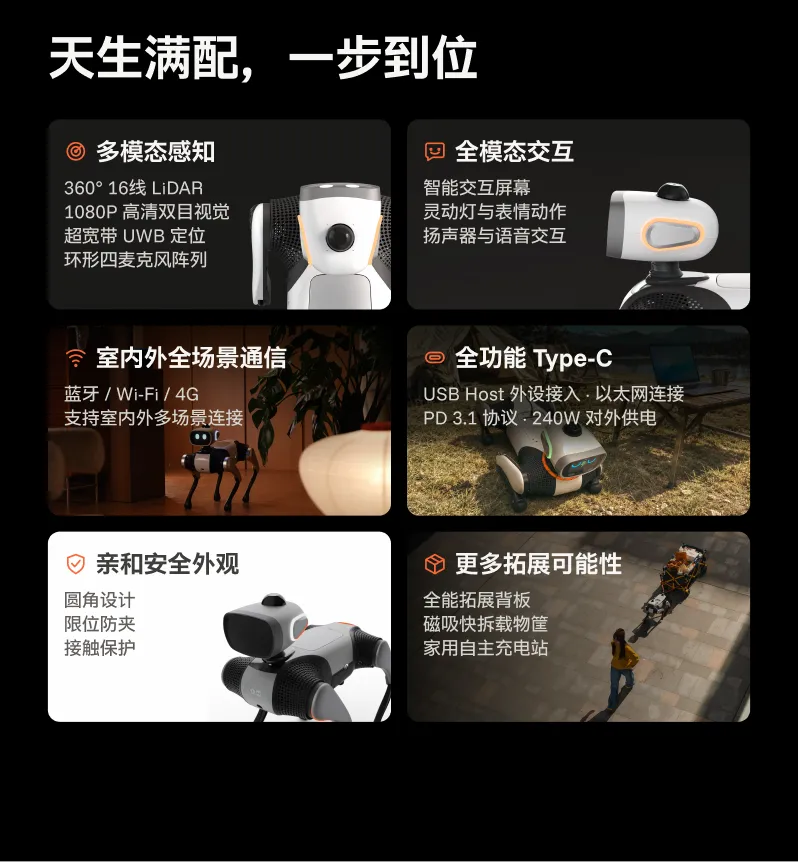
From an overall configuration point of view, this means that developers can develop applications around these devices such as environmental perception, target identification, spatial positioning and human-to-human interaction without having to purchase equipment separately to build a set of basic perception systems.
Computational configuration is also an important part of DEV. It is equipped with 128 TOPS AI, which uses a dual-platform 12+4GB memory configuration to provide computational support for end-side visual recognition, local VLM applications, and multi-modal interaction. For developers who want to run AI models on machine dogs, end-side computation is directly related to whether applications can run on the robot itself, and whether interaction responses can be more timely.
In terms of durability, the DEV is equipped with a 594Wh battery, with a range of 3 to 5 hours and about 10 km. The larger battery capacity provides more space for outdoor testing, long-term modulation and continuous mission operation.
From the standpoint of similar product configurations, the combination of DEVs is very competitive.
The U2 Go2 X is positioned as a semi-consumer experience with light development, the second development is partially open, the official price is 29,999 yuan, the calculation is 6 TOPS, the battery capacity is 236.8Wh; the flagship version of the Vietnamese Rover X1 sells for 44,999 yuan, using 40 TOPS Orin Nano calculation platform, the battery capacity is 201.6Wh; the flagship version of the U2 Go2 EDU is geared towards scientific research and education, the XT16 package sells for 89,999 yuan, the calculation is 128 TOPS, the battery capacity is 432Wh.
It can be found that at relatively computational levels, DEV prices are significantly lower than the Go2 EDU package; in addition, DEV is higher in computational and battery configuration compared to the Go2 X, while incorporating perception, interaction and development support into the whole machine.
While different products differ in chip platforms, sensor portfolios, and location, DEV offers high hardware configuration, software capabilities, and development support for individual developers with limited budgets who want to develop rich applications directly, and at a price of just 20,000 yuan, it is undoubtedly a high quality value among similar four-foot development platforms.
In addition to hardware, DEV also provides a wealth of expansion space for developers.
The body is equipped with a full-featured Type-C interface that supports USB Host, Ethernet, PD 3.1 and up to 240W external power supply; while retaining a physical expansion screw, it can install camera brackets, backboards, loaders, and other DIY accessories. Whether adding a set of visual devices, or accessing speakers, projectors and other external devices, it can continue to expand around the existing platform.
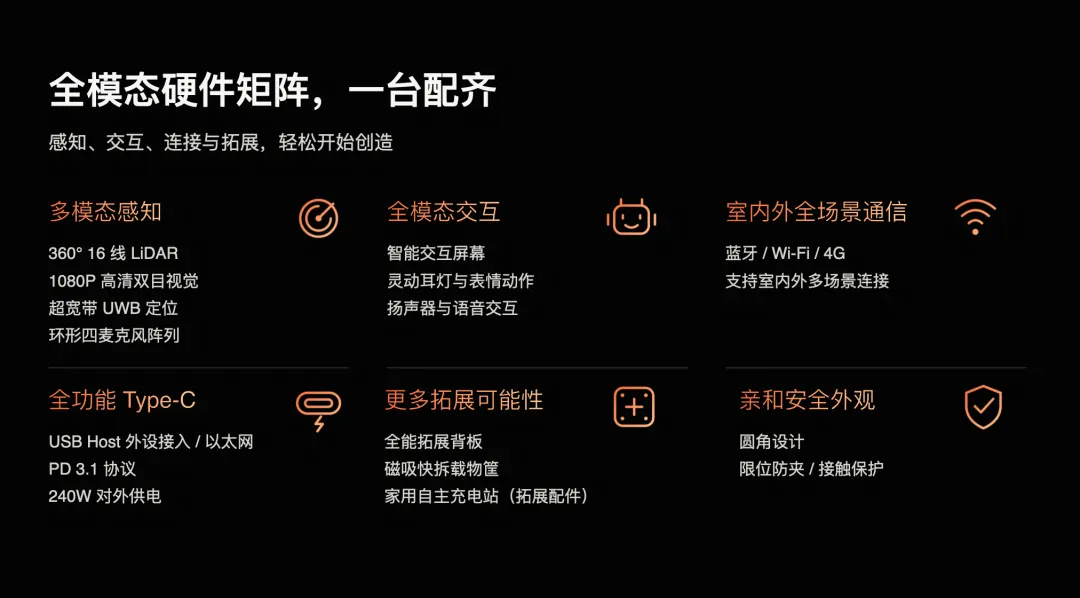
For Polaris users, these interfaces mean that machine dogs are no longer just a closed sporting product. Developers can change the exterior, modify the appearance, or even redesign the way they use it according to their creativity.
If the hardware determines how many devices a machine dog can connect, the software determines whether the developers can directly call on these capabilities.
DEV provides six main functionality bases, including spatial memory and navigation, pulling and tracking, local visual recognition, voice interaction, RCP robot control platform, and action packet storage. Developers can directly use existing navigation and tracking capabilities to superimpose their own visual algorithms, voice commands, and task logic.
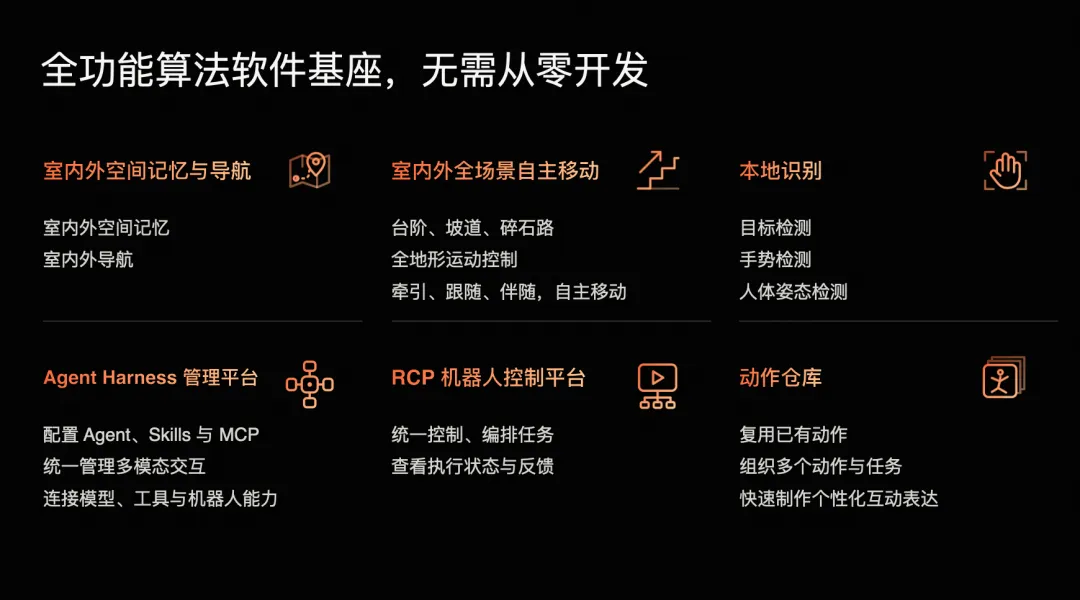
In terms of software openness, DEV is compatible withROS 2 and is open-source from the R&D distributed middleware Aorta. In addition to SDK, MCP, Skills, development documents, model assets and simulation Studio, developers can choose tools based on their own technical routes or deploy them to real machine dogs through simulation environment verification functionality.
From hardware to software, DEV integrates development conditions that were originally scattered across different nodes. Developers don't have to spend a lot of money to buy a sensor, then spend time building a navigation and interaction system, and then have the ability to develop it a second time around existing capabilities.
02.
From writing code to saying what needs to be done, it's easier to develop machine dogs.
The most notable capabilities of DEV are the way it is developed. The hardware determines the bottom of the development platform, and the development toolchain and development paradigm determines its upper limit.
For individual developers who want to experiment with physical intelligence, DEV wants to make sure that developers don't have to spend a lot of time and money on infrastructure to put more energy into their creativity.
In the past, developing a robot often required developers to be familiar with operating systems, communication protocols, sensor interfaces, and motion control. Even for a simple function, they had to go through a number of stages such as environmental configuration, interface learning, code writing, and functionality modeling. This process is relatively familiar to professional robot developers, but the threshold is not low for more interprofessional individual developers.
DEV attempts to reduce the friction of this link with a combination of tools. In development support, DEV provides SDKs, MCPs, Skills, ROS2 compatibility, Aorta intermediates, and ROS2 compatibility enables developers to connect to existing robots; Aorta serves as a self-developed distributed intermediate to provide underlying support for higher performance and scalability; and Simulation Studio enables developers to verify prior to machine deployment, reducing trial error costs.
A detail that can be easily overlooked is Wi-Fi direct connectivity. Many quadruped robots still rely on wireless connectivity, limited mobility, and decaying modeling experience when outdoors modeling. DEV supports Wi-Fi direct connectivity, allowing developers to directly connect devices in outdoor scenarios, access to software versions and data inputs, which is especially important for real-world development.
The real difference lies in AI native development and Vibe Coding.
DEV is aimed at optimizing the development process of the Agent, where developers can use the AI Agent to search for interfaces, write code, and debug programs. The Vbot team's demonstration of the case of a smart home manager demonstrates the feasibility of this link. The user says, "I feel a bit dry, the environment is a bit dry, the machine dog needs to complete voice understanding, needs to analyze, connects to the device, arrange tasks and perform actions, automatically turns on the humidifier; the user says, "I'm going to get out of the hatch", and it checks the lights, turns off the unwanted lights and returns the voice.
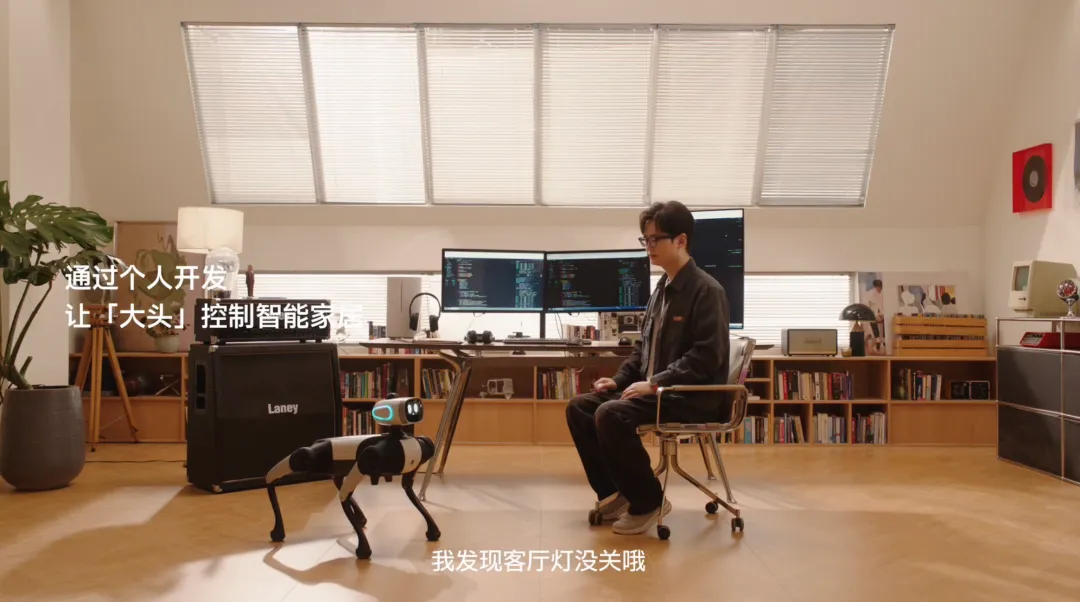
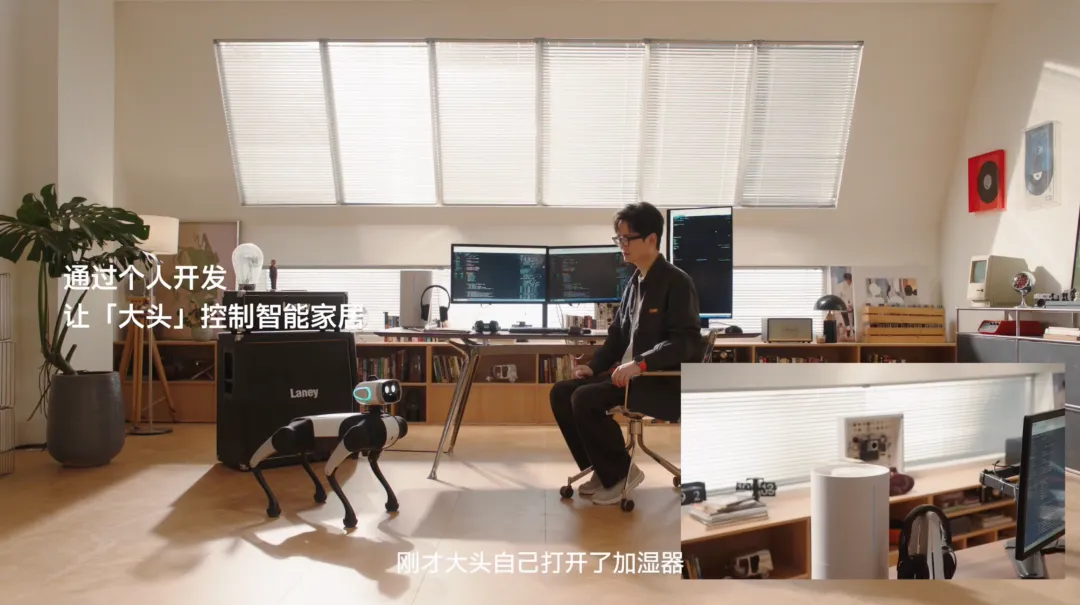
Seems to be a simple interaction, behind which is voice understanding, device connectivity, collaboration between task compilation and robot action execution. Developers describe needs to the AI Agent in natural language, assisting the Agent in reading code, SDKs, MCPs and Skills, completing deployments, and then responding to real machine feedback.
In the past, developers needed to connect these links one by one. With the functionality underpinnings and AI development tools provided by DEV, developers could focus more on application logic and then complete interface search, code generation and debugging with Agent assistance.
In terms of technological trends, this represents a new entrance.
AI programming is changing the way robots participate in development, and in the past developers had to master programming languages and robotic frameworks to translate their ideas into code; now, the threshold is shifting from grammatical ability to demand expression and system integration.

However, this does not mean that engineering skills are no longer important. On the contrary, AI native development is really available, the platform must provide stable atomic capabilities, clear interface borders, replicable Skills and reliable simulation verification closures. Otherwise, the code generated by AI will only transfer the cost of debugging to the developer.
This change is especially important for developers with a non-robot professional background. For example, a person familiar with a smart home can try to make a robot dog a housekeeper; a person who is good at visual algorithms can develop new recognition features; a polar opposite who is interested in interactive entertainment can also combine voice, action, and appearance modification.
AI programming is making robots develop from the exclusive skills of professional engineers into a technology practice in which more creators can participate.
Machine dogs also have the opportunity to become a new carrier of AI applications into the physical world.
03.
Developers are redefining machine dogs from hospital accompaniment to companion dogs
Prior to the launch of the DeV Polaris development version, Vbot had been supporting developers to explore more applications of quadrupeds through activities such as hackathon.
At the SheNicest hackathon in August 2026, the Robotics Workshop found that polar bears from different professional backgrounds had developed a number of creative explorations, three of which brought us to the limelight.
For example, the Penguin Project attempted to bring a machine dog into a hospital, explored the creation of an AI hospital companion robot, a project that combines autonomous navigation, voice interaction and tracking capabilities to provide patients with in-patient pathway and process reminders. To make the accompanying process more natural, the team also designed a distance monitoring mechanism: patients with a machine dog are more than 3 meters away and last for 2 seconds, the machine dog will stop and wait for the patient to return to a safe distance and continue to navigate.
It can actively invite users to exercise, extract key points from the human body through YOLO Pose, identify the user's jaw posture, recall and reorganize the machine dog action library, complete the action simulation. It is accompanied by voice awakening, motion area recognition and safety avoidance, and can involve users in the exercise process, providing a more interactive companion experience.
Barbie, for example, opted for a more creative IP direction, with the team using 3D printing to create head covers, clothing and decor, combining video IP images with quadruped robots, and adding AI conversations and interactions, giving virtual characters physical shapes that can move, express and interact.
From hospital accompaniment to the home movement, to the materialization of IP, the works present the different ideas and possibilities for developing quadruped robots. Developers can call on navigation, vision, voice and motion capabilities according to specific needs, and then build their own robot applications through external expansion and appearance modification.
The three works, the same machine dog, different external combinations and software logic, are expected to become hospital assistants in the future, sports partners in the living room, and interactive characters with unique characteristics.
From this, it can be seen that openness determines the space to apply innovation, the boundaries of a machine dog's ability, largely to see how many things can be installed, how many games can run. But there is no doubt that the imagination of the developer, who is on a super valuable machine dog, opens up more space for innovative ideas.
Vbot is also continuing to build a developer ecosystem based on this highly valuable product. For example, around the "thousand-person co-creation program", Vbot aims to recruit 1,000 smart developers globally to support developers running their own robot algorithms on the platform. At the same time, it has also expanded its development tools and ecosystem resources through hackers, developer communities and technical support, connecting creators from different professional backgrounds to allow development experiences, applications and technical resources to be exchanged and shared in the community.
Because the ecosystem of innovative developers is not just about bringing a bunch of people together. The tool chain needs to be continually improved, the interface needs to be stable, development cases need to be repeatable, and great works need to be shown and accessed to real-world scenarios.
Once the participants expand, the change will not only occur in sales. More people from different professional backgrounds enter, which will lead to more subtle needs, more unexpected ideas and closer to life application exploration. For example, the aforementioned hospital accompaniment, foster companionship, IP materialization of these creative exploration works have shown that the same machine dog can access different scenarios through software and external combinations; as the number of developers continues to increase, the limits of machine dog ability will also shift from the manufacturer-defined product functionality to the list of applications co-written by more developers.
The next stage of the four-legged robot competition will not only revolve around the physical parameters, but will essentially revolve around who can make the development environment, toolchain and ecological input more complete, and Vbot is undoubtedly the champion.
04.
When more people are involved, robot innovation is just getting started.
In the past, the value of a machine dog was largely measured by how many preset tasks it was able to complete. As development entrances gradually opened up, it could be redefined by another group of people as more overvalued products such as Vbot DEV emerged.
When more developers are able to turn their ideas into new robotic skills, the application boundaries of machine dogs will no longer be limited to the functionality of the product that the manufacturer originally set up, not just how much functionality it has when it goes out of production, but how many people can recreate it.
When a machine dog starts running in a few days with an idea, this is the real super-value dog.