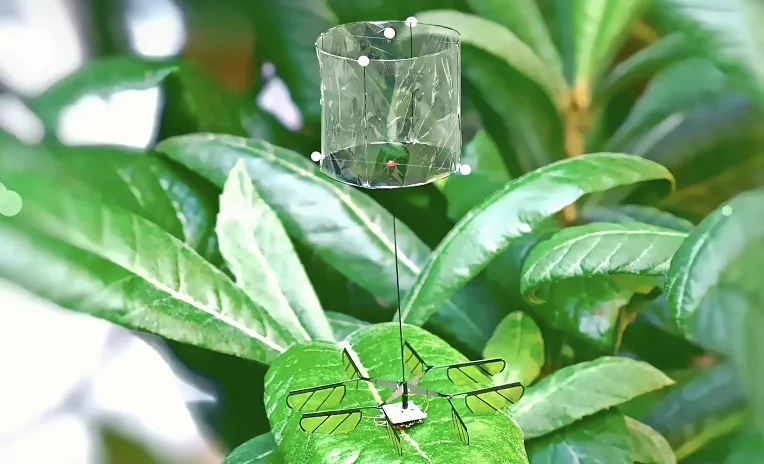
“ A team from the Department of Defense attacked the difficulty of integrating AAC-class flying robots.
In the field of micro-robots, creating a flying winged flying robot with a weight limit of less than 1 g, i.e. AC, is a very challenging engineering challenge.
Due to its extremely limited weight, it cannot carry large-capacity batteries and does not fit into complex flight control chips. In order to keep it off the ground, past schemes often only compromise, either by making a bracket to leave the flight barrier and dragging the power line behind it; or by using ground lasers to continue to provide illumination, and the light source drops off immediately. Some slightly heavier 2.1-g versions, such as the Toyota Tobot-BAT, although with batteries, completely abandoned posture control, can only calculate short uncontrolled takeoffs.
Short distances from the ground, with continuous, steady autonomous flight, are two completely different scales in engineering implementation.
Recently, a team from the Laboratory of Microsystems Technology at the National University of Science and Technology and the MEMS Research Center in Hunan published a study on a completely new winged flying robot in the journal Nature Communications.
With a wingspan of only 6.8 cm, the robot weighs only 984 mm. It not only lasts more than 240 seconds (4 minutes) without connecting to external cables and is fully powered by its own 3.7 V lithium-ion battery, but also reaches a maximum altitude of more than 10 meters.
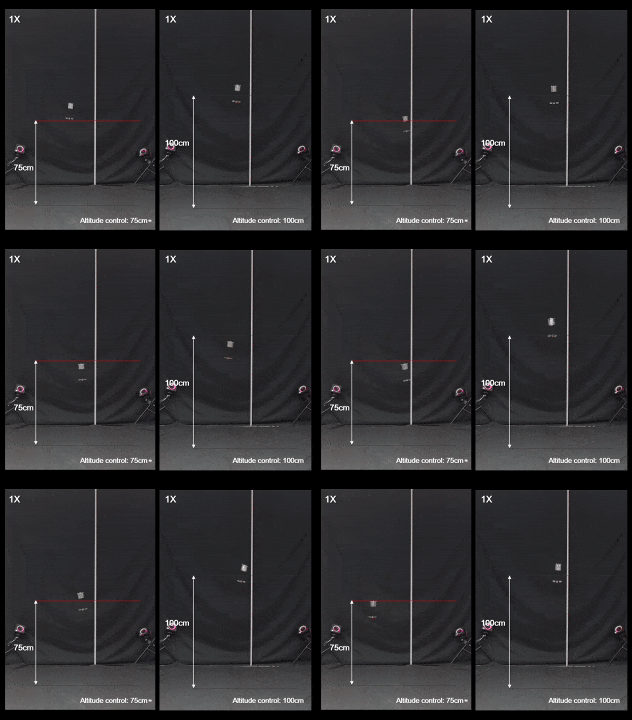
How did this winged flying robot complete system-level integration under strict weight restrictions?
01.
It resonates like a forklift, turning vibration into lift.
For winged flying robots, the first solution is efficient power output. Traditional straight-line dual-drive structures can easily trigger body resonances when pressurized ceramic plates vibrate high frequency, resulting in significant energy loss in unnecessary vibration of the body, resulting in limited lifting power.
The robot, codenamed FwW-Flycan, uses a cross-shaped four-stroke electrically directed V-wing structure. Its core principle is borrowed from the resonant forks vibration model cylinder in acoustics, as well as the symmetrical vibration of the four interspersed voltage-driven modules, which effectively offset the body's torsion and clutch loss.
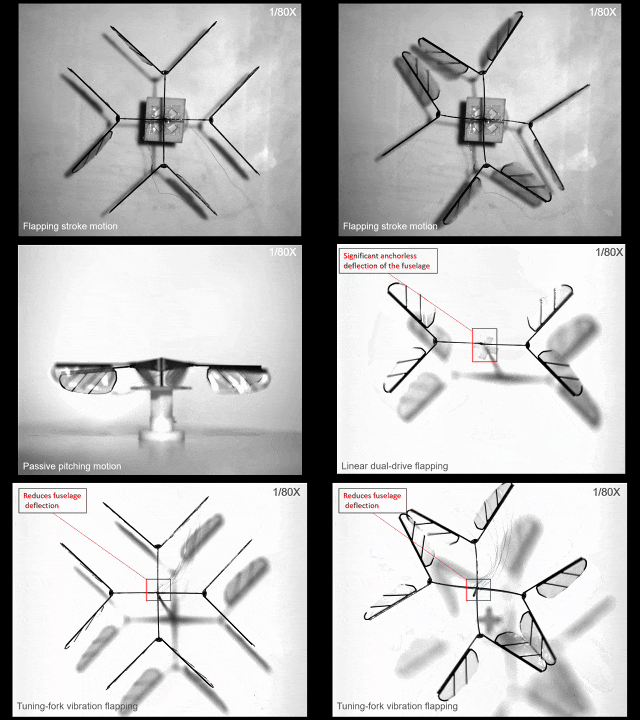
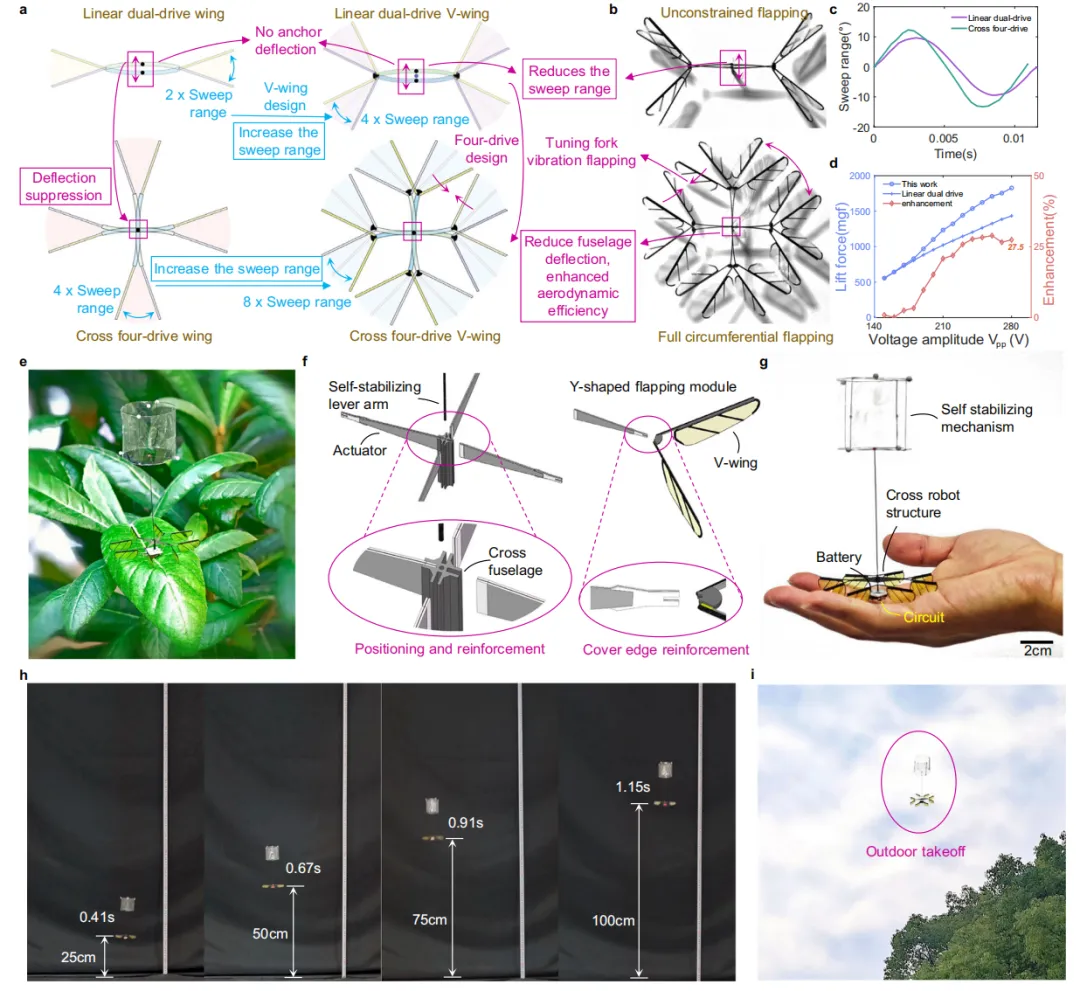
This design converts the vibrational energy that was originally consumed internally into a wings-efficient wings-to-wings torque. The data shows that its effective torque angle reaches 13.3°; at the same driving voltage, the maximum lifting power reaches 2.55 times the conventional linear structure, enough to lift 1,850 milligrams of weight.
This means that the aircraft's own mechanical body (which weighs 389 milligrams) has enough lifting redundancy to support the battery and circuit system.
02.
173mm micro-module, powered by hundreds of volts of high-pressure drive
After the air efficiency solution, the drive circuit is the next threshold. Pressurized ceramic drives require 100 volts of high voltage, while micro robots can only carry a 3.7V micro-aluminium battery. How to achieve the elevation and make the circuit extremely light?
The team developed a millimeter-level high-voltage drive and control electronic system (HVDCE). The two-layer flexible circuit board has an area of just 9 mm x 10 mm and weighs 173 mm. It converts 3.7 V DC to 200 V-300 V AC, with an overall drive efficiency of up to 45%, via a front-level anti-heat voltage and a reverse-level full-bridge circuit.
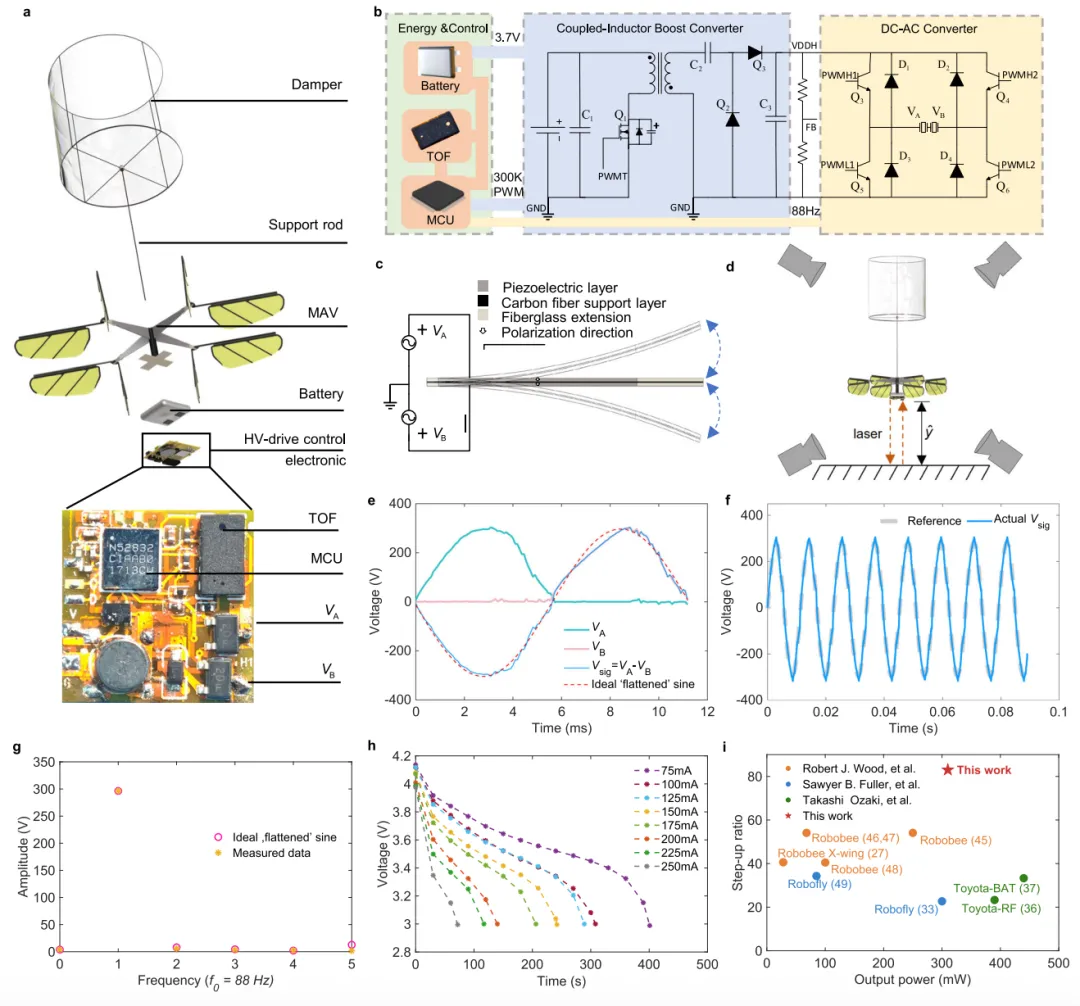
In addition, the system is highly integrated with a single-chip machine, Bluetooth communication modules, and a key ToF (flight time) laser range sensor. This microelectronic system not only solves the problem of high-pressure drive, but also constitutes a hub for the perception and interaction of wing-flying robots.
03.
Passive self-stable lithium to replace complex calculus
In a body of less than 1 g, adding complex flight control calculations is extremely difficult. The team has adopted a strategy that focuses on postural stability and the use of passive-physical mechanisms.
Due to the addition of batteries and circuits, the robot's focus will inevitably shift. To compensate for this instability, the team installed a 70 mm long carbon fiber blocking arm at the top with a cylindrical air blocker.
When a winged flying robot is tilted, air resistance naturally generates a recuperative torque that pushes it back into a straight-line state. This pure-physical passive self-stabilization design greatly reduces the reliance on active control algorithms while giving the robot some resistance to interference.
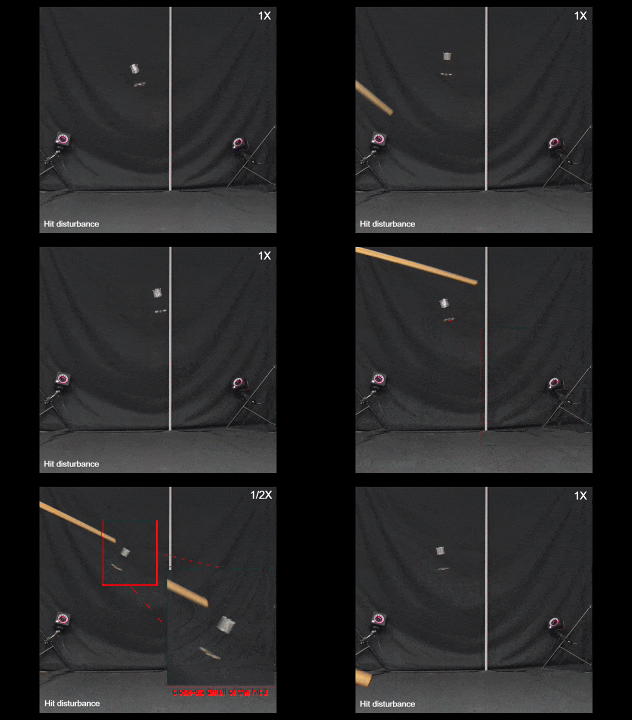
With a stable posture, high sensing is also required. The ToF sensor at the bottom of the body is laser measured at a frequency of 100Hz, and the flight control is dynamically adjusted to drive the voltage at a frequency of 50Hz, forming a closed loop. In the observations, the winged flying robot achieved a suspension not only at a height of 100 cm, but at a height of 50 cm more stable suspended for more than 1 minute, with no apparent height drift.
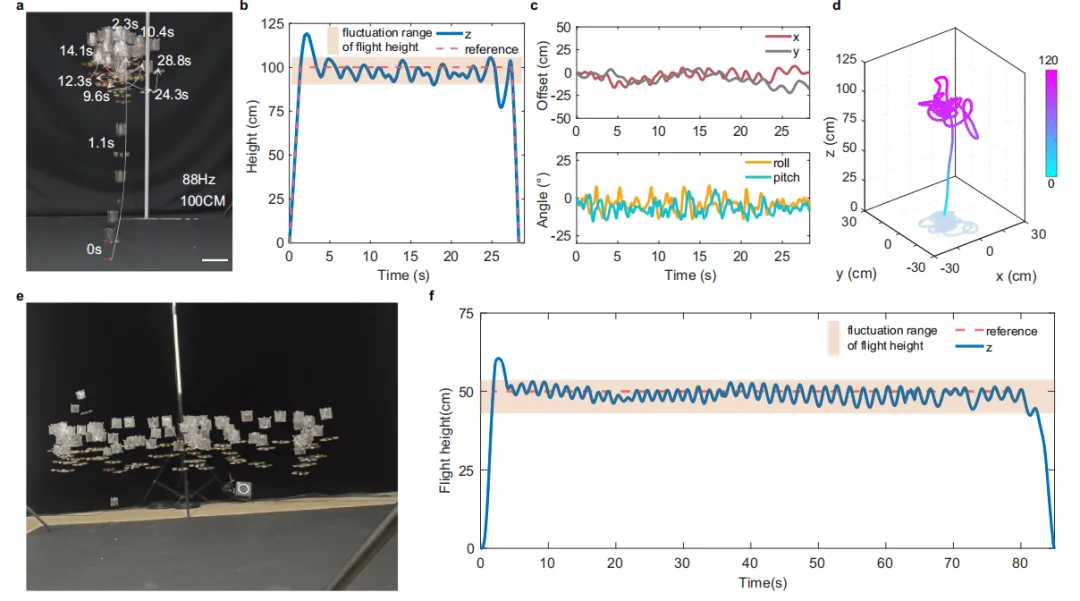
Of course, the paper also points to the current limitations. Minimum modulation steps of 5-10V drive circuits can cause up-and-down fluctuations of several centimetres when suspended; at the same time, there is still the phenomenon of slow deviation of the robot when suspended due to the small physical differences in the four voltage executors. However, under the AC system, this has been an important advance in system-level control.
04.
Differentiated route of Chinese winged flying robots
The major breakthrough of this paper was that it ran through the system closures of the Ajax-class+ wireless+ or high-altitude systems. Throughout the study of domestic wing flying robots, different top teams based on different weights and application goals have presented a clear differentiated layout.
Northwestern Industrial University: A 30 kg to 3 kg avian wing-like robot focused on true wing-like aerodynamic design, long-range and engineering applications in complex environments. Its latest 90 kg NPU-Sparrow class uses a bionic wing tail + wing tail synchronization to achieve cruising efficiency and mobility, representing the team's latest exploration in the direction of micro- and agile flight.
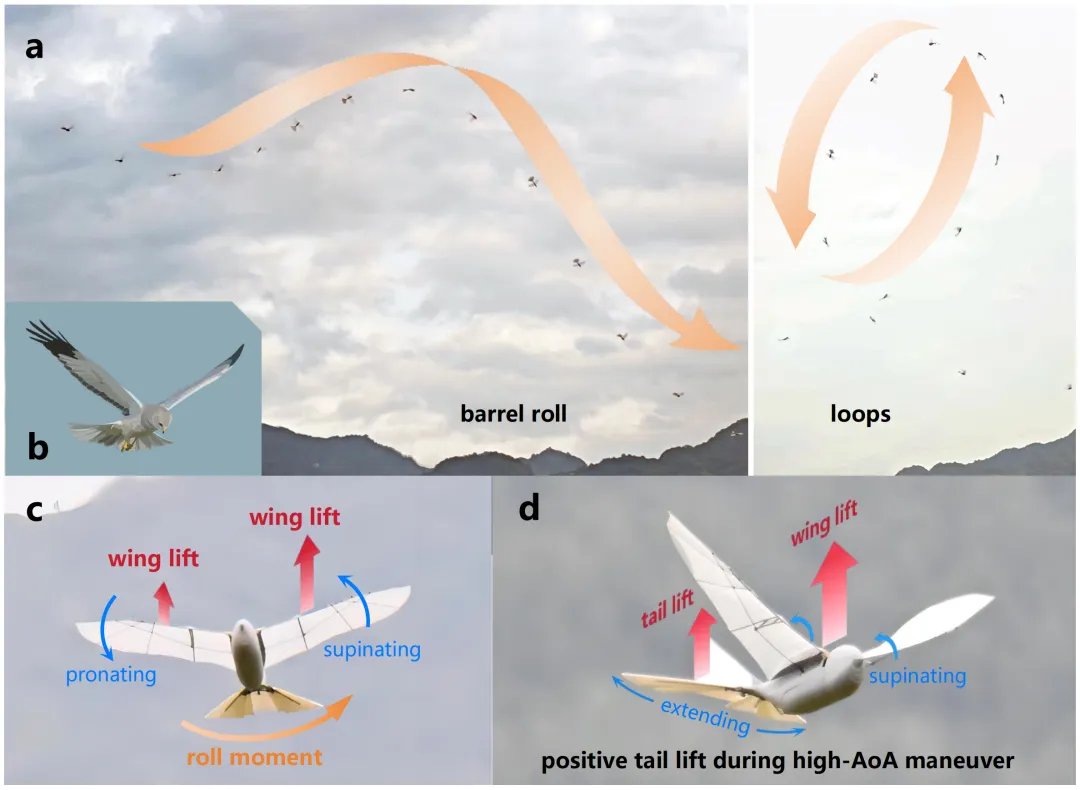
The NPU-Sparrow, a small winged robot from Northwestern Industrial University's School of Aviation, combines cruising efficiency with mobility.
Shanghai University of Transportation: Compared to the extreme micro-shrinkage of aluminum and aluminum-shaped biomaterials. There are both <100mm-scale micro take-off and torque control studies, as well as 600g-scale high-motion winged winged robots with real wings.
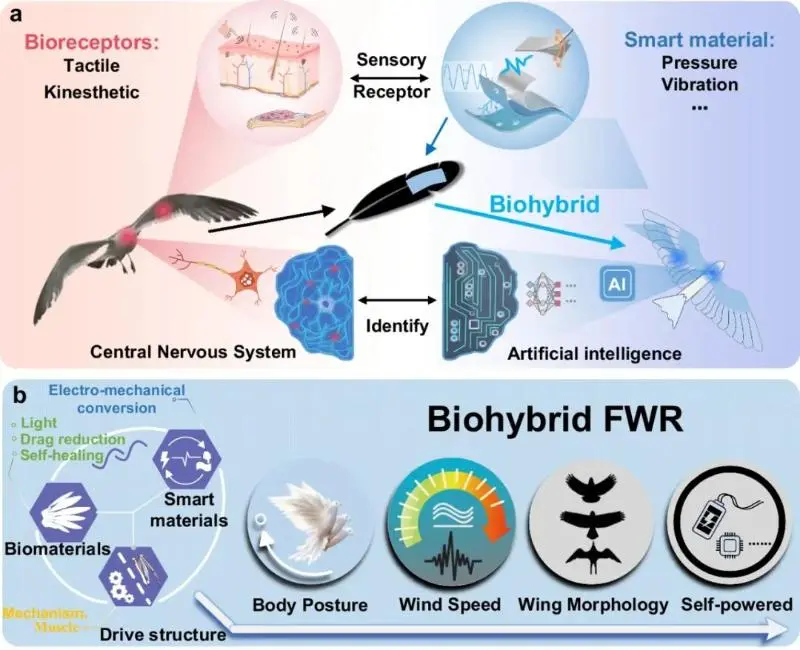
Tsinghua University: Focusing on new materials with multiple drives, such as the 26k-class butterfly-like robot, and the suspension studies using the 200mm-grade transurethral electrolyte (MUS) to expand the drive boundaries of the robot.
National Defence Science and Technology University: Deep-farming AC-class wireless system integration. Integrating mechanical structures, high-voltage circuits, passive stability and sensor closures into a system of less than 1 g represents an engineering solution for continuous wireless flight under this particular weight class.
05.
The Future and the Word
From a brief detachment from external lasers, to a few minutes of steady flight with self-contained batteries, the AC-class winged flying robot finally broke free of the shackles of the cables, crossing the threshold of laboratory demonstration towards practical exploration.
Currently, it has a power output of about 634 megawatts in the closed-loop high state, with a battery life of about 125 seconds and a long distance of autonomous operation. However, this study has verified the feasibility of a system-level integrated pump in a physical cage of less than 1 g, installing batteries, circuits, sensors and achieving stable flight, which is entirely engineered.
In the future, with the rise of battery energy density and the introduction of chip-level circuit design, this winged flying robot capable of performing missions in narrow space, with the potential to play a difficult role in areas such as post-disaster search and rescue, limited space patrols, and more.