The year 2026 is coming to an end, and a number of publicly traded companies have recently released their results for the third quarter of this year. Looking back at this year's robotics industry, from the hustle and bustle to the cooling down, from crazy tickets to the performance, to the divestment of capital and the PR jacket, the results may be a way for us to get closer to the truth of the industry.
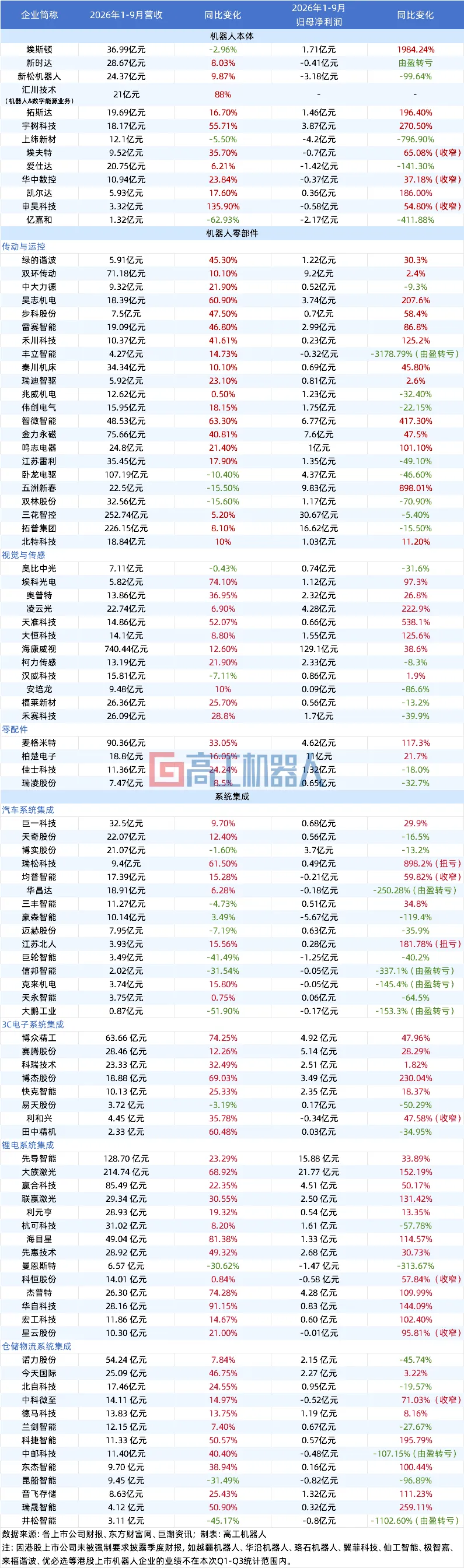
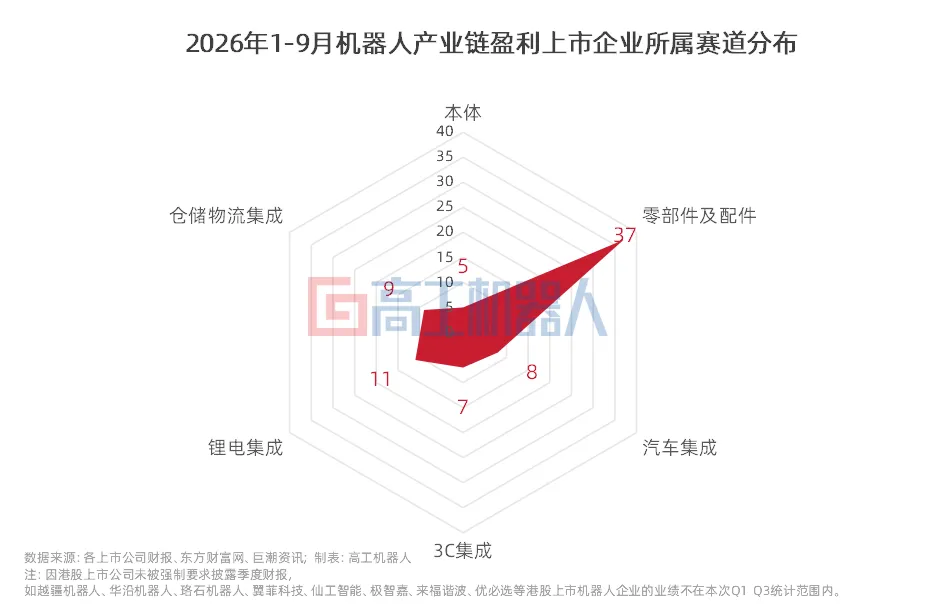
However, there is a significant gap between the company's earnings growth and the company's earnings growth, and the profit pressure is still high on the robot corporations, with more than seven of the above statistics being at a loss, with only six corporations, including Aston, Topsta, Utrecht, Keldar, Eft, Shenzhen and Shenzhen, experiencing net profit growth, lower overall earnings, and sharp dividends.
For this reason, on the one hand, the industrial robot market is still in a competitive environment in which the price and quantity of robots are exchanged, and on the other hand, the rise in the cost of precious metal materials, parts, and the continuous investment of superimposed intelligence has brought enormous pressure on cost control.
In the first three quarters of the year, both industrial robots and humanoid robots led the way, and Aston, Utrecht and Tech returned to their net earnings growth of 24% and 270.5% respectively, respectively, according to the profit performance growth chart.
Compared to the satisfaction of home manufacturers, can be used to describe the boom in the parts industry in 2026. According to high-tech robots statistics, in the third quarter of this year, 33 of the 38 companies listed on the market for robotic parts, about 87% of revenue achieved the same growth, in addition to wealthy intelligence as a loss, the remaining 37% were in a profitable state, and about 6% of parts enterprises' domestic net profits showed positive growth.
This barbaric growth trend is particularly reflected in the increase in earnings. On the one hand, the revenue growth of some parts enterprises achieved the lead, and in the first three quarters of the year, the revenue of some parts enterprises increased significantly by more than 50%. On the other hand, the net returns of many parts enterprises led to over-growth, and the profitability of enterprises increased significantly.
Leading company in the field of high-end industrial sensors in China, Eco Electrics revealed that the demand for new types of displays, semiconductors, high-end PCBs, lithium-ion batteries, and other industries is booming, as well as a further increase in the market share of high-end industrial camera products, with a cumulative revenue of 582 million yuan in the third quarter of the previous year, an increase of 74%.
Eco Photovoltaics has launched new products such as 1MHz linear high-speed TDI linear cameras, 2.4K near-infrared linear cameras, 105 million pixels high-speed linear front cameras, color 2.5D imaging systems, Vulcan-CXP12-8-UD high-speed pickup cards, linear spectroscopy focus sensors, large-scale autofocus systems this year, continuously advancing product generation upgrades and broadening application boundaries, covering high-end industrial cameras, smart optical units, image transfer pickup hardware and other product lines, not as a single point-to-point capability, but as a breakthrough in matrixing high-end product innovation and industrial transmission ecology.
In the third quarter of this year, its revenue exceeded the full-year level of 2025, returning net earnings to more than 97% last year, and the robotics industry's revenue contribution rose by more than 55% for four consecutive years.
In addition to its performance, it also exhibits wild-eyed gestures, consistently signing orders, and well-expanding capacity.
In the first half of the year alone, the i-Kinco series of servo modules delivered 6.8 million units of mobile robot components, an increase of 119.05% compared to the first half of the year.
As of the end of July, the company had ordered more than 400,000 wavelength reducers and plans to complete a monthly storage capacity of 80,000 units by the end of 2026, with an annual capacity of close to a million units.
In the first three quarters of this year, the company said that its revenue from the robotics field, including 3D cameras, ToF cameras, and single-lens structured light, has more than doubled from the same period last year, serving more than 1,000 robotic customers, including Glory, Purdue, and GoPro.
In the first half of this year, TIANPROTECH said that it offered more than 315 million yuan of new orders for body-brain programs, human-robot domain controllers, an increase of 229.74%, with customers covering body-robot manufacturers such as Galaxy General, Intel, and Starheart. In addition, visual manufacturers such as Liang, Opti, and others have also been deploying physical AI, data collection equipment, and visual models to streamline the body-robot business.
It is worth noting that many automotive parts enterprises are entering the silicon robot parts business chain, generating solid orders and performance. The Top Group said that in the first half of this year, robot joint execution apparatus revenue grew by 83%, the product line expanded from straight links to rotary joints, brilliant mobile phone assembly, silicon structural parts, and built the first base of the robot parts industry.
Every round of hardware production in history, the first to earn money was never from the factory, but from the vending machines. This round of robots is no exception: corporations are still struggling for the gross profit rate, and parts companies have placed orders for the next year, planning capacity to be in the millions.
As the certainty of upstream increases, the question left to the downstream becomes more acute: how long will the price war in the factory last? from industrial robots to humanoid robots, the turning point of evolution and volume, in which quarter exactly?
And another obvious change in the industry is that the industry is changing.It's still the mainstream of the industry, but it's not the same.The business ecosystem of the robotic enterprise is expanding and growing.The boundary between upstream and downstream is also blurring.Robot-core enterprises in bulk do project integration, system integrators are also gradually mastering technologies such as robot-core brands, core parts in their own hands, and parts enterprises themselves are starting to assemble the core.
System integration: The auto industry is fragmented
3C, hydroelectricity, storage continues to warm up
In the third quarter of this year, automotive systems integrators released a split to almost fractured scoreboard.
Of the 15 firms surveyed, revenues accounted for half of positive and negative growth, but the profit gap was far greater than the revenue gap: Rise Technology's net profit rose by 898%, Jiangsu's grew by 182%, while Household Intel's lost $567.0 million, its losses expanded by 119%, and Huawei's, Shenzhen's, and China's smartphones lost by 119.0%.
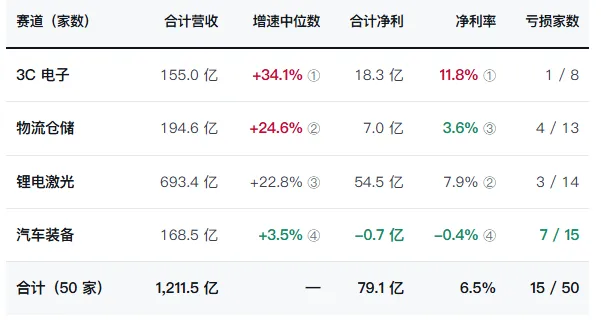
Data sources: Quarterly reports and announcements of publicly traded companies for 2026; mapping: High-tech robots. Note: Some system integrators involve project business crossover, which is categorized by the main business of the enterprise or the highest revenue share of the sector.
Thanks to the multi-faceted benefits of AI computing infrastructure expansion, domestic semiconductor equipment expansion, consumer electronics heating, and other factors, 3C systems integrated enterprises saw the fastest growth in five years, the best profit quality for nine months, and average revenue growth of 34%.
In the field of logistics storage system integration, 11 enterprises are growing in revenue, with a median growth rate of 24.55%. However, an interesting phenomenon is that the two highest returning net interest rates are not pure integrated merchants.
System-integrated business revenue growth of 70% is dominated by melodic bulldozers, but the industry's clearing-out bulldozers are also accelerating. 2026 is the closing year for low-priced orders.
In the third quarter, the gross margin shifted by 40 percent, revenue fell by 40 percent in two consecutive quarters; the loss was attributed to customer delays, increased competition and R&D investments in the transition period; and a 103.28 percent return on equity of 72.44 million yuan.This cycle no longer has a "Save All" window, and orders are accelerating to the head.
Look at the growth rate, logistics and 3C leading; look at the net interest rate, only 3C has really regained its pricing power; look at the business model, and the degree of branding is replacing the degree of downstream attractiveness, becoming the key variable in deciding whether equipment vendors will cross the cycle, whether they can increase revenue and increase profits.
High-tech robots have noticed that in addition to the changing performance and competitive landscape, a new narrative is emerging from systems integrators.Being physically intelligent。
In the third quarter of this year, Samsung's Intelligent Fitness business has contributed revenue of US$93.94 million; the company's shares in the Tianjin-owned Tianjin Galaxy Delivery Hubble Automobile Abu Dhabi project (body tag, parts grab and place data collection, etc.), to achieve overseas breakthroughs in the implementation of the Intelligent Fitness program; the research and development costs of Samsung Smart have increased to US$426 million (about 35% of revenue), and the funds have been explicitly invested in overseas expansion and intelligent technology; the company's self-built Ego data collection plant, and its non-flow programs in collaboration with Fitness Enterprises such as Uber, Bing and others.
The role of system integrators is changing rapidly in an era when robotics enterprises are about to embrace full-scale capabilities: in the past, it was the chip that delivered a line of production, and in the future, it may be the chip that delivered a trained set of scenario data and operational capabilities. This shift will not be reflected in the reporting in the short term, but will determine who will be able to rise up the value chain in the next round.
She wrote at the end:
It's not.In the 2026 robotics industry, the dividing line of competition under the new cycle is whether or not lithium orders can turn into profits, a new variable that comes from how much smart lithium companies are investing and how quickly they can turn the second growth curve of lithium into real gold and silver, which will determine who gets through the cycle first.
On December 15-16, industrial robots will be a new variant of the growth of the industrial robot industry chain? How to seize the opportunity for growth? A series of front-end themes will be unveiled at the annual meeting site, welcome to click on the link or scan the following two-dimensional session.

* Article cover for AI mapping