10 milliseconds of full body reflection
It's very sensitive to reflection.
Human robots react slowly, and often the problem is not the algorithm, but time.
After a collision, the first power peak often occurs within tens of milliseconds, while a full-body strategy of 50 Hz is to wait 20 ms for the next reasoning.
And now the mainstream full-body control is a motion-tracking paradigm that is trained to drag the actual state back onto the reference trajectory. You give it a protective withdrawal, it takes this as its own tracking error, and then actively offsets this movement. The more rigid the field randomization training, the stronger the instinct of the rig to refuse to disturb the trajectory.
The ReflexArc (ARC) from Qingdao, Northeast China and Galbot made adjustments in both directions: a 10 ms internal combustion engine's reflection path, plus three sets of mechanisms that allow the reflection to be turned on simultaneously with the steering wheel clutch.
For humanoid robots, the bottleneck of shock suppression is the moment when the reflection reaches the motor, and the action itself is not critical.
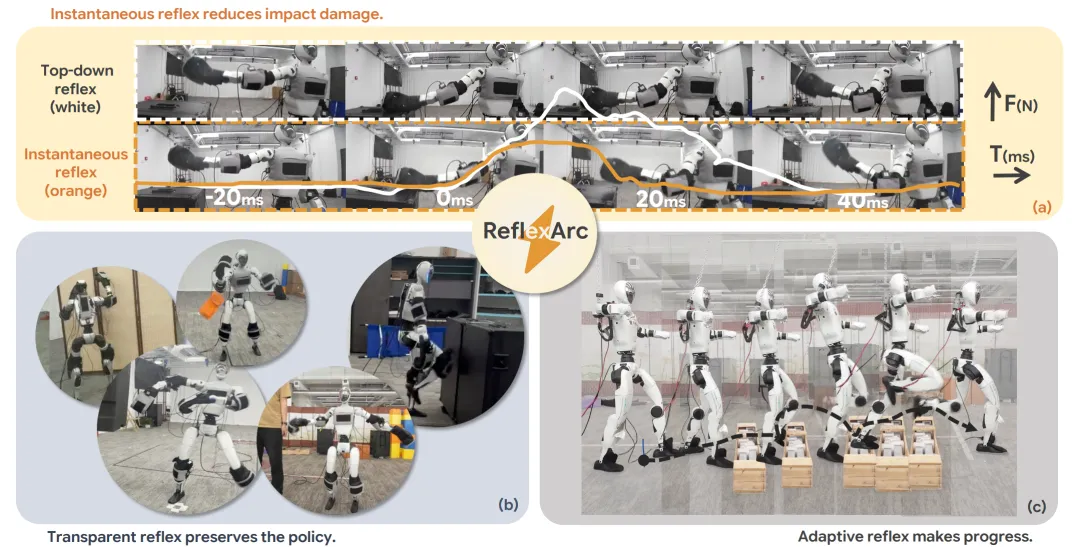
Image: Full-body tactile reflection based on ARC. (a) tactile reflection (orange) reaches the motor before the first impact peak; if the same reflection is sent down through the white strategy, a further delay in reasoning steps occurs. (b) The strategy continues to track the task while maintaining the reflection.It's a great way to get started.

Why is this so hard on a humanoid robot?
20 ms delay, costing twice as much rush
The impact reflection on the mechanical arm is relatively simple: detecting the impact, the underlying controller takes over several hundred milliseconds, and the mission stops and retreats.
A humanoid robot cannot: in the process of withdrawal, it must maintain the balance of the whole body, the movements of the knee and knee joints directly change the support and the core, and even the withdrawal of one arm must be fully accompanied.
The result is that two sets of controllers can't work at the same frequency at the same time. This is the core contradiction that ARC has to deal with: reflection needs to be fast enough, hard enough, but balance and task cannot be given to it.
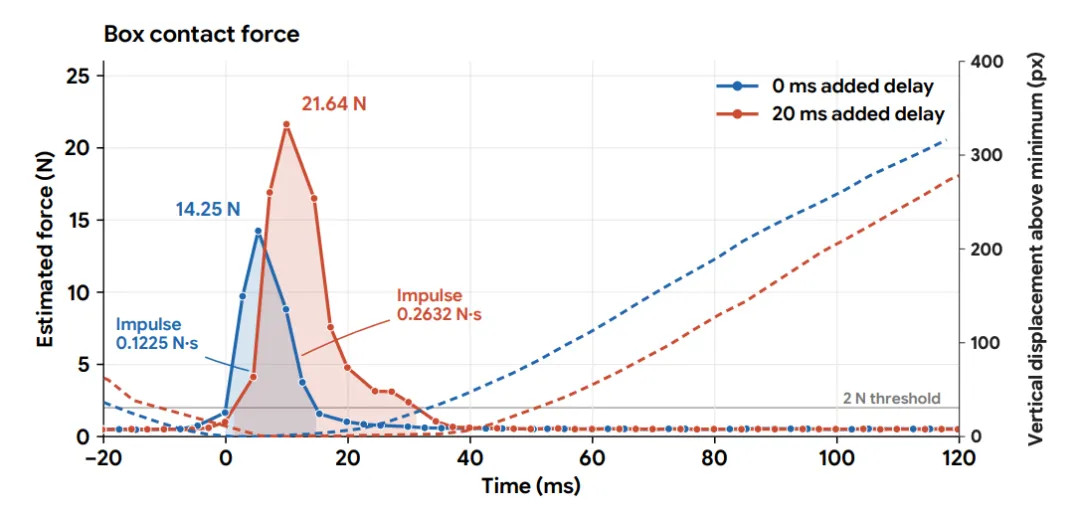
▲Blue/red: additional 0/20 ms delay. The main line is the contact force (left axis), the empty line is the hand area (right axis) and the shadow is the impact score in the F>2 N range. After the 20 ms delay, the first force peak decreases from 21.64 N to 14.25 N, and the contact force decreases from 0.2632 N·s to 0.1225 N·s (2.15 times).It's a great way to get started.
In this impact experiment, they did not use the robot to measure the skin force on themselves, as rapid motion produced vibrational noise; the force sensor was installed on the fixed box that was hit, and a 240 Hz motion camera was used to track the light signals near the contact point for a second route timetable.
The two-way data are consistent in judging the difference in latency.
There's also a time lock in perception.
Conventional touch perception concerns the long-term contact mode, where only the initial contact is available. Dangerous contact usually takes until the 2nd contact 3 to clearly distinguish, which is too late.
The study first recognized the ability of this rodent to threaten the rodent, which is called tactile startle, and separated the rodent from the rodent's own vibration by two characteristics:
The collision would trigger a small space-connected group of taxels, with neighboring readings rising simultaneously; and the base vibration was scattered.

10 ms reflection path
I've got an electronic skin patch.
Touch patches on the wrists, elbows, knees, chest, back and both legs are the most prone to bumps in movement. Each piece is a flexible pressure-resistant fabric, 16 cm × 8 cm inlay 128 taxel, 300 Hz sample.
It is marked after the top point and registered in a digital parenthesis: each taxel records its parent axle, relative position and surface orientation.
This step is a prerequisite for the rear solver to know where the collision was and in which direction it was retreating.
Each taxel also has an adaptive threshold that changes with its own noise baseline, and typically silent taxels will automatically become more sensitive.
Reflective position: 4 ms of full body constraint optimization
After getting the point of impact and the direction of retreat, the question becomes: at 29 degrees of freedom, find a position where you can both retreat and not turn yourself upside down.
Five of the targets are: withdrawal quantity (relative center of gravity calculation, preventing congestion of the plane from posing as a local retrogression); directional torsion (restricting world position to fall within the retrogression torsion, avoiding becoming a reclining torsion); the inertial cost of the whole body and the horizontal center of gravity; and the rule of joint positioning.
Three constraints: the boundary of the joints, the support selected at the start to remain stationary, the balance given to the strategy, and the minimum distance from the collision pair.
In the case of inertia, this item uses an all-body inertia matrix (rather than simply weighted by the angle of the joints), so the bending of the elbow and the twisting of the wrist are no longer equal; at the same time, the center of gravity parallel to the elbow direction is released, the knee is struck, the leg is stretched is a natural reaction, and the elbow should not be banned from lifting the elbow.
Using a series of local secondary scheduling (LQP), each round is re-linearised at the current point, but the cost of all moves is calculated uniformly with the same starting position q0: each round is refined to the same endpoint, rather than using the previous round as a free starting point.
The entire query was completed in 4 ms, plus the detection, and the instructions from the collision to the motor were obtained in less than 10 ms.
If the first reflection is not completed and the next one is not struck, the new solution will be pointed to the final position of the reflection being interrupted, rather than the test position because the test position cannot express where the body is going.
This small detail determines whether a continuous collision will cause further turmoil.
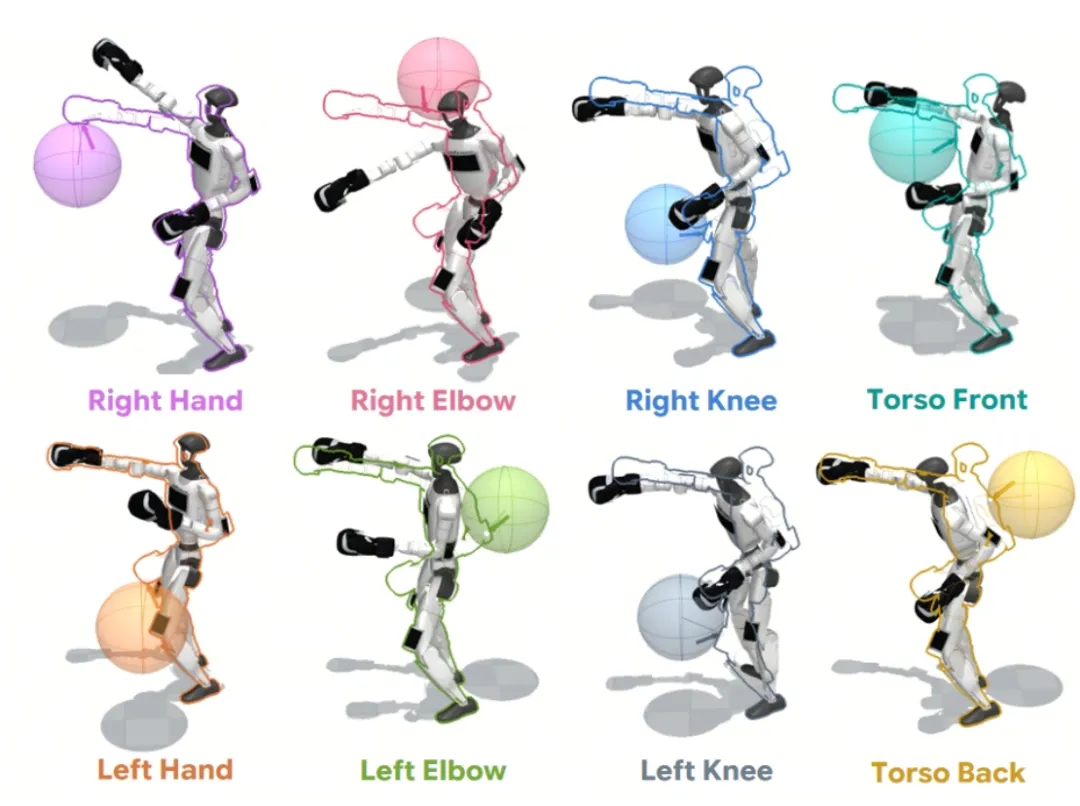
▲The diagram shows the reflection positions for different contacts. Starting from the same initial configuration, the reflector gives different reflection positions for the whole body depending on the part of the body that was struck and the sphere.It's a great way to get started.

Let the reflection and the strategy hold the steering wheel simultaneously
It's not enough just to get through.
You put a strategy in a state where you haven't seen it, and it either collapses or makes up for it.
ARC uses three sets of designs to solve three different phases of the problem.
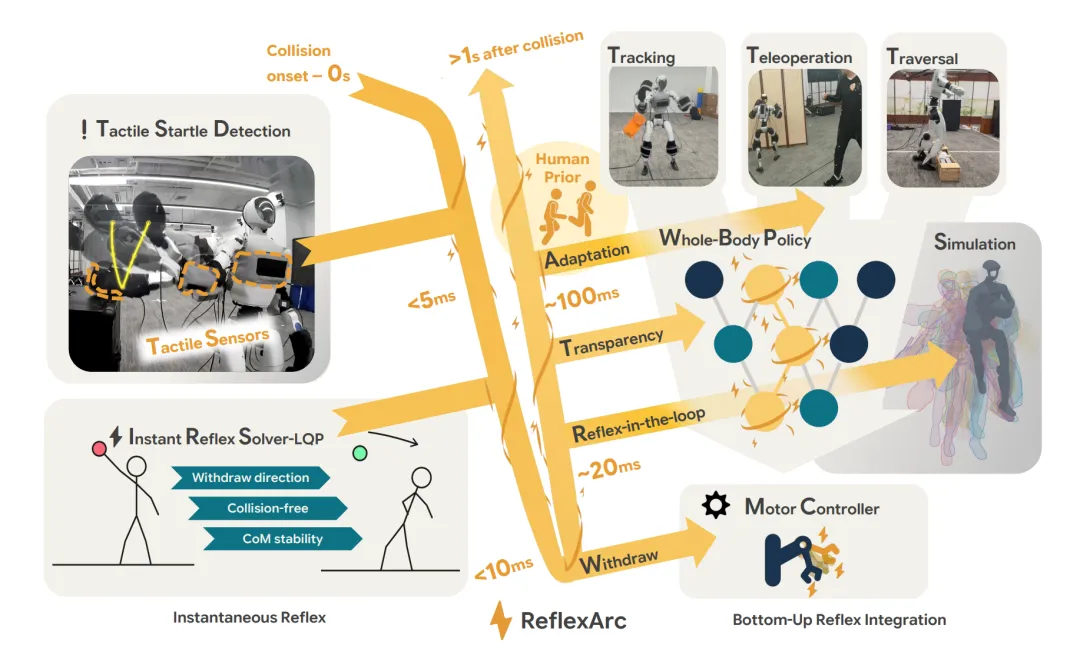
▲ARC overview: Hazardous contact is positioned in milliseconds, the entire body reflection position is solved, the engine is withdrawn within 10 ms of impact; the reflection is then passed downwards to the strategy, maintaining the reflection by the strategy, continuing the mission, and allowing humans to naturally retreat from the contact area to avoid a second collision.It's a great way to get started.
Reflection into the training cycle: let it see the curve first
The strategy's observation space adds a path of reflection observation beyond conventional targets and body perception: whether each patch has a trigger, the location and direction of the point of impact, the current reflection action being applied.
Tracking targets are converted into reference movements during reflection + reflection deviations.
But there is a problem with engineering: reflection in a scene is a low-frequency event, and the timing of the simultaneous environment triggers differently, and once the LQP is solved, the rest of the environment becomes dry.
Thus, ARC-Gym was performed: tracking training alternated with reflection training; collisions in the tracking epoch did not immediately trigger the reflection, but instead stored the collision state in the buffer zone, reset the sub-environment, etc. This round of tracking was completed, and one-off batch of the buffer collisions were solved, and the sub-environment began to reflect training from the cached state.
Reflective transparency: Making the strategy sound like nothing happened
Since reflection is triggered by an external hazard, which is inherently unpredictable, it is not necessary to learn a set of strategies for each direction of reflection.
ARC simply erased the reflection from the strategic perspective:
Perceptive end: Point to the strategic position of the joints = true position - reflective deviation;
Execution end: PD target of the engine = strategy output + reflection deviation.
Thus, the strategy faces only one distribution, rather than one distribution in each direction of reflection.
But it's not enough to just do the coordinate plane, the reflection does change the dynamics, the follow-up state is different, and compensation will emerge in a more hidden form.
So they added a counterfactual oversight: using DAgger's constraint strategy to output it close to the pump, what pump would the pump have produced without this reflection.
This is not to make it imitate, but to prevent it from gradually erasing the reflection at the execution level.
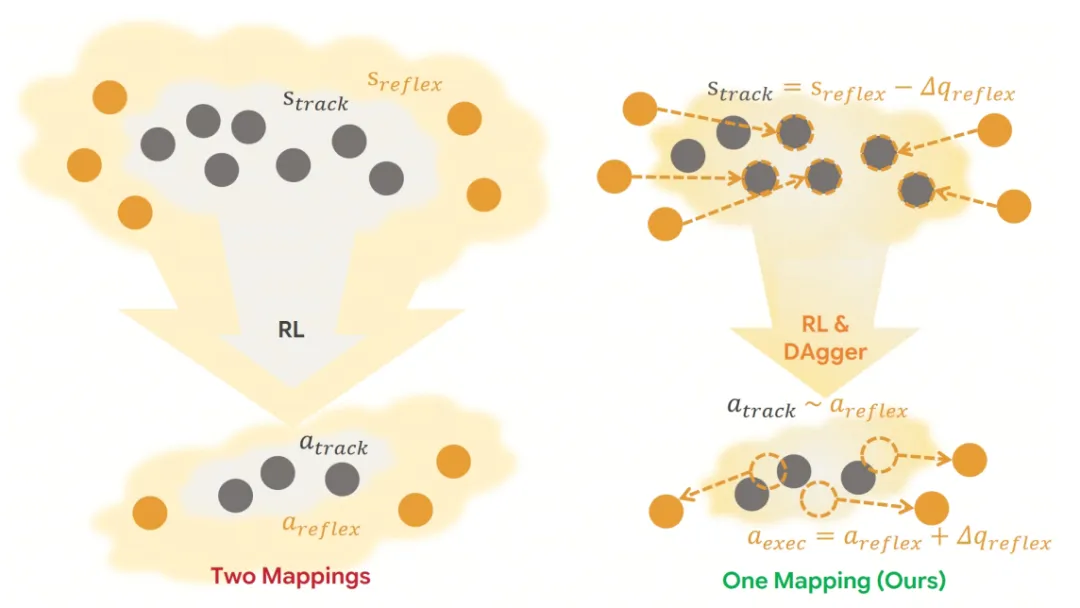
▲Graph: Single mapping -- we subtract the reflection deviation from the position of the joints we observed and add it to the target joints of the strategy's output, so that the strategy faces only one distribution, not one distribution in each direction of the reflection, while using DAgger to monitor the counterfactual output of the non-reflection coefficients.It's a great way to get started.
Reflective intelligence: After local withdrawal, you have to go out again.
The reflection can only be localized on a millisecond scale. It is constrained by support and joint limitations, a single gesture change fails to bring the robot out of the contact area, and the remainder of the path must be completed strategically at the secondary level.
There is a real dilemma here: the current reference path may not allow this displacement, even requiring the robot to remain stationary, or to continue in the direction of contact. Once the strategy leaves the reference, the tracking reward will no longer restrict how it moves, and it will complete the displacement in the most conservative way possible.
ARC uses a set of human motion data to reposition itself in different directions as an AMP reward, which is only activated during reflection. It is restricted to the behavior of the mouse after leaving the reference, rather than the entire style of action.
The mechanism also has a byproduct: it reverses the long-term direction of the task.
When a person is quickly knocked down, the first reaction is to hold back, but the next reaction is often to go past rather than backwards.
By reversing the direction of long-term mission rewards, and adding a small amount of corresponding human demonstrations, ARCs are able to cross thresholds and climb stairs without vision after being triggered by a touch at the bottom of the foot.

Experiments
Three types of contact, one set of reflections
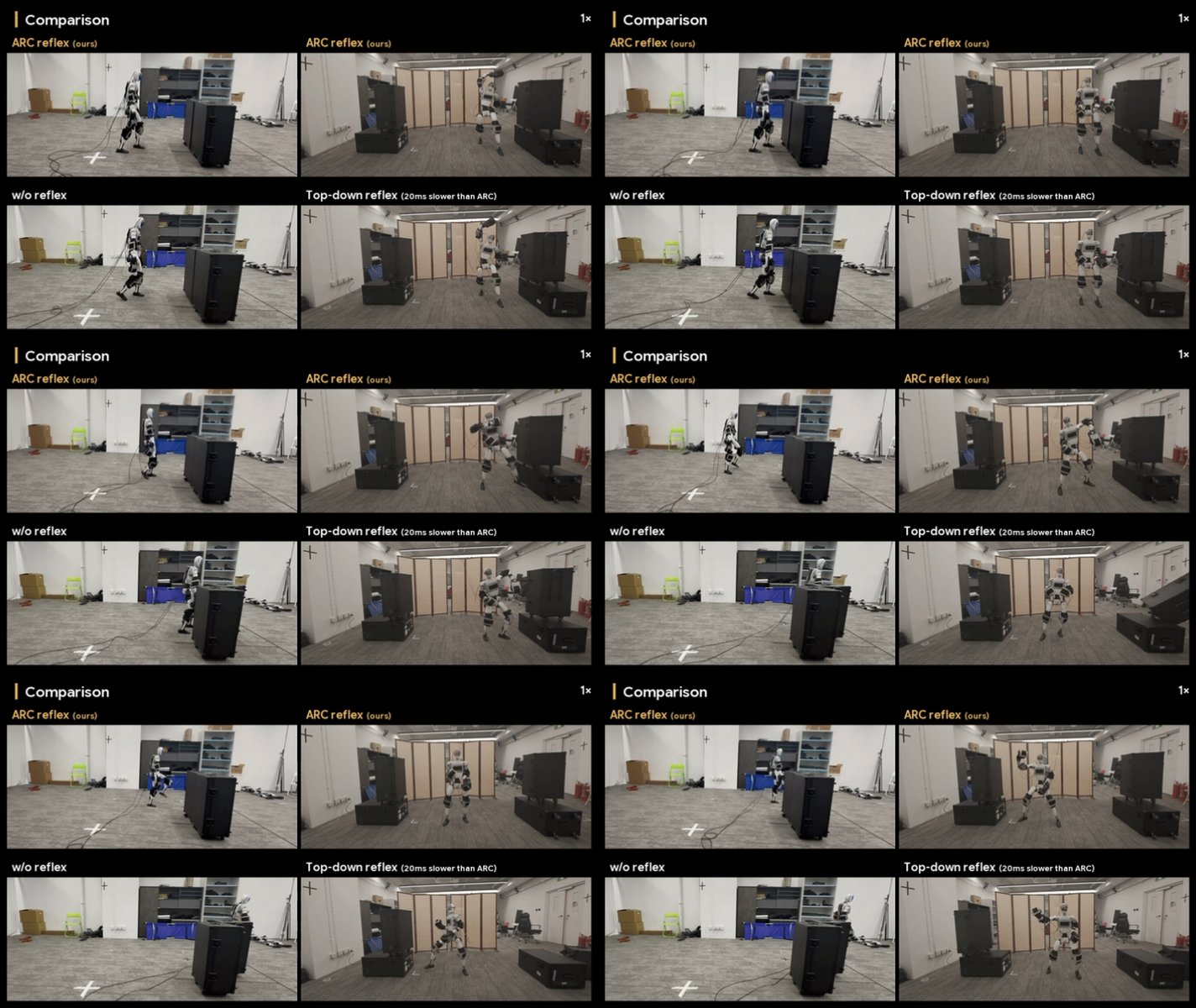
The G1 covers three types of hazardous contact: static obstacles in motion, collisions with dynamic objects, collisions with people or other robots in motion; more than a dozen tracking missions (walking, martial arts, dancing).
In remote operation, the solution Δq is directly superimposed on the reference without additional training to fit the general tracker; however, the upward and downward delay in reflection is significantly higher due to the downward movement of the tracker.
Not only is it repeatedly reasoned, but because the general tracker itself favours smooth continuous motion, a mutant Δq happens to be something that it is trained to avoid, so it is slowly being realized.
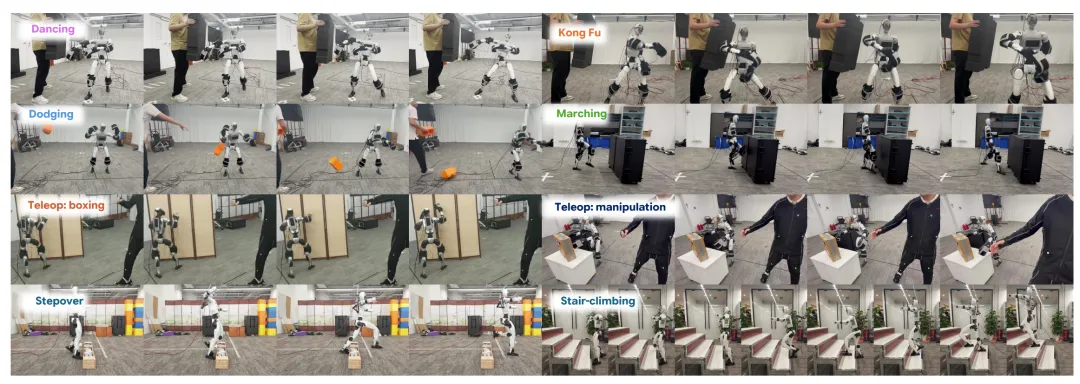
▲ARC's real-world mission involves tracking movement, remote operation, and evaluation in three-dimensional scenarios, including contact with static obstacles, dynamic objects, and people in motion.It's a great way to get started.
Three things read on the melting chart
In the table, the indicators are divided into three groups: local withdrawal, contact, and overall recovery.
Remove the reflection into the training cycle: the survival rate dropped to 82.0%, and the contact torque rose from 3.42 to 4.34 N.s. 90.9% of the trials hit the same obstacle again after separation.
Remove the transparency: the withdrawal distance dropped from 11.06 cm to 6.74 cm, the compensation score C from -9.1% to +29.7% ((positive means strategy is countering reflection), and the thrust rises to 4.22 N.s. Note that the coil's collision rate is slightly lower than the coil itself (58.3% vs 59.4%).
Remove adaptation: Local withdrawal is still in place, but root displacement stops at -0.01 m. The experiment struck again at 88.0% of the time. The reflection itself works normally, but nothing takes over afterwards. This is another failure: withdrawal is true and recovery is false.
Another observation is worth noting: replacing the AMP with an AMP directly tracks a withdrawal movement of the AMP, with a withdrawal distance of 10.89 cm instead, but the torque rises to 4.91 N·s, only 14.1% of 1.5 m within 3 s (ARC is 63.0%); after removing the AMP, the success rate of climbing stairs and crossing the thresholds goes straight to zero.
Explaining that the retreat is two things: a fixed retreat trajectory cannot be adjusted with actual contact, nor can it be followed by subsequent passing actions.
▲It's just a matter of time.It's a great way to get started.
Written at the end
Determining the impact size is not a deceleration, but a deceleration of when to decelerate. The difference of 20 ms is 2.15 times the torque, which indicates that the whole-body strategy of the up-and-down path, there is a structural delay in physical contact in this matter, not a modification that can be solved.
The solution given by ARC is to disconnect control over time: milliseconds to reflect and seconds to strategies:
Intermediate conflicts have been seen, perceived, erased, enforced, and contradicted by the fact that these four steps are constrained by martial arts training.
The idea is to put a mechanical arm, a quadruped leg, and an outer skeleton that can be recycled.
As to whether it's the general answer to the robotic safety net, it's too early - the cost of touching the skin with wiring, coverage substitution, and lack of cross-schedule contrast make it now more like a prototype that defines the problem clearly, rather than a layer of safety that can be directly mass-produced.
Edited by Dr. Little Monkey
I'm not sure what I'm doing.
Ref
ReflexArc: Bottom-Up Integration of Instantaneous Tactile Reflexes into Whole-Body Humanoid Control
The title of the paper is:
Link to the project:https://minusmodulo.github.io/reflexarc-website/