A robot learns a new operation, usually through multiple rounds of sampling, training, and testing. Each round generates new data and models, leaving behind many judgments: what is used for training, what is missing from the current version, and what samples should be supplemented in the next round. These judgments determine how learning continues, but are often scattered in videos, scripts, formats, and the experience of the operator.
RoboLineage, proposed by the University of Hong Kong, is the study of this learning process. The system allows intelligent agents to perform tasks according to common standards of work, taking on tasks at different stages, and connecting the execution of evidence, data selection and model changes. Subsequent work can continue to use previous judgments and bases, without having to reorganize each round. The relevant paper has been recorded by the International Conference on Robot Learning CoRL 2026.
The paper:
The main page of the project:
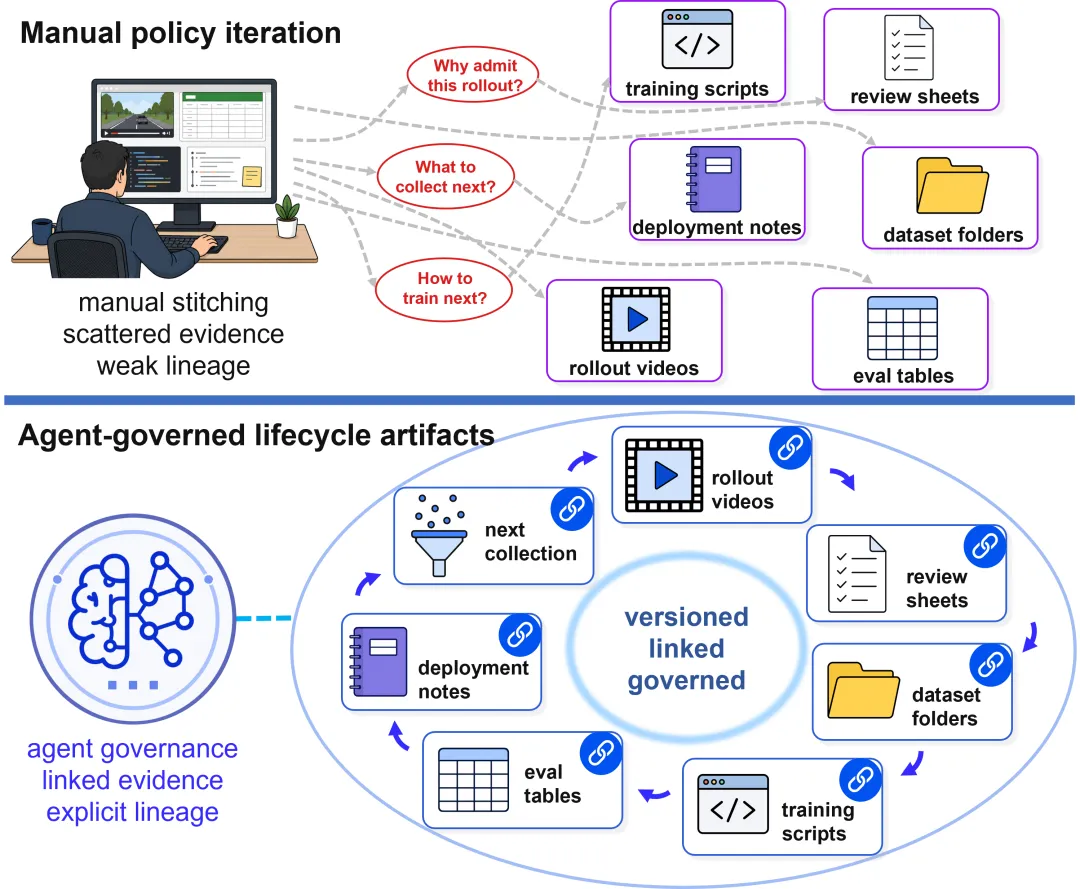
Let the stages continue to work according to common standards
In actual experiments, the focus of the collector, data reviewer and training leader is not exactly the same. Once an operation is completed, it may be necessary to see if the object is finally stabilized; whether a record can be entered into the training set, and whether the evidence is sufficient and complies with the rules of the task.
RoboLineage allows the intelligent body to combine task requirements, execute images and already recorded work to understand the current work, and then call on the corresponding tools to complete the processing. Robots and task access, organization, collection, data review, training, version management and evaluation have their own explicit responsibilities. When communicating, explain what evidence is used, what conclusions are drawn, and where it is still uncertain. The results can be used for the next stage after validation.
The different tasks still use their respective success criteria, and robots and learners also retain their respective configurations. Common standards dictate how the work is delivered, how to judge how to leave the basis, and how subsequent links read and check the results.
When accessing the robot, the intelligent organism organizes the camera, state and action data interfaces, and establishes the operational stages and completion conditions of the task. These configurations can be reused once confirmed by the operator. The latter intelligent organism understands the data according to the same agreement, without having to rework the robot interface and task definition at each link.
Lineage connects work outcomes to cross-cycle memories
The results delivered at each stage according to a common standard will be associated with the corresponding execution, data and model versions. These results together constitute a continuously updated working state, with subsequent smart entities judging the current progress accordingly. Once a review of which execution corresponds, which model trained the selected data, evaluation and what adjustments were facilitated, can be checked along these links.
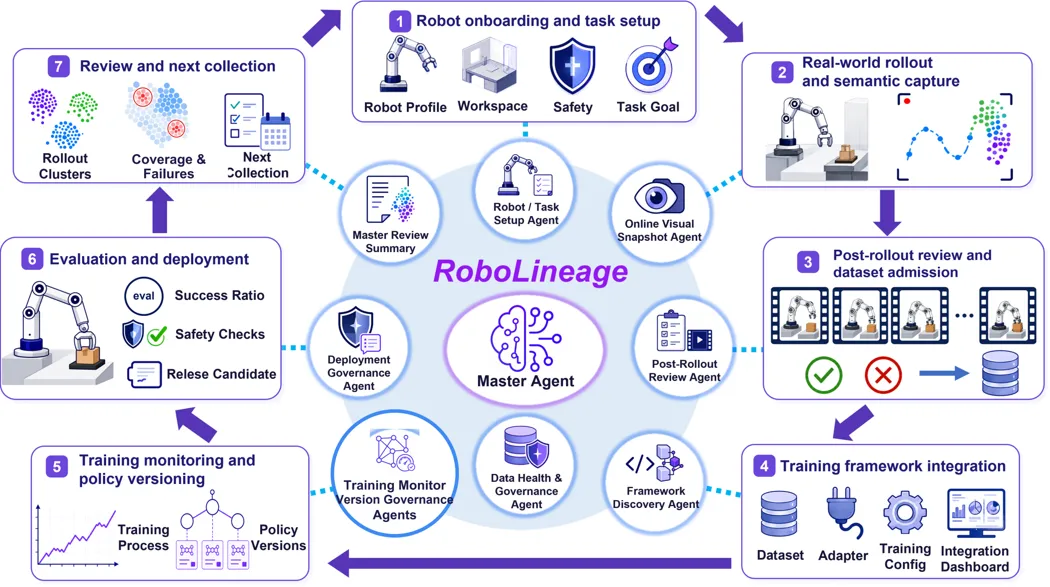
For example, before the start of the training, the system fixes the selected data and the corresponding configuration. The new model is then associated with the training input, the training record and the inherited model version. Even if the data is converted into the format required by another learner, the original record can still be found.
The Master Agent reads the results of each link with the history of the rounds, summarizes the current state, organizes unresolved problems, and suggests the next step. Here, the memory pump comes from a continuous maintenance working state: the intelligent body can see what it has done before and can write back the new results of the rounds for subsequent stages and rounds to continue to use.
How to implement evidence into training decisions
For example, when the clavicle moves the blocks above the target, it does not mean that the task has been successful. The blocks may slip when released or may fall when the clavicle leaves.
RoboLineage will divide the related processing into three lines: continuous recording of the original image and robot status; online visual snapshot VSA marking of the action phase; critical events and risks; asynchronous review of the execution and online processing, combined with key segments; final observation and review of the information process. Online models temporarily respond slower and do not block the original collection; the review can also proceed with subsequent collection.
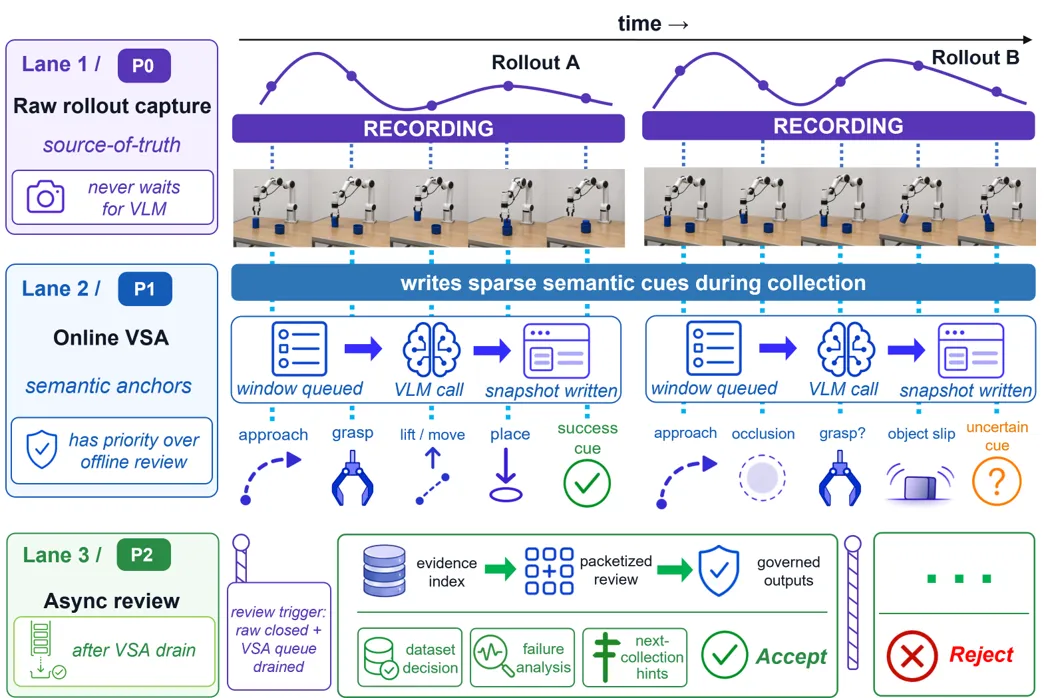
Review the conclusions and data use records respectively. The system first explains what happened and then determines whether the record is allowed to train based on the mission rules. If there is insufficient evidence, it is handed over to an artificial review, and the main training set only receives the records of the licensed training. Failures that can help to locate the problem are kept in the failure pool for the analysis of gap coverage and the development of replacement plans for use.
After a step-by-step review, the entire batch of data is checked to see if it is adequately prepared. Data Health Intelligence Agency will use the data obtained, rejected and reviewed together for analysis, to check which task stages are missing coverage and where failures are concentrated. A single record does not represent that a batch of data is ready for the next round of training; these gaps will enter data status reports, training arrangements and follow-up references.
Training is still carried out by existing learners. Smart entities are responsible for checking and preparing the data inputs they need, tracking training records and model versions, and compiling evaluation evidence. Operators can review execution, check judgement bases, modify data usage and view supplementary recruitment recommendations through the front end; artificial confirmation and modification remain in the work record as well.
Evaluation also follows the same delivery method. Smart phases record successes, failures and security issues, compare the current version with changes in previous versions, and form further recommendations for continued deployment, delay, withdrawal or replenishment. Decisions regarding actual deployments are still confirmed by the operator, while the test and model history on which the judgments are based remains.
This process is tested on real robots.
The paper conducted experiments on three sets of robots and learners already configured: ARX and ACT-style strategies, Realman and Diffusion Policy, and GALBOT G1 and VLA/LeRobot-style workflows covering crawling, placement, tool use and pulling operations.
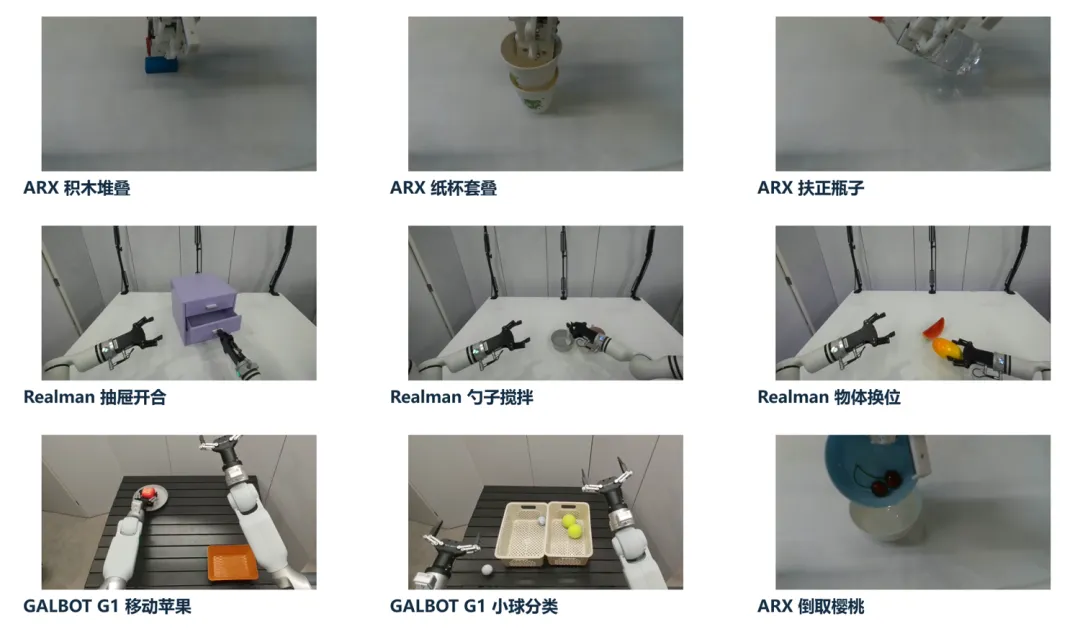
On a review benchmark of 25 tasks and 500 articles of execution records, the data of the entire system was 96.4% consistent with expert consensus and 79.6% consistent with direct video review controls. These results were taken from the same records and review models that were used before the operator modified them. The percentage of errors in the main training set decreased from 16.0% to 2.1% in 194 articles of records that experts judged should be rejected.
The method of organization of the evidence was also examined. The error rate was 11.3% when only specifying the output format; 6.2% after removing the focus on the final observation and the final state of the test; 4.6% after cancelling the parcel review. These results indicated that the output format was not correct enough, and the model needed to judge on the appropriate evidence.
The next step is to see if these processes can support strategic training. The study consisted of eight tasks, including building a data pool containing 100 candidate records, an artificial expert process and RoboLineage, each of which selected 60 samples using the same training setting and tested 60 times, respectively. The average success rate for both processes was 93.1% and 92.7%, respectively.
After access to the robot and the training framework, in 12 sets of pairing experiments, 30 records were processed each round, reducing the time spent before training from 130.2 minutes to 54.3 minutes, reducing it by about 58.3%. Physical collection time was essentially unchanged, saving mainly from censorship, data access sorting and training preparation. Timing included actual operation and blocking waiting, excluding one-time access modeling, adapter development and GPU training.
How past experiences helped the next round of learning
Once the entire process is connected, the next round of replenishment can refer to both current failures and previous learning experiences. Where the current model has failed, with which scenarios the data has been replenished, how the post-replenishment model has changed, need to be considered together. Lineage provides these connections for the intelligent body.
In the case of block stacking, the replacement focus is adjusted as the difficulty changes. Initially, the successfully grabbing samples of the unfamiliar starting position is completed; after grabbing improvements, attention is shifted to whether the placement is aligned, whether the blocks are stationary; then the problem of late or unreleased claws is dealt with again.
The following table shows the change in the success rate of block stacking and drawing tasks in three rounds of replenishment, taking the average of three independent operations. Examples of each method include additional 30 points for each round of licensed training, controls include random replenishment, fail-by-step replenishment, and planners that use only this round of information.
At the end of the three rounds, each run was followed by 60 independent tests of the final strategy. RoboLineage had a success rate of 83.3% on the pile of blocks, with only 70.0% of planners using this round of information; 78.9% and 66.7% on the open draw, respectively. The controls could also read current visual snapshots, review results and data coverage summaries, as opposed to not reading previous supplementary plans, historical data status and model assessments.
Let the learning process itself accumulate experience
The paper examines and assesses routine processes, based on three sets of robots and learners already configured; the targeted complementary experiment covers two tasks.
Cross-mission experience migration and long-term autonomous operation require further testing.
RoboLineage focuses on the collaboration in the process of obtaining robotic capabilities. AI agents follow common standards and continuously advance the work at each stage; lineage retains the data and model changes behind the foundation, so that the follow-up work can continue on previous experience. Every time a robot completes a round of learning, the process of organizing and advancing this round of learning also leaves a next round of available experience.
Paper information
RoboLineage: Agent-Native Data Lifecycle Governance Across Robot Policy Iterations
CoRL 2026
Written by Qian Luo, Wentao Guo, Zhennan Qin, Nanchun Guo, Yunhan Zhao, Yi Ma, Yanchao Yang
Research institutions include TranscEngram, the University of Hong Kong, and Beijing University of Technology.
The paper supports the research code: