I'm going to tell you something.What's the matter?
On 12 November, the robot forecaster reported that today, at CoRL 2026, Li Feifei gave a speech on the subject.Atlas: a unified world model kit for generating and rebuilding,In September, AMD announced a final acquisition agreement with World Labs worth approximately $8.2 billion (approximately RMB5.47 billion) and expected to be completed by the end of 2026. Li Feifei mentioned the following key points in the speech: (1) in the field of robotics, how to understand and represent the environment, predict the possible consequences of operations, and by simulating the addition of real-world data, the three core problems that humans need to solve are the three core models of Atlas, namely, how many images are to be imported for complex reconstruction, how many zero values are to be generated, how few images are to be retrieved for complex reconstruction. Atlas can not only generate and rebuild three-dimensional environments, but it can also be used to train and navigate robots, connect the real world to the simulated world, and apply simulation results to real robots. At the same time, Li demonstrated in his speech the exploration that robots can be trained entirely in virtual simulation environments and deployed to the real world in a zero-sample manner.5 Finally, Li also emphasized that Atlas is ranked first in the Rapidata camera movement benchmark.
 The following is an extract from the lecture and the roundtable discussion:
Today I want to share with you a model recently developed by the World Labs research team, called Atlas. It is a Unified World Model for Generation and Reconstruction.
Since we are at the CoRL meeting today, let's talk about the needs of the robotics field.
I know that the field of robotics is changing a lot, and a lot of progress has been made. Just a day ago, we saw new research. Regardless of what kind of robotic path we take, whether we use strategy learning (Policy Learning), whether we use smart bodies (Agent), there is a fundamental problem that the field of robotics is trying to solve:
Given the current state of the world, the goals of the mission and robots themselves, what should the next step be at each moment?
In general, robots need to solve a number of basic problems.
First, robots need to have the ability to understand and characterize the state of the world and the environment around them. We can discuss whether this characterization should be implicit or explicit, but understanding the environment itself is very important.
Second, robots need to be able to predict the consequences of their actions and plan for them in some way.
Finally, data is always a problem. The field of robotics has a long long tail distribution, and robots want to successfully deploy, as well as a large number of long tail scenarios. Therefore, in many cases, it would be very valuable to be able to simulate as many different environments and states as possible to supplement real-world data.
Regardless of the method we use, these three problems remain in the field of robotics.
It also reminds me of the world model. In fact, the above three problems correspond to the three problems that the world model is trying to solve.
For example, understanding and representing the environment, problems of rendering in corresponding world models and visual models; predicting the consequences of possible actions, corresponding to planning problems; simulating different states in the simulated world, corresponding to simulation problems.
Of course, I don't want to make these issues absolute, and I don't think they're completely independent of each other. In fact, in many cases, we can bring them together, and they are intertwined. These are very exciting fronts in this field of research right now.
01.
Atlas is trying to reconstruct life with 3D.Today, I want to focus on Atlas. This is a new model that we have just proposed.
Overall, Atlas is primarily focused onResolving problems of rendering and simulation, particularly the simulation of world geometry structures and 3D and 4D dynamic processes.
Simply put, the Atlas is a self-regressive foundation model trained from scratch. It is a full-mode model that can receive multi-mode inputs, including:Text, images, video, depth signals, gray boxing and three-dimensional structural signals.
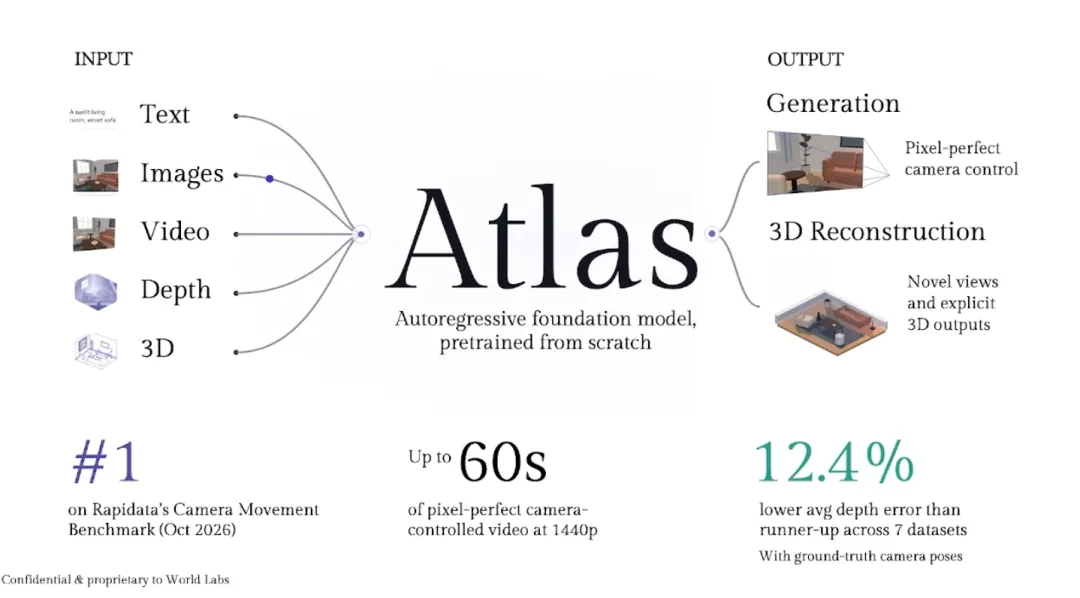
Its output is a pixel array. But Atlas is not only able to generate high-quality image arrays in a way that is consistent with time and space, it is also able to synthesize new perspectives, thus achieving precise, high-resolution, three-dimensional reconstruction.
Next, I'll show you some experimental results and specific details. First, I'll introduce you to the overall capabilities of Atlas.
First, let's look back at the development of related research.
There are two very important problems in the field of computer vision. Of course, these are not the only two problems in the field of computer vision, but they are very important. Researchers have spent many years, even generations, studying these problems.
One of them is:The problem of 3D reconstruction.The research I am presenting here includes both the classic paper Building Rome in a Day and the most recent advanced research, such as NeRF-related papers.
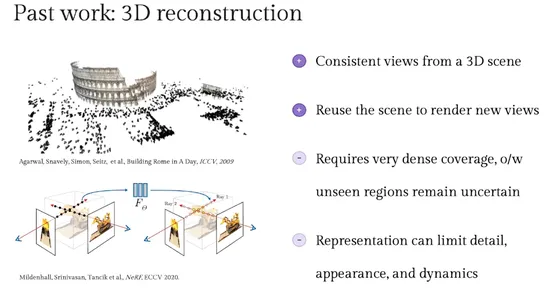
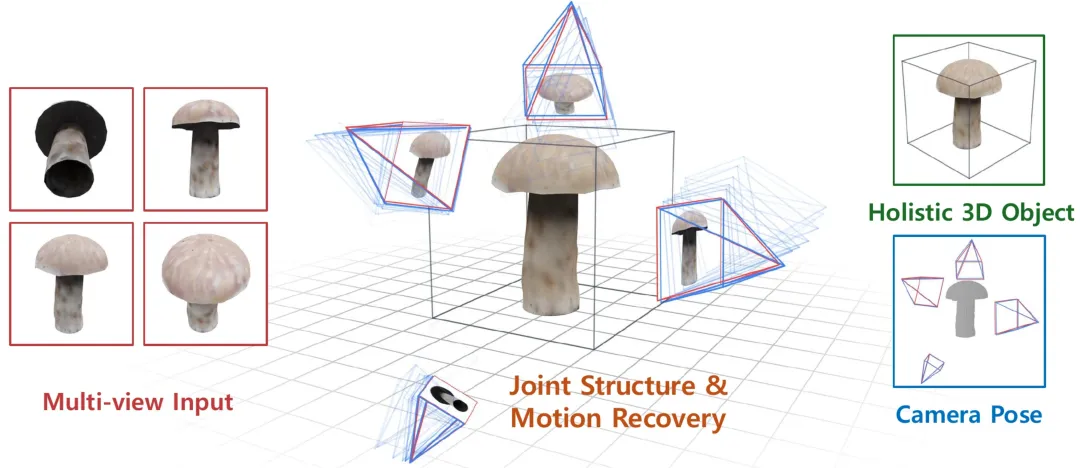
The fundamental problem we are trying to solve is:How to create a 3D scene that matches the real world based on images taken from different camera positions and gestures?
Most traditional methods require large quantities of images with camera posture information.
If these camera viewpoints do not cover the entire surface area of the scene, reconstruction becomes very difficult, and it is difficult for models to accurately estimate the uncovered area. Consequently, the final results of 3D reconstruction are often highly uncertain.
This is the classic 3D reconstruction problem.
But in recent years, generative AI has made great strides. Now we have pure-generation models that can directly generate high-quality pixel content.
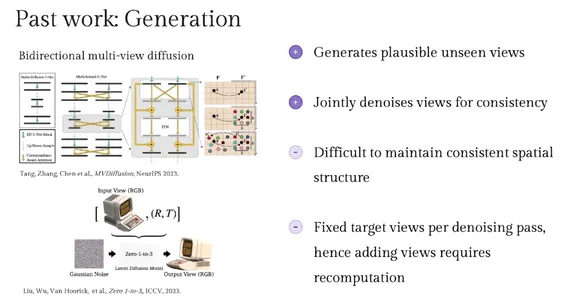
At the same time, the framework architecture based on the diffusion model also provides a new direction of exploration for polygonal generation studies, further shortening the distance between generation and reconstruction.
Along this path of research, some very excellent work has been done. They try to generate a perspective that has not been observed before and maintain spatial consistency by combining noise with multiple viewpoints.
Overall, however, the effectiveness of these methods remains limited. They are still difficult to maintain spatial consistency, and each de-noise process is usually aimed only at a fixed target perspective.
Atlas continues to explore the direction of a series of studies over the past few years, attempting to combine generation and reconstruction.
Our goal is to solve both problems using the same model architecture and the same training program at the same time.
Specifically, Atlas can switch between generating and rebuilding in both directions.
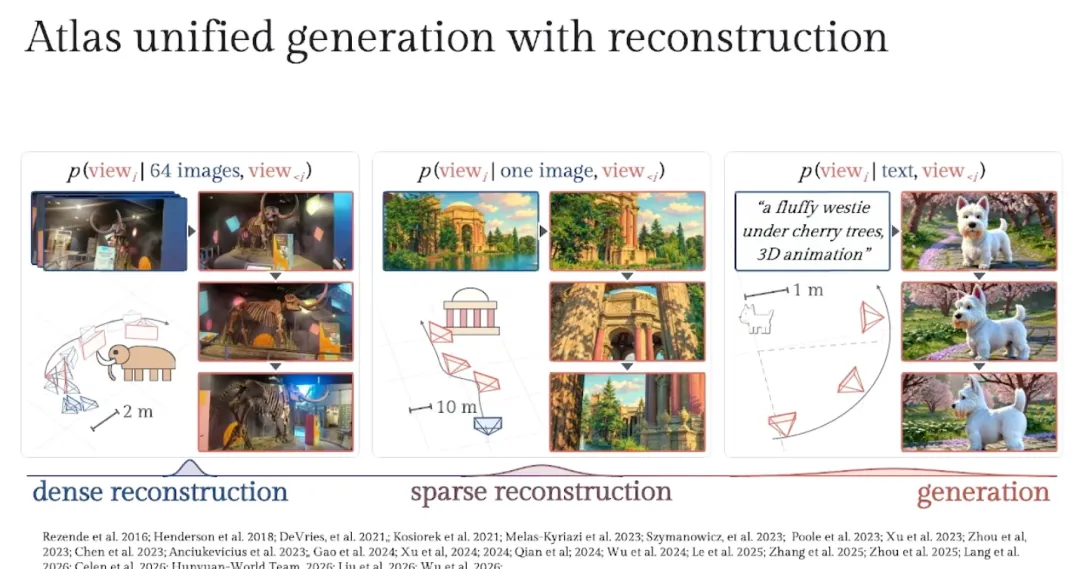
In an extreme case, if the Atlas receives multiple input images, and the number of images is large enough, it can perform reconstruction tasks. The model can perform intensive reconstruction, producing high-quality scenes and world structures.
In the other extreme case, if no pixel conditions are entered, and only a text prompt is provided, the Atlas can perform a purely generative task. It can also generate multiple sequential images with perspective consistency.
What's even more interesting is that Atlas is also able to complete a task of generating and reconstructing connections, which we call Sparse Reconstruction.
In this case, the number of views Atlas receives is very limited. In extreme cases, the input is even only one image.
Atlas can estimate the position of the camera and then further generate multiple perspectives within the scope of the model's capabilities, ultimately reconstructing and generating a complete world.
Thus, under the same model framework, Atlas was able to achieve a shift from dense reconstruction to scarcity reconstruction, and then to pure-produced switching.
02.
Just a few images can rebuild a whole world.Before I go into the technical details, I'll give you an example. Some of my friends here should know that this is the Stanford campus.
Stanford has a very famous Main Quad.
If only two limited input images were given to the model, it would generate, or complete, a main square.
If you're familiar with Stanford, you'll find that this isn't really our main square. It looks like it feels like the main square, but it's not really the main square.
The model is conditionally generated based on features such as longwalks in the input image, so the scene generated retains some of the characteristics of longwalks, and there is a valve, but overall it is still a square generated by the input.
If you give the model eight images, the effect would be much better.
Considering that the space itself is very large, the information provided by the eight images is still very scarce. But if you look closely, the model has basically reconstructed the entire square.
At first glance, it was almost perfect. However, those familiar with Stanford University will find that the famous Memorial Church is missing.
Finally, if 33 images are entered, although these images are still very scarce in terms of the size of the entire space, many areas are not covered, but one of the images does contain a memorial church.
As a result, Atlas has essentially been able to rebuild the beautiful main square of Stanford University.
I would also like to emphasize that all 33 images were taken at ground level, that is, just ordinary images taken by one person with a camera.
But the model is able to generate different perspectives of observation, including the one I'm showing you now.
So what's the technical key behind Atlas being able to do this?
03.
Perspective forecasting is the core technology of Atlas.For large language models (LLM), we are already familiar with the target function of the next token prediction.
And for Atlas, our core psychology is:The point of view is everything.(Viewpoint Is All You Need)。
We use precise camera positioning controls to allow the model to predict the next perspective.
Specifically, Atlas uses a multi-modal self-return spread Transformer architecture.
As previously mentioned, the Atlas can receive text input and generate images based on the position of the camera.
It can also receive an image, estimate the corresponding position of the camera, and then condition the input image to generate more images and more new camera views.
This is a very cute little robot that is located in the garden. We can see that the model is able to generate images from different angles along the path of motion around the camera.
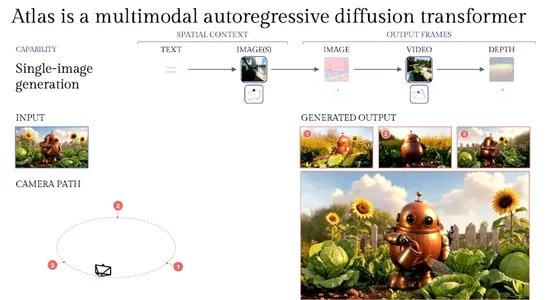
In addition, as the example of Main Square in Stanford just shows, the Atlas can also be used as a source of information.It takes images from multiple angles and inserts and pushes them out along different camera movement paths, thus restoring a three-dimensional scene.
It can also receive deep image or grey box inputs and output RGB pixel images. This ability is very useful in many robotic and game application scenarios.
Next, we use some quantitative results to look at the performance of Atlas. I want to show its results in terms of generation and reconstruction, respectively.
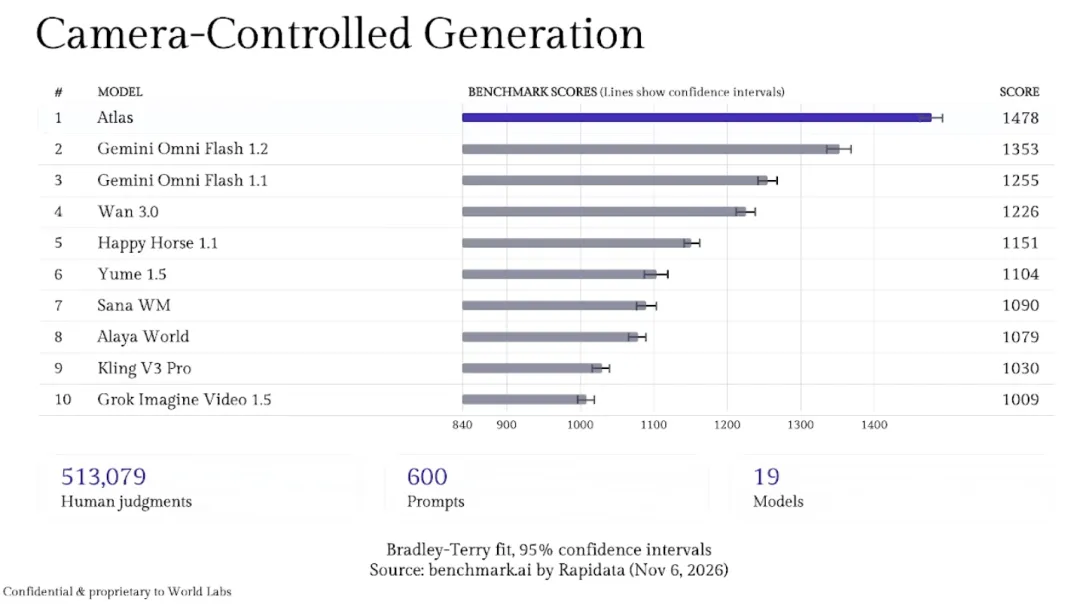
The first is the camera control generation.
The results here are actually what we just got a few days ago from an independent third-party agency called RapidData.
Without informing us in advance, they performed benchmarking tests on several of the most advanced video models, assessing the camera-controlled generation capabilities, which included about 500,000 artificial judgments.
In the end, Atlas took first place in this test, surpassing several of the current most advanced video models.
As can be seen from the chart, there is a fairly noticeable gap between the Atlas and the second-ranked model.
Atlas is capable of producing more than 60 seconds of continuous video.That's a lot more than 60 seconds.
Here are our latest results for 2026. I especially want to compare it to an earlier model I tried about a year and a half ago.
As you can see, the scope of the early models was very limited and the geometrical consistency was very poor. At the time, we even received criticism that what you were doing was not the world model, but the closet models.
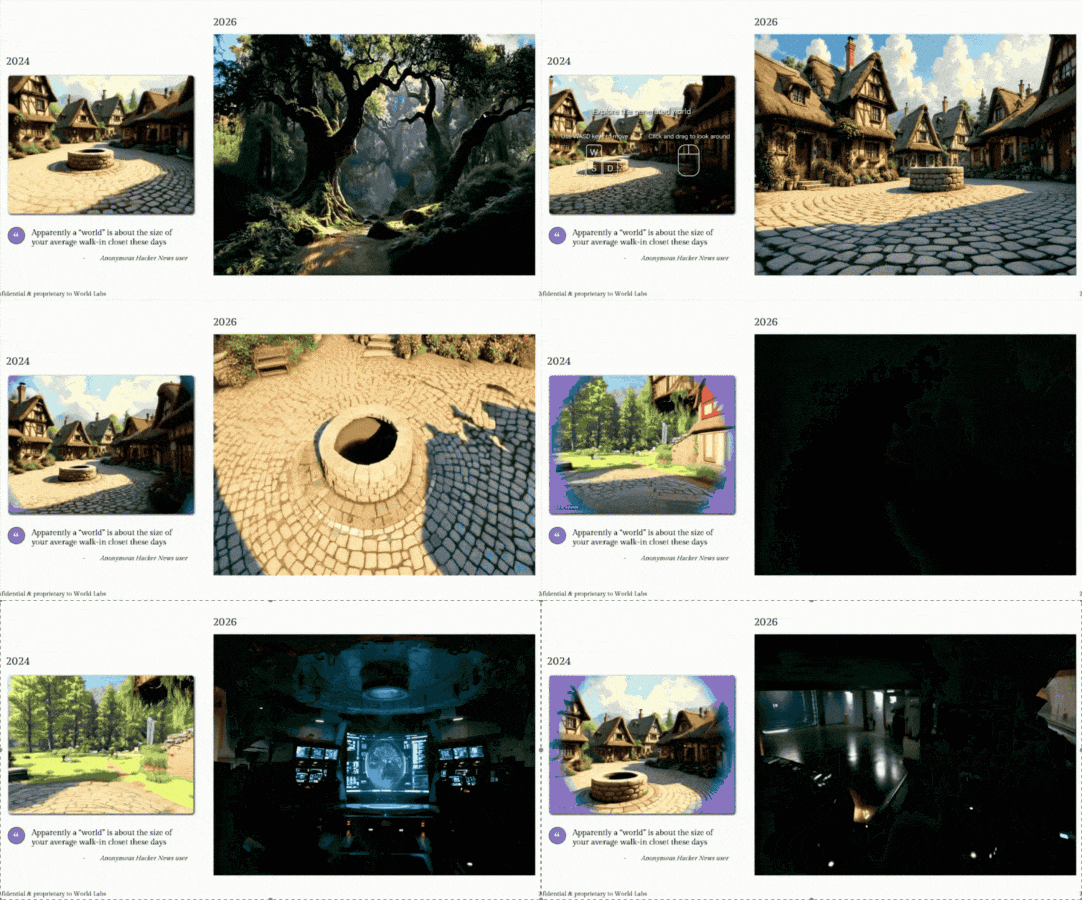
And now, we've moved from a closet to a much bigger world.
And here's another interesting case of generating.
Atlas can pick up two completely different, unrelated objects and then estimate a reasonable camera posture, further complementing the rest of the scene, ultimately producing a fantasy world that combines the two.
This ability is ideal for a wide range of creative applications.
One last example is the grey box input.
Atlas was able to pick up these ashtrays and create a whole, beautiful world.
This ability is useful not only in the field of robotics, but also in design and creative application scenarios.
04.
From deep prediction to three-dimensional reconstructionNext, we look at the results of the reconstruction.
We've compared the Atlas to some models specifically designed for 3D reconstruction.
First, we tested the depth prediction task on seven different datasets. The lower the indicator, the better, because it measures the error rate.
Atlas has outperformed some of the most advanced 3D reconstruction and depth prediction models in recent years.
In addition, the Atlas itself does not need to use Gaussian Splatting as a way of depicting scenes.
But if we use this method of representation in subsequent processing, we can compare the Gaussian reconstruction error of Atlas to a specific reconstruction model in six different datasets.
Here we used two different error measurement metrics. The results showed that Atlas performed very well, outperforming most specialized models.
In addition, we have gradually adjusted the number of views given to Atlas to see how the model transitions from scarcity reconstruction to more dense reconstruction.
In this experiment, we also compared Atlas to several advanced methods and tested it on two different datasets.
In terms of error rates, Atlas once again performed well.
Here are some specific examples.
This is a very famous apartment scene in the field of three-dimensional reconstruction. Given eight input images, Atlas was able to reconstruct this large apartment complex.

Now, we can sample scenes from a variety of different points of view, and people can completely control these camera points of view, thus observing the whole scene.
Here's another example of how to convert the content generated by the Atlas based on a single input image further into Gaussian representation space.
As you can see, with just one input image, the model creates a very beautiful fantasy space.
Similarly, in the example below, we are not only able to generate scene content, but we are also able to generate in-depth information, allowing artists to precisely control the location of the camera and generate videos that meet the expected effects.
Friends who are familiar with visual effects may be familiar with a very popular feature called bullet time.
This effect was first demonstrated in the film The Matrix, which uses hundreds of cameras to simultaneously capture a scene with time-space dynamics and combine the images to create a beautiful bullet-time effect.
Now, with only three iPhone cameras temporarily installed in our offices, we're able to recreate this dynamic scene in space and time with the help of Atlas, and we've got a beautiful bullet-timing effect.
Here's another example. Designers combine Atlas with LLM to showcase the semantic information in the scene.
In a world built by Atlas, we can both do design work and simulate robots.
Another recent progress made by Atlas is that we have distilled the model so that it can run at 15 tons per second in real time.
Finally, I want to talk about Atlas.Potential applications in robotic simulation.
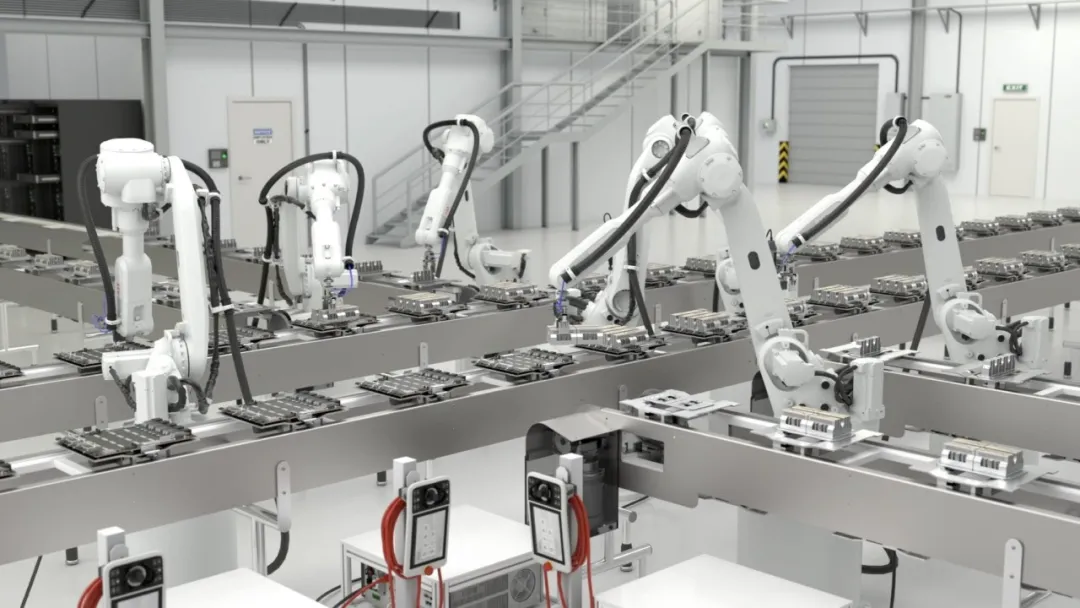
We are testing the real value of Atlas in robotic simulation, including its use in robot training and navigation, connecting the real world to the simulated world, and applying the results of the simulation to real robot operations.
As you can see, some recent research shows that robots can be trained in a simulated virtual world and then deployed directly to the real world using zero samples.
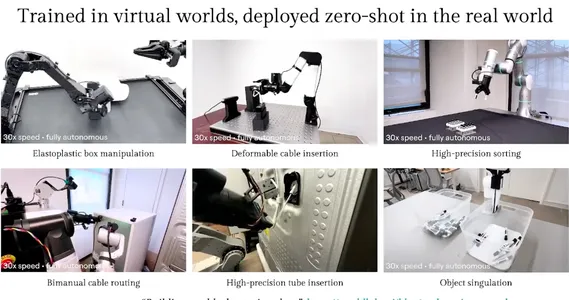
We are deepening our research in this area through the collaboration with Atlas. We will be releasing Atlas soon, so please keep an eye out.
Finally, I would like to invite you to pay attention to the great work that my students have done.
One of them is the Behavior Challenge, hosted by the Stanford Behavior Team. This is the second year the contest has been held, and we will announce the winners tomorrow.
This year's competition is very exciting. The challenge itself is evolving, and we are now seeing many new approaches, including generative AI.
I will also be presenting tomorrow's workshop on what generated AI-powered robots can and cannot do.
In addition, I have many students who have put a lot of effort into participating in the CoRL.
We have six papers to choose from, and you are welcome to learn about our papers during or after this CoRL meeting. The World Labs team and the Stanford student team have put a lot of effort into these studies. Thank you very much!
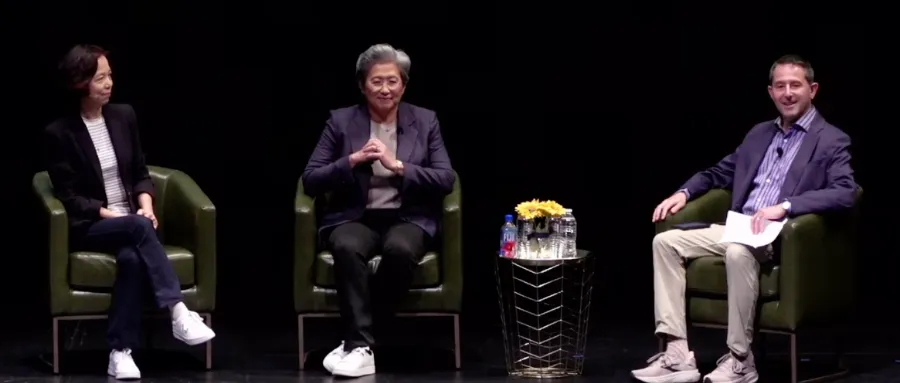
The following is an extract from Lifeifei's second round table discussion with Suzhou Feng.
05.
Lifeifei talks with Suu Kyi, who said:Talking about opportunities for robot development, demand for AI computingDeveloping talent for the futureOne, the robotics market could reach hundreds of billions of dollars in the next few years.Peter Stone:First of all, I want to start with Lisa and Flyfly. Everyone here today is a robot researcher.
We've heard that AMD is pushing for the acquisition of World Labs, and we've just shared her views on the world model and future development opportunities.
First, I asked Lisa, "What do you think are the biggest opportunities for AMD, from the perspective of robotics and physical AI, and how will World Labs integrate into AMD's broader strategy?"
What are you doing here?Thank you, Peter, and thank you for inviting me here.
I think this is a very exciting time in the development of AI. Looking back at all the progress we've made so far, it's clear that we're actually still in the very early stages of future development possibilities.
I thought,Physical AI, especially in the field of robotics, is a huge opportunity, a market that could reach hundreds of billions of dollars in the coming years.
The key here is that we have to really understand the laws of physics, the models, and the environment as a whole.
In addition to being a superstar in its own right, we can look at this from a different perspective.
In our business, the more you know about workloads, the better you understand the future direction of development if you consider that hardware optimization will take many years to complete.
I thought,The concept of synergy optimization between hardware, software and systems is also applicable to the field of robotics.
In the next five to 10 years, this will be a very important area.So I'm really looking forward to World Labs joining AMD.
More importantly, for AMD's ecosystem, I look forward to further expanding the AMD ecosystem to include the entire robot community.
2 -- AI is computing, and computing is AI.Peter Stone:The next thing I want to ask you is how do you think joining AMD will expand the capabilities of World Labs?
You've already outlined your vision of a world model. So what will the combination of the two lead you to build next?
He said:In fact, I've known Lisa for many years. Looking back over the past decade, from AMD to the whole computing world to the era of AI, everything Lisa has done is amazing and amazing.
In the field of artificial intelligence, the relationship between models and computing has changed fundamentally.
Now, as we go around the world, people often ask me, what is AI? My answer is: AI is computing, computing is AI.
This is true for both the world model and the language model.
Frankly, we're seeing a fusion of many different models, including single-mode and multi-mode models. As Lisa just said, this requires collaborative development, collaborative design between hardware and software.
So this is a very interesting opportunity.
I also want to talk about the Ph.D., M.S. and undergraduate students who are here.
I believe that as AI becomes a tool, the way scientific research itself is changing. AI is not only a problem that we need to research and solve, but it can also be a tool for our research.
We are entering a very exciting era of Team Science.
Combining the strengths of each of the four laboratories with the strengths of AMD to contribute to the development of computing and artificial intelligence in a team-scientific manner is exciting for all of us.
Peter Stone:You just talked about the inextricable relationship between AI and computing and about the changes that are happening in the field of robotics.
We see that big language models and other basic models are playing a role in the field of robotics, and at the same time, video generation models are also beginning to be applied to the field of robotics.
What do you think the future of robots will be driven by? Do we still need to develop different levels of modules separately? Or do you think that the foundation model will eventually solve the problem of robots in an end-to-end manner?
Will they be able to do everything independently, to really solve the problems of robotics?
He said:Let me answer first. We still have to be rational and honest.
The results of the research recently published by the Frontline Laboratory, as well as some of the results presented at the conference, are truly amazing.
We are at a very early stage, but we are also seeing a clear turning point.
I think robots powered by visual language models (VLM) or large language models (LLM) will play an increasingly important role.
But I don't think we have completely solved the problem at the system level.
There are still many problems in the field of robotics and physical AI, and we are not sure if we have found a way to solve them fundamentally.
So, in the future, we will continue to see various changes.
Next year's CoRL meeting will be very different. For the past two weeks, we have been reviewing the results of the Behavior Challenge competition.
I think this change is far from over.
As a researcher, I personally have been very vigilant, because I sometimes feel a little nervous about what research directions we should be betting on.
But at the same time, it's also incredibly exciting. Because now, we've seen new signals from many different directions, and there's an opportunity to combine these potential approaches.
What are you doing here?I would like to add something. In many vertical applications, what we see is that there is no single model or direction of development that can solve all the problems.
In the face of various real-world application scenarios, we actually need to cover a very wide range of use cases and use different types of models.
Fly, I agree with what you just said. In some situations, the front-end language model we're talking about will perform very well. But I can also imagine that in other situations, a more specialized model will be more advantageous.
3. Robots will drive the growth in demand for computing in all forms on a massive scalePeter Stone:Lisa, robots have become one of the key drivers of growing demand for chips, computing resources and tokens.
There are a lot of students and academic researchers here today who are desperate to have access to more computing resources.
So how does AMD view the future demand for chips and computing resources in the robotics space?
Training models require enormous computational resources. Of course, once a robot is actually deployed in a real environment, it also requires real-time perception, reasoning and action, and is often subject to strict power constraints.
Does this mean that robots are essentially a problem of systems engineering?
For these workloads, how does AMD consider designing computing, memory, software, and other parts of the system together?
What are you doing here?What I want to say is, does anyone here need to calculate resources?
In our time, computing is fundamental, and in many ways, it is directly related to intelligence.
Looking back at the developmental stage we're in right now, I can say that we need a variety of different types of computing skills. This is why I'm so excited about the entire computing ecosystem.
I've been working in computing for 30 years. Compared to everyone here, this makes me look a little older.
But the truth is, there has never been a better time or a more important time than this.
We need computing skills at every level.We need cloud computing resources to train these massive models.
We also need computing resources within the enterprise, we need computing capabilities in the edge environment. As robots become increasingly important, these resources will also become very critical.
In addition, we also need computational capabilities to get into the real physical environment.
My view is that we need computing skills of different sizes and shapes, but they all need to follow some basic principles.
If models have different sizes, then our computational capabilities need to have different sizes.
It's basically a solution problem.
We need toHardware, software, and systems are combined for collaborative optimization to solve specific problems as efficiently as possible.
He said:I would like to add one more thing. We were talking about this at the robot conference today, and I'm not saying this because I'm at the CoRL, but I really think:Robots will push computing capabilities into the next stage of development.
I like that judgment, and it's a good thing.
If you look back at the evolution of robots, you will find that their development in the past lacked the impetus of the large language models, because the robot itself is a very difficult problem and it also needs to interact with the physical world.
But the turning point we see now is real.
I can't accurately predict the future slope, but we can be sure that we have entered an upward trend.
Robots will massively drive the growth of computing demand in a variety of forms, not only at the training end, but also at the edge.
Peter Stone:Fly Fly, you've been through this from many different angles.
You've been a professor and you've been racing for resources for academia; you've started a funded startup; and soon you'll be the chief scientist at AMD.
As we have just mentioned, one of the challenges facing cutting-edge research is that researchers have difficulty accessing the computational resources they need.
What do you think needs to be done to make more advanced robotics research and development more open to researchers, startups and students?
What role can a company like AMD play?
He said:This is a question I left to Lisa to answer.
However, Peter, you and I have always been colleagues and partners. We have been pushing the public sector to access computing resources in the past.
As early as 2019, some of us pushed a bill called the National AI Research Resource Bill (NAIRR).
What I want to say is that one of the most important moments in the history of AI would be a huge mistake if we didn't provide enough resources for the public sector.
In other words,We must provide resources for the public sector.
The public sector includes researchers from universities, as well as non-profit organizations, as this is the first stage of innovation.
The country's innovation engine starts with basic research in the public sector, open-ended, curiosity-driven research.
At the same time, we are also developing the next generation of inventors and the workforce of the future.
But now, the public sector in the AI sector is facing a serious resource shortage. I think we have to solve this problem because we need to invest in the future.
In addition, we now need more and more responsible AI, both in terms of security and security.
The public sector must play a key role in this.
We needTo help the public sector understand and evaluate what AI is doing, conduct benchmarking tests, and provide information to the public,At the same time, it offers advice to the government to let people know about the good, the bad and the problems that exist in these AI models.
Therefore, the public sector plays a vital role.
Peter Stone:I totally agree with you, so what role can AMD play and how can you help achieve this goal?
What are you doing here?I think a good way is to ask the chief scientist of AMD what they should do.
First of all, I'm 100% in agreement with everything Flyfly has just said.
For us, the opportunity lies in the fact that we are building a very large computing capacity at the scale of thousands of megawatts.
In fact, frankly, we are at the stage of demand far beyond supply.
However, it is absolutely our responsibility as industry leaders to dedicate some of these resources to long-term research and provide them to universities to ensure that the next generation of innovators have access to computing resources.
We look forward to spending time with the community and making sure this really happens.
I'm just not totally joking.
There's a reason why I'm so looking forward to flying to AMD and being the chief scientist.
I think AI has made tremendous progress. We've seen the development of AI and the changes that big language models bring.
But this is still at a very early stage.
Now, what we need to think about is how can we make sure these technologies really make the world a better place?
Robots are one of the most important areas.
I think we're very close to the goal, but we haven't really shown the real value that robots can bring.
I hope that AMD can be a part of it. Of course, I believe that other companies in the industry have the same motivation to help us make this vision a reality.
Will AMD build a robotics research team?Peter Stone:And then I want to move on to the question on Slido.
There are a few very high scoring issues here, and their rankings have been changing.
We're very interested in this question: Will AMD build a team of robots?
What are you doing here?By default, we don't have a robot team yet.
In fact, we already have a scale.We have a pretty good physical AI and robotics research team.However, it is still in its very early stages.
If you look at it from a computational point of view, you will see that many of the components that robots need are already in our possession.
For example, we have embedded FPGAs, processors, and AI engines. These components have been able to control many robots, especially those we see in industrial environments.
But I think we're still at a very early stage if we're going to get further into the field of robotics that people are studying.
I'm really looking forward to flying after joining AMD, to be able to put a lot of energy into robotics research while also strengthening our connections to the entire ecosystem.
Because I've always been convinced that no company can do all the work in the whole tech box alone.
In the end, this is why startups can play such an important role today.
We have industrial laboratories, universities and large enterprises.
What we really need is to combine the strengths of these different areas.
In such a development environment, building open ecosystems, providing powerful hardware, allowing different levels of software to collaborate with each other, and allowing different laboratories to conduct their own research, are important ways that I think can accelerate the speed and processes of robot development.
We also need to really bring robots to manufacturing and industrial applications.
5 - No matter how advanced AI is, human intelligence is still very valuable.Peter Stone:I think there are a lot of people here who are at the beginning of their careers, who are seriously thinking about what the most important and interesting questions they should be studying as PhD students.
On the other hand, are there any research directions that you don't recommend that you choose, unsuitable for collaboration for your PhD thesis?
I would like to hear the views of both sides at the same time.
What areas are particularly worthy of being the subject of a PhD or undergraduate study and which areas should be chosen with caution?
In addition, many people at this conference have asked me a question that I think you might be interested in: what does a PhD really mean in the years to come?
I think, Fly Fly, your answer may not be what everyone likes to hear, but I still want to share it with you.
He said:First of all, I think this is a time of great change.
To be honest, the three of us on the stage may have some envy for all of you, because you're so young, and you were born in the era of the AI revolution.
And we are not entering this age until we have grown up.
My own answers to the question of whether to pursue a PhD and what to do during a PhD are also changing.
I don't think a PhD is for everyone.
Especially in the era of AI, learning tools and software engineering have changed so dramatically.
Now, people can become researchers, innovators and make a real impact through more and more different paths.
This does not mean that a PhD is no longer worthwhile.
I think it's still very good. I personally enjoyed the experience of reading the PhD, and I'm sure Peter and Lisa enjoyed it too.
But now that more different paths have emerged, you need to take action to find your own direction.
So what exactly does a PhD mean?
I'm still convinced.The core of a PhD is curiosity.
This is a fully protected period in your life. During this time, you can pursue the most challenging, curious, interesting, and potentially influential questions.
I have always believed,No matter how advanced AI is, human intelligence is still very valuable.
It may even be becoming more scarce, but it is still precious.
Now, we have a lot of tokens competing with human brain activity.
But I think that the civilization we're building still needs human intelligence and the courageous curiosity of humans.
Therefore, I do believe that a PhD is still a very good path for those who have a strong desire and curiosity at heart.
But you must have this conviction and go boldly to the important things.
What are you doing here?I want to speak from my own experience.
When I was a PhD student, I didn't really think I was going to get a PhD.
My parents said to me: "Come on, you're too young, what are you going to do next?
As a result, it was truly the best four years of my life.
The reason is, as I just said.
It's not what you study specifically that matters, because specific problems change.
The specific problems that we are studying today are changing very quickly.
But what's really important is that you have the opportunity to be one of the best people in your field, or to be one of the best researchers in this field, because you have the opportunity to explore.
So, for this reason, I think that studying for a PhD is a very good thing.
If you have the chance, I would encourage you to try.
Because life is so long, no one can take your doctorate.
And you will always have that experience and knowledge: you have chosen a problem and put it at the forefront of your field.
As for what Peter just asked, what should be studied, I have a very strong opinion.
Now, the entire industry is discussing general AI (AGI) and how far we are from AGI.
Sometimes I hear some colleagues and people in the industry say that we are very close to AGI and it seems that we can do it right away.
But I don't really agree with that.
I don't think we're that close to AGI.
Looking back at the tremendous progress made in AI, we have indeed achieved many incredible achievements.
But the performance of AI still largely depends on what we let it solve and how we guide it.
So when you look at AI as a tool, you want to be able to use the best tools.
But at the end of the day, you still need to use your expertise and intuition.
I often say that when recruiting talent, you can tell which people are really intuitive in their field and which people are just so-called literate.
In today's era, it can also be said that AI is rich in knowledge.
You need to find the issues that really interest you and cultivate your intuition in this area.
In this way, no matter how the tools change, you will not be affected to continue driving the development of your field.
Because you already have a professional instinct in this field.
This is also one of the hardest things to do in the industry.
This is because the industry lacks patience.
We all lack patience. We want the product to be launched as soon as possible and we want the next model to be released as soon as possible.
This is precisely the difference between the university environment and the industry.
Peter Stone:Flying, you just mentioned, human intelligence is still very special and very important.
There are still some gaps between how AI models are trained and how we already know they can be implemented.
One research direction I often give is how to use less resources and less energy to stay gay.
I think this is a very important area of research.
Of course, this may conflict with the commercial goal of selling more chips.
I want to hear what you two think about this. Do you think that reducing energy consumption and improving efficiency should be an important area of research for today's students?
What are you doing here?Of course, this is definitely a very important direction.
This brings us back to the question we just discussed: there is no uniform scheme for computation that applies to all scenarios.
The physical world is not just a fixed scale, but a variety of different scales.
I think that's why we're still at a very early stage.
You're right, now we have big data centers and we have scaling laws.
But at the end of the day, we need to make computing everywhere.
Therefore, lower power consumption, higher efficiency, longer service life and lower latency all need to be optimized.
In addition, I think we need to pay attention to one thing: not to confuse the 20-watt power consumption of the human brain with the enormous energy required to train an AI model.
He said:Evolution itself is also very expensive.
Yes, the human brain is very efficient, but it's the result of billions of years of evolution. I don't know how to calculate the cumulative energy consumption of the entire animal kingdom over a long period of evolution.
Therefore, we should not confuse these two factors.
In addition, I have always believed that brain science itself is an independent science. Whether it's understanding the brain, recording and copying the brain, or helping to solve brain diseases, these are questions that brain science needs to study.
But at the same time,AI itself is also an independent science. AI is not necessarily just to replicate the human brain.
Because the computational problems we are trying to solve are beyond the limits of some human capabilities - for example, writing code, generating simulation environments, and providing computational capabilities to robots.
As a result, brain science and AI science are two intertwined research issues.
Peter Stone:Another question on Slido, given that you are currently on your honeymoon after the announcement of the partnership, someone asks: do you have any differences?
He said:Seriously, do we have any points of disagreement?
I don't know. We've seen it, we haven't figured it out yet. We've never seen this happen before.
If you invite us back later, we can ask you again.
6 In an age of change, seeking unchanging valuesPeter Stone:As you can see from the questions that have just been asked, students today are both anxious and excited about AI.
If you combined your own experiences and assumed that you were in the same place as these students, how would you look at this time?
Finally, what advice do you want to send to everyone here? This is indeed a turbulent time for many students, because the times are changing.
He said:Your own lives are changing because you are in the student phase and your field is also changing.
From the perspective of human civilization as a whole, we are also at a very special moment because we are experiencing a technology that has the meaning of changing civilization.
In fact, I would like to invite all the students to attend.In an ever-changing age, look for the eternal values that never change.
As Lisa just said, life is long. Many things change. Research problems change, challenges change, opportunities change.
But how we live the life we really want to live depends largely on the things that don't change, the eternal values.
For me personally, this experience has made me realize that the eternal values include curiosity, integrity, and the courage to fearlessly pursue truth, to explore it, while also daring to explore it in thought and remain honest.
What are you doing here?I thought,I would encourage you to be far-sighted and truly optimistic about the future.
For you are living in a wonderful time. You have great tools and opportunities.
Many people come to me for advice, asking questions about career development, such as what to do, what direction to choose.
I usually tell them a piece of advice I got when I was younger.
At the time, I was a young engineer at IBM and had just worked for about two years.
One day someone asked me: "Mom Lisa, what kind of person do you want to be when you grow up?"
At the time, IBM had a position called an IBM Fellow, a position focused on deep research; there was also a position as vice president of IBM.
What I was actually thinking at the time was that I might not be smart enough to be an IBM Fellow, but I might have the opportunity to be an IBM Vice President.
So I decided to work in that direction.
At that time, someone suggested to me:We are always moving towards the most difficult questions.
At the time, I didn't really understand the meaning of this phrase. But this advice has been with me for many years. Now I will share it with others.
Because at the end of the day, our job as engineers, scientists and researchers is to solve problems.
We are going to solve very interesting, very important, and exciting problems.
We can enjoy and succeed in the process of solving these problems and, through these efforts, push the world forward.
So if you're ready to do something, you need to solve the hardest problems and believe that you can make a huge impact.
I think that's why this era is so interesting.
The tools you have now have been able to help solve some of the most interesting problems, some of which have not been solved for decades.
What a funny thing!
So, I want to say that this is a very exciting time for students who are starting their careers. I also hope that in the future you can consider joining AMD.
He said:By the way, she will be our recruitment manager.