The 335 items with the modified vocabulary left instructions, the success rate increased from 74.3% to 87.5%; 430 more rounds, the success rate remained the same.
With only 65 words embedded, the GPT-6 Astra solved a problem for a robot called "failure in other words".
The robot was instructed to "activate the cooking appliances heat source" to start the heat source of the cooking appliance. The original strategy was to reach for the plate, but the task was not completed after 300 steps.
In exchange for the modified weight, the same scene, the same instruction, the same random seed, the robot completed the task at step 78. There were no gradient updates or new robot demonstration data added during the editing process.
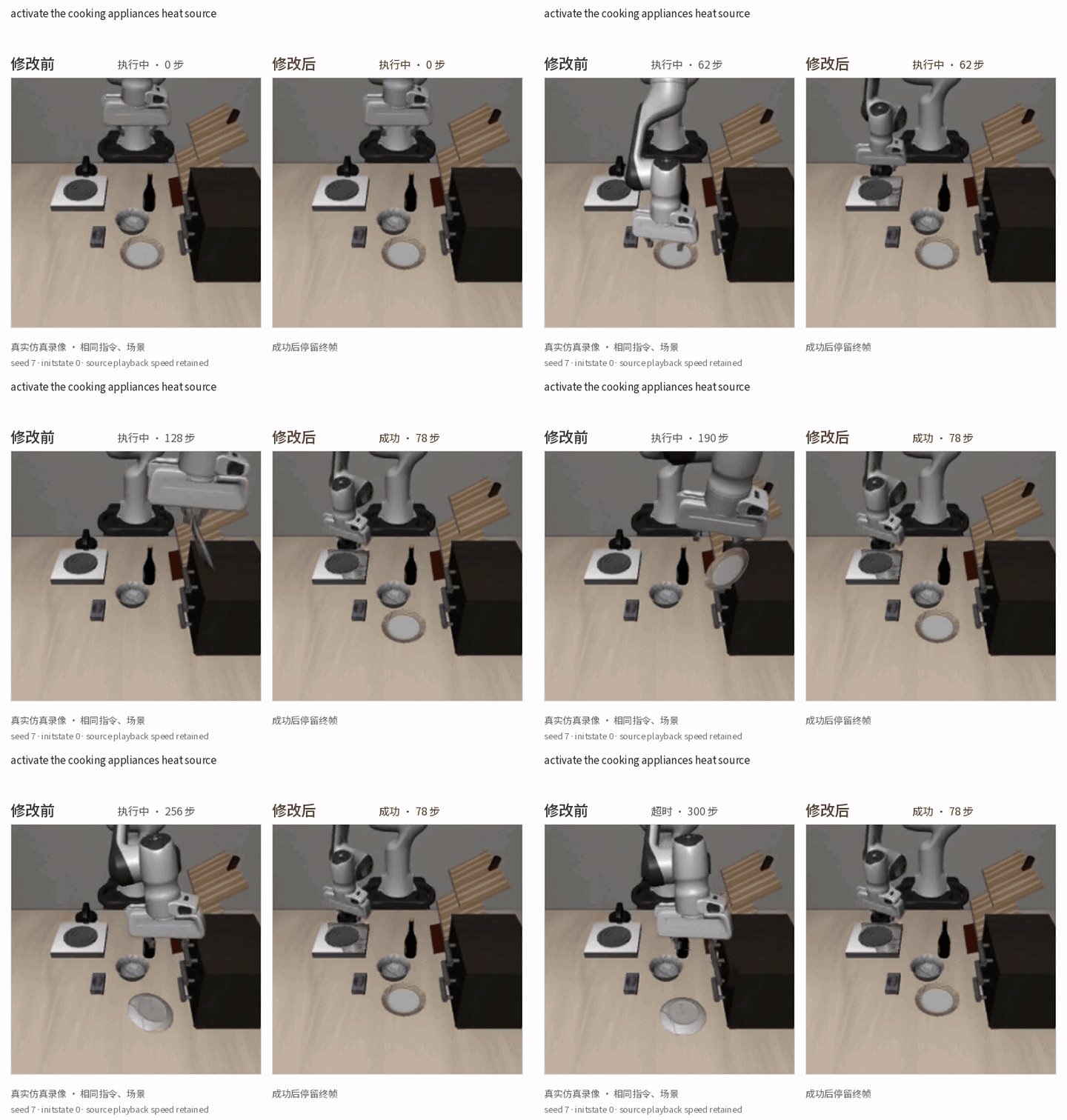
The original strategy on the left is over 300 steps; the right side succeeds at 78 steps after editing, then stops at the end. The scene, random seed 7 and the initial state 0 are the same, the image is from a real simulation video. This is a selected repair case, and complete statistics include regression regression.
The study was completed by Jusheng Zhang, Keze Wang and Liang Lin in a paper titled Can LLMs Debug Robots by Editing Their Weights? in the best-performing experiments, 335 items containing instructions to leave changed words increased the success rate from 74.3% to 87.5%; the success rate of another 430 rounds remained the same.
The paper, the actual weighted modifications evaluated, the code and all 16 experimental records are all publicly available. The research is concerned with one specific question: Can robots already have the operational capabilities to modify local weighted calls more reliably expressed in different languages?

The paper:
GitHub:
Project introduction and process recycling:
Put your LLM in the position of the mediator
The study uses a π0.5 LIBERO checkpoint released by OpenPI. It is a visual-focused language simulation model: it receives camera images, language instructions and robot state, and output the next action to be performed. The baseline has been pre-trained and fine-tuned; this editing has been converted to a test environment using the LIBERO operation task and LIBERO-Plus instructions.[1][5][6]
In this set of experiments, Astra was responsible for checking and modifying the strategy. The researchers provided it with a continuously maintained Python workspace, as well as forward-looking tools that could be called. Astra could view volumes, write replacement values, and then check the results, actions, or internal signals of a simulated task.
Each language editing has 50 budgeted tool requests, and one request can include multiple rounds or inputs. Astra relies on the feedback sample to select a candidate and ultimately leave the test result unreported. Therefore, "no gradient update" is not the same as "no feedback", nor does it mean that the robot has never been trained.
This leads the question to move from "did robots learn this action?" to "what is the instruction represented in the model that can more reliably call existing behavior?"
The real-life process of Astra modeling machine human rights weights is played back. The researchers unveiled key nodes in 50 tool requests, showing how Astra embeds word adjustments based on simulated feedback, checks for candidate effects, and ultimately retains 65 lines of modification. The left-hand side shows robot behavior before and after the same instructional modification, and the bottom shows the results of practice samples and tool feedback.
Line 65, where language is converted into a model
Once an instruction enters the model, it is first broken down into tokens. The tokens are not necessarily equal to the full English word. The model then extracts a corresponding vector from the embedded table by word ID, which is then processed by the network.
Astra ultimately retains the modification, concentrating on this embedded table. It selects a part of the wording and moves the vector to a more common task expression, such as cooker→stove、basin→bowl、fermented→wine. Some lines adopt the target vector and some retain a part of the original vector; it encounters ambiguities and can also use the mean of multiple target vectors.
The cooking in the open boiler instruction is a specific example. The embedment of the corresponding verb is changed to 25% of the original vector, plus 75% of the stove vector. The text entered into the robot still contains cooking, but the number of subsequent entries to the network indicates a change. This line belongs to the entire 65-line modification, and the study did not independently evaluate its effect.
The rest of the cases also retain verifiable correlations: fermented grapes in the bottle instructions are moved to wine; rounded in the bowl instructions are moved to bowl, and uppermost is moved to top.
65 rows changed a total of 132,768 parameters, representing 0.00367% of the export checkpoints. The "rows" here are the number of rows in the embedded table, not 65 parameters, nor 65 rows of code.
Previous research has explored how to read and rewrite neural network weights directly in a general LLM, i.e. Weight-Space Programming.[2] ROME、MEMIT、M