When language models began to "grow out of mathematics": BriLLM-MetaPred landed the first core native language introduced by AGI theory for the first time
As the industry as a whole continues to make increasingly expensive incremental improvements on the Transformer extension line, the team of Shanghai Transport University's Huaihai Professor gave an anti-intuitive answer: first define AGI rigorously mathematically, and then let machine learning models "grow out" of that definition.
They've just uploaded to arXiv's BriLLM-MetaPred, the first engineering feat of this path. It's not just another "better language model", but it's the first workable example of a machine-learning native language, MetaPred, introduced by AGI's mathematical theory ("A Mathematical Theory of AGI").
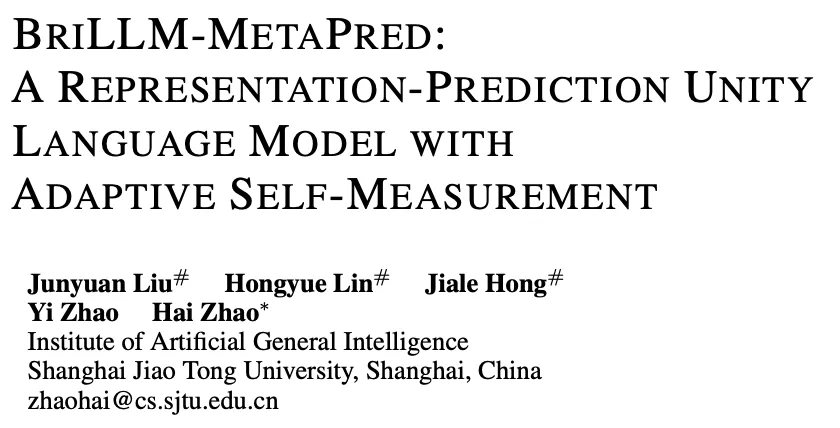
BriLLM-MetaPred: A Representation-Prediction Unity Language Model with Adaptive Self-Measurement
arXiv:
The team: Shanghai Transport University's General Institute of Artificial Intelligence (GIAI)
A combination of two independent lines of evidence:
Constructing mathematical inference with brain principles
Just looking at the line "derived from the AGI definition of MetaPred", readers have reason to ask: Is it just a self-contained form system? The mathematical theory of AGI gives an easily overlooked but crucial addition: this mathematical pathway is highly synonymous with the predictive coding/free energy principle that is mainstream in neuroscience, at the abstract level.
The final chapter of the theoretical paper deals specifically with this issue. The "principle of natural equilibrium" in AGI mathematical theory, a generalization of the ratio of only energy (systemic costs) to hydrogen (systemic information gains), likewise derives MetaPred as the optimum. This means that MetaPred is not only deduced from "the boundary of infinite self-knowledge in this sense, but also from the principle that "any self-organizing system must achieve the optimum balance between energy costs and information gains" that is closer to physical and biological constraints.
BriLLM-MetaPred's Related Work also explicitly lists Friston's prediction coding work on free energy principles and microcircuits by Bastos and others as a theoretical reference. This is not a decorative reference. The core proposition of prediction coding is: the brain maintains the alignment of internal models with the world by minimizing prediction errors; while MetaPred's core mechanism carries a single dynamic state simultaneously with representation and prediction, and by continuous self-measurement maintains internal consistency at the moment of inertia.
This constitutes an indirect interdisciplinary argument, rather than a circular argument. Neuroscience has no "proof" that MetaPred is correct, and mathematical theory has no "prediction" that the brain must adopt MetaPred. But when an original language derived from a purely mathematical definition meets with a unified principle derived from experimental neuroscience on the same abstract structure, the credibility of this theoretical pathway no longer depends solely on "saying itself necessary and sufficient", but on an external focus from an independent discipline. In other words, the theory behind BriM-MetaPred is not a thorough wait-and-see system; it has formed a corollary description of the brain mechanism at this level of "what the core computation of intelligence should look like".
Starting with:
An autonomous and rigorous mathematical definition of AGI
The overwhelming majority of AGI's paths, either to seek inspiration from the biological brain or from external embedded engineering modules. A Mathematical Theory of AGI, based on BriLLM-MetaPred, takes an entirely different path: not to predict any specific network topology or cognitive modules, but to "grow from general cognition itself, give an autonomous mathematical definition and then come up with a solution".
The theory defines AGI as "the boundary of infinite self-knowledge". From this definition, the theory translates it into a rigorous mathematical variation problem. In the syntactic sense, the only solution to this variation problem is a machine learning native language called MetaPred.
In other words, MetaPred is not a man-made, but a mathematical derivative. The theory further argues that MetaPred is necessary and sufficient for general cognition. The paper's statement on this is not ambiguous: "MetaPred is the first machine learning paradigm to be derived entirely from mathematical theory, rather than from artificial design and incremental improvements in assembly".
The core of MetaPred is:
A state that is both representative and predictive
So what's the origin of the word "long" from the best mathematical optimization?
The defining characteristics of MetaPred are very simple, but distinct from contemporary mainstream architecture: the "representation" of the model and the "prediction" it produces are two aspects of the same dynamic state of continuous evolution.
Traditional language models break down representations and predictions into two structures: the encoder or hidden layer is responsible for forming representations, and the output head is responsible for reading predictions from the representation. MetaPred eliminates this breakdown. It maintains a single dynamic state of continuous evolution: the context information is written into this state, the state itself evolving over time, while the predictions of the next vocabulary are read directly from the same state.
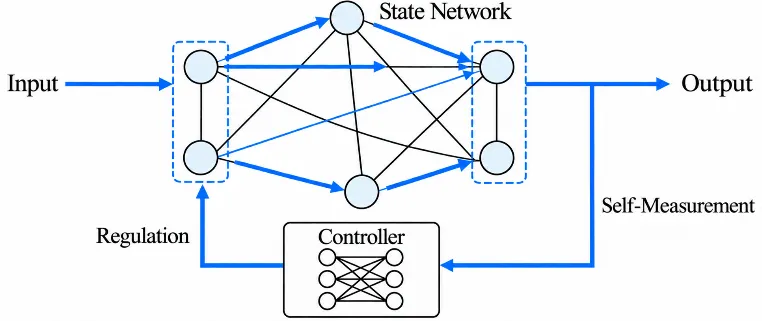
This results in another key mechanism: continuous self-measurement. Models continuously measure their own dynamic state, which has the triple effect of reducing inconsistencies caused by finite depths, maintaining internal consistency, and providing internal dynamics with fixed-point self-monitoring signals.
This is worth taking a look at. The current mainstream self-monitoring, external-constructed proxy task mask prediction, as opposed to learning, the next term predicting the source of the signal outside the dynamics of the model. MetaPred's self-monitoring signal comes from the state's own measurement of itself, and its training goal is formally equivalent to the requirement that internal expression tends to be consistent with the self in the generation. This is an "internal" rather than "extra" monitoring signal.
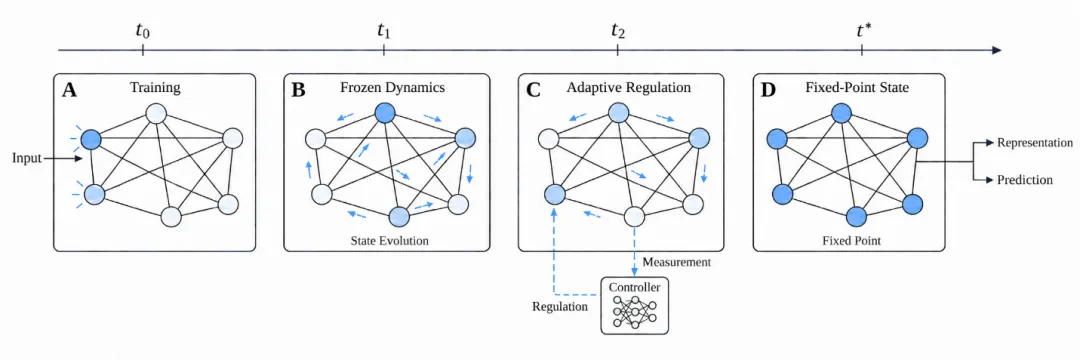
Because training and reasoning share the same dynamic state, MetaPred presents a symmetry thesis on almost all of the key elements of machine learning that describes it as "an intuitive and observable nature that mathematics best optimizes in a paradigm space".
BriLLM-MetaPred:
Install the original language in an operational carrier
The theory gives the original language, but the original language requires a carrier to run on real hardware.
BriLLM-MetaPred's engineering path clearly connects two pioneering contributions: AGI theory provides the construction and motivation of MetaPred's original language; and the SiFu node-signalling paradigm provided by BriLLM provides the original language for execution on existing software and hardware accelerators.
Civilization does define its own boundaries: BriLLM-MetaPred is not another circular language model, nor is it simply an extension of BriLLM. It is a bridge bridge that connects the original language that the theory is derived from to an engineered operational carrier.
At the implementation level, it is a node-state language model: a word projection vector is written into a fixed interface line, a circular algorithm updates the entire volume through dynamic evolution, and the distribution of the next word is read from the specified output line and the finite auxiliary pool.
Key confirmation results are: The predictive performance of BriLLM-MetaPred is equivalent to the equivalent size of GPT baselines (approximately 13.2M parameters).
For a new paradigm derived from zero, the meaning of this result is not "beyond GPT", but in proving: that the original language derived from mathematics is engineered in the core cognitive task of language modeling. The paper positioned it as "a preliminary proof of the feasibility of MetaPred framework engineering".
Compared to its predecessor, BriLLM, this was a major performance leap: the latter required about ten times the size of the GPT-1 model to barely deliver comparable generation performance; while BriLLM-MetaPred achieved the same result with only about 1/10 of the scale.
Currently, the maximum verification size has reached 1.5B, the same size as GPT-2.

A unique location on a parallel route:
The only AGI theoretical path to complete LLM sequential engineering validation
The unique advantage of BriLLM-MetaPred is not that its theory is "more accurate" than the free energy principle, nor that it is "more elegant" than AIXI, but that it is the only way to do both "derived from the original language of mathematics" and "modern in LLM".
The core proposition of this comparison is simple: whether an AGI theoretical route is serious, that an unavoidable engineered filter can't land on an open-field sequence task of this scale in language modeling. This is not to say that language is the only input to AGI, but that if a theoretical route to GPT-1 level sequence modeling is not done, its expertise will always remain in a "non-collision state with the strongest engineering reality".
The FEP has a deep neuroscience foundation and a closed loop, but it does not provide scalable implementation in open-field language modeling; AIXI has a rigorous optimization theory, but it has been shown to be incalculable, standing close to this wall between the engineering reality of LLM; routes such as CAA-X have large mathematical specifications, but have not yet produced comparable real results in LLM sequences. BriLLM-MetaPred adds to this gap. It proves not that "MetaPred is already superior to GPT", but that "mathematics derived from AGI theory can stand on the playing field of contemporary LLM".
For this reason, the seemingly restrained result of "equivalent to GPT baseline performance of the same scale" has a positioning significance in the larger route competition landscape. It does not announce AGI's arrival, but it pushes a route that previously existed only in mathematical derivation onto the engineering test platforms of contemporary language models for the first time.
The GPT frontal pain point is aligned with:
It's not a larger encyclopedia, it's the core of self-correcting dynamics.
Understanding BriLLM-MetaPred simply as "another language model" will miss its real relevance. The paper repeatedly emphasizes at the paradigm level: the difference between MetaPred and GPT is not the difference between the architectural variables, but the difference at the "machine learning paradigm" level. GPT is based on Transformer, whose representation and prediction are two separate computational phases; whereas MetaPred's defining characteristic is that representation and prediction are two sides of the same continuous evolutionary dynamic state, with training and reasoning sharing the same state evolutionary path, with no independent "training forward" and "reasoning forward" paths.
Second, continuous learning and catastrophic neglect. The mainstream GPT paradigm's training and reasoning are separate: after training is completed, model parameters freeze, and the deployment stage learning can be achieved almost indirectly only through the above-mentioned window or external retrieval. MetaPred's single dynamic state combines training and reasoning on the ground: when training, self-measurement provides a gradient of parametric updates; when reasoning, the same self-measurement provides direction for state correction.
Second, the structural premise of recurrent self-improvement (RSI). The core requirement of RSI is that the system can measure its own performance and thus improve itself. MetaPred's continuous self-measurement mechanism matrix model continuously measures its own dynamic state in the form of inertial self-monitoring signals. The matrix has already incorporated a "self-assessment→ self-correcting closed loop shape" in the structure. The paper describes it as a Lambek motionless logic in machine learning: the differentiation between finite modeling and deeper-step modeling, which constitutes a uniformity signal that does not require external labels. This complete RSI still has a long way to go, but it "self-measurement" from an external monitoring tool, which makes the model a part of dynamics itself.
The third pain point is scalability, and "AGI does not have to be an encyclopedia". The GPT pathway's discussion of scalability focuses on the long-term synchronous expansion of parameter size, data size, and computational size. MetaPred's theories suggest a different direction: Because the model carrier is weakly coupled to the dynamic state, the dynamic state needs to be aligned with only one subcarrier, rather than being strictly homologous to the entire architecture. The theory does point out that the easing of this bond is a fundamental mechanism that BriLLM supports with arbitrary input and output models while maintaining a constant model size. In other words, processing longer contexts, more complex sequences, does not have to be inflated at the expense of the model itself. MetaPred's theory even predicted performance could be matched to model scale, and BriLLM-MetaPred achieved GPT baseline performance of about one-tenth the size of GPT-1, the first verifiable engineering focus in this direction.
It is necessary to point out with restraint that these alignments are currently "structural orientations" rather than "finished solutions". Continuous execution training mechanisms are not lifelong learning in the open world; the immobility loop of self-measurement is not recurring to self-improvement; the constant model size supports arbitrary length inputs and does not equate to scalability problems have been eliminated. But they all point to a default setting that is different from the GPT paradigm: the core of intelligence is not "storing as much knowledge as possible in freezing parameters", but a dynamic process that can continue to evolve, self-measurement, and maintain internal coherence in interaction with the environment.
Breakthroughs at the core component level, not AGI terminals
The key to understanding BriLLM-MetaPred is to see what it does and what it doesn't claim.
It is made up of: one of the most difficult, most important parts of the core learning native language derived by the mathematical theory of AGI, the Python language model framework has been exemplified and has been proven to work and reach a level equivalent to the basic performance of contemporary mainstream architecture. This is the first point of focus verified by engineering between mathematical definitions and executable systems.
It does not claim that this example of a language model is itself a complete AGI system. The title and abstract of the paper always position it as the first engineering realization of a language model, rather than the complete realization of general cognition. In theory, systemic requirements such as dynamics, closed-loop, lifelong learning, are a follow-up to the theoretical blueprint, rather than an engineering contribution to this paper.
The value of BriLLM-MetaPred lies precisely in the fact that it refuses to bypass the most difficult step. An AGI theoretical path will be permanently suspended if it fails to land on open-field learning tasks of this scale and complexity in language modeling. BriLLM-MetaPred provides the first engineering focus for this path by using "constrained but testable results that are comparable to the performance of GPT baselines of the same size".
BriLLM-MetaPred is a class-brain model, but unlike other class-brain models: the "class-brain" characteristics here are natural and inevitable results of theoretical and engineering realizations, rather than design motivations.
It was not a faster engine, but the first prototype engine to be built according to a completely new, autonomous mathematical blueprint.