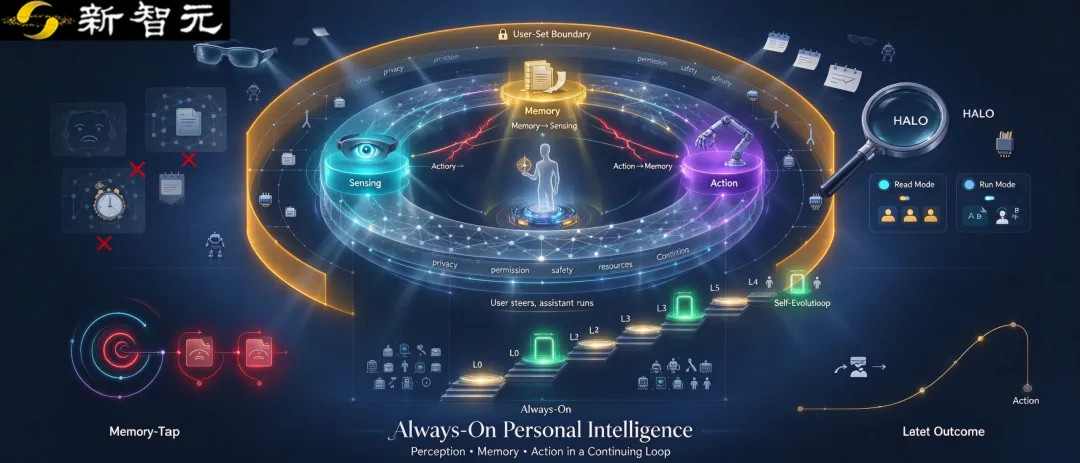
Personal AI agents are developing rapidly.
Overseas, leading AI labs have launched a series of new products such as Muse, dots, Claude Duet, Grok Bot, and Gemini Daily Brief. They no longer just passively wait for users to ask questions: some continue to work silently in the cloud after the conversation is over, some deliver customized briefings on time every morning, and some automatically check the user's associated accounts every few hours.
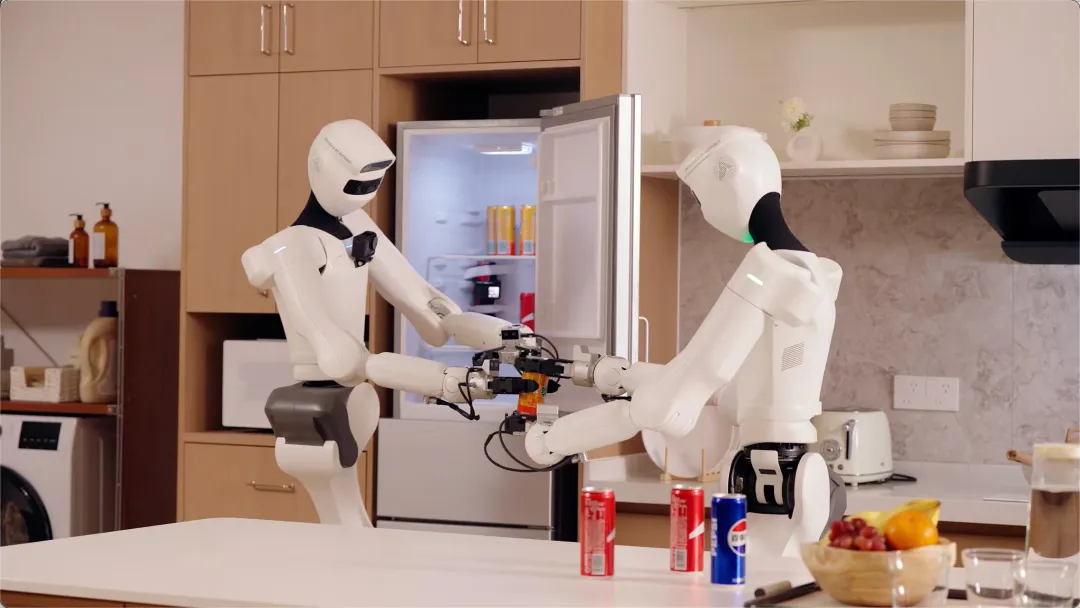
In China, large technology companies such as Tencent, Alibaba and ByteDance are also moving quickly, launching products including Lingguang 2.0, LightVela and Qwen Go. On the hardware side, AI glasses such as Thunderbird and Rokid have begun to focus on recording and remembering everything around the user around the clock; embodied intelligence is also evolving in the same direction:
Cutting-edge large models are becoming the high-level "brains" of robots, and the next step is to become life partners who understand users better.
This wave of product launches points to a clear shift: The second half of competition in personal AI agents is shifting from competing for a single model and single point function to competing for a complete system architecture.
A system must not only run for extended periods; its three core modules of perception, memory and action to cooperate with each other and exchange information - and all this must happen autonomously when the user does not speak.
The shift also raises fundamental questions:
- If it hangs in the background and keeps running, does it count as truly "constantly online"?
- When the user is not present or has not given instructions, what should the assistant do and what should not do?
Boiled down, the entire industry is looking for answers to three core questions: How can an assistant be truly “always online”? How can it "understand you the more you use it"? How far is the existing system from these two steps?
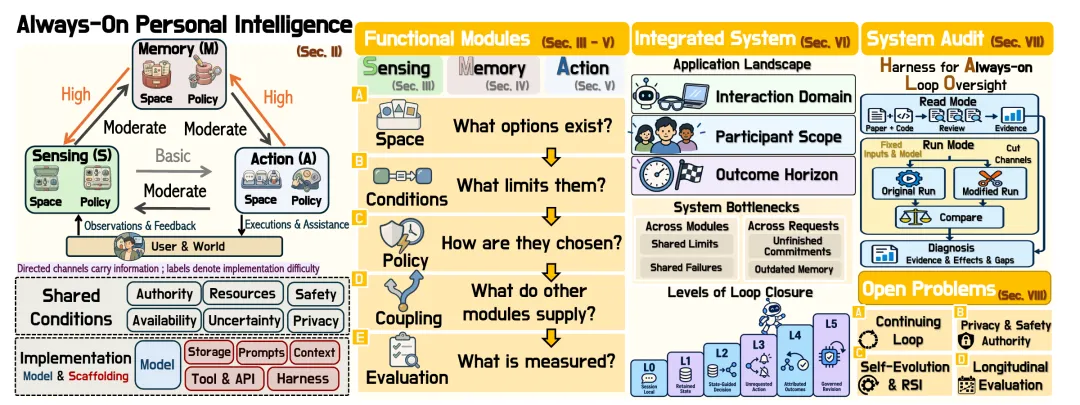
Figure 1 | Roadmap overview: Define continuous closed loop, review three modules, analyze integrated systems and closed loop levels, review existing systems with HALO, discuss open issues
Focusing on the above three major questions, 23 researchers from nine universities including Nanyang Technological University, University of California, Berkeley, Princeton University, Stanford University, National University of Singapore, King Abdullah University of Science and Technology (KAUST), Dartmouth College, University of North Carolina at Chapel Hill and Northwestern University jointly released a 126-page panoramic review.
Project homepage:https://always-on-intelligence.github.io
Paper list:
In the paper, the author wants to emphasize that the assistant is "always on", which does not mean "continuously online".
"Always-On" is not a new term. In software and hardware engineering, it has long been used to describe a system that is always on and available at any time.
But when it comes to personal assistants, there is still no clear definition of what it means. Recently, this type of system is often confused with concepts such as Proactive Agent, Personal Agent, and Long-Horizon Agent, and the boundaries are even more blurred.
To this end, this review combed 632 documents and 119 research systems and products, covering three categories of wearable, digital and embodied intelligence scenarios.
From a closed-loop perspective of "three functional modules of perception, memory, and action × six directed information flows", the author provides the definition, functional framework, six levels and future roadmap of continuous online personal AI agents, and proposes the final concept: the user is at the helm and the assistant runs.
Although today's intelligent agents can already share many specific tasks for people, they still need people to stay in the closed loop at all times, issue instructions and give permission step by step, so that the closed loop can turn around. In the final form envisioned in the paper, users no longer have to maintain the operation of the closed loop themselves, but are only responsible for controlling the direction and delineating boundaries.
The assistant decides for itself when to observe and when to take action, improves its working methods based on experience, and only stops to ask for confirmation before taking actions that require user authorization.
An interesting interactive demo is also launched on the project homepage: in 8 daily scenarios, readers can make a decision for the assistant and see what happens in another situation.

What is truly "constantly online"?
Let’s look at a small daily scene first: You say to your assistant, “Remind me to send out the report after the meeting.”
As soon as the voice fell, the conversation ended, but the assistant's work had just begun - it needed to pay attention to when the meeting ended, then choose an appropriate time to pop up a reminder, and during this period, it kept remembering the unfinished errand.
The paper identifies two core properties that a continuous online assistant must possess at the same time:
- Operational Continuity: Even when there are no new requests, the assistant can independently decide whether and when to act based on the current situation - among which, "keep waiting" itself is also a reasonable decision.
- State Durability: Continuously retaining available personal state across multiple interactions (such as user preferences and promises promised but not completed by the assistant). Even if the current conversation has ended, these to-do items can still be fulfilled by the assistant at some point in the future.
These two properties combined into one form a "Continuing Loop", which is also the cornerstone of continuous online personal AI agents.
According to this strict standard, several common types of assistants on the market are actually not truly “constantly online”:
- Assistant with memory but passive: It has long-term memory, but has to wait for the user to speak first. This only has "state persistence";
- An assistant that can initiate conversations but does not retain state: Although he can initiate a conversation, he will retain nothing after the conversation. This only has "operational continuity";
- Mechanical scheduled tasks: Although the alarm clock or script can run around the clock, it is only triggered mechanically at the preset time and does not make any decisions on its own.
Always-on agents and long-horizon agents address different problems. Long-range agents are concerned with "how to complete a given complex task," even if it spans multiple sessions; while continuously online personal AI agents faces another situation: the user's goals and needs change at any time, and new situations emerge one after another. It must provide uninterrupted companionship and support during dynamic changes.
In order to adapt to this continuous change, it is not enough to just "memorize" more information. The assistant must also continuously improve its working mechanism during the operation process. The paper calls this high-order capability "Self-Evolution."
Continuous closed loop is the basisSelf-evolution is the direction
Based on the above definition, the review puts forward the core argument of the full text: The foundation of always-on personal AI agents is a continuous closed loop, and the evolution direction is "self-evolution".
The key to understanding "continuous online" is to expand the vision from a single capability to the entire closed loop. Active speaking, long-term memory, and background persistence, none of them alone can support continuous online use. Continuous online is only truly established when observation, memory, and action still work together to deliver information during the gap between requests. Therefore, continuous online is a system attribute of the entire closed loop, rather than a local function of a certain module.
On this basis, "self-evolution" is an advanced expansion of continuous closed loop. Here we need to clarify a common misunderstanding: remembering users does not mean self-evolution.
Still taking the "post-meeting reminder" example: saving "the user likes to receive reminders after returning to their workstation" only updates a record, and the assistant's working method has not changed. Only when the assistant discovers that previous reminders are frequently closed, and then changes the reminder timing rules to "wait for the user to return to their workstation before reminding", is the mechanism truly revised.
Once the mechanism is changed, the way all subsequent inputs are processed will also change. Because of this, the paper puts forward higher requirements for self-evolution:
- Traceable, checkable, and revocable: Every mechanism revision must be traceable to specific basis, checked before taking effect, and can be withdrawn.
- Complete evidence chain: To prove that a system has the ability to self-evolve, you must provide complete evidence from "what was done" to "what were the results" to "the modified rules will indeed take effect in subsequent use."
Along the line from "basics" to "direction", the paper divides the development path into six levels from L0 to L5. At L3, the assistant decides whether to act or wait independently when there is no request, and a continuous closed loop is established. At L5, the assistant modifies its own working mechanism within the boundaries set by the user, and self-evolution is considered established.
In short, the continuous closed loop allows the assistant to "always be present", and its self-evolution allows it to "understand you better the more you use it."
three modulessix directed channels
Having AI assistants always around to help is a long-standing idea. Early studies tended to separate perception, memory and "when to help". As large models make each module more versatile, how to truly connect the three and handle the information flow between modules has become a new difficulty.
The paper disassembles the continuous online assistant into three functional modules in the same closed loop:
- Sensing: Responsible for observation. It can be left on all the time, woken up by specific cues or timers, or activated on demand.
- Memory: retaining information useful for subsequent decisions. Remember what happened in the past, current facts and preferences, and unfulfilled promises to users.
- Action: Decide whether to help, when to help, and how to help. This includes responding to requests, honoring previous commitments, and offering help when no one asks for it.
It is worth noting that each module includes two aspects: "what can be done" and "how to choose". "Not doing" itself is also a choice: perception can not be seen, memory can not be changed, and action can be kept silent.
The three modules are connected through six directed channels (Coupling Channel). Each channel represents the information transmitted by one module to another module:
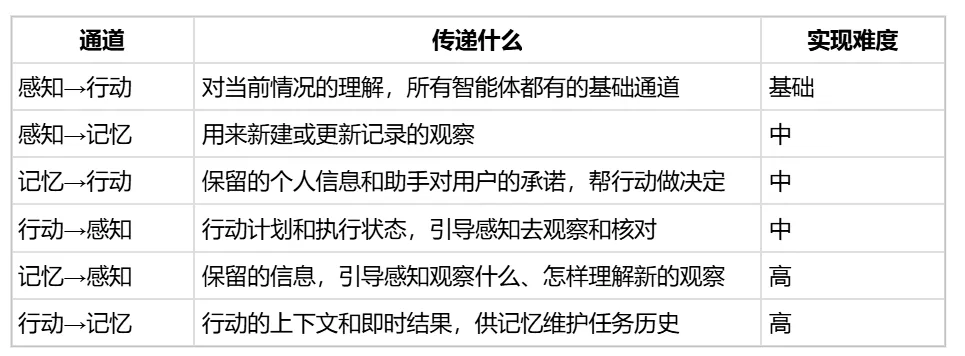
In addition to the closed loop formed by three modules and six channels, there are two layers of support:
- Shared Conditions: Set by users and the real world, covering privacy, permissions, security, resources, availability and uncertainty, and constraining every module and channel. For example, in a confidential meeting, the assistant can listen, but cannot save or paraphrase what is heard.
- Implementation layer (Implementation): It consists of the model (Model) and its external scaffolding (Scaffolding). The model is responsible for understanding the input and making decisions. Scaffolding includes the execution framework (Harness), storage (Storage), and tools and interfaces (Tools/APIs), which are responsible for connecting the output of the model to the user's devices, applications, and data.
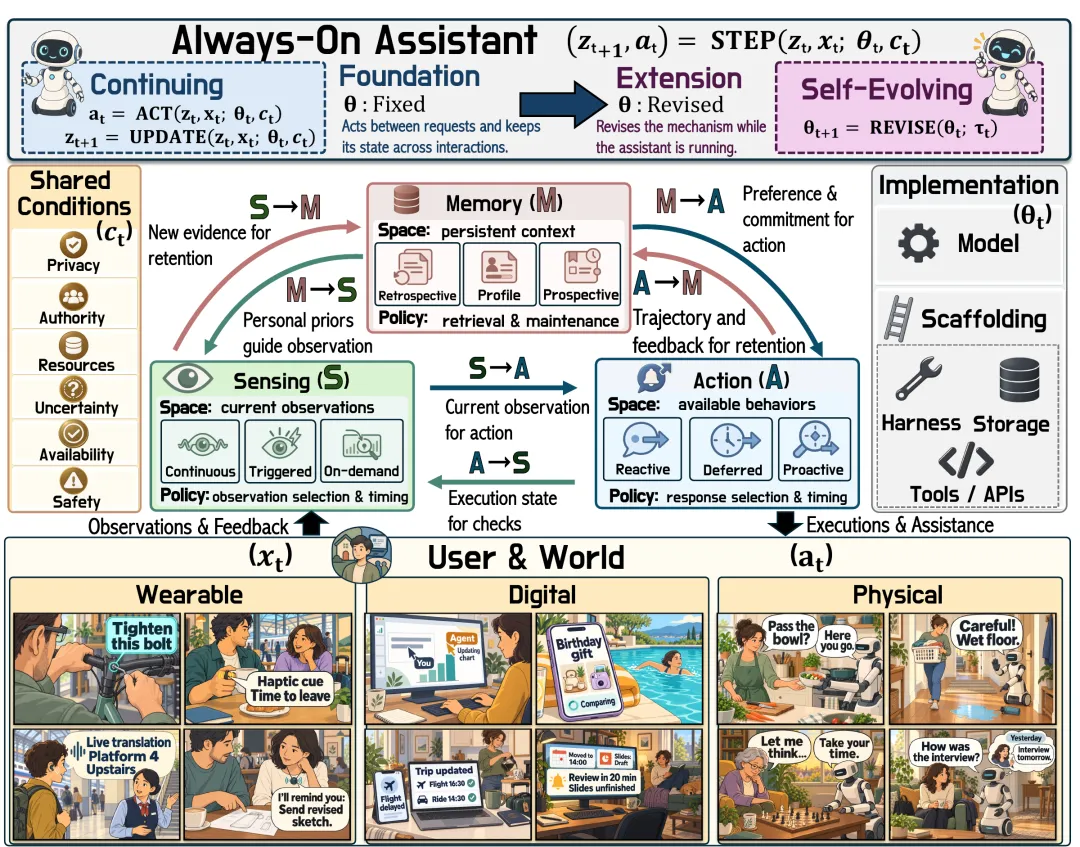
Figure 2|Continuously online personal AI agents framework
Three types of landing scenariosThe bottleneck is stuck "between modules"
Using this framework, the paper sorts out three types of scenarios: wearable, digital and embodied intelligence. A commonality emerged: the bottlenecks in each scenario cannot be solved by upgrading a single module.
1. Wearable Assistant: Dilemma between Power Consumption and Social Boundaries
Wearable assistants rely on what users see and hear to provide assistance.
- Bottleneck 1: The trade-off between collection cost and future memory. The more sensors such as cameras and microphones are turned on, the greater the power consumption and computing power. But how much you collect cannot just be counted as expense, because "what you take now" determines your memory and "what you can recall in the future."
- Bottleneck 2: When and to whom to speak. In multi-person meetings or conversations, the assistant has to decide when to speak and who should be heard, and other people present often do not agree to be recorded.
2. Digital Assistants: Competition for Computing Power and “Old Memory Does Not Help”
Digital assistants bring planning and personal context to different apps and conversations. According to the public information compiled in the paper, Muse combines timed and event-driven tasks with cross-conversation memory. OpenAI's dots continue to work on their own cloud computers between two conversations, deciding by themselves when to pause and when to wake up.
- Bottleneck 1: Competition for computing power. Background checking, memory maintenance and responding to users all compete for the same computing resources.
- Bottleneck 2: Misuse of old information. After the interface, tasks, or permissions change, copying the previously retained context will not help. At this time, the assistant can figure out whether there is a lack of new information, a mistake in remembering it before, or a record that is correct in the wrong place and with the wrong person.
3. Embodied smart assistants: mistakes are more costly
In the physical world, consequences such as collisions cannot be undone once they occur. Although recent robotic agent systems also retain personal state across tasks, most still act according to instructions.
- Bottleneck 1: The overhead of result verification. It takes time and resources to "take a look" after completing the action. If you don't check, you may continue to do it with mistakes.
- Bottleneck 2: Determine whether the help is useful. Whether a favor is helpful or adds trouble depends on memory to retain the user's reaction and subsequent progress.
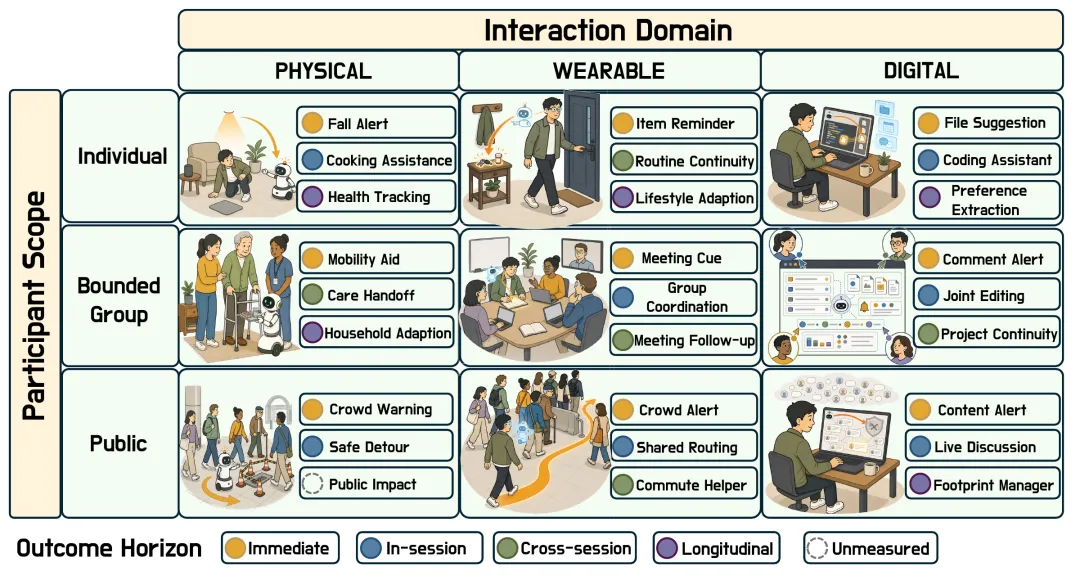
Figure 3 | Three dimensions of application scope: interaction domain (where observations and actions occur), actor scope (who is involved or affected), and outcome time span (when consequences can be observed)
five questionsUncover the "hidden pain points" of three modules
The paper uses the same set of five questions (What options are there? What are the restrictions? What strategies are used? What can other modules provide? How is the effect measured?) to examine the three modules and draw a key finding in each:
PerceptionWhat you miss will not be noticed by yourself. In a continuously online system, "missing something" is often worse than "misreading it" because the assistant doesn't know what it has missed, so it won't correct the status or adjust the observation strategy.
On wearable devices, due to power consumption limitations, continuous acquisition can usually only use a low frame rate, and short movements can easily slip away between two frames.
In the digital scenario, what is missed is the change of information: a reservation cancellation without notice, or an email rescheduling a meeting, will not be discovered as long as the assistant does not take a second look.
However, most existing evaluations only test whether the content seen by the assistant is correct, and rarely test what an assistant should read and whether it has missed anything.
memoryMistakes are not only used over and over again, but also create "memory traps." An erroneous memory may have been repeatedly recalled by the system countless times before it is noticed by the user.
What’s even more frightening is that erroneous memories can distort the assistant’s understanding of subsequent user feedback, causing each self-correction to retain or even amplify the original error. The paper calls this vicious cycle a "memory trap."
Of all the systems reviewed, none have yet demonstrated long-term immunity to it. The author makes a sharp judgment based on this: Keeping memories correct and effective for a long time is much more difficult than simply retrieving memories.
actionThe result is long overdue, and "help" may also turn into "burden".
"The message has been sent" does not mean that the matter is completed. The real results often come later and rarely. A reminder that feels thoughtful today may become an annoying interruption tomorrow; suggestions accepted by users now may not be beneficial in the long run.
In addition, when the system undergoes restarts and cross-device migrations, and the original dialogue to accept the task has long disappeared, how to ensure that the tasks promised to the user are "neither missed nor repeated"? Existing benchmarks are almost blank in this regard.
Roadmap ratingFrom L0 to L5, where have the 119 systems gone?
The main line of the entire review is the six levels composed of L0 to L5. Each time you go up a level, the closed loop has one more ability.
What needs to be emphasized again is: Personal AI agents that is always running in the background does not mean that it is always online. There are two types of assistants on the market that seem to be online around the clock, but are actually stopped at L2. One type is like a recorder, which silently records everything in the background, but has to wait for users to ask questions before it can work.
The other type is like a timed script, which is triggered when the time comes and never determines whether it should be done this time. The real watershed is: after waking up, it is up to the assistant to decide whether to deliver the results to the user.
According to this set of standards, the research team placed 119 research systems and products into six levels. Among them, 52 are not considered to be continuously online, and 67 have passed the L3 threshold and can decide for themselves when to act. As for limiting each self-modification within the boundaries set by the user (L5), there are only 5 research works, and currently no product has reached this level.
Among the products that have attracted much attention recently, Muse and Claude Duet are placed in L3, and OpenAI's dots, Grok Bot, OpenClaw, Hermes Agent, etc. are placed in L4. The paper also explains that products are rated based on public information, so each level only represents the lower limit that can be supported by public information.
As for the difference between L4 and L5, the core lies in "whether the assistant modifies itself or not is controlled by the user." L5 requires that every mechanism modification must be explicitly approved by the user or be strictly locked within a preset security range.
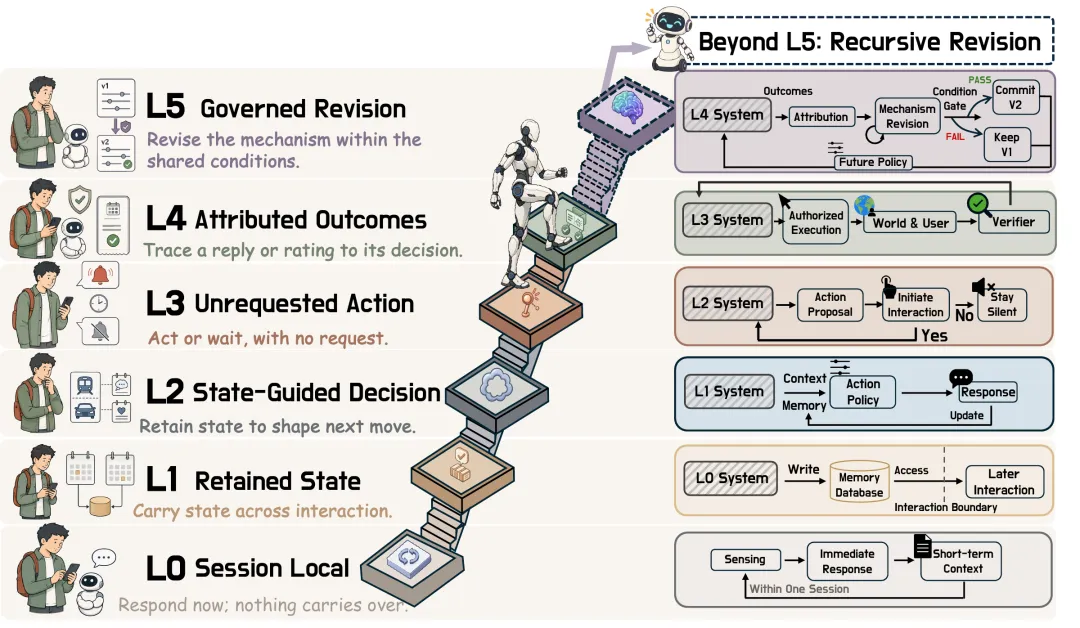
Figure 4|Six levels of closed loop: Each level retains the ability of the previous level and adds a new one. From L3 onwards, the assistant can decide to act or wait by itself when there is no request.
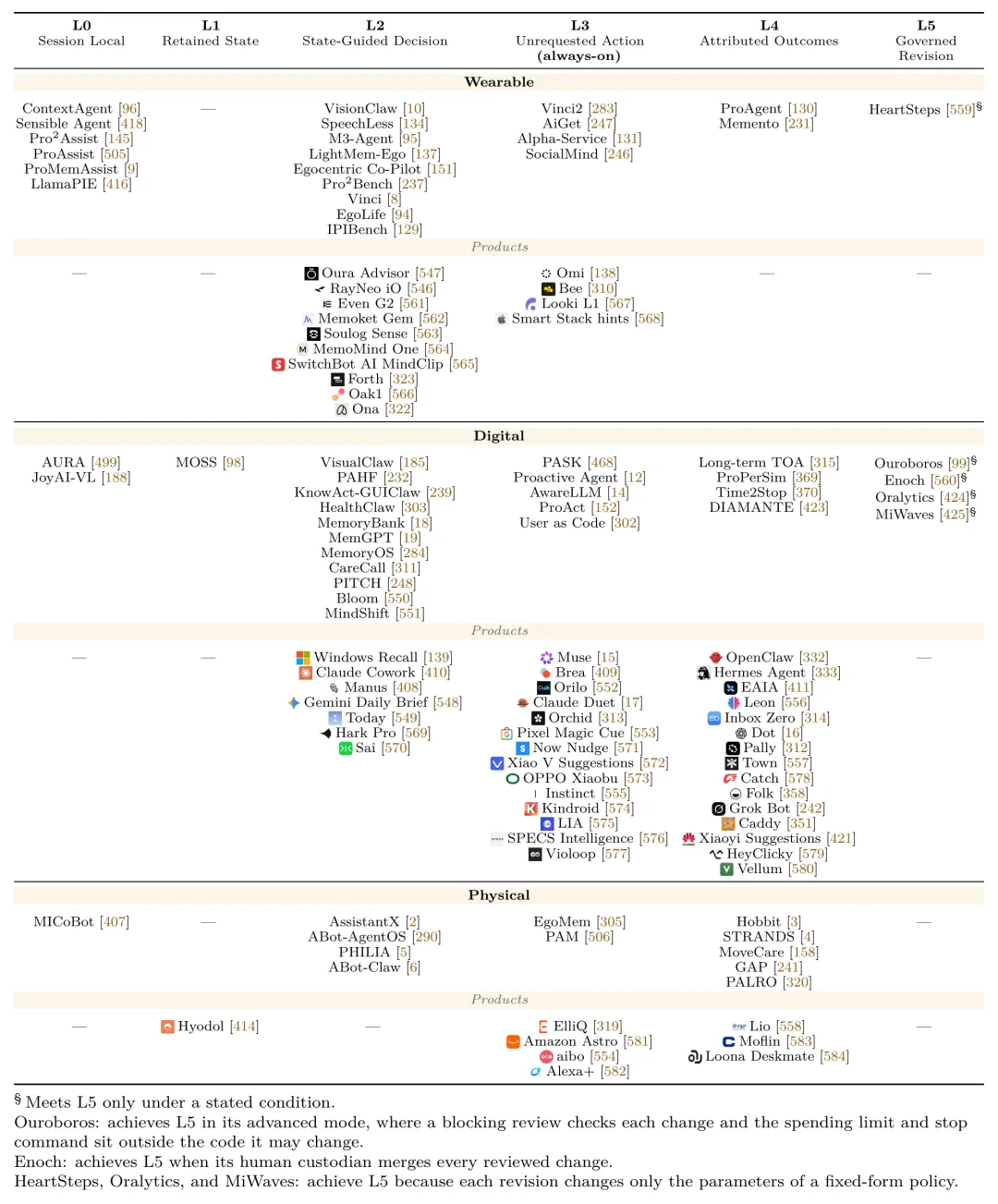
Figure 5 | The closed-loop level of each system: arranged according to three categories of wearable, digital, and embodied intelligence scenarios. Each category includes research systems and products.
Open source diagnostic tool HALOFind the two weakest channels
In order to see clearly what steps the existing system has taken, the research team simultaneously open sourced a set of review and diagnosis tools HALO (Harness for Always-On Loop Oversight).
HALO focuses on two things: each channel of the continuous closed loop, and each step in the self-evolving evidence chain. For each item, it asks two questions: Is this design reported in papers and public code? If this channel or this step of evidence is cut off, will the output of the system change? In order to answer these two questions, HALO designed two modes:
- Read Mode: A "jury" composed of three large models, each reading through the paper and code, judging whether each channel and each step of evidence has a report, and finally making a decision based on a majority vote.
- Run Mode: The approach is similar to an A/B test. First let the system run as it is, then cut off a certain channel or a certain step of evidence and run again under the same input and model. Finally, another "blind test" model that does not know the grouping will judge whether the output has changed.
Read-only mode discovery: Emphasis on "action", light on "perception" and "result closed loop"
The team reviewed 40 pieces of work and uncovered obvious flaws in the current system design:
- Memory is rarely used to guide perception: of the 40 tasks, "Perception→Memory" and "Memory→Action" each had 37 reported implementations, "Action→Perception" had 28 items, and "Memory→Perception" had only 17 items. In other words, the memory in the report is used more to decide "what to do" and less to guide "what to read next."
- The feedback chain is often endless: 25 tasks report the "action → memory" channel, but only 15 tasks also retain the results of the action. In the self-evolving five-step evidence chain, 24 items retained action records, 16 items retained results, and 18 items linked results and decisions. However, only 5 items actually revised their own mechanisms, and only 4 items could show that the revised mechanism was used subsequently.
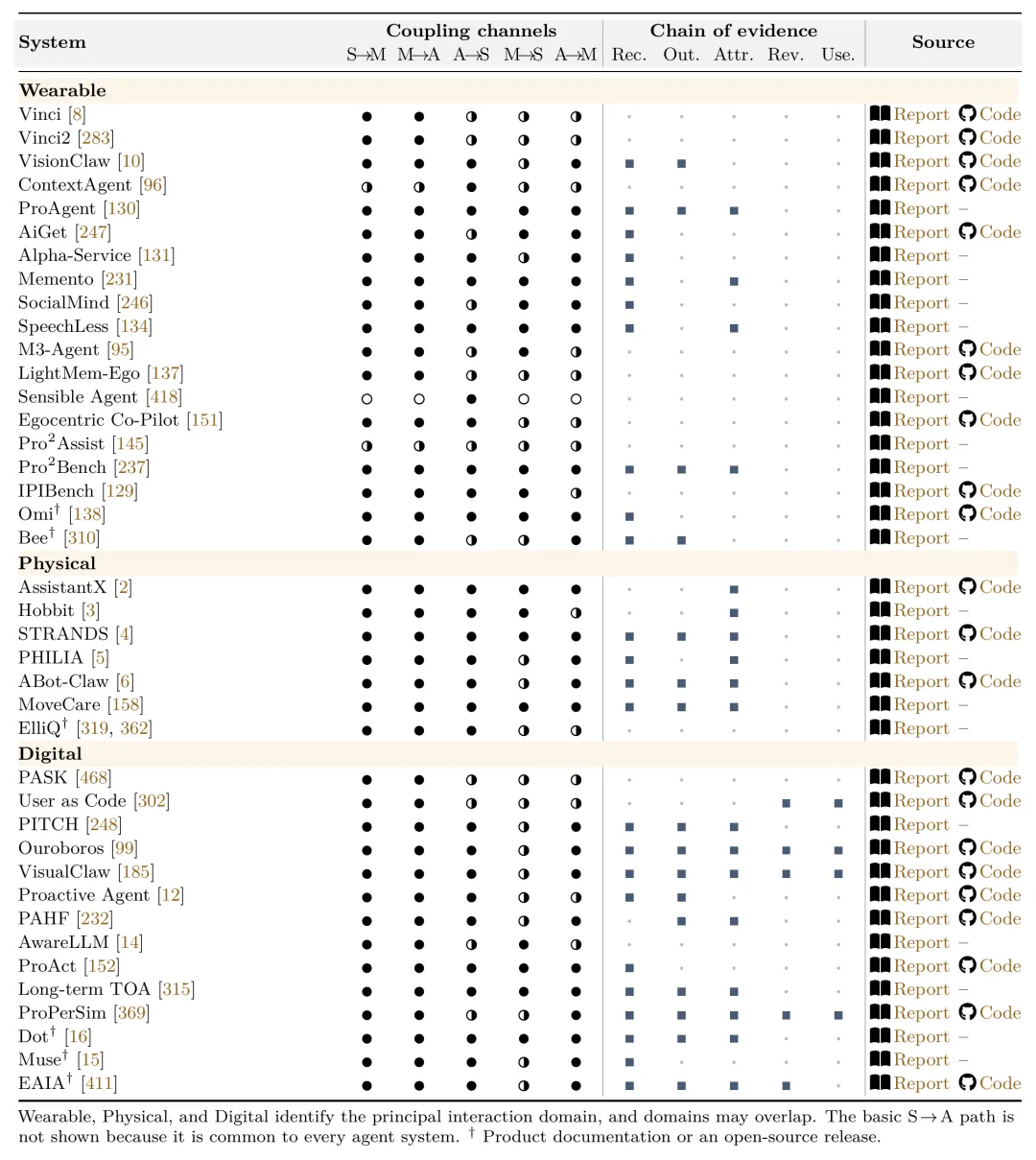
Figure 6|HALO’s inspection results of 40 pieces of work: on the left are the five channels except the basic channel, and on the right are the self-evolving evidence chains
The operating model found that "memory→perception" and "action→memory" are the biggest weaknesses
Actual measurements on two open source systems, the smart glasses assistant AiGet and the email assistant EAIA, show that once some channels are cut off, the output immediately collapses; some channels are redundant and complementary, and two need to be cut off at the same time for the impact to be apparent.
Combining the diagnosis of the two modes, the paper points out: "Memory→Perception" and "Action→Memory" are currently the two weakest channels in the entire field, and their absence will directly cover up the evidence required for system error correction.
For example, the meeting time has obviously been rescheduled by a new email, but if the outdated memory misleads the perception module, the assistant will feel that "the old time looks fine" and miss clues to the new email. Therefore, the two priorities for the future are very clear: keeping the perception module open to unexpected changes, and accurately linking each delayed result to the original decision rule.
Zero-invasive MCP plug-in: you can do "black box physical examination" without seeing the source code
HALO's design concept can be condensed into two sentences: the architectural design on paper does not equal the real runtime state; the closed-source system black box does not mean that the possibility of inspection is lost.
The evidence of running mode is the strongest, but the premise is that the code of the system can be obtained, and most products are not open source. To this end, the research team made an MCP plug-in for HALO so that closed-source assistants can also be checked:
- How to connect: Just like ordinary users adding tools to the assistant, connect HALO as an MCP tool. There is no need for the manufacturer to open any additional internal interfaces.
- What to remember: The assistant runs as usual in the background. Every time it does something, such as seeing a new email, checking a memory, or sending a reminder, it reports to HALO and explains what previous observations and memories it was based on.
- What to read: HALO reads from these records which channels are transmitting information, what step the self-evolving evidence chain has reached, and what level these records can support.
For development teams that have code in hand, HALO also provides an adapter interface: the development team marks the part of the code corresponding to each channel in the adapter, and HALO can cut off the channel and run the test again to see if the output has changed.
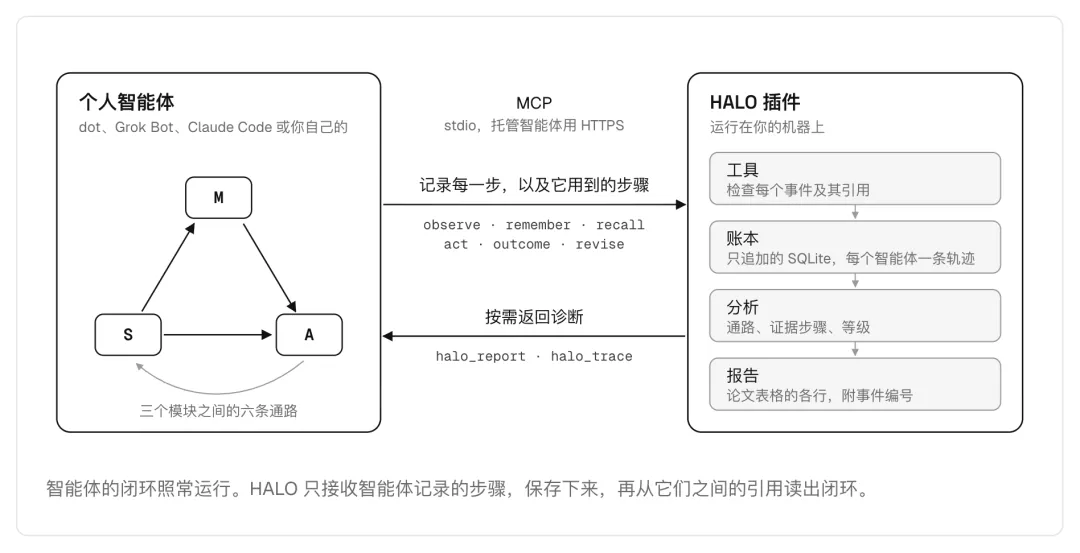
Figure 7|HALO plug-in architecture
Putting users at the helm15 open questions point the way to next steps
At the end of the paper, four groups of 15 open questions are used to outline the deep water area of continuous online personal AI agents. When the assistant begins to act autonomously when no one is giving orders, the main line of research is no longer "whether it can keep running", but "whether it can be both reliable and disciplined when the user is not present."
- Problem 1: How to get through the long gap when “no one asks questions”? When there are no instructions, it is up to the assistant to decide what to look at, what to believe, and when to take action. If you don’t read the morning newspaper for two weeks, is it because the user’s habits have changed, or is he just on a business trip? The tasks promised to the user have been delayed for several days, and have been rescheduled, restarted, or the user has quietly completed it himself. How can the assistant ensure that it does not drop the chain or do it twice?
- Problem 2: How to prevent "legal override" and "memory poisoning" when the user is not present? The authorization a few days ago was triggered a few days later. One direction given by the paper is to check the permissions at the moment the action takes effect. The sandbox cannot prevent the abuse of legitimate accounts, and even if you shut down the process, you cannot undo the emails that have been sent. The web pages and emails you read every day may also contain instructions, which will affect the assistant's subsequent actions after entering the memory.
- Problem 3: Keeping boundaries and "self-evolution", how to make mistakes in a life that cannot be repeated? If the reminder was crossed out by the user, was it because the timing was wrong, the time was misremembered, or the matter was already done? If the assistant wants to improve itself, it must not only distinguish between "should the records be changed or the rules", but also must prove that it really understands you more and more as you use it, and that it has never crossed the boundaries set by the user without being able to replay the user's life.
- Problem 4: How to say goodbye to static playback after months of real use? The effects of the help fade, and the burden of the interruptions accumulates. Log playback can only test how different versions react to the same past period. In real use for several months, every active intervention of the assistant will change what the user does next. There is still no answer to how to calculate the general ledger of "helping" and "causing trouble" in dynamic interactions.
Figure 8|15 open questions revolve around closed loop, users, self-evolution, and evaluation
Behind these 15 questions, the paper emphasizes an extremely critical iron law of safety: constraints that can be rewritten by the self-evolution mechanism cannot constrain self-evolution at all. The ultimate boundary that controls the assistant must be set by the user himself and stored in a place where the assistant cannot change it.
Let the most profound technology "disappear"
In the past, when we evaluated a personal assistant, there was only one core criterion: "When I asked a question, did it answer appropriately?" But when personal AI agents entered "continuous online", there was an additional criterion: "When no one asked a question, did it do it correctly?"
This 126-page review gives a clear judgment: continuous online is not about letting the program never shut down in the background, but about allowing perception, memory and action to collaborate into an uninterrupted closed loop, and allowing this closed loop to continuously improve itself within the boundaries defined by the user.
From definitions, frameworks, three types of scenarios, to L0 to L5 levels, HALO diagnostic tools and 15 open questions, researchers from 9 universities have collected scattered explorations into the same roadmap.
As the author writes in the conclusion, when these problems are solved one by one, the assistant can gain more room for action as the evidence that "it is indeed serving the user" increases, while always running steadily within the track set by the user.
At that point, people can really worry less and rely on it more. Personal AI agents may be quietly integrated into everyone's daily life, as Mark Weiser, the father of ubiquitous computing, predicted in 1991:
"The most profound technologies are those that disappear."
Author information
The paper was jointly completed by researchers from Nanyang Technological University, University of California, Berkeley, Princeton University, Stanford University, National University of Singapore, King Abdullah University of Science and Technology, Dartmouth College, University of North Carolina at Chapel Hill and Northwestern University.
The first author and project leader of the paper is Shuai Liu, a first-year doctoral student in S-Lab of Nanyang Technological University, and the supervisor and corresponding author is Professor Ziwei Liu. Advisory board members include Gedas Bertasius (University of North Carolina at Chapel Hill), Manling Li (Northwestern University), Jiajun Wu (Stanford University), Mengdi Wang (Princeton University), and Dawn Song (University of California, Berkeley).