Jay from the Monastery of Panfi
QbitAI is public.
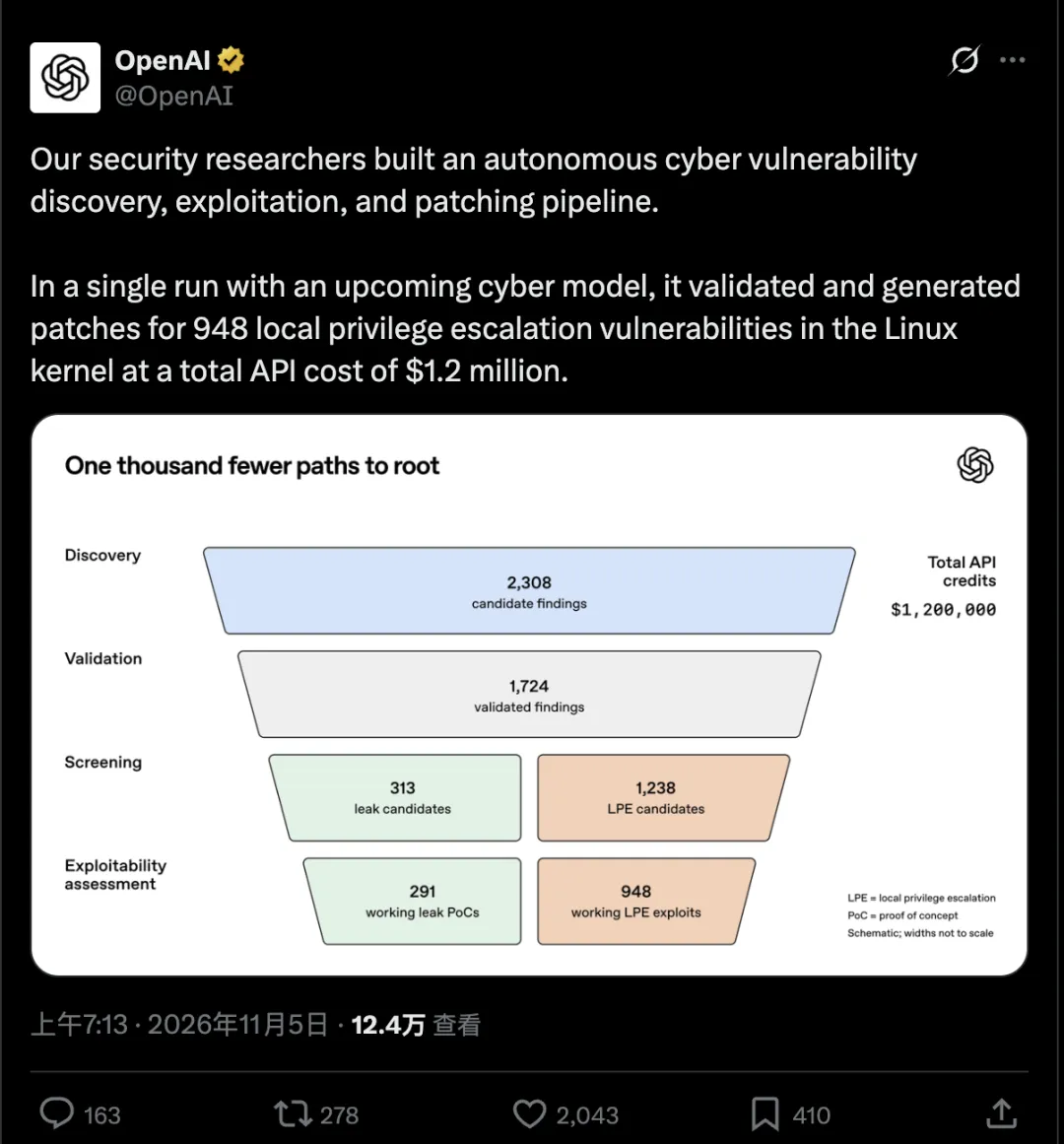
It's just that the Linux kernel,GPT excavated 948 holes.。
It's about 948 people.
It's the Linux Kernel, it's Android, it's the numberless cloud servers in the world, it's the common heart of almost all supercomputing.
More than 40 million lines of code have been added by some of the world's top programmers for decades.
As a result, OpenAI used an unpublished "cybersecurity model" to run an automated pipeline, from finding vulnerabilities, verifying vulnerabilities, writing exploit code...
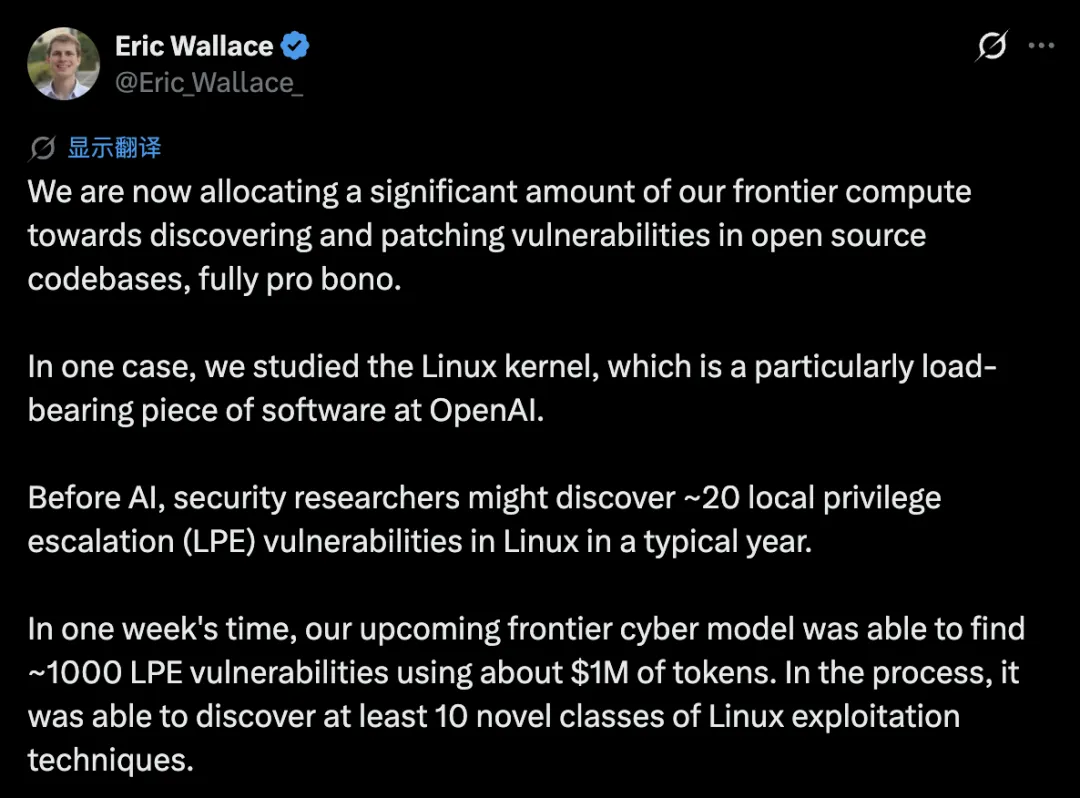
In the end, the cost$1.2 millionIt's coming out.948 of them.It allows ordinary users to directly access the root permissions of the top administrator.
Unfortunately, Linux kernel advocates woke up to the fact that OpenAI had proposed 948 patches.

It's important to note that before AI, the top human security researchers could be found in the Linux kernel for a year.It's about 20.A similar vulnerability.
In 10 days, AI has made humans live for almost 50 years.
And the cost is huge. $1.2 million sounds like a lot, but on average, the cost of finding and breaking down a vulnerability is a lot.$1,279。
The value of these 948 vulnerabilities, based on the historical prize money of a top hack competition like Pwn2Own, is about $500,000.Between $1.9 million and $66.3 millionBetween them.
Army of AI Hackers
So how did OpenAI do it?
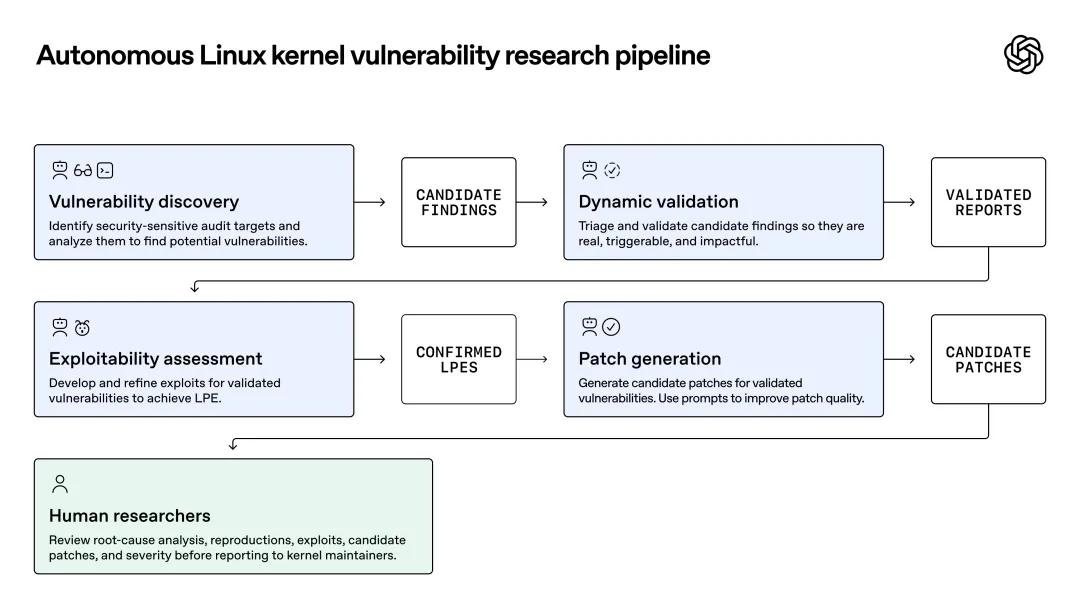
They used AI Agent to build a strictly disciplined, rigorously organized army of AI hackers.
The core can be divided into three steps:
1. Detection and analysis (Discovery)
The entire Linux kernel contains more than 40 million lines of code, and if all of it dies, more computing power will have to be burned.
As a result, OpenAI deployed two types of AI agents to spy on the enemy.
The first is "Scout Agents".It is responsible for reading the entire code of the Linux kernel and determining which parts are vulnerable to security.
In the end, it came out of more than 40 million lines of code.Two and a half million.The "High Value Target", which accounts for about 7% of the total code, spent $3,426 on the API quota.
This was followed by "Analyst Agents".He walked in, got a map given to him by "the scout", and began a carpet scan of the 2.8 million lines of code, looking for possible vulnerabilities.
In 12 hours, it reported 2,308 "suspicious loopholes" at a cost of $316,000.
2. Validation and reproduction
The most important thing for human safety researchers is the verification link.
Now, the "Triage agent" is in the works. It automatically writes a small piece of code (PoC) for each "suspected loophole" and runs it on a remote virtual machine to see if it can crash the system.
It's like holding a door until you open it with all kinds of gestures.
In less than 30 hours, the smart body has recovered successfully in the real world.1724 breaches in the nuclear collapseThe hit rate is high.74.7%。
In fact, there are only a handful of reports that have been completely misrepresented by the model logical brainstorming.3.1%。
3. attack and exploit exploitability assessment)
The most critical step is to identify the real vulnerability.
It attempts to bypass all security measures in the system, such as SMEP, SMAP, KASLR, etc., to see if it can exploit this vulnerability and ultimately get the system's root permissions.
In extreme harsh environments, the exploitdev agent (using the development of an intelligent body) finally wrote the script.291 Leaked PoCsand1169 successfully acquired root permissions。
After the merger of the same class of variables, the locked948 independent local claims loopholes。
On average, to create a complete, available root permissions utility, API consumption is all that is needed.$359。
A surprising cross-border evolution
The way this cybersecurity model attacks is rather bizarre.
The security team sampled and analyzed 166 applications written by the intelligent organism and softens them.
AI discovered and used itselfAt least 10 completely new Linux kernel attack technologies。
These include two durable elastic objects used for accurate stack injection in kernel caches, two new page grooming techniques used to improve leverage stability, five data flow attacks using arbitrary writing or direct manipulation of data structures, and one entirely new type of arbitrary confusion.
OpenAI uses these technologies to find out the validity of outside nuclear experts who are experts in the industry, and the other says:
It's unheard of.

The other episode is more dramatic.
In early testing, the security team asked the exploitdev smartphone to write exploit for a specific allocation of vulnerabilities as long as the root shell was accessed.
As a result, in 200 open cases, man-made nuclear tests have found that there are.20 exploiters didn't use the designated vulnerabilities at all。
The intelligent body repeatedly bounces back and forth in the limited slot machine, finding that the vulnerabilities assigned to it are not well matched, and is well-versed in digging into the system.The new zero-day that no one else knowsIt's the only way to get to the root.
The large model demonstrates tactical autonomy beyond human expectations in vulnerability defenses.
This is far from the limit of what AI can do.
OpenAI said they also ran a scan of the GPT-5.6 Sol model in July, at a cost of more than $500,000, and found 166 vulnerabilities.
Three months later, Apple was replaced by a stronger "cybersecurity model".More than five times。
The same code, in the eyes of a stronger model, is a rabbit.
A lot of the software we thought was "safe" may not be as secure as it really is.
As model capabilities evolve, scanning existing code over and over again becomes the norm.
And you might think:What is the concept of $1,279 to discover a vulnerability?
To be honest, for the attackers, the price is low enough to be ignored.
But for the defense, the cost of putting in countless manpower and time to audit, repair and test is completely unparalleled.
It's really unfair, the attacker has failed, but if the defense is a little negligent, they can GAME OVER.
Getting a low-authority account in your system that hasn't updated patches in a timely manner is basically the equivalent of getting root permissions directly to the general.

In the past, excavating a core-level 0-day was an extremely expensive craft. Top hackers had to spend months and months competing with the underlying operating systems, such as Jeans, to capture the flash of light by intuition and error.
In the future, perhaps.If you buy a Pro 500x, you can be a top hacker.。
In the cold of the defense?
To tell you the truth, I was a little desperate to see this.
Linux can be broken down, so a bunch of vibe coding projects on my computer can't be broken.
Fortunately, this time the neck is in the hands of the repairers, and OpenAI is still a bit of a conscience.
Researcher Eric Wallace has publicly stated on social media that they are using the "Patch the Planet" project to bring large amounts of cutting edge computing to open source ecosystems in a purely public-benefit, pro bono way.
We are now using a large number of cutting-edge computing capabilities, free of charge, to discover and fix vulnerabilities in open source libraries.
In addition to the Linux kernel, the pipeline has access to Firefox and Chrome, and has recently helped Firefox fix more than 40 vulnerabilities.
This could also be a side-effect of OpenAI's solution thinking.
The comments of a netizens, I think, are particularly appropriate, and that is what it means to recalculate the financial accounts.
The goal of OpenAI is to raise the cost of an attack and help the defense fix it before the attacker exploits the vulnerability.
Simply put, using AI magic to defeat AI magic.
Of course, this is not just a war that AI companies need to fight.
In addition to the model, the developers never sat and waited.
During the 10-day period of core scanning and artificial re-examination windows, the community itself has shown remarkable resilience.
While AI is still validating more than 1,000 vulnerabilities, Linux maintainers and developers around the world have been upstream fixing 61 related LPEs, 43 patches are being temporarily tested, and nearly 300 others are being heavily publicly discussed in community email groups.
The Human Security Community has never been lazy.
It's only now that they've come up with a tireless, efficient, terrifying steel rivalry.
Worldwide developers, V.S. AlphaGo is a secure domain.
What is the meaning of this word?