The next industrial revolution will make physical labor as scalable as software. We look forward to a future where physical AI becomes a shared public resource on which anyone can continue to build.
References
Today, we're releasing Verne V0.5, an open-weight world-action model designed to accelerate the deployment of general robots in industrial settings. As of this release, V0.5 is the leading model in the open-weight model developed by U.S. companies on the LIBERO and RoboTwin 2.0 benchmarks. We're opening its weight because we believe that the future of robotics lies in post-training and deployment: allowing a fully capable model to learn real work in real facilities.
Verne deploys robots to help American companies make more products, realize bigger concepts. The value of our robots goes beyond reduced costs. They expand the productivity of the Pareto frontier, carrying out heavy, tiring work in semiconductor cleanrooms, refrigeration facilities and large warehouses. These deployments have shaped the models we develop as well as the tools we build around them.
At Verne, we believe that every business can benefit from a universal robot. Bringing robots into every business requires the participation of many teams with deep operating experience. With V0.5, these teams can start from a cutting-edge model without training from scratch.
Our investment in this platform is driven by the need to learn new tasks efficiently, adapt to different environments, and run reliably in production. We will continue to push the boundaries of the world's action model capabilities while improving the tools to help our teams transform these capabilities into successful deployments.
At the same time as opening up weight, we've launched a fine-tuning platform that enables teams to use their own prototypes and adapt V0.5 to their own tasks. We also provide custom deployment services for partners who want to work directly with us to address specific application needs. Together, models, platforms and services provide a foundation for the team that can be built independently; teams can also gain expertise and support from Verne in the process of putting robots into production.
This article will present the technical details of V0.5, the Verne technology kit, and the experience we gained in building them.
Problems
Our goal is to have two-armed mobile robots complete complex, long-term tasks common to the industry. These tasks include many steps, covering a larger work area. The robot must track the progress of the task and recover from failure. As the work content changes, the robot must adapt while maintaining production speed and accuracy.
The Verne Technical Kit is built for this purpose. It consists of three parts: V0.5 models, data and training systems, and reasoning and control software. Together, they provide four capabilities:
It's a long-term self-executing process.Short language instructions are synchronized into new long tasks and track execution progress.
Full operation.Synchronizing the mobile basement with the two arms allows the robot to cover a wide range of work areas. A full shift of work cannot be put all on one table, and sending the work to a fixed robot requires transmission or manual transportation.
Fast learning and steady error recovery.Using less than two hours of demonstration and artificial correction, learning a new task, or new steps in a longer task, and recovering from errors on the basis of the model's already existing knowledge. The less input required to teach a task, the more tasks are worth automating.
It's a quick and accurate execution.To meet the rhythm and precision requirements of the production line, reasoning and control work in sync to keep the movement continuous, fluid, and able to respond in a timely manner.
Figure 1: Long distance autonomous execution with full body operation.Robot A moves a container from the shelf to the table. Robot B scans each item and places it in a blue or green container as instructed by the scanner. Robot A returns the empty container to the top of the shelf.
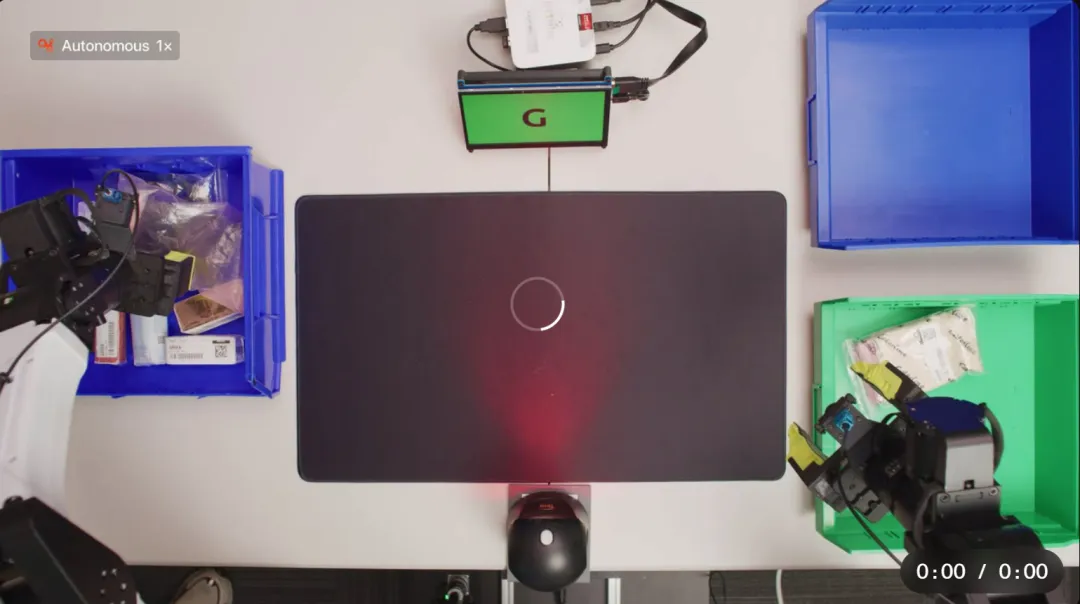
Figure 1: Fast learning and robust error recovery.A person takes the bag with a hook and throws it back into the rotary box. Each time V0.5 picks it up again.
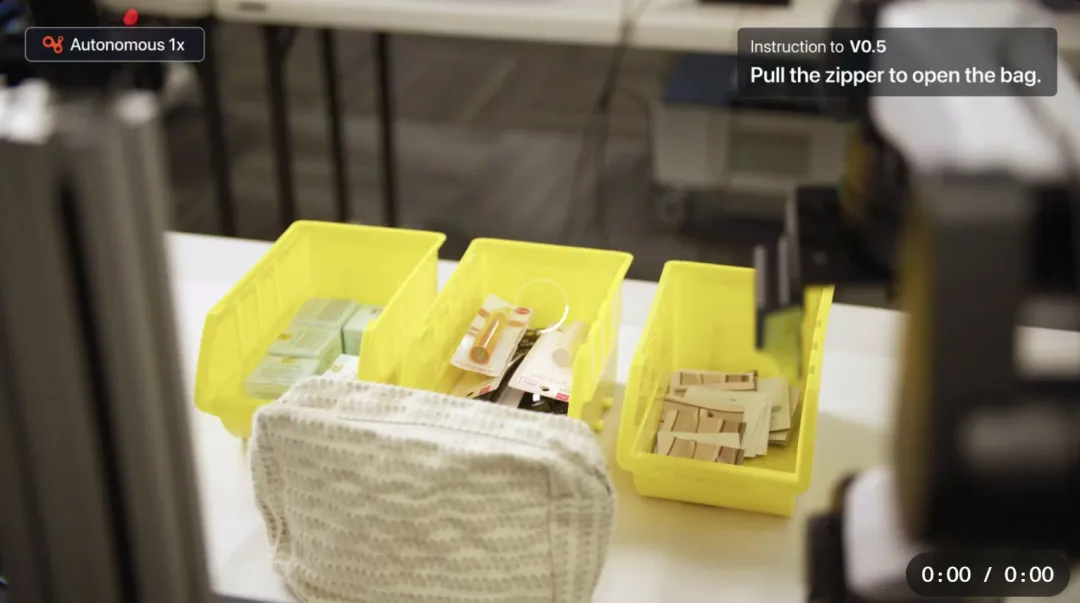
Figure 1: Fast and accurate execution.One mechanical arm fastened the makeup package, the other pulled the chain, and then pulled it up.
See the original demo video for this article.
The method
Overview of the system
When running, V0.5 and our reasoning and control software comprise four layers. The task target is the input from the top and the engine instruction is the output from the bottom. V0.5 is the strategy layer, the second of the four layers. The other three layers are the higher reasoning layer, the execution layer and the controller respectively.
It's a high level of reasoning.It reads task targets and camera images and provides the next language instruction for V0.5. A long task is then converted into a series of short instructions.
The strategy layer: Verne V0.5.A world action model containing two Transformers: a video Transformer learning how to change the scene, a Transformer predicting robot movement. The two combined training. When running, the model only generates movements. Its inputs include current camera images, memory, robot status, and language instructions. It produces an action block containing targets executed at 30 Hz, each of which includes end-user execution positions, claw commands, and bottom position, see Figure 2.
The execution layer.To convert each block of action into a joint trajectory for a specific robot. When the robot performs the current block of action, V0.5 plans the next block of action. The new block of action starts from the state in which the robot will be at the end of the reasoning, so that the movement between the block of action will not stop or jump.
The controller.A motor instruction to convert the trajectory of the joints into an executor. It operates at 500 Hz in real time, independent of model reasoning.
System 1 is fast and automated and System 2 is slow and thoughtful. Strategy level V0.5 corresponds to System 1, Strategy level V0.5 corresponds to System 2. NVIDIA's GR00T N1 and Figure's Helix use similar dual system design.
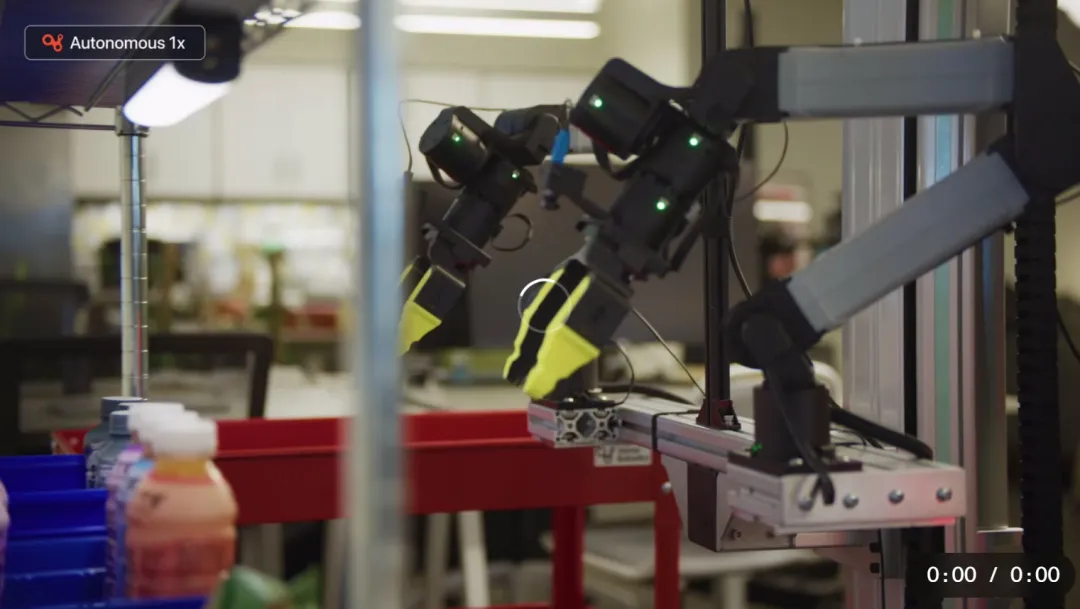
Figure 2: Full body operation.A robot pushes the beverages and snacks on the shelves into the truck, then moves the finished truck. V0.5 controls the moving trunk with its arms.
The data
Our data collection is industrial-oriented. We pre-train V0.5 using over 1.7 million samples from data providers, open source datasets, and our own collection. In pre-training content, we focus primarily on remote data, as well as hand claw data, which is similar to UMI claw. In addition to pre-training, we also record our own post-training data through remote operation and hand claw, which we have designed in collaboration with the robot's end claw executor.
The quality of the data in pre-training and post-training is critical to the success of the model. For this reason, we have established an automated data quality processing pipeline. We check the timing information, the quality of the movements, and whether the instructions accurately describe the demonstration movements in each record.
Data labels and markers are critical to the success of the post-training process, as they ensure that the model is able to reliably accept language guidance. For this, we have created a semi-automatic labeling pipeline to provide subtasking language labels for post-training demonstration episodes that correspond to actual actions. We draw on BLADE's experience in applying semi-automatic labeling to identify subtasks performed by robots.
Model performance continues to improve during pre-training. In the absence of any tweaking, when the proportion of data used in pre-training increased from 29% to 100%, the success rate on RoboTwin 2.0 increased from 23% to 51%, see Figure 3. We observed significant Scaling Laws, similar to the results of the Generalist AI, Physical Intelligence and NVIDIA reports.
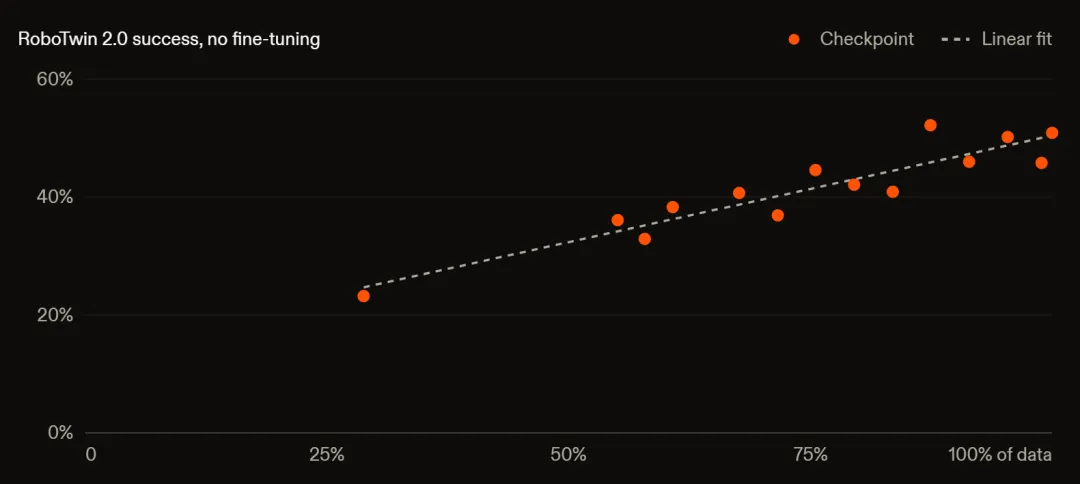
Figure 3: Continuous improvement in performance during pre-training.Each point corresponds to an unminimized pre-training checkpoint. We evaluated each checkpoint in about 1,000 RoboTwin 2.0 episodes: each task was evaluated 10 times in both clean and random scenarios.
Strategic layer: Verne V0.5
V0.5 is a world action model (World Action Model, WAM): it simultaneously learns to predict what the robot will see next and what it should do. It learns how the scene changes to help the model learn how to act in it. In training, Video Transformer and Action Transformer exchange information and learn together by masking attention, each with their own separate Flow Matching objectives, see Figure 4.
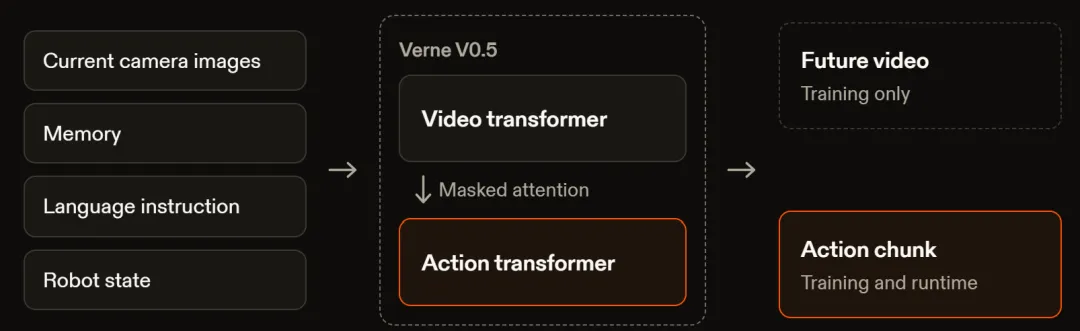
Figure 4: Learning from video animation.The two Transformers trained together. When running, the model only generated movement.
Video-generation models are a good starting point for changing learning scenarios. However, robot operations for them belong to extra-distributed data: camera views, movement and contact with objects differ greatly from the video they see when training. VPP2 shows this gap, as well as the benefits of adapting video models to operational tasks. V0.5 uses the Wan2.2 video model as a starting point. We expand its architecture and use more than 1.7 million samples for pre-training.
It's the first time I've ever seen a robot.Adapting video models to robot observation allows them to learn how to manipulate a scene.
Video and action combined training.Using paired observations and movements, Transformer trains video with Transformer movements, linking visual predictions to the actual movements produced by the robot.
Special post-task training.Using a small amount of Verne data, the model is adapted to deployment tasks through fine tuning, artificial correction and RL. Each cycle begins with a robotic evaluation.

Figure 5: Three stages of training.The final stage is repeated: evaluation, correction, re-training.
When running, V0.5 directly generates motion, not generating future video. Video planning methods such as VPP2 predict future visual representations and then use an inverse dynamics model to look for movements that can reach that representation. V0.5 keeps the video prediction as a training signal and saves it costs while running, following the same principles as Fast-WAM.
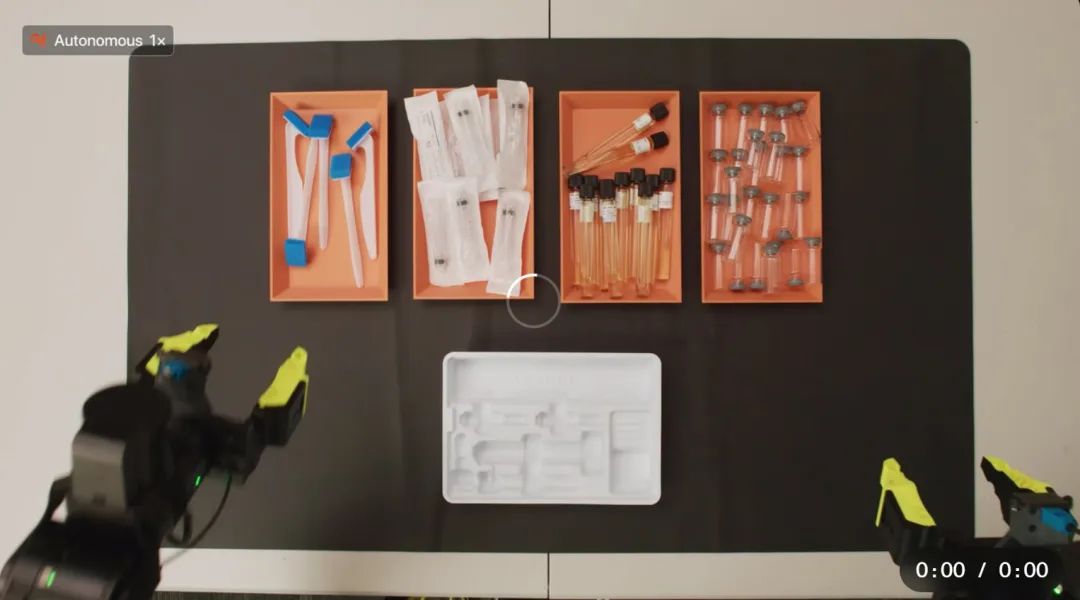
Figure 6: Medical equipment assembly.V0.5 controls both arms by means of an end-to-end execution position position and claw instructions: pick up items from the four material trays and place each item in the corresponding slot in the kit trays.
V0.5 performs movements in end-user space rather than joint space, see Figure 6. Thus, samples from different devices, regardless of their joint configuration, can share the same motion description, which is consistent with the interface design of UMI.
High-level reasoning: using VLM to plan
Each time V0.5 follows a short language instruction, such as a cup of tea. The higher reasoning layer breaks down the long task into a series of such instructions. An existing VLM reads task objectives, camera images, and context information such as memory and maps. It provides the next instruction to V0.5 and updates the schedule. V0.5 reports the execution progress of each instruction.
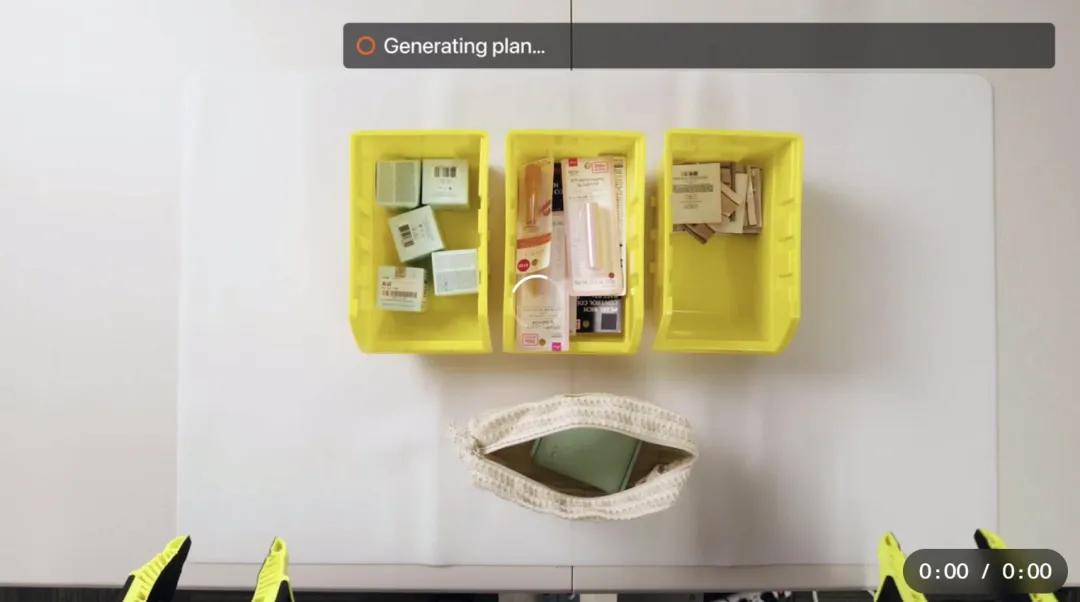
Figure 7: Set up a make-up kit.The higher reasoning layer plans the task in four steps and gives instructions to V0.5 for each step: put a liquid cosmetic in the bag, put a tear gasket in the bag, put a tear gasket in the bag, and attach the bag and pull the chain link. It reads the camera image and checks what items have been put in the bag. Only after completing the first step, will it start the next step.
These two layers of collaboration accomplish tasks that no single layer can accomplish on its own. In Figure 7, the top layer of reasoning is gradually assembled to make the kit. Each step corresponds to an instruction, so that the reasoning layer can handle different orders for different types of products. It can also recover from the error: it counts the items in the package and when an item falls, it asks V0.5 to pick them up again. It identifies that the container has been cleared and requires V0.5 to drop the container back onto the shelf. It can also notify the personnel in the container that the items need to be added. The bottom layer of reasoning uses the normal language to reach the V0.5 instruction, so when the new task consists of only the steps that V0.5 has mastered, a new task needs to be provided.
Execution layer: Action Chunking
The execution layer converts each movement block into the joints trajectory of the robot's timing information and connects it to the movement that is already underway.
By real-time Action Chunking (real-time chunking), the robot will continue to sustain its movements while modeling. V0.5 calculates that during the next block of movements, the robot will execute objectives that have already been determined and entered the queue. V0.5 considers these objectives as a set of conditions, after which it plans the remainder of the block of movements so that the new block of movements can be connected to the current movement without stopping, without jumping, see Figure 8.
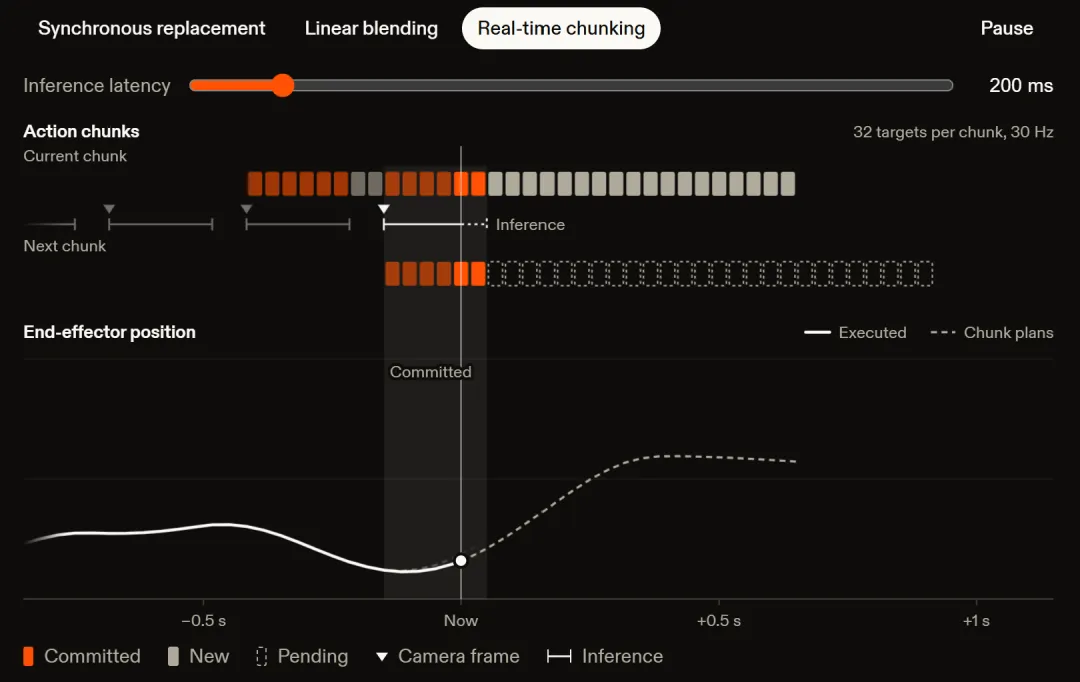
Figure 8: Simulation of the welding of moving blocks.When two action blocks are inconsistent, the linear mixture averages them to a sequence of moves that have never been planned. Real-time Action Chunking keeps the targets executed by the robot during reasoning and plans the remainder after those targets. V0.5 uses a maximum of 12 defined targets during training, so it can accommodate a reasoning delay of up to 400 ms.
There are three common methods of welding motion blocks. Synchronous replacement stops the robot during model planning. Linear mixing in welding gradually transitions from old motion blocks to new motion blocks. When two motion blocks are inconsistent, the average result is a movement that neither has been planned. Real-time Action Chunking maintains a defined goal and then plans.
The controller
V0.5 continuously output movement blocks, with the execution layer converting them into joint targets. The controller then converts these joint targets into motor instructions. Even if the load or contact state changes, it can also allow the mechanical arm to keep track of the target.
The appropriate controller depends on the executor. Pulse wave transmission can provide precise, low-velocity positioning, but a higher deceleration rate increases friction and deflects to the motor's inertia on the side of the joint. Quasi-Direct-Drive, QDD executors combine high-turn reciprocating motors with low deceleration rates to allow the joint to be reversely driven and respond quickly to external forces.
Most of our robots use QDD: it can handle contact very well, and costs much less than filtering. The filtering sensors with related torque sensors can also handle contact very well, but at present, at a machine scale, its costs are often too high to bear. QDD's weakness is its tracking performance. Gravity, load changes and joint junctions are all manifested as uncommanded movements.
The controller is a C++ process that is independent of model reasoning. It runs on the Linux kernel in real time, using real-time prioritization and locked memory. Timing is important: training and execution share a clock that is captured by a camera as a benchmark, so that each action is aligned with the image that generates it. If the controller appears to drift in time, the strategy will see instructions and observations that have never actually happened at the same time, and errors will accumulate.
When the strategy is executed, the controller executes the target sequentially from a pre-filled queue, so the time-consuming reasoning and network vibrations are not transmitted to the motor. It also models the mechanical arm dynamics and controls the forward movement of the joints, acceleration and torque, so that action is taken before the tracking error accumulates, rather than after the same error is formed. Figure 9 shows the performance of the same V0.5 strategy on the same task, respectively using the original YAM controller and our controller.
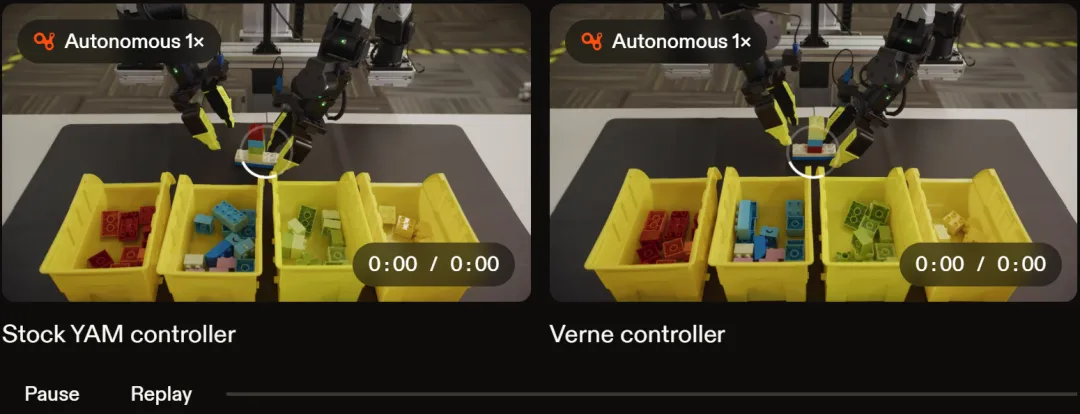
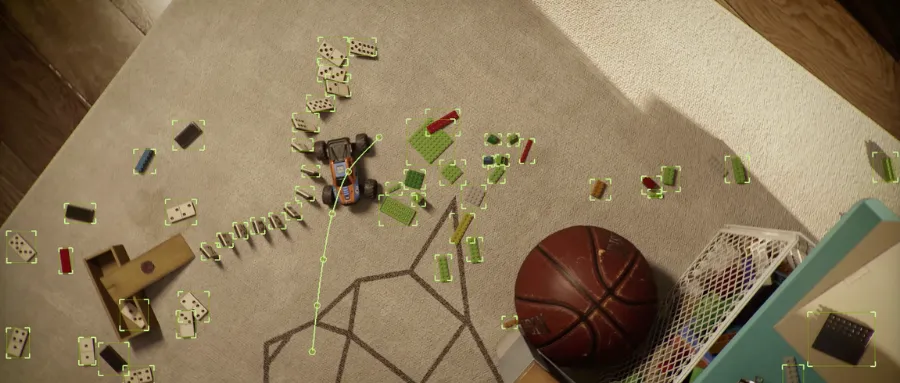
Figure nine:The same V0.5 strategy used the original YAM controller and the Verne controller to dismantle LEGO respectively. Both clips used the same clock to play, so both executions were executed in parallel per second.
We ran 20 LEGO missions for each controller, measuring the extent to which its end-user tracks the instructional targets, see Figure 10. The original YAM controller sent each target as a location target and set the target speed to zero. Therefore, its obstruction would impede each movement, causing the mechanical arm to lag behind the instruction at different speeds 52 to 60 ms. The faster the mechanical arm moves, the further it lags: the median error rate increased from 9 mm to 26 mm.
At 30 Hz, 60 ms is almost equivalent to the interval between two instructional targets. This delay would undermine the effect of real-time Action Chunking, see Figure 8, since the method assumes that the mechanical arm can reach each defined target on time. V0.5 works in sync with the controller: the model starts planning from where the mechanical arm is going to reach, and the controller makes the mechanical arm reach there on time.
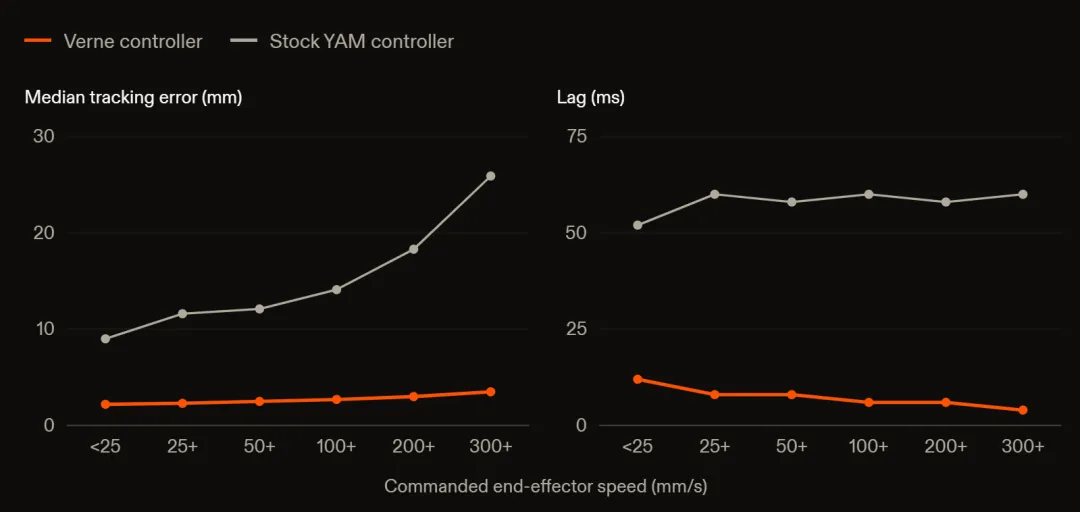
Figure 10 is as follows:During the LEGO mission, the two-arm tracking performance, grouped according to the speed of the instruction terminal executor: each controller runs 20 times using the same V0.5 strategy. Tracking error refers to the median distance between the location of the instruction terminal executor and the location of the test at the same time. Delay refers to the delay in the movement of the mechanical arm relative to the instruction, even if the speed of the instruction terminal executor reaches the optimal timing of the time delay.
The presentation
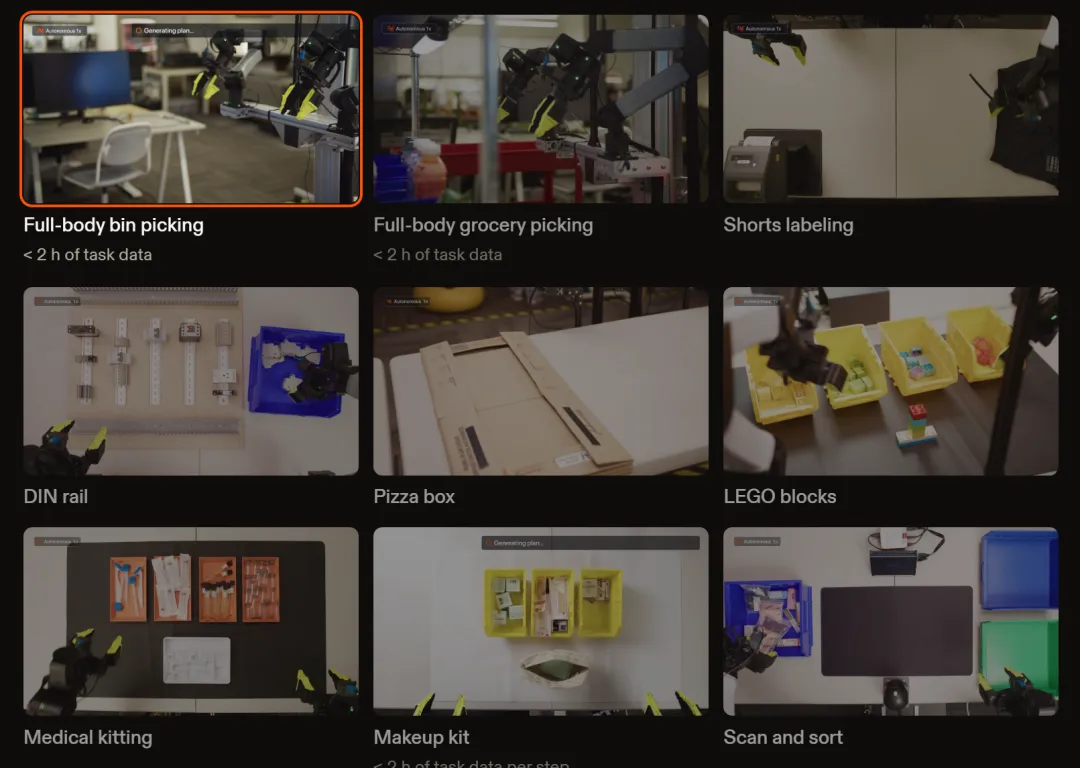
We trained V0.5 on nine operational missions, ranging from long-distance movements to contact-intensive desktop assembly.
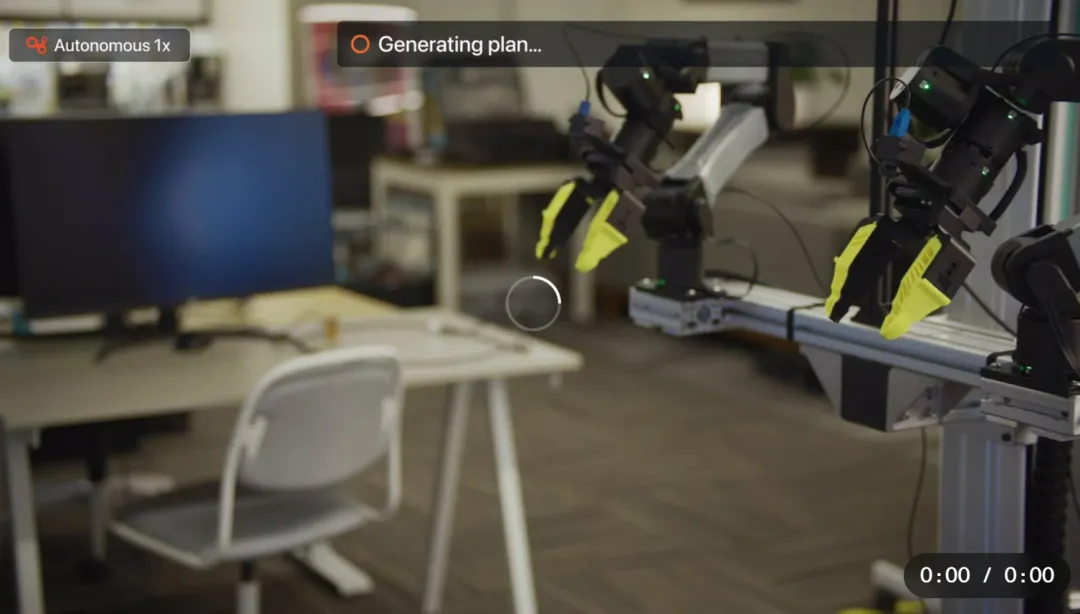
The whole container was removed.
Mission data is less than 2 hours.
The robot picks up the next container from the shelf and puts it on the table. After the container is empty, the robot puts it back on the top of the shelf.
Whole-body selection
Mission data is less than 2 hours.
The robot pushes the beverages and snacks on the shelf into the cart, and then moves the loaded cart. Each movement unit moves the trunk and arms together. It performs autonomously, at 1x the speed. See Figure 2.
Short stamps
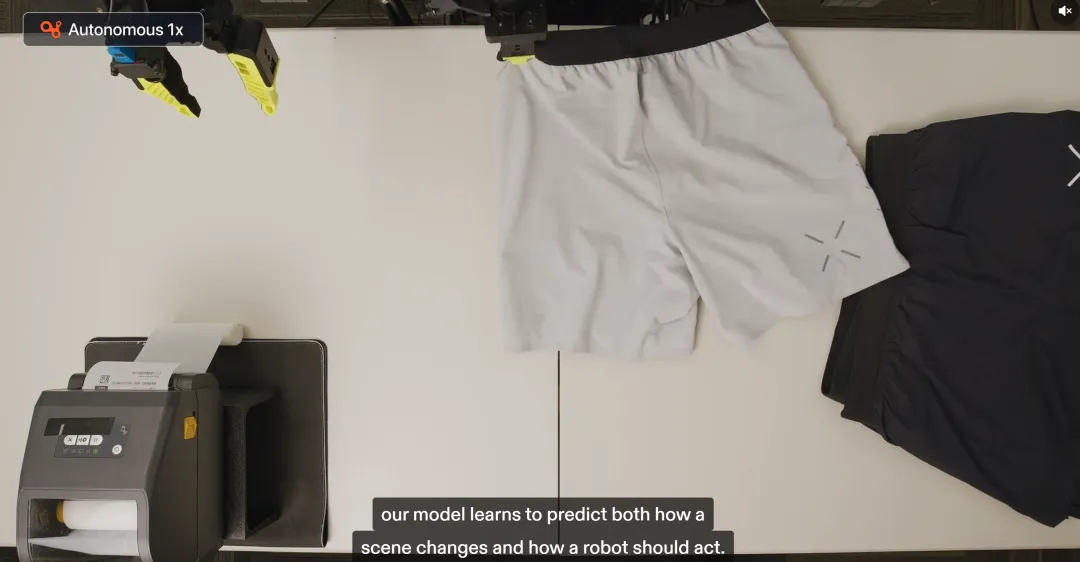
The robot lays a shortcut on the table, unlocks the label from the printer, and presses it onto the shortcut. It then moves the shortcut and starts processing the next one.
Directed by DIN
Each component must be mounted on the corresponding conductor and placed in position. Self-executing, one-fold speed.
The Pizza Box
Folding a flat sheet of paper into a closed box. Each fold depends on the previous folding.
LEGO bricks
The robot pulled the blocks from the stack and sorted them into the feed box by color. Automatically executed, 1x faster. The same task was performed on both controllers. See Figure 9.
Medical equipment fittings
The robot picks up items from four material trays and places each item in the corresponding slot in the set trays. V0.5 controls the arms through the end-user position and claw instructions.
Costumes and costumes
The task data for each step is less than 2 hours.
The robot puts a liquid cosmetic, a tear gas and a lipstick in the bag, and then pulls up the chain. For each step, the higher reasoning layer gives an instruction, V0.5 picks up the items specified in the instruction.
Scanning and sorting
The robot picks up items from the rotating box one by one, scans them, and, according to the scanner's instructions, puts them in a blue or green container.
Results
We compared V0.5 with published results on two public simulation benchmarks, LIBERO and RoboTwin 2.0. For each benchmark, we used our own training demonstration of the benchmark to fine-tune V0.5 and evaluate it according to its standard protocol.
Impersonating the benchmark
LIBERO consists of four task suites, each with ten tasks: Spatial, Object, Goal and Long. V0.5 has an average episode success rate of 99.3 percent on the four suites, 99.2 percent on the multi-step Long suites, and 96.85 percent on the π0.5 and 94.15 percent on the π0.[11] ABot-M0.5 has a slightly higher average success rate of 99.4 percent, but a lower Long score of 98.4 percent.
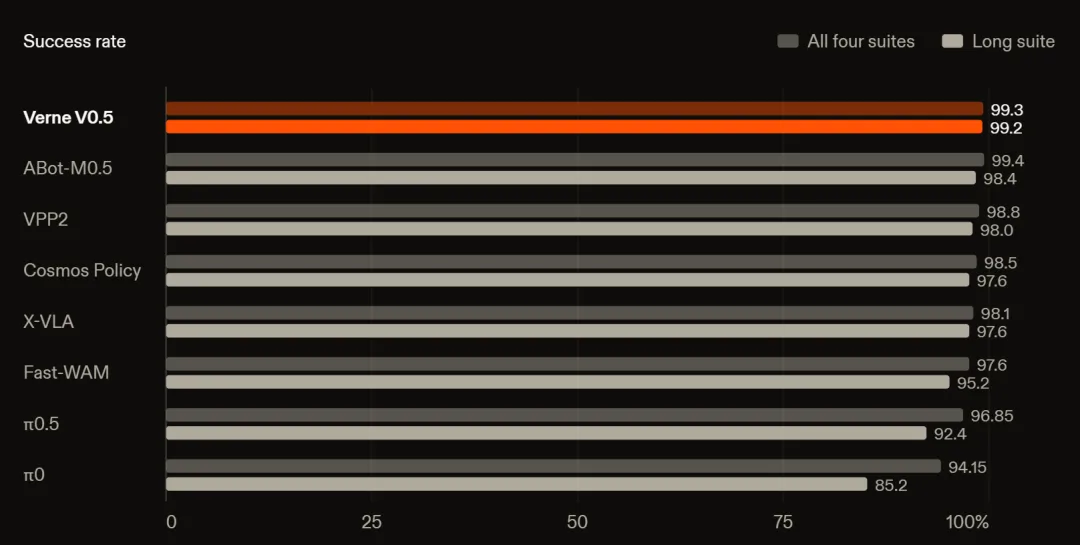
Figure 11LIBERO success rates, showing the average values of the four sets and the results of the Long sets, are arranged according to the average values of these two sets. The other results are based on data published by their respective authors. Our average success rate of 95% ranges from 98.8% to 99.7%.
RoboTwin 2.0 consists of 50 dual-arm missions. Its protocol uses 2,500 clean-scene demonstrations to fine-tune each strategy, with each mission 50 items. It then evaluates the strategy in clean-scene and random-scene, with random-scene scenes containing dirt, new textures, different lighting and different desktop heights. V0.5 has an episode success rate of 81.0%, 73.4% in clean-scene and random-scene, see Figure 12. π0.5, 70.7% and 46.0% respectively.
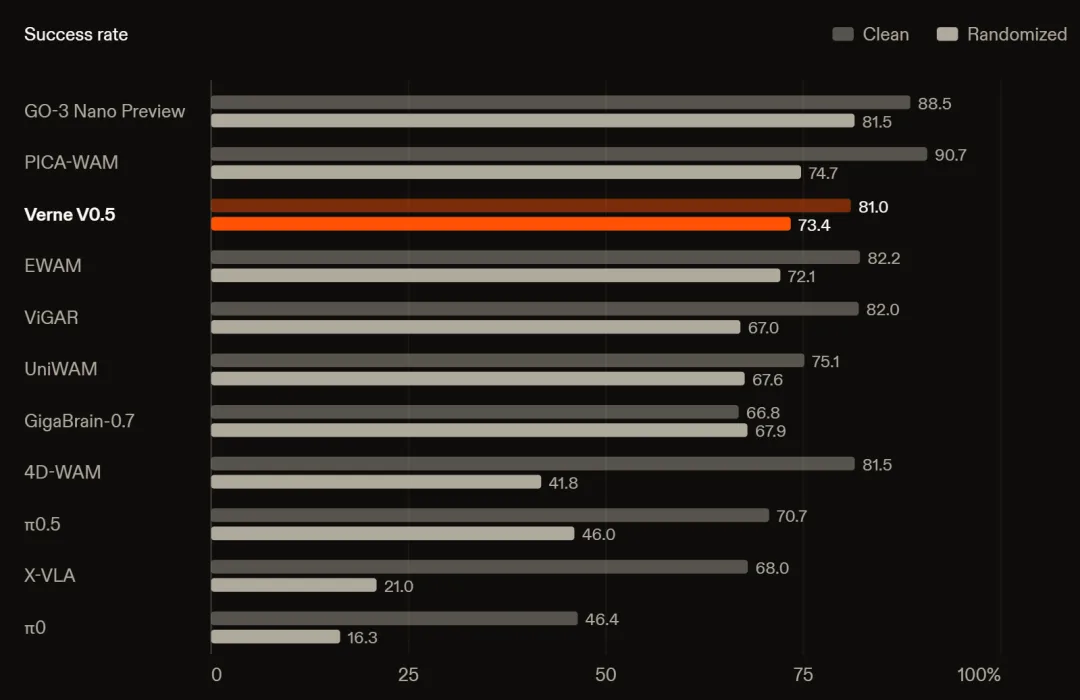
Figure 12:RoboTwin 2.0 success rate in clean scenarios and randomized scenarios. V0.5 for each task, 100 episodes for each scenario type, and 90 for Scan Object in randomized scenarios. Other results were selected from a ranking dated October 30, 2026.
As of November 1, 2026, V0.5 is the leading open-weight model developed by U.S. companies on LIBERO and RoboTwin 2.0. The closest models are NVIDIA's Cosmos Policy, which has a LIBERO success rate of 98.5%, and Physical Intelligence's π0.5, which is the closest model to RoboTwin 2.0.
Difficult tasks and random scenarios
On LIBERO, V0.5 and π0.5 are 98.8% flat in the Spatial suite. On the Long multi-step task suite, V0.5 leads by 6.8 percentage points. On RoboTwin 2.0, we compared all 100 combinations of task and scenario types, one by one, and compared the two models according to the π0.5 success rate, see Figure 13. On a combination of π0.5 success rates below 30%, V0.5 leads by an average of 38.5 percentage points.
Figure 13 is as follows:The difference in the success rate between V0.5 and π0.5 in RoboTwin 2.0 is calculated as a percentage and averaged for the combination of task and scenario types in each group. The grouping is based on a success rate of π0.5; indicating the number of combinations π0.5 results from the RoboTwin 2.0 ranking dated October 30, 2026.
V0.5 maintained a good performance in randomized scenarios with dirt, new textures, different lighting and different desktop heights, resulting in an average decrease in V0.5's success rate of 7.6 percentage points, resulting in a decrease in π0.5 by 24.7 percentage points, so our lead was extended from 10.3 percentage points in clean scenarios to 27.4 percentage points in randomized scenarios. In 50 missions, π0.5 had a decrease in the success rate of 11 missions by at least 40 percentage points.
Figure 14 is as follows:RoboTwin 2.0 is the success rate of each task in a clean scene and in a random scene. Each point corresponds to one of 50 tasks. The point on the opposite corner line indicates that the task's success rate in a random scene has not decreased.
Conclusions
The next frontier of AI is to help people build a better physical world. Robots expand the range of things we can make, take on dangerous, tiring jobs, and make more human concepts a reality. We want to help build a future like this.
Starting today, we're pushing this mission in three ways. We're releasing the weight of V0.5 so anyone can continue building on it. We're launching a fine-tuning platform that allows developers, scientists and researchers to use their own prototypes and church V0.5 to execute their own missions. We're offering customized services to partners, deploying V0.5 in their application scenarios, with service objects that include both small startups and experienced automation teams within manufacturing enterprises.
We're building the Verne technology suite around developers to make it easier to collect data, train models and deploy robots. In the coming months, we'll also be releasing a handheld claw that will allow you to capture demonstrations of what you want to learn about robots.
Bringing robots into every U.S. business requires the participation of many teams and the ability to continuously increase intelligence. Our next generation of models has begun to train. It is larger in scale and learns from more diverse data.
Most importantly, we want to help build a U.S.-led, open-source robotics business that people around the world can continue to develop on its basis. Fourteen months ago, Physical Intelligence unleashed the weight of π0.5 and pushed the boundaries of capability. NVIDIA's work on Cosmos and related models is another important contribution.
References
@misc{verne2026v05,
  title  = {Verne V0.5: An Open-Weight World Action Model to Accelerate Industrial Robot Deployments},
  author = {{Verne Team}},
  year   = {2026},
  url    = {
}