Speculative Decoding has become an industry benchmark in the lossless reasoning acceleration of large-scale language models (LLM). Although the self-return draft model, represented by EAGLE-3, predicts that every guess of a token takes several steps forward in a sequence; while DFlash, inspired by a distributed language model, generates drafts in complete parallel.
However, parallel drafting is always faced with a core paradox: when the latter location is computed, it is not at all known which word the former location will ultimately choose.
This blind guessing can lead to severe multi-modal collisions with suffix decay: each position alone looks at the probabilities as reasonable, spelled together but back and forth contradictions. Because the target large model is verified in strict forward order from left to right, once the failure to weld a position in the middle is rejected, all subsequent draft tokens will be scrapped.
In order to compensate for the causal dependence of parallel drafting, recent DeepSeek work such as DSpark and Domino, DFlash2 has offered improvements. However, existing methods either leave the dependence injected into the backbone network after calculation (e.g. Domino, DSpark's light string head) and cause the subsequent location to be unable to perceive a predetermined tendency at the feature-forming stage; or directly mix adjacent hidden states within the backbone (e.g. local convolutions in DFlash2), confusing the context information with predictive signals.
For this bottle, a team of researchers from Tencent Uto Laboratories, Shanghai University of Transportation and Xiamen University has proposed DSpine (Draft in Parallel, Condition Through Depth).
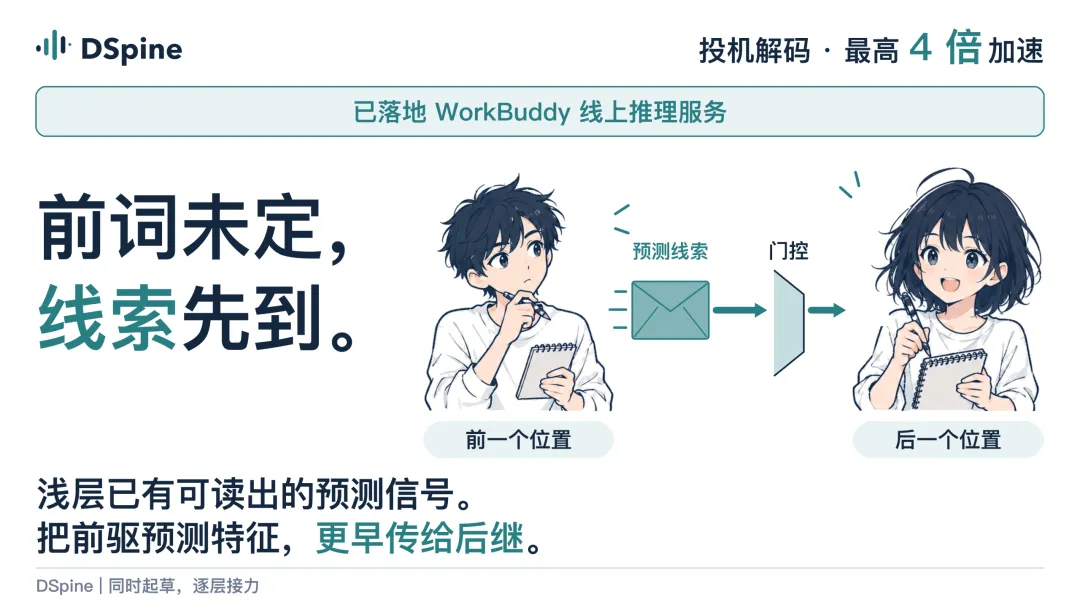
The core idea of DSpine can be summarized in eight words: simultaneous drafting, layer-by-layer retrieval. It no longer tries to select a discrete token at a previous location, but instead starts at the first layer of the draft network by extracting the predictive characteristics of the predetermined position of the pendulum in formation to a unified word embedded space, which is injected layer by layer into the adjacent sequence; when it arrives at the network's endpoints, by transferring caches (Transition Cache) it simultaneously calculates the scores of adjacent candidate portfolios and completes the condition modification with the established predetermined token.
Draft in Parallel, Condition Through Depth: Adjacent Causal Injection for Speculative Decoding
Link to the paper:https://arxiv.org/abs/2609.36173
Open source code:https://github.com/tencent/dspine
Model weight:https://huggingface.co/collections/tencent/dspine
The main page of the project:https://dspine-project.github.io
In the Qwen3-4B and Qwen3-8B acceptance length ratings and the SGLang service throughput ratings, DSpine achieved SOTA in all data and concurrent scenarios: an average increase of 19.0% in throughput compared to DSpark, SGLang service throughput compared to DSpark, 8B, and 20.1% compared to 4B; an average increase of 11.1% compared to the strongest baseline DFlash2, 8B; and a 4.01x acceleration compared to the highest standard auto regression code.
Furthermore, the team has newly trained the Qwen 3.8-27B DSpine draft model optimized for the Agent specialty: in the evaluation of open-source SWE-bench Pro、τ2-bench and the real office scene WorkBuddy Bench ((Code/Web/Office) and in open thinking mode, it accepts an average length of up to 5.63, decoding throughput up to 3.84 times that of returns under concurrent 8 conditions.
Currently, DSpine has successfully landed service on Tencent WorkBuddy online reasoning business, reasoning code and open-source model weighting ((seven benchmarks with an average acceptance length of up to 7.83) are fully open.
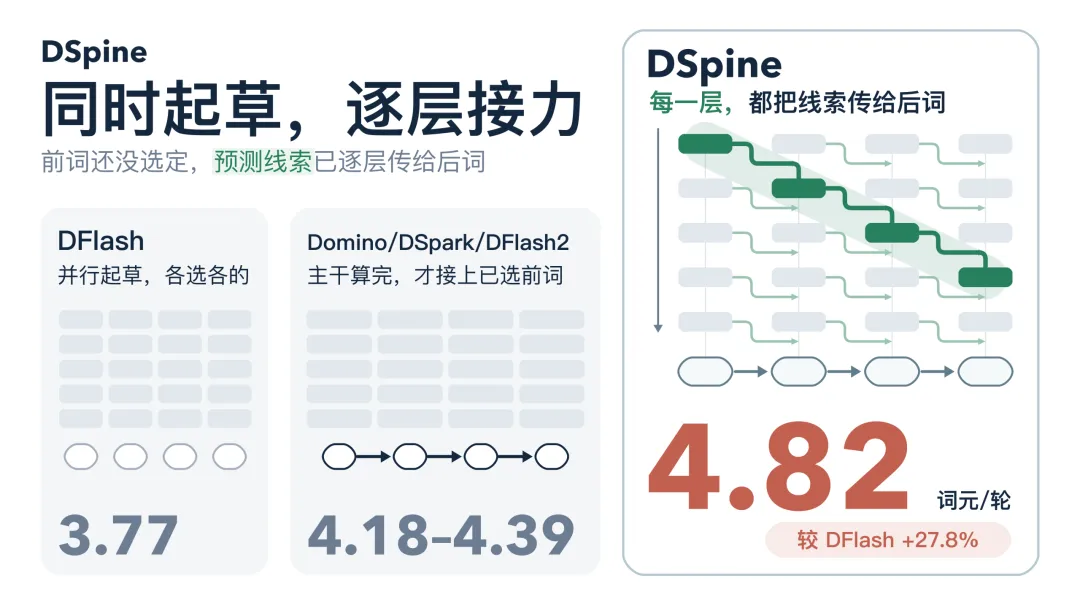
Figure 1 DSpine: Simultaneous draft, layer-by-layer take-up. In the diagram, DSpine is contrasted with mainstream speculative schemes, accepting lengths of Qwen3-8B as the average accepted length on seven benchmarks.
One, two key experimental insights: When do pronouns appear and when is the most effective injection?
Give an example of an intuitive Chinese continuation: given the common text above, the gate has a... gate, position 1 candidate has a cat cat cat, a car cat, a car cat, a car cat. A cat cat cat cat and a car cat are both high frequency natural continuations, but it is very easy to spell out the absurd combination of a cat cat cat if the two locations are moving forward in a single direction.
To let position 2 know position 1, to choose whether it's a car crane or a crane crane, do you really have to wait until the five layers of the skeletal network is complete, position 1 spits out the final token?
By conducting step-by-step probing and intervention experiments on the middle layers of parallel draft models, the team came up with two empirical findings of direct-driven DSpine designs:
1. The forward position prediction signal has emerged in the shallow plane: at the same shallow depth of the network, the forward positioned token within the block has a much higher prediction accuracy rate than the back position. This means that the forward position in the shallow plane already has a readable prediction clue that can be transmitted downstream before the token is finally selected.
2. Close proximity leads to a 31.8 percentage point drop in predictive accuracy on average as long as close proximity leads to a biased draft prediction, even if the earlier historical context is perfectly correct. More importantly, close proximity leads to an average of 14.8 percentage points higher accuracy than delayed injection when the same reliable preconditions are injected.
The conclusion is very clear: Causal dependence on adjacent locations should not be dragged to the end of the skeletal network to do post-traumatic stress repair, but should be calculated from the first layer into the subsequent locations.
DSPINE Analysis: Fold the causative chain into the depths of the network
Based on the above insights, DSpine builds a causal dependence on the depth of the network through four core designs on the premise of maintaining a single forward, parallel updating of the entire position of the same layer.
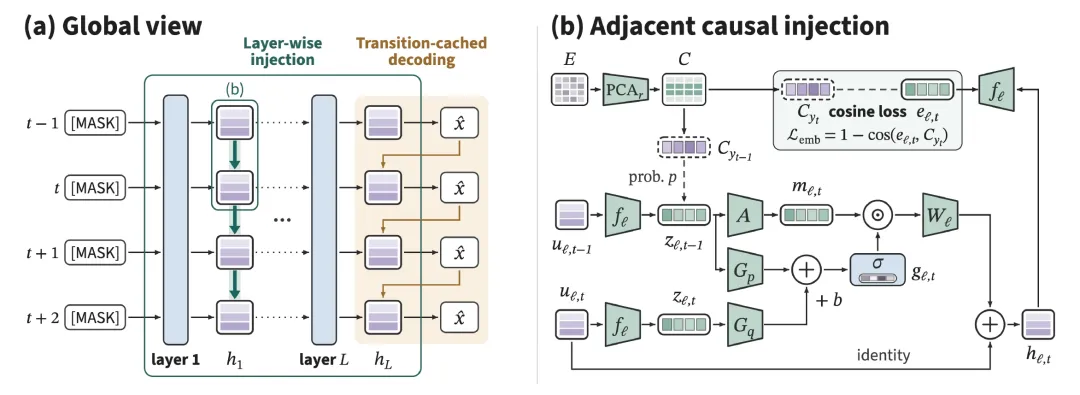
Figure 2 DSpine's overall architecture: Draft network layer by layer passes forward prediction characteristics to the next, with the final selection using the already-defined forward token; continuing to be updated in parallel within the same layer.
Unified Transfer Space: Transmitted only The filter tends to blur and does not convey a confused state
If the front-drive transformer is transmitted directly to the back-drive, it is difficult to separate the back-drive from the back-drive because of the confusion of large amounts of context-gathering information in the back-drive state.
DSpine cleverly used the LM Head output embedded matrix frozen in the target large model to construct a unified transmission space: for the LM Head to be unified with PCA whitening; to remove all token shared shares, retaining the core main direction; to obtain a compact word table. Within the core network, each layer will be hidden state by light projection mapping as a predictive feature; at the endpoint selection stage, the identified discrete front-drive token directly checks the display to be mapped as the corresponding word vector.
Since the characteristic cube in the cube prediction is in the same geometric space as the token cube selected by cube, and has exactly the same algebraic form, DSpine can be decoded with the same set of injected pathway seamless interlayer characteristics and end conditions.
Adjacent Causal Injection: Parallel, cross-layer connections
After each layer of the Draft Transformer network, location t receives the predictive characteristics of the adjacent front-drive t-1, and combines its own characteristics to calculate gate controls, automatically deciding how much front-drive information it absorbs and rewrites the residual flow.
Why doesn't this disrupt parallelism? Because within each layer, all the locations read are characteristics before the layer is updated, and all the locations within the same layer are calculated in complete parallel. Whereas the leads transmitted by the front-drive location in the l-layer are involved in the calculation of subsequent locations in the l+1 layer, and are transmitted further backward. In this way, the cause-dependent chain moves backward along the network depth, without adding any sequence of skeletal steps.
3. Layer-by-Layer Output Embedded Supervision: Why not directly use the full word list CE?
In order to encourage the shallow layers to form clear predictive characteristics as early as possible and to align with the real token injected at the end, DSpine directly aligns its tightly embedded computational directional alignment loss with the real target token after each layer is injected.
The dilution experiment reveals a very interesting anti-intuitive phenomenon: if the whole word chart is directly crossed over in the middle layer under the supervision of Token CE, the acceptance of the length does not only increase, but also breaks the unsupervised DFlash baseline on multiple benchmarks! The reason is that the forced requirement for the middle layer hiding state to do the whole word chart classification directly would compress and interfere with the subsequent layer's upper context representation calculations; while DSpine only constrains the direction of the low-dimensional projection, allowing the prediction thread to appear clearly in the shallow layer and allowing the full hiding state to serve as a free subtext model.
4. End-layer condition decoding and transfer caching (Transition Cache): converting the sequence of selected words into parallel tables
At the end of the skeleton calculation, each position selects the initial Top-K candidate set. This is the time from left to right to select the official word: once the forward position determines the specific token, DSpine replaces the final layer of module input from the predictive characteristic with a real word vector, directly modifying the candidate score of the position (Last-Write Refinement).
DSpine introduces transfer caching (Transition Cache): Since the end-level modification relies only on candidate tokens adjacent to the predecessor, the model simultaneously calculates the conditional score matrix for all adjacent location candidate portfolios directly before the start of the selection.
Three: Experimental results: 28 groups take length and 40 groups serve through full-length.
The team compared the systems on Qwen3-4B and Qwen3-8B to DFlash, Domino, DSpark, DFlash2 and DSpine, assessing seven benchmarks across mathematics (GSM8K, MATH-500), code (HumanEval, MBPP, LiveCodeBench) and dialogue (MT-Bench, Arena-Hard).
1. Accept the length: 28 groups evaluate all first, and the advantage is greater in the sampling mode.
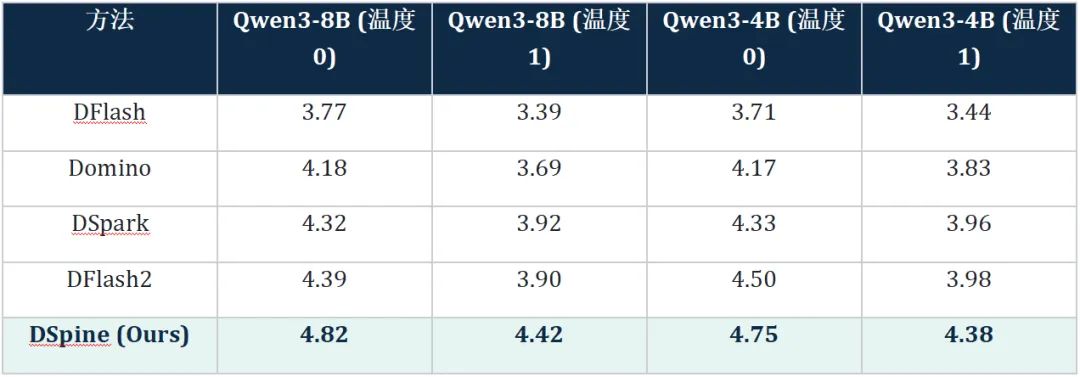
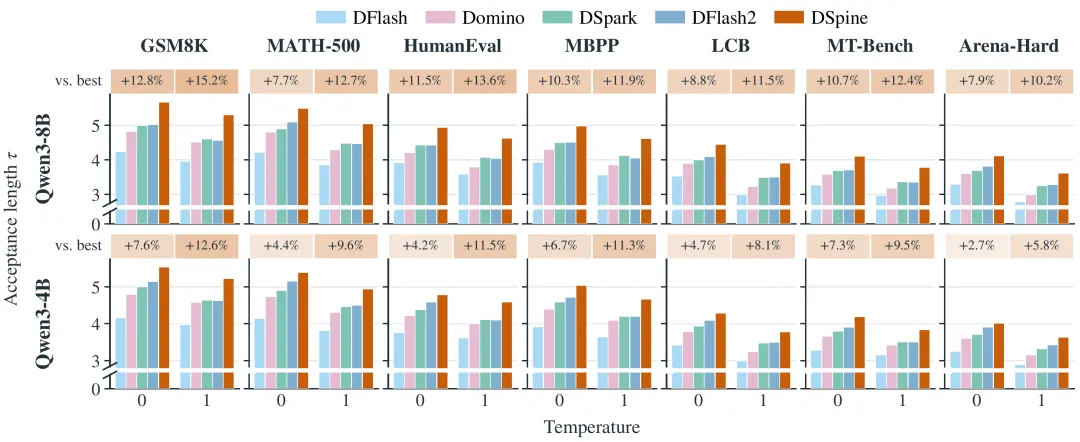
Figure 3 accepts the length contrast of the seven benchmarks. DSpine takes the overall lead in both models and at both temperatures. Source: DSpine paper
Of the 28 groups of tests consisting of two models, two temperatures (temperature 0 and temperature 1 samples) and seven benchmarks, DSpine achieved the longest acceptance length:
Qwen3-8B: At temperature 0, the seven criteria for the average acceptable length increased significantly from 3.77 for DFlash, 4.32 for DSpark, and 4.39 for DFlash2 to 4.82. In mathematical reasoning, GSM8K and MATH-500 reached 5.67 and 5.49, respectively; at temperature 1, the average acceptable length increased from 3.92 for DSpark to 4.42, a relative improvement of 12.8%.
Qwen3-4B: Average acceptable lengths below 0 and 1 are 4.75 and 4.38, respectively, leading the strongest baseline at 10.1% in the sampling mode.
2. SGLang end-to-end service throughput: about 20% faster than the average DSpark, up to 4.01 times faster
In the high-end and end-to-end testing of the mainstream logic engine SGLang (which covers GSM8K, MATH-500, HumanEval, MBPP, four major missions and 2 to 32 five-degree concurrency), DSpine also took first place in a total of 40 group service tests of the two models:
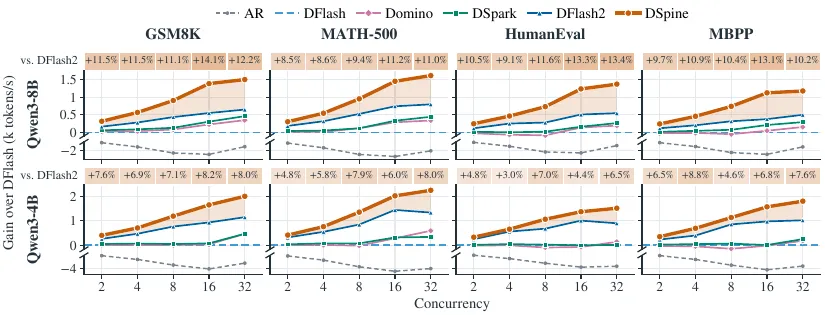
Figure 4 Comparison of different tasks and simultaneous SGLang service throughput. Source: DSpine paper.
Qwen3-8B's average service throughput improved by 19.0% compared to DSpark: Qwen3-8B's average service throughput improved by 22.1% and Qwen3-4B's average improved by 20.1% and 22.5% respectively.
Compared to DFlash and DFlash2: On Qwen3-8B, the average throughput of DSpine improved by 23.3% over DFlash and 11.1% over the strongest baseline DFlash2; Qwen3-4B improved by 6.5% over DFlash2 on average.
Qwen3-8B achieved an end-to-end throughput acceleration of up to 4.01 times, and Qwen3-4B achieved an acceleration of up to 3.80 times.
Delayed demolition: 5 layers of injection is only 0.15ms longer, and conditional selection is more than twice as fast as DSpark's serial head.
Why has DSpine added tiered injecting and tiered end condition selection while still significantly refreshing throughput?
Combined with CUDA Graph, all five layers of injected modules add up to just 0.15 milliseconds per round.
Thanks to the parallel pre-calculation of the Transfer Cache, DSpine end-layer condition decoding takes less than half the time of the DSpark and Domino back-end sequences.
Ultimately, DSpine's single-wheel total time (7.14 ms) and DFlash2 (7.19 ms) remained essentially flat, but due to more tokens being passed consecutively per round, the average decoding time for DSpine generating a valid token was 10.9% lower than for DFlash2.
Fourth, the evolution of the Special Agent: Qwen 3.8-27B test for overall improvement
As larger models moved from single-wheeled conversations to long-range Agent, the greater burden of deep thinking, code-writing and multi-wheeled tool calls raised a greater need for reasoning acceleration. For this reason, the team trained DSpine draft weights specifically for Agent scenarios on Qwen 3.8-27B, as opposed to official open-source DFlash2 weights. The evaluation covered open-source SWE-bench Pro,τ2-bench and real-world office scenarios WorkBuddy Bench (Code/Web/Office), each with two levels of low/xhigh thinking intensity.
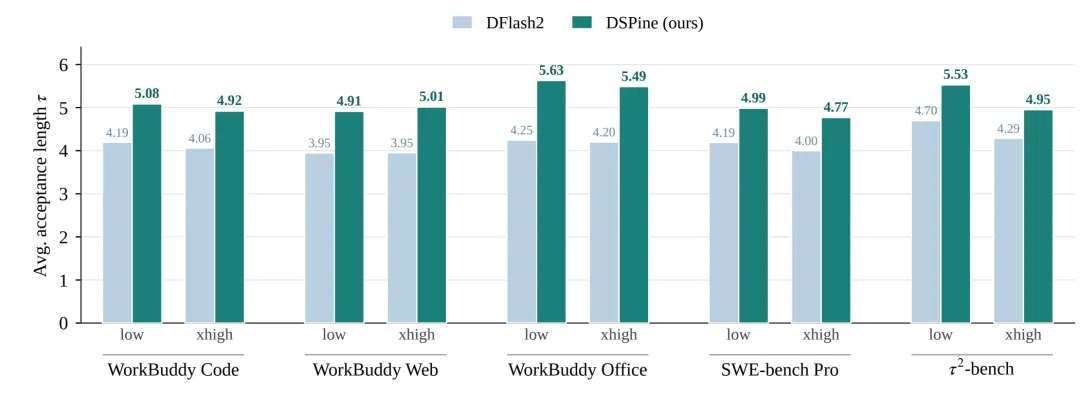
Figure 5 Qwen 3.8-27B Average Accepted Length Contrast under the five major Agent benchmarks, two grades of thought intensity.
Figure 6 Qwen 3.8-27B end-to-end throughput of tokens/s and acceleration ratio.
DSpine received an average length improvement of 5.13 and WorkBuddy Office ((low) of up to 5.63; decoding throughput of open source DFlash 2 improved by an average of a maximum of 21.2%, with a relative acceleration of 3.84 times higher than the original since its return. Of these, six real office groups received an average length improvement of 26.1%.
In addition, the team simultaneously unlocked the draft weight of Qwen3-8B and Qwen3.8-27B for the production environment, relying on SGLang, which has been packaged as lightweight plug-in wireless access. Currently, DSpine has officially landed on the Tencent WorkBuddy online logistics business, and developers can install the DSpine plug-in with just a few commands, directly experiencing acceleration effects on their own Agent and general business load.