In robotic operations research, the Vision-Language-Action model (VLA) and the World Action Model (WAM) provide different pathways for robots to generate action. However, when the task extends from a single crawler to a continuous build-up with two-arms collaboration, the success determines not only whether the action will be completed for the time being, but also whether the conditions previously established will continue to support subsequent execution.
What is the real lack of robots, a stronger model of action, or a system of organizing these actions?
A research team from the Chinese University of Hong Kong (Shenzhen) and institutions such as Singapore A*STAR, Qinghai University and others have proposed LOGIV, which introduces Graph Engineering into the execution architecture of Agentic Robot. It builds explicit task charts on existing VLA and WAM strategies, converting the conditional dependence and resource sequence between actions into a verifiable, traceable and correctable execution basis.
LOGIV focuses the system on whether an action has been completed and progressed to whether a follow-up plan is still in place. By graph-dependent verification and cause-and-effect local remediation, the robot can restore the necessary support after the conditions are found to be ineffective, retain the still-usable plan, and continue to advance toward the goal. Without adding new trainable components to this layer, the task graph can actually participate in the robot's execution decisions.


Logiv: Graph-Verified Execution with Causal Local Repair for Long-Horizon Robot Tasks
The full text of the paper:
The main page of the project:https://enqiao-lu.github.io/logiv-project/
Code and presentation:https://github.com/Enqiao-Lu/LOGIV
Breaking the cycle of execution, from action to dependence
It doesn't sound complicated to get a robot to build a bridge of bricks: set up the support on both sides, pick up the beam, and put the beam on it. But what if the robot picks up the beam and accidentally twists the beam?
The grabbing action was successful, and the previous placement action was indeed completed, and the next step could not have been established. Continuing as planned, the robot is likely to place the beam on a branch that no longer exists. This is a hidden problem in long-term physical interactions. Completion of the action is a historical one, but the conditions that result from the action may fail at any time. If the system only records the progress of the task and does not check that these conditions are still in place, past success may cover up the current risk.
If a long task is written into a to-do list, the robot knows what to do first and what to do next. If it is organized into a task map, the robot can ask what the next step is dependent on, which conditions will fail and which subsequent actions cannot continue.
Task Nodes: High-level sub-tasks such as capturing and placing, including the starting point and the end goal of the task.
Conditional supporting edge: records which movements establish the conditions for subsequent movements, such as when the supporting block is in place before the beam is installed.
Resource sequence: records the sequence of use of resources, such as mechanical arms, claws, and conflicts that have been modeled between actions.
This diagram links planning and action and provides a basis for failure recovery. Once the support blocks are moved, the system can track the after effects of the support relationship along the conditions of failure, without having to treat the entire task as a failure.
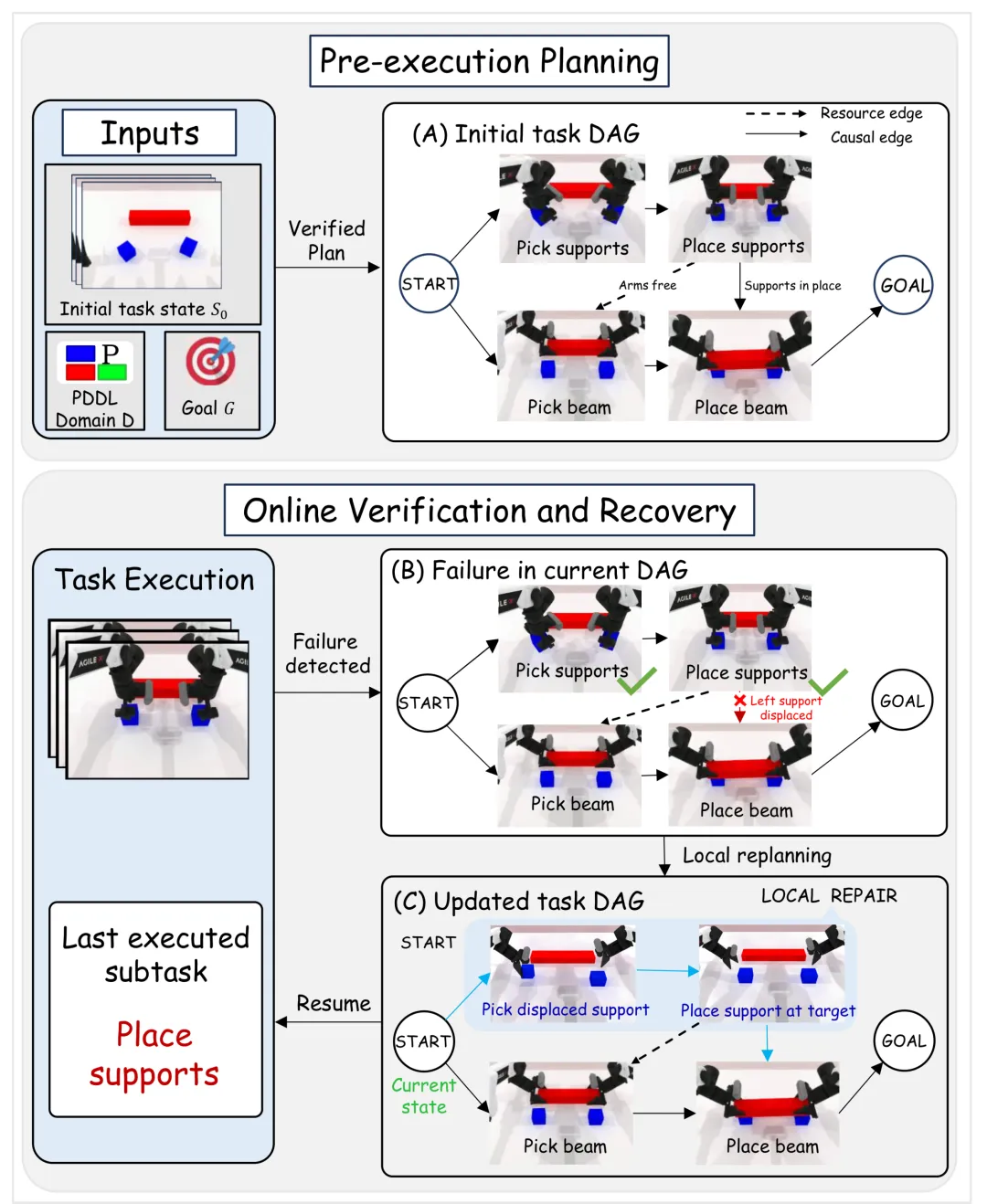
Figure 1: After the support block is twisted, LOGIV restores the defective support conditions and retains the subsequent transverse operation that is still available.
Connecting VLA to WAM to execute a closed loop
If Graph Engineering is in charge of organizing the main task, who does the bottom moves? LOGIV gives a clear breakdown. The top moves are converted into natural language instructions depending on the current state and the task depends on the selection subtasks. The bottom strategy combines the instructions with visual observation to execute the operations, then the conditions required by the top to check the effect of the moves and the remaining plans. The end of one move will be the starting point for the next round of judgement.
The paper combines three execution models to test whether the architecture crosses different strategic routes.
π0.5 serves as a VLA execution model, mapping visual observations and mission instructions to robot actions.
AHA-WAM and Light-WAM are two WAM execution models that perform the above-mentioned operations under their respective strategic architectures.
As shown in Figure 2, LOGIV builds an independent task organization and recovery layer on top of VLA and WAM, allowing different execution strategies to access a unified planning, verification, and repair loop, without having to retrain them into a large model, and without adding trainable components to the framework. The architecture has been validated on mission-modulated π0.5, AHA-WAM, and Light-WAM, which rely on checking and local repair mechanisms for cross-strategy replication, and requires matching task models, sensing information, and execution interfaces when entering new tasks.
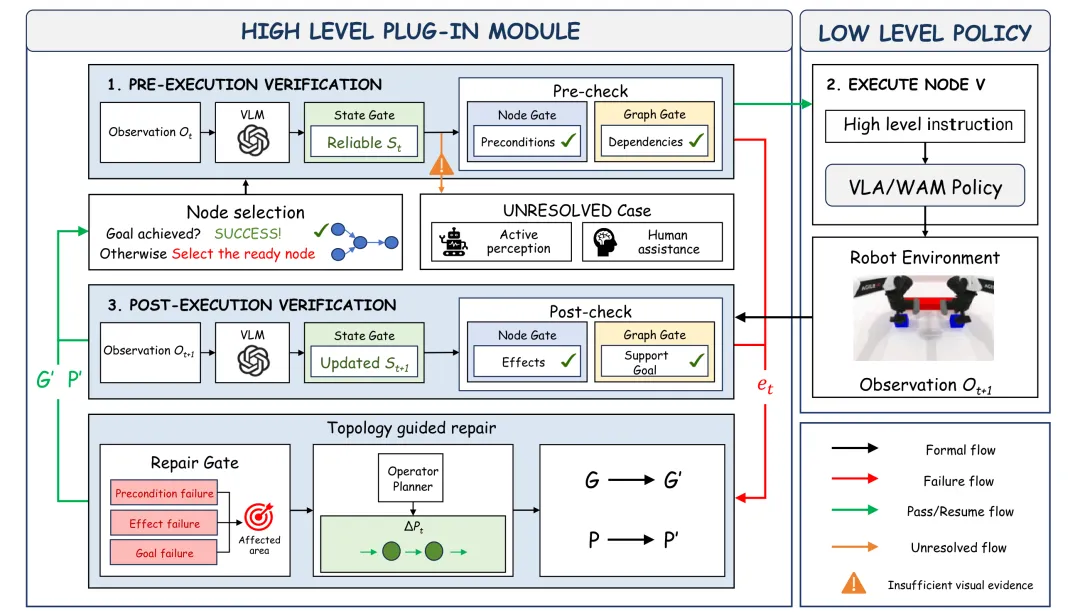
Figure 2: LOGIV is located above the underlying VLA or WAM strategy, checking the status, node and graph dependence before and after the execution of the action, confirming the failure to enter the repair process.
In specific implementation, LOGIV implemented the architecture shown in Figure 2 as a task map, online verification and local repair of the three interconnected links.
1. Construction of task charts: Compile the action sequences into depending charts
The system first uses a predefined PDDL task model to describe the action prerequisites, expected effects and available objects, generate a sequence of actions by Fast Downward, and then hand over to the independent verification tool VAL to check the action parameters, prerequisites, and final targets, only to be compiled into a task map through the verification plan, specifying which conditions the subsequent action depends on, and which of these conditions are provided by the action.
2. Online verification: Continuous verification of actions and supporting conditions
Going into the execution phase, LOGIV connects field observations to task charts via State Gate, Node Gate and Graph Gate, where State Gate combines visual observations, robot status and executor feedback to confirm the facts of the current task, while Node Gate checks preconditions and expected results before and after the execution of the action, while Graph Gate further verifies the dependence of the task to determine whether completed actions still provide effective support for the remaining program. The three together constitute a verification process after the execution of the action, allowing the system to determine whether the current operation was successful and to detect changes in the conditions affecting subsequent tasks.
For example, even if the robot successfully grabs the beam, the Graph Gate will still recognize that the conditions required for subsequent installation have failed and trigger repairs, rather than continuing to execute on the basis of a successful record of current actions. In the case of insufficient visual evidence, temporarily unconfirmed states, the system will supplement information by re-observing or adjusting the viewing angle, and if it is still uncertain within the observation budget, stop execution, avoiding mistakenly treating uncertain states as conditions.
3. Local remedies: restoration of necessary conditions and maintenance of effective plans
When the failure is confirmed, the LOGIV tracks the affected dependencies along the task graph and distinguishes the affected movements from those that actually need to be replaced, while preserving the unfinished plan that is still available. In the case of bridge-building, the relocation of support blocks does not mean that the subsequent step of installing the overhead beam itself is problematic, so the system can retain the relevant operation, start from the final destination, and proceed in reverse sequence along the retained movement to resume the execution of the conditions that must be met before, and then generate the corresponding repair segment according to the current state.
After the repair segment is generated, LOGIV combines it with the retained program to verify whether the complete follow-up program can achieve the final goal under the symbol model by VAL, rather than merely verifying whether the current failure conditions have been recovered. If the verification is not passed, the system will reprogram to the current extent based on the failure position, or expand the range of actions that need to be replaced, to reconstruct the task and resume execution after the verification passes, thereby connecting the processing of local problems to the progress of the complete task.
The results of the experiments will benefit various underlying strategies.
In RoboTwin V2 and BiCoord, the team selected 10 dual-arm missions for a total of 20 missions. Each mission used 10 predefined initial states and evaluated both the unmanned injected interference and the predefined interference settings, respectively.
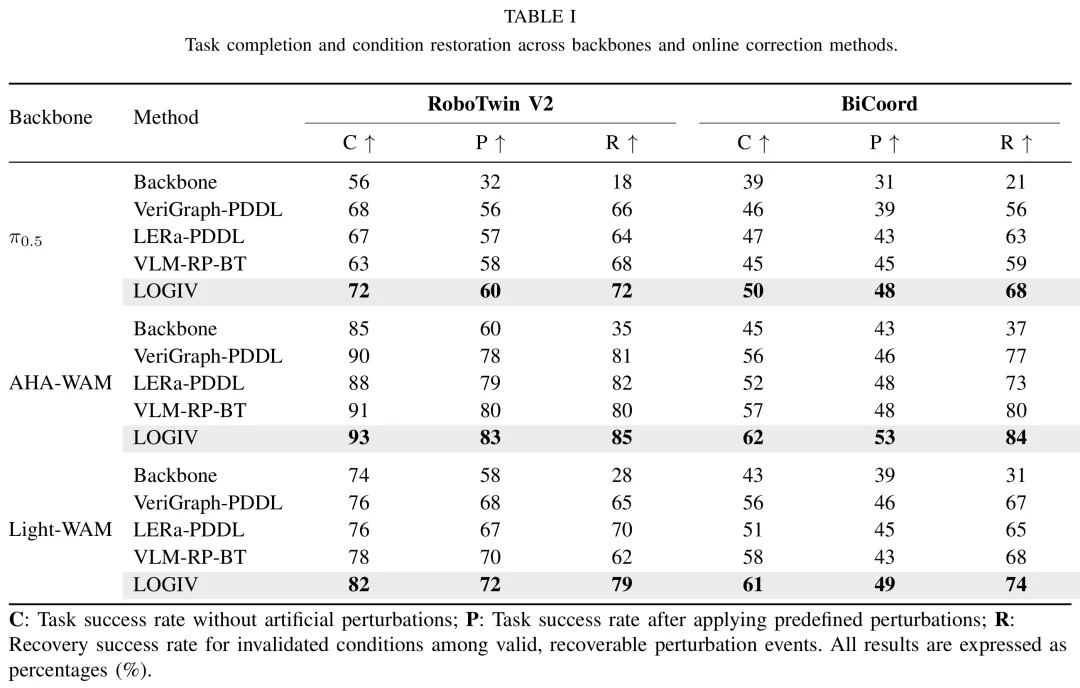
Figure 3: Experimental results of different underlying strategies and online remediation methods. C represents the success rate of complete missions under no man-made injection of disruption, P represents the success rate of complete missions under pre-defined disruption, and R represents the effective recovery rate of failures in recoverable events, each unit as a percentage.
1. Non-interference benefits, with a maximum success rate of 28 percentage points.
The average success rate of the three models increased from 71.67% to 82.33% on RoboTwin V2 and from 42.33% to 57.67% on BiCoord, based on uninterrupted averages, and increased by 10.67% and 15.33%, respectively. This shows that the role of LOGIV is not limited to external interference, normal execution of state deviations and failures, and can also be processed through graphing and online proof-of-work, thus improving completion of tasks.
The research team injected recoverable disruption for each task when the default event occurred, resulting in a P-column in Figure 3, where π0.5 increased the success rate on RoboTwin V2 from 32% to 60%, an increase of 28 percentage points. Compared with VeriGraph-PDDL, LERa-PDDL and VLM-RP-BT triadjusted recovery baselines, LOGIV achieved a higher failure rate of recoverable disruption and recovery in all two baselines and three baselines.
2. Picture inspection and local repair, each contributing
The research team further dismantled the key link in the framework. With the π0.5 setup of RoboTwin V2, after removing the Graph Gate, the disruption task success rate decreased from 60% to 48%. This indicates that it only blocks the immediate action and misses the dependence on subsequent execution. After replacing the local repair with a reprogramming of all the remaining actions, the average repeated execution of the effective operation has increased from 0.2 to 1.6 times, while the disruption task success rate has increased to 54%.
This group of results supports the design choices of LOGIV, first figuring out what subsequent tasks depend on and then deciding where to repair them.
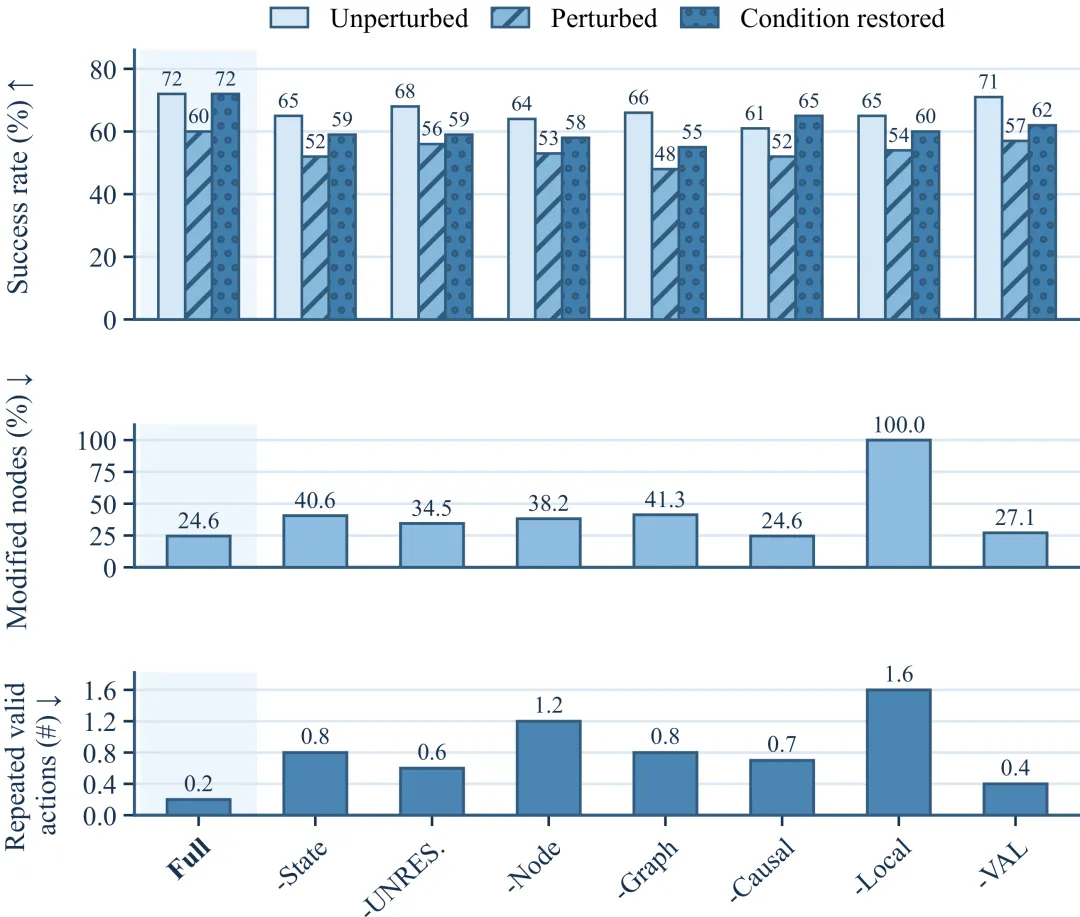
Figure 4: Chart dependent on checks, local repair and planned verification results. Full for the complete framework, Graph for the removal of chart checks, Local for the re-planning of all remaining operations.
Go to the virtual machine and let the closed loop be physically examined
The team also tested on the Astribot S1 twin-armed robot and two AgileX Piper mechanical arms, such as tomato-grabbing, two-armed blocks and wiring, demonstrating that LOGIV is not only effective in simulation, but also in landing scenarios.
Let's take a look at a real-life mission demonstration of arm-packed blocks.
Video: Astribot S1 with two-armed blocks.
There are similar difficulties in building blocks as in previous bridge examples. Subsequent stretching actions may distort the already laid blocks, causing the subsequent required support conditions to fail. LOGIV will repair the corresponding conditions after such changes are checked and keep the work still valid.
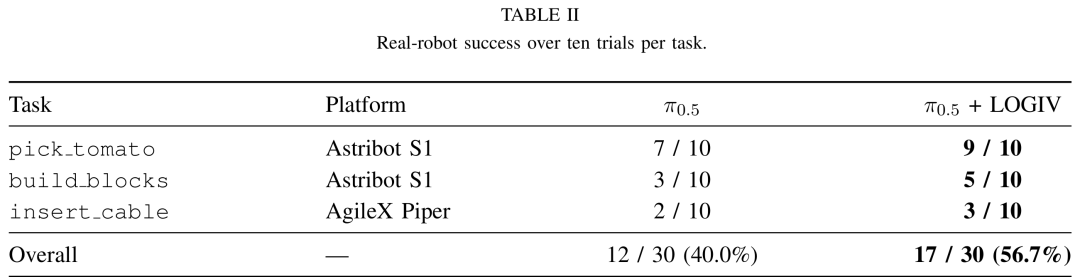
Figure 5: Ratio of successes of real robot tasks. For each task, each configuration is tested 10 times, with a total of 30 times for each configuration, without artificial interference. Data are from Table II.
The overall success rate increased from 40.0% to 56.7%, and improvements were observed on all three missions. From empty crawling and early loosening, to damaged building support conditions, and deviations in actual execution also provided testing scenarios for this set of verification and repair mechanisms.
In other words, what kind of execution system does a robot need?
With the continuous improvement of VLA and WAM's operational capabilities, the study of Agentic Robot poses an unavoidable question, waiting to be answered, how to make these capabilities a complete task that can continue to advance in a changing environment? LOGIV moves Graph Engineering from task representation to online execution.
Robots need models that do more action, and systems that can do things in a changing way. Logiv is turning the latter problem into a graph engineering that can be built, verified, and evaluated.