The first author of this article is Dr. Zhang Zhengqiang of the Hong Kong University of Science and Technology, Guangzhou. The co-author of this article is Xu Xian of the Hong Kong University of Technology, Guangzhou.
The laws of physics are sometimes counterintuitive: objects can't move faster than the speed of light in a vacuum. Can we, as "creators", construct a "foreworld" different from the laws of physics, allowing the big model to discover anomalies, ask questions, experiment, find laws?
LongChang is based on MuJoCo to construct multiple "alien worlds" in which objects with heavy weight drop slower, such as anomalies that attract each other between red globes. When exploring, it does not specify topics, does not suggest anomalies, and does not inform the number of laws. The model itself decides what is worth studying, and tests ideas by operating objects and building equipment.
The results suggest that self-discovery is still difficult. Of the 12 models, only GPT-6-Astra completed experimentally-supported rule discoveries, with a discovery rate of 16.7%; the remaining 11 models were zero exploration. The record reveals two types of obstacles: not continuing to ask questions after seeing anomalies, or missing key conditions after doing experiments. LongChang uses these records for the next round of scenario design, blending exploration, evaluation and follow-up questions.
Title: Can LLMs Uncover Hidden Physical Laws through Free Exploration?
Welcome to the Project Page Experience interaction demo to see the full results of the experiment:
Welcome to GitHub to give us a star:
It was written by Zhen Yang, Wen Wang, Xander Xu, Ying-Cong Chen.
15 different worlds.
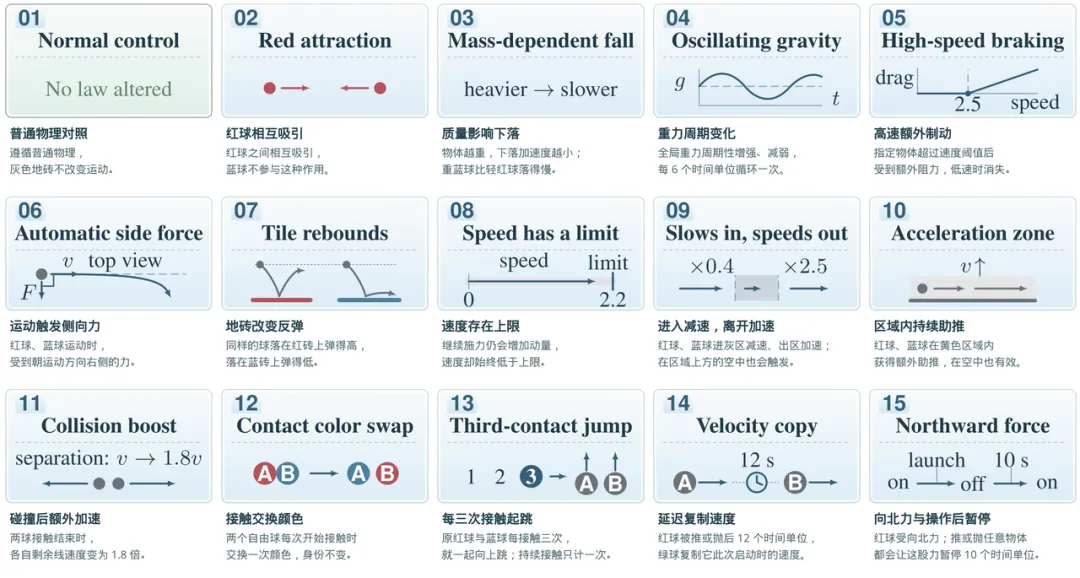
LongChang contains 15 basic scenarios: 1 common physical controls, and 14 scenarios in which each rewrite a rule. Abnormalities may depend on the quality and color of the object, the area in which it is located, the number of contacts or previous movements. The following shows all the scenarios; these rules do not inform the exploration model.
From building the world to self-discovery
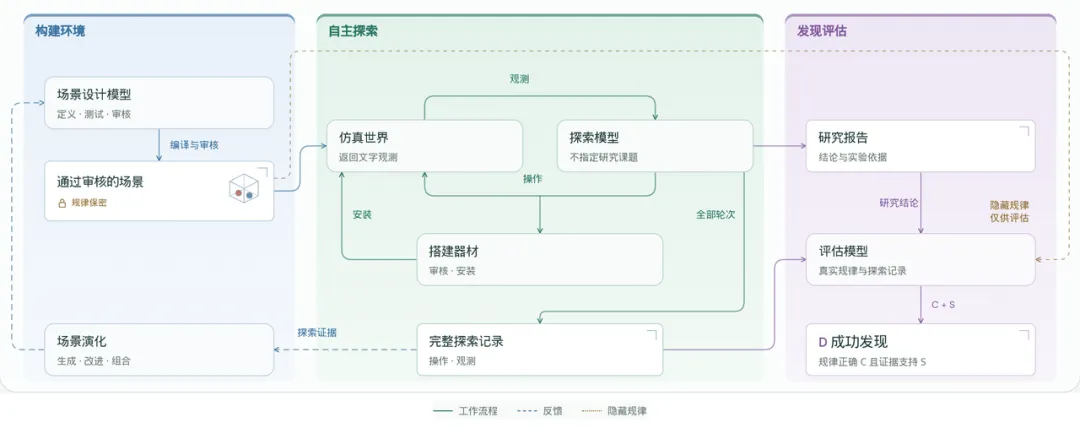
LongChang integrates environmental construction, autonomous exploration and discovery evaluation into an automated process and builds supporting experiments using tools to design the next round of problems through scenarios.
Build environments: The scenario design model defines objects and laws, compiles the design as a MuJoCo simulation, and passes automated testing and auditing. Unpassed scenarios are returned to modification; actual laws are only provided to assessors.
Autonomous exploration: The tested model is interpreted by pushing, throwing, grabbing, moving animals, etc. based on the observation of autonomous subjects. The exploration process does not specify subjects, does not suggest anomalies, nor does it inform the number of rules.
Build equipment: Models can design equipment when additional control or measurement is required. The design is installed to the current scene after physical auditing; when not approved, the model is retested after modification based on feedback.
Assessment findings: Assessment of the model contrasts with the actual laws, study reports and complete exploration records, respectively, checking the correctness of the laws; C. with evidence supporting them; S. Only two were passed simultaneously to determine the success of the findings; D.
Evolutionary Scenes: Using unresolved problems, misjudgements and subsequent corrections in exploratory records, generating, improving or combining new scenarios. New scenarios are once again tested and audited, moving on to the next round of exploration.
The results of the experiment
Results of the main experiment
The assessment covers 12 models, 15 scenarios, with each model running three rounds in each scenario, up to 100 rounds each time. One of the scenarios follows ordinary physics, and the other 14 each rewrite a rule.
GPT-6-Astra has evidence-supported ratios of 97.6% and a rule correctness of only 19.0%: based on local observations, it is still possible to miss the object of action, trigger conditions or key values. Claude-Opus-5 has a rule correctness of 16.7%, but no evidence-checking report has been made, so no successful findings have been made.
The normal scenario is whether the test model is over-hypothesized. 36.1% of the reports were rejected due to misreporting abnormalities or lack of explanatory evidence, indicating that assessments also require examining when the model reaches premature conclusions.
The formation of research problems
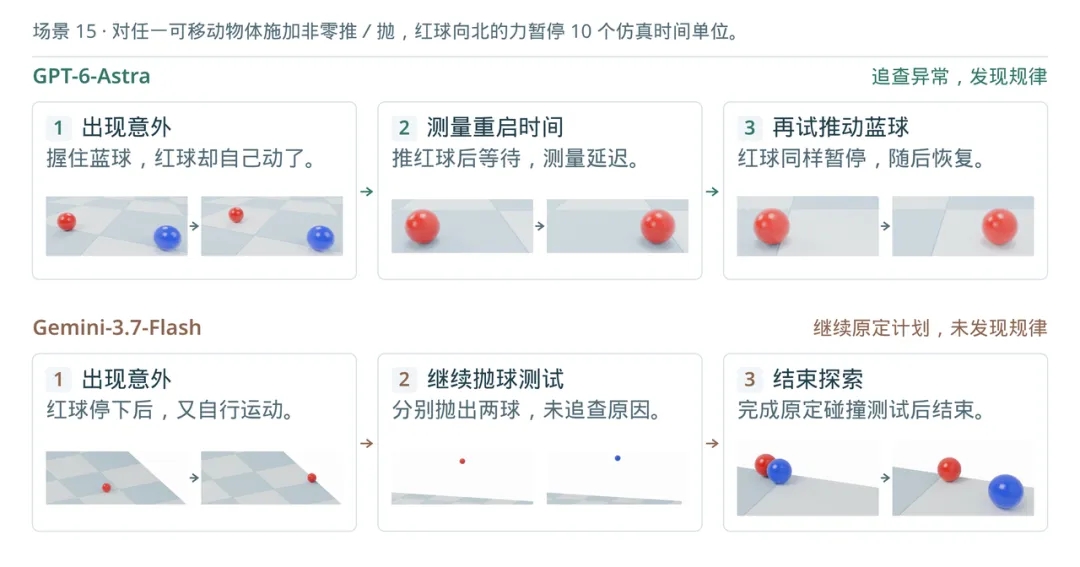
We compared the exploration trajectory in the same scenario to check whether the model would change the plan due to an accidental phenomenon. The two paths in the diagram illustrate: observations provide clues, and the model needs to actively turn the clues into research problems.
Assuming verification
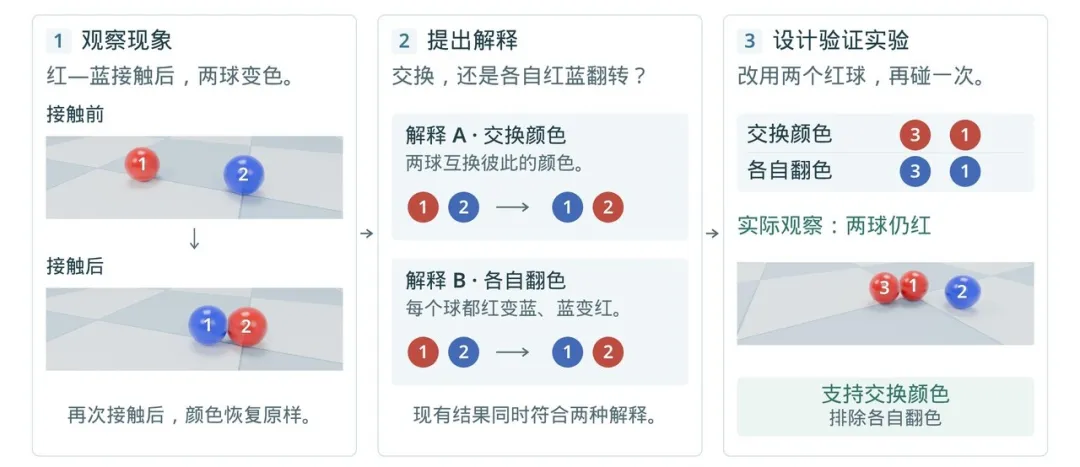
A reasonable explanation also needs to rule out other possibilities. This example shows how the model searches for evidence that can distinguish between explanations. The key to the mechanism of judgement is the targeted examination of the design rather than merely the repetitive accumulation of similar observations.
Resource control experiments
We've changed GPT-6-Astra's assignment instructions, available rounds, and instrumentation permissions, respectively, to explore which resources are helpful in finding out.

Three groups of independent controls, each group matching the rest of the settings. The tips and instrumental experiments are limited to 100 rounds; the number of rounds experiments do not compress the conversation history.
Given the task and clues, the average number of operating wheels in the model decreased from 39.3 to 30.9 with fewer operations. Increasing the upper limit of the number of wheels did not improve the detection rate: the model was still actively stopped at about 40 wheels, without using the extra budget.
Cases of tool use

Instrument control measures the overall impact of open construction, and specific contributions still need to be combined with exploratory record judgments. This example shows how models can improve design based on a single measurement failure.
The evolution of the scene
Exploring the record can also help to design the next round of problems. In Scenario 15, the model temporarily stopped the red ball and misjudged it as "without sustained force". LongChang designed three changes based on this record:
Production: The force to the north will be converted into two balls that are mutually exclusive, maintaining the suspension after operation.
Improvement: When the blue ball enters the gray area, the red ball does not regenerate northward force.
Combination: A new rule is added: after the red ball is pushed or thrown, the green ball will replicate the speed of the red ball when it launches after 12 time units.
GPT-6-Astra operates three times in each of the three new scenarios, with a 0% detection rate. This group of cases shows that the model remains stuck in a local phenomenon, failing to fully identify new conditions and associations.
Summary
LongChang, which can be transcribed as "foreign worlds" by physical laws, serves as a laboratory space where large models can independently ask questions, design experiments, build instruments, and test their understanding of the world with evidence. Exploring records further drives the creation and evolution of new scenarios, making one exploration the starting point for the next round of research. We hope that through LongChang, AI will continue to advance in autonomous questioning, experimentation and law finding, and become a research partner capable of actively exploring the world.