It's the first time I've ever been to a temple in China.
QbitAI is public.
The stronger the agent, the more environmentally friendly it is.
Your colleagues used Agent to organize their reports, and it went smoothly. You used the same models, tools, and processes to replace your own files, but you started repeatedly trying to read them and coming back to work frequently.
The model hasn't changed, the harness hasn't changed, the environment hasn't changed.
Different file locations, confusing data formats, and changes in template constraints can cause the methodology to fail. The model provides reasoning capabilities, and Harness organizes the process, but Agent still needs to judge:What is the environment here, and what is the past experience that is not applicable?
This also reveals a problem that is easily overlooked in Agent's ongoing self-improvement process:Not only does the agent learn how to learn from the missions, but it also determines under what circumstances these experiences are still effective.
In the continuous optimization process of recursive self-improvement (RSI), Agent can improve execution methods through task feedback, accumulate replicable experience. But if environmental awareness is not updated in sync, past effective experience can also become a new obstacle: interface conditions change and old calls are still being retested; data formats change and are still following the old rules.
If we fail, should we change the approach, or should we correct our understanding of the environment?
Agent's new puzzle hides old clues in cognitive science
Cognitive science is the study of the structure of knowledge that provides the inspiration to differentiate between the two types of questions:
In 1983, cognitive scientist John R. Anderson, in a theoretical study related to ACT-R, discussed two important types of systems in human knowledge:
Declarative Knowledge (Declarative Knowledge)For example, closed containers obscure internal objects that can be observed when opened.
This is the first time I've been able to do this.Description: Describe how bees should behave. For example, if you need to look for multiple similar objects, after finding the first one, you should continue to check for other possible locations.
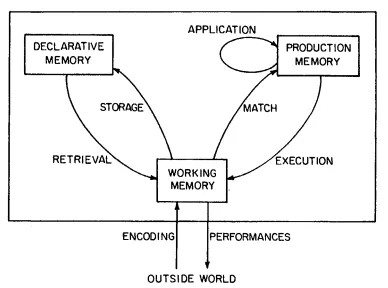
Researchers such as Larry Squire have subsequently confirmed this separation from neuroscience.Biological foundationsThe two types of knowledge are responsible for different regions of the brain, with different learning rates and extraction methods.
If you introduce this point of view to Agent, you can see:Knowledge of the environment and mastery of practices are interrelated, but require different methods of verification and updating.Environmental judgments need to verify whether they are in line with the facts on the ground and whether the method of action is effective under the corresponding conditions. Confounding the two may be to consider accidental successful operations as a rule of stability, or to continue using methods that are ineffective after environmental change.
In this way, OpenJiuwen is working on a new project.RSIIn the ongoing exploration of the direction, further proposals were madeTTSE ((Two-Track Self-Evolution, two-track self-evolution)。
In a previously released introduction to the two-dimensional RSI framework, OpenJiuwen has adopted theHarness+Artifacts two-dimensional optimizationTo enable Agents to continuously improve their working methods and delivery results based on real-world mission feedback, while TTSE focuses further.Reliability and reliability of the experience itself,Not only does it allow Agent to accumulate effective execution methods, but it also continually corrects environmental awareness, avoiding the failure of experience after environmental change.
To this end, TTSE draws on the distinction between statistical knowledge and procedural knowledge in cognitive science, dividing the experience gained in the mission into two tracks:
FACT: Environmental factsIt's a great way to keep up-to-date and keep up-to-date.
TIP (conditional technique)Continuous improvement: what should be done under these conditions.
TTSE bi-track framework: an experience that builds feedback-driven, self-evaluating closed-loop
The first step is to identify the type of experience.How can Agents continue to learn from mission feedback and translate effective experience into the next round of execution improvements?
This is also the core idea of RSI: driving improvement through real-world mission feedback and continuous verification and optimization in subsequent execution. TTSE implements this idea at the management level of experience, allowing existing experience to be continuously tested for new evidence, determining which experiences should be retained, which need to be modified or withdrawn, and applying the updated experience to the next round of tasks.
The framework consists ofBi-track knowledge representation, cold start, online growth evolution, final output and evaluationIt consists of four parts, as shown below:
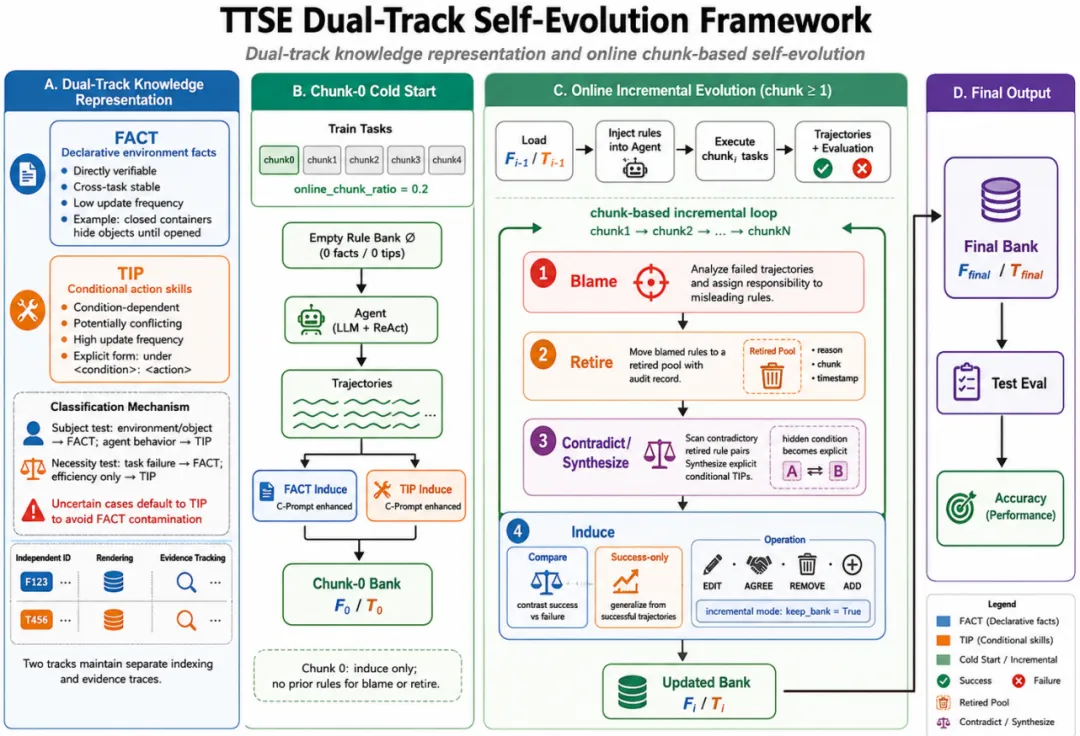
1 Bi-track Knowledge: Based on environmental facts and implementation methods
FACT is used to describe the properties and laws of the environment itself, with emphasis on direct verifiability, and cross-task stability under applicable scenarios; TIP is used to describe execution methods under specific task conditions, with the use of hashing.Under what conditions, what operations to performIt's a form of greeting.
Maintaining knowledge separatelyIndependent numbering, presentation and evidence tracking mechanismsThis makes it possible for each experience to be cited, verified and updated separately, and makes it easier to track which factual judgments or operational suggestions have influenced the implementation of the problem.
When classifying, the framework combines experiences to judge the subjects and roles described (and develops how to classify according to the mechanism); difficult to determine content is defaulted to TIP, reducing the risk of mistakenly classifying unverified operating experiences as environmental facts.
2 Cold Start: Recruiting initial experience from first missions
TTSE starts from an empty rulebook, where the agent performs the first set of tasks (chunk 0), and then assigns FACT and TIP to the execution trajectory, respectively, to create an initial bi-orbit experience library.
This stage is mainly attributed to the fact that there are no historical rules involved in the execution, so the old rules are not attributed and retired, but to the experience of establishing the first batch of evidence supporting the task for further development.
3 Online growth evolution: testing and modifying existing experience in new tasks
Subsequent missions are carried out in batches. In each round, the Agency uploads a round of FACT and TIP, taking advantage of previous experience to execute the current batch of missions, and then completes four sections according to the execution trajectory and evaluation results:
I'm not sure what I'm talking about.Analysis of failed trajectories, identification of rules that may mislead execution, and experience-correcting positioning of objects.
Retirement from the militaryThe rules to be blamed will be transferred to the retirement pool, and records such as cause, batch and time will be kept to make the adjustment process traceable.
Contradict / Synthesize) is a synthesis of synthesis.Examining the contradictions in retirement rules, attempting to identify the applicable conditions implied therein, will combine the experience of seeming conflicts into a more precise TIP of conditions.
I'm not sure what I'm talking about.: Contrast success and failure trajectories, or extract effective experience from successful trajectories, by updating the bi-trajectory experience library through operations such as adding, modifying, confirming and removing.
Blame→Retire→Contradict/Synthesize→InduceMultiple missions run in batch cycles, allowing the experience to continue to be tested for new evidence: both updating the awareness of the environment and adjusting the execution methods under the corresponding conditions.
4 Final output and evaluation: the real benefits of testing and experience evolution
After several rounds of incremental evolution, the framework produces the final FACT and TIP experience libraries and assesses their impact on accuracy or task performance in test tasks.
It's the core of the mechanism.Environmental Facts and Implementation Methods are documented, traceable, and verified and corrected in continuous implementationEvery time an agent completes a task, they can transform new interaction evidence into the next round of usable experience, gradually forming a closed loop from environmental interaction to knowledge updating and action improvement.
But one crucial question remains to be answered: Is it really more effective to manage environmental facts separately from action skills than traditional single-track experiences?
From mechanism to confirmation: five benchmarks to verify the effectiveness of TTSE binary evolution
The methodology and experimental results of TTSE have been studied in the paper A Two-Track Online Self-Evolution Framework for LLM Agents.
In order to verify whether the binary experience mechanism is really effective, the research team is working on theALFWorld, ScienceWorld, GDPevo, SOPBench and PinchBench are five benchmarks.Each experiment was evaluated and repeated three times independently to evaluate the actual benefits and operational stability of the method.
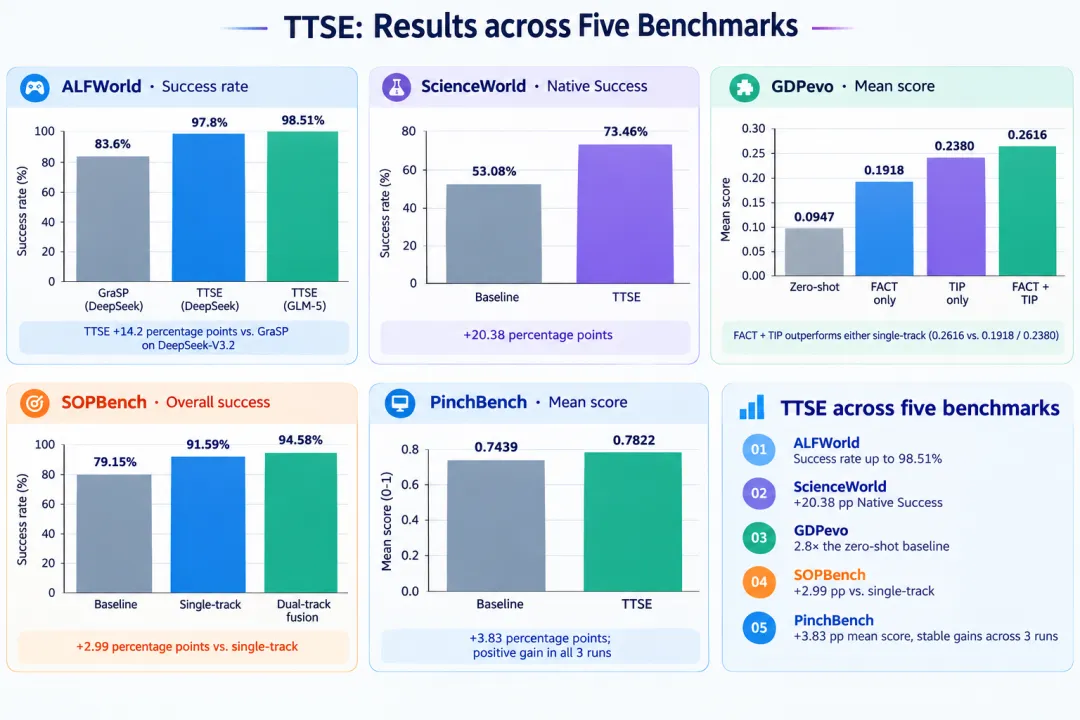
Five benchmarks showing multi-dimensional gains
ALFWorld: The highest success rate is 98.51%.On GLM-5, the TTSE success rate was 98.51%; on DeepSeek-V3.2, the success rate was 97.8%, up 83.6% from the previous best practice GraSP.14.2 pointsAt the same time, it reduces the number of execution steps.
ScienceWorld: Mission performance has significantly improved.MACRO Reward increased from 0.7204 to 0.8534, and Native Success increased from 53.08% to 73.46%.20.38 points。
GDPevo: Double track is better than single track.The average score for the full FACT+TIP program is 0.2616, which is about 0.0947 on the zero sample baseline.2.8 times• The performance of a complete bi-track program, which has not been achieved using either TIP or FACT alone, confirms the value of environmental fact-management in conjunction with operational skills.
SOPBench: Further improvement after integration with Bayes Skills Management.The overall success rate increased from 79.15% of the baseline to 91.59% of the single-track program and further reached the dual-track convergence program.94.58%The single-track system was further improved by 2.99 percentage points.
PinchBench: Keep up steady growth in real-world missions.TTSE accessed OpenClaw in a non-invasive manner, performing three independent runs on 147 real-world end-to-end missions. The average score of the bi-track program rose from 0.7439 to 0.7822, increasing the number of missions.3.83 pointsThe increase in the three runs was consistent, and the operating margin decreased from 3.33 percentage points to 1.61 percentage points.
These results, covering physical interaction, scientific reasoning, business operations, industrial processes, and real-world end-to-end tasks, show that the value of TTSE is not limited to a specific model or single scenario.
The dissolution experiment further answers the question: Why do we have to have two tracks?
The dissolution experiment of GDPevo provides more direct evidence:A complete two-track scheme is better than a single-track scheme that only records facts or only records techniques.
The reason for this is that environmental cognition and action strategies have different responsibilities. Only FACT, an intelligent organism that may know the constraints of the environment but lacks appropriate methods of action; only TIP, an intelligent organism that may master the operating techniques but cannot accurately identify the conditions under which these techniques are established. Only the combination of the two can answer simultaneously to "what the environment is like" and "what should be done under the current conditions".
Therefore, bi-track design does not simply divide the experience library into two parts, but allows different types of knowledge to be categorized, validated and replicated according to their respective semantics and applicable conditions.
From cross-model, cross-mission to real-world assessment, the results of the experiments not only validated the effectiveness of the TTSE binary experience mechanism, but also further demonstrated the potential for application of RSI at the level of experiential learning:The agent can gradually improve the performance of subsequent tasks by continuously accumulating, validating and updating task experience without changing the model parameters.
This also provides evidence for TTSE's move from the research framework to real-world office smart products.
TTSE bi-tracks evolved to land at WorkSwarm
TTSE has not only verified its effectiveness in paper experiments, but has also officially launched OpenJiuwen's WorkSwarm office intelligence body.
Do you want to test TTSE yourself?Just install and startWorkSwarm 0.2.7 and aboveIt's open in settings.TTSE switches on its ownThis means that experience accumulation and reuse can increase efficiency.
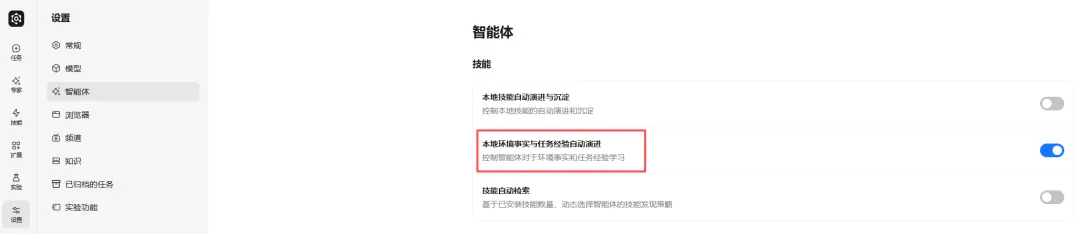
Then, through two real office tasks, come together to see how TTSE makes Agent faster and more efficient in actual execution.
TTSE moves into the real office scene to make experience efficient
Agents have been widely used in everyday work.Data cleaning and analysis, document editing and sorting, report generation, information extraction and format conversionHowever, faced with different file structures, data formats, and business requirements, Agents often need to repeatedly explore the environment, try tool calls, and retrieve the execution path of the task.
To intuitively demonstrate the actual effects of TTSE, the team selected Excel data cleanup and documentation and table sorting of two typical office scenarios, as opposed to Agent's performance after first execution and injection experience.
The results show that both scenarios achieved different levels of efficiency improvement:
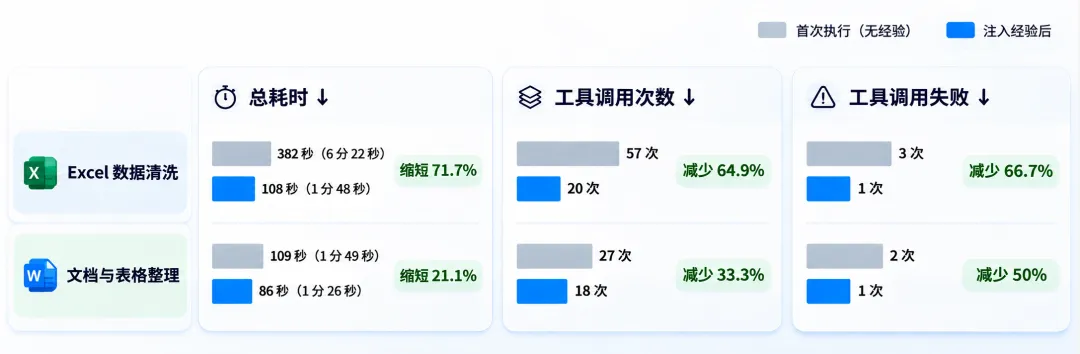
These improvements are not due to changes in model capabilities, but in the contrasting tasks shown, the Agent is able to use historical execution experience to more quickly identify environmental constraints and select appropriate handling methods.
So what experiences has TTSE embedded and how can it help Agent reduce trial and error?
Example 1: Excel data cleaner reduces data recognition and processing errors
The challenges for this type of task include not only cleaning the data, but also locating the input files, identifying hidden data formats, and identifying rules that meet business requirements.
When first executed, the Agent had no replicable task experience and needed to explore the location of the input file, judge the data format, and derive the processing rules for the replica records.57 instrument calls, three of which failed; total time of 6.22 seconds。
At the end of the mission, TTSE extracts replicable mission experiences from real execution trajectories. They are no longer just a record of past operations, but based on decisions that directly affect the next execution:
Quickly locate input materials.When the user does not specify the location of the file, prioritize checking the workspace/input, directly searching for upstream files, avoiding repeated searches in unrelated task directories, and avoiding unnecessary user queries.
It's about deep data recognition.When faced with seemingly normal dates, amounts, and text in Excel, use openpyxl to directly check the original storage value, identify text type dates, currency symbols, track spaces, and other hidden issues, to reduce omissions caused by incorrect reading methods.
Repeated re-use of verified recycling rules.Grouping by business field, keeping the earliest dated records, and recording the number of deletions, no longer redirecting to heavy quality from scratch, reducing repetitive judgments and trial errors.
When performing similar tasks again, these experiences are directly involved in tool selection and decision-making.Twenty failed calls were reduced to one, reducing the total time to 1 minute 48 seconds.。
Case Two: Document and form sorting to reduce file exploration and format trials
Unlike Excel data cleaning, the main difficulties with this type of task are unknown file locations, ambiguous CSV encoding and separators, and the complexity of Word template structures. When first executed, the agent needs to gradually explore the file, identify the format, and determine the appropriate template processing method.
For the first time in a document and form sorting task, Agent takes time to executeOne minute and 49 seconds, 27 total tool calls, two failed tool callsFollowing the completion of the mission, TTSE takes a set of environmental facts and operational techniques from the real execution trajectory.
When implemented again, the Agent no longer explores the file directory from scratch, tries how to read CSV, and doesn't have to wait until the document is generated to find a template replacement problem. It can directly replicate verified environmental experience, pre-selecting more appropriate tools and processing paths.
The second execution time was reduced toOne minute and 26 seconds, tool calls down to 18 and failures down to 1Overall reduction in the amount of time spent21.1%Reduced tool calls33.3%Failure calls decrease50%。
Instead of simply remembering what operations have been performed in the past, TTSE goes further, allowing Agents to simultaneously accumulate awareness of the environment and effective methods of execution under specific conditions.
From accumulation of experience to improvement of abilities, the key is to use it correctly.
Two office cases demonstrate the value of TTSE's application in real-world tasks: Agents do not have to explore from scratch every time, but are able to validate the historical experience in the task and turn it into a reference base for subsequent execution.
This is the continuous improvement that RSI hopes to achieve: that every mission executed not only yields delivery results, but also the opportunity to accumulate effective experience for the next execution.TTSE uses the two-track mechanism of FACT and TIP to make this experience more verifiable, updated and reusable.
However, are these gains only present in specific tasks, or can they be reflected in a broader range of office tasks?
TTSE shows comprehensive gains in the office benchmark
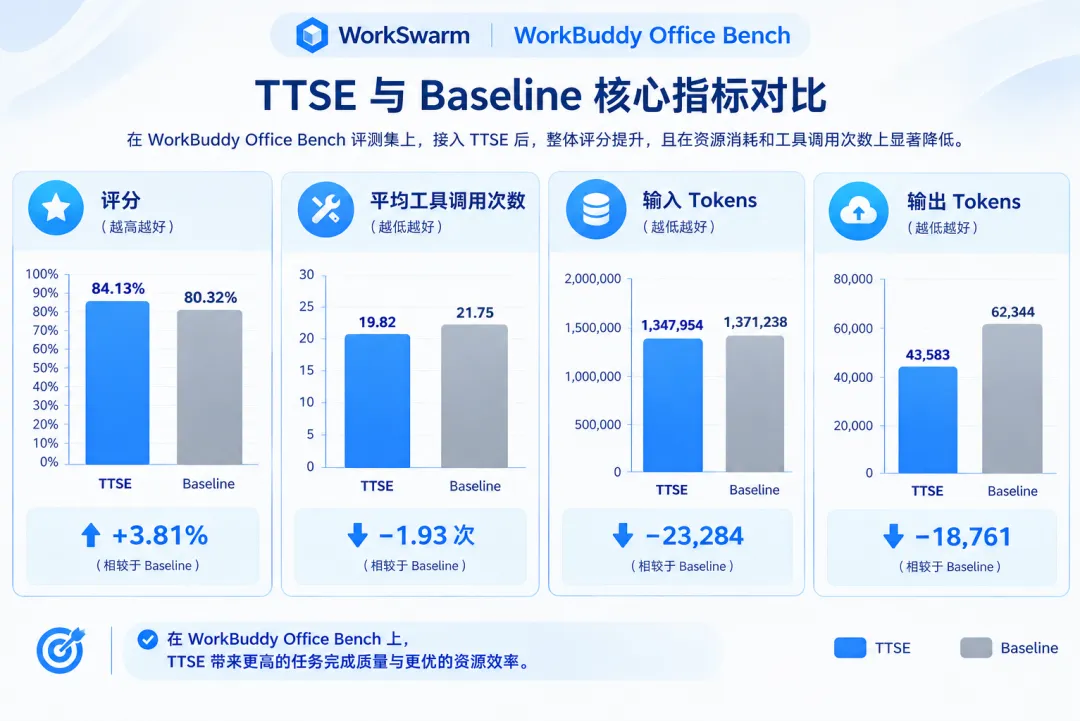
To further evaluate TTSE's performance in the integrated office scenario, the team tested the effectiveness of WorkSwarm access to TTSE on the industry's Open Source list WorkBuddy Office Bench.
Not only has it improved on task performance, but it has also effectively reduced token consumption and tool call costs: the evaluation results show a 3.81% improvement in task performance compared to original results, and a 1.70% decrease in input token consumption, a 30.09% decrease in output token consumption, and a 2x decrease in average tool call times.
Written at the end
We are at a turning point in Agent's journey from a "one-off tool" to a "continuous evolutionary partner".
The core value of RSI is not only to enable Agent to complete more tasks, but also to enable it to gain feedback, accumulate experience from each real execution, and transform that experience into continuous improvement.
From the two-dimensional optimization of Harness and Artifacts, to TTSE's two-track evolution of environmental facts and execution techniques, OpenJiuwen is exploring different paths for intelligent people to continue improving themselves: both optimizing working methods and delivering outcomes, and continually correcting environmental cognition and deploying reliable experiences.
TTSE provides a verifiable, traceable mechanism for the self-evolution of these experiences.It enables the agent to not only learn how to play the game, but also to understand the environment in which to play the game effectively, and to continually improve itself in the course of one mission.
Experience should not be overlooked. It allows Agent to learn both "how to do" and "what the world is like", which is the first lesson it takes towards long-term autonomy.
TTSE: A Two-Track Online Self-Evolution Framework for LLM Agents
What is the meaning of this article?
TTSE Bi-Track Evolution Rail is now available in WorkSwarm 0.2.8, and users can download it with a click on the official website to start the experience of self-evolution and instant experience:
WorkSwarm is an instant experience:
GitHub code stores:https://github.com/openJiuwen-ai/
This is the first time I've seen this.
If you are also working as an Agent/LLM Self-Development/Memory and Skills System, welcome to chat in the comment section:
Do you think Agent should be "remembered", a trick or a law about the environment?
*This text is licensed for publication by Qubit, and the views are solely those of the original authors.